Monday, 17 August 2020
Soon there won't be anyone left for this government to blame
As their troubles mount, bungling ministers will point the finger at minorities, migrants, teachers … anyone but themselves writes Nesrine Malik in The Guardian
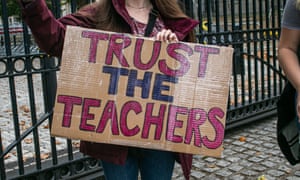
‘A source “close to Gavin Williamson” has said that teachers were “not to be trusted on grading”.’ Students protest in London on Saturday. Photograph: Amer Ghazzal/Rex/Shutterstock
As a second peak of Covid-19 infections looms, one thing is certain: the Conservative party is dedicating itself to what it does best – crafting a narrative that blames everyone else for its mistakes.
Brace for it. After six months of catastrophic mismanagement, from delaying lockdown to the A-level marking fiasco, this autumn is sure to bring even more diversion, distraction and brazen victim-blaming.
Led by a shallow prime minister, populated by careerists and directed by a grandiose and sophomoric special adviser, the government at present is fashioned towards ruling – not governing. But it’s not lack of qualification alone that has produced its incompetence. The defining feature of today’s Conservative party is indifference to the outcomes of its failed policies – none of which it has been seriously punished for.
These aren’t new tactics. The poor were blamed for borrowing beyond their means in the wake of the financial crisis
The gutting of the state, the impoverishment and deaths caused by austerity, the chaos of Brexit and the global embarrassment that has been its pandemic response are failures that should have brought an end to its tenure. But the party has developed one skill: avoiding consequences by way of constructing false enemies – immigrants, welfare scroungers, the European Union. It has achieved this herd impunity with the help of a credulous and oftentimes knowingly complicit media.
When faced with the actual task of governing during a real crisis, not a confected one, the government has flailed, U-turned and contradicted itself. Throughout it has stuck competently and consistently to its one principle – never apologise, never explain, always blame someone else.
The political and cultural infrastructure that makes it so easy for the powerful to shift responsibility on to others while refusing to show humility or acknowledge mistakes encourages a limited range of public responses to political crises. When an issue arises, the government launches into dramatic displays of action for the benefit of the watching public, and the media follows its cue, inflating the scale of the problem. Any legitimate demands for rational analysis of a situation are trivialised as liberal hand-wringing. Calls for accountability are dismissed as a “politicising” of events, as Boris Johnson has repeatedly characterised Labour questions about its handling of the pandemic, or the result of media “agendas”, such as when journalists sought answers about Dominic Cummings defying lockdown rules.
When immigrants are spotted crossing the Channel, we are presented with the grossly disproportionate response of appointing a chillingly named “clandestine Channel threat commander”. The journalists ignoring the distress of a man in a dinghy bailing out water with a plastic bucket are likely not doing so out of a studied xenophobia, but this callous way of reporting is so entrenched that it’s become habit.
And everything is about to get worse. What lies ahead is the diversionary plan to make the British public accountable for the government’s failures. The seeds for this deception were planted during the pandemic’s first act. We were to “stay at home, protect the NHS, save lives”, and then later “stay alert, control the virus and save lives”. Cabinet ministers rolled out these staccato orders to us whenever they were cornered on the detail of their policies, as if the entire success or failure of the pandemic response hinged only on public observance and not the government’s decisions.
The seeds are flourishing. The Conservatives want us to believe that their efforts were thwarted by a mass exercise in national sabotage by irresponsible individuals, by black and ethnic minority communities allegedly not observing its rules, by badly run old people’s homes, even by the poor advice of its own scientists.
At crucial junctures the Tories will anticipate public anger and earmark a convenient target to be subjected to public scrutiny. As A-level students saw their futures dissolve, a source “close to Gavin Williamson”, the education secretary, was mobilised to the Daily Telegraph to say that teachers were “not to be trusted on grading”, and it was they who gave students an unreasonable expectation of their results.
Round two of the fight between teachers’ unions and local governments is brewing, as they object to schools re-opening in September without a robust test, track and trace system. Perpetually locked in a fight with professional bodies and their own civil service, ministers bully people whose sense of vocational duty will not allow them to warp reality to suit government propaganda.
These aren’t new tactics. The poor were blamed for borrowing beyond their means in the wake of the financial crisis, and the bankers got away with it. Immigrants, not government austerity, were blamed for the shrinking of the welfare state. After a decade of gutting public services and growing its media patronage, the Conservative party has become very good at making people fight for the scraps of resources it leaves behind. Its efforts will add one more test to the trials facing the British public in the autumn – will we turn against the government, or each other?
As a second peak of Covid-19 infections looms, one thing is certain: the Conservative party is dedicating itself to what it does best – crafting a narrative that blames everyone else for its mistakes.
Brace for it. After six months of catastrophic mismanagement, from delaying lockdown to the A-level marking fiasco, this autumn is sure to bring even more diversion, distraction and brazen victim-blaming.
Led by a shallow prime minister, populated by careerists and directed by a grandiose and sophomoric special adviser, the government at present is fashioned towards ruling – not governing. But it’s not lack of qualification alone that has produced its incompetence. The defining feature of today’s Conservative party is indifference to the outcomes of its failed policies – none of which it has been seriously punished for.
These aren’t new tactics. The poor were blamed for borrowing beyond their means in the wake of the financial crisis
The gutting of the state, the impoverishment and deaths caused by austerity, the chaos of Brexit and the global embarrassment that has been its pandemic response are failures that should have brought an end to its tenure. But the party has developed one skill: avoiding consequences by way of constructing false enemies – immigrants, welfare scroungers, the European Union. It has achieved this herd impunity with the help of a credulous and oftentimes knowingly complicit media.
When faced with the actual task of governing during a real crisis, not a confected one, the government has flailed, U-turned and contradicted itself. Throughout it has stuck competently and consistently to its one principle – never apologise, never explain, always blame someone else.
The political and cultural infrastructure that makes it so easy for the powerful to shift responsibility on to others while refusing to show humility or acknowledge mistakes encourages a limited range of public responses to political crises. When an issue arises, the government launches into dramatic displays of action for the benefit of the watching public, and the media follows its cue, inflating the scale of the problem. Any legitimate demands for rational analysis of a situation are trivialised as liberal hand-wringing. Calls for accountability are dismissed as a “politicising” of events, as Boris Johnson has repeatedly characterised Labour questions about its handling of the pandemic, or the result of media “agendas”, such as when journalists sought answers about Dominic Cummings defying lockdown rules.
When immigrants are spotted crossing the Channel, we are presented with the grossly disproportionate response of appointing a chillingly named “clandestine Channel threat commander”. The journalists ignoring the distress of a man in a dinghy bailing out water with a plastic bucket are likely not doing so out of a studied xenophobia, but this callous way of reporting is so entrenched that it’s become habit.
And everything is about to get worse. What lies ahead is the diversionary plan to make the British public accountable for the government’s failures. The seeds for this deception were planted during the pandemic’s first act. We were to “stay at home, protect the NHS, save lives”, and then later “stay alert, control the virus and save lives”. Cabinet ministers rolled out these staccato orders to us whenever they were cornered on the detail of their policies, as if the entire success or failure of the pandemic response hinged only on public observance and not the government’s decisions.
The seeds are flourishing. The Conservatives want us to believe that their efforts were thwarted by a mass exercise in national sabotage by irresponsible individuals, by black and ethnic minority communities allegedly not observing its rules, by badly run old people’s homes, even by the poor advice of its own scientists.
At crucial junctures the Tories will anticipate public anger and earmark a convenient target to be subjected to public scrutiny. As A-level students saw their futures dissolve, a source “close to Gavin Williamson”, the education secretary, was mobilised to the Daily Telegraph to say that teachers were “not to be trusted on grading”, and it was they who gave students an unreasonable expectation of their results.
Round two of the fight between teachers’ unions and local governments is brewing, as they object to schools re-opening in September without a robust test, track and trace system. Perpetually locked in a fight with professional bodies and their own civil service, ministers bully people whose sense of vocational duty will not allow them to warp reality to suit government propaganda.
These aren’t new tactics. The poor were blamed for borrowing beyond their means in the wake of the financial crisis, and the bankers got away with it. Immigrants, not government austerity, were blamed for the shrinking of the welfare state. After a decade of gutting public services and growing its media patronage, the Conservative party has become very good at making people fight for the scraps of resources it leaves behind. Its efforts will add one more test to the trials facing the British public in the autumn – will we turn against the government, or each other?
Sunday, 16 August 2020
Friday, 14 August 2020
Wednesday, 12 August 2020
Tuesday, 11 August 2020
Economics for Non Economists 5 – Inflation - Why is the government’s inflation rate lower than my personal experience?
By Girish Menon
Some of you would have realised that in the China virus season the supermarkets have raised prices and stopped offering discounts on many goods. As a result you would have experienced rising food bills which according to layman knowledge should translate into inflation*. At the same time, you may have read many economists predict a period of recession, deflation** and high levels of unemployment. So how is it that when you are experiencing inflation personally, economists predict the existence of deflation?
It all depends on the way the inflation rate is calculated.
The UK government uses the Consumer Price Index (CPI) to estimate the inflation rate in the British economy. It works like this:
1. Every year a few thousand families are asked to record their expenditure for a month. From this data the indexers estimate the types of goods and services bought by an average household and the quantity of their income spent on these goods.
2. With this information, surveyors are sent out each month to record prices for the above mix of goods. Prices are recorded in different areas of the country as well as in different types of retail outlets. These results are averaged out to find the average price of goods and this is converted into index numbers.
3. Changes in the price of some goods are considered more important than others based on the proportion of the income spent by the average household. This means that the above numbers have to be weighted before the final index is calculated.
Consider this example:
Assume that there are only two goods in the economy, food and cars. The average household spends 75% of their income on food and 25 % on cars. Suppose there is an increase in the price of food by 8% and of cars by 4% annually.
In a normal average calculation, the 8% and 4% would be added together and divided by 2 to arrive at an average inflation of 6%
However, this provides an inaccurate figure because spending on food is more important in the household than spending on cars. Food is given a weight of 75% and cars are given a weight of 25%. So the price increase of food is multiplied by ¾ (8*3/4 = 6) and added to the price increase of cars which is multiplied by ¼ (4*1/4 =1) which will result in an inflation of 7%.
Therefore if the inflation index was 100 at the start of the year then it will read 107 at the end of the year.
The accuracy of inflation calculations
Some of you would have realised that in the China virus season the supermarkets have raised prices and stopped offering discounts on many goods. As a result you would have experienced rising food bills which according to layman knowledge should translate into inflation*. At the same time, you may have read many economists predict a period of recession, deflation** and high levels of unemployment. So how is it that when you are experiencing inflation personally, economists predict the existence of deflation?
It all depends on the way the inflation rate is calculated.
The UK government uses the Consumer Price Index (CPI) to estimate the inflation rate in the British economy. It works like this:
1. Every year a few thousand families are asked to record their expenditure for a month. From this data the indexers estimate the types of goods and services bought by an average household and the quantity of their income spent on these goods.
2. With this information, surveyors are sent out each month to record prices for the above mix of goods. Prices are recorded in different areas of the country as well as in different types of retail outlets. These results are averaged out to find the average price of goods and this is converted into index numbers.
3. Changes in the price of some goods are considered more important than others based on the proportion of the income spent by the average household. This means that the above numbers have to be weighted before the final index is calculated.
---Topics covered earlier
---
Consider this example:
Assume that there are only two goods in the economy, food and cars. The average household spends 75% of their income on food and 25 % on cars. Suppose there is an increase in the price of food by 8% and of cars by 4% annually.
In a normal average calculation, the 8% and 4% would be added together and divided by 2 to arrive at an average inflation of 6%
However, this provides an inaccurate figure because spending on food is more important in the household than spending on cars. Food is given a weight of 75% and cars are given a weight of 25%. So the price increase of food is multiplied by ¾ (8*3/4 = 6) and added to the price increase of cars which is multiplied by ¼ (4*1/4 =1) which will result in an inflation of 7%.
Therefore if the inflation index was 100 at the start of the year then it will read 107 at the end of the year.
The accuracy of inflation calculations
As the example makes clear this calculation is based on an imagined average family’s spending patterns. There maybe only a few families in the UK that have the exact same spending patterns as imagined by the government.
Theoretically, different rates of inflation could be calculated within an economy by changing the consumption patterns or weightings in the index. This will explain why the inflation that you experience may be higher or lower than the government’s inflation rate.
* Inflation is an average increase in price level compared over a previous period.
** Deflation is an average decrease in price level compared over a previous period.
Disinflation means the inflation in the current period is lower than the earlier period.
Subscribe to:
Posts (Atom)