Search This Blog

Tuesday, 10 September 2013

Obama's rogue state tramples over every law it demands others uphold


For 67 years the US has pursued its own interests at the expense of global justice – no wonder people are sceptical now
US fire white phosphorous at Taliban
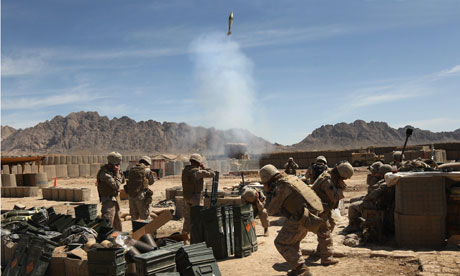
US troops fire a white phosphorous mortar towards a Taliban position on 3 April 2009 in Helmand province, Afghanistan. Photograph: John Moore/Getty
You could almost pity these people. For 67 years successive US governments have resisted calls to reform the UN security council. They've defended a system which grants five nations a veto over world affairs, reducing all others to impotent spectators. They have abused the powers and trust with which they have been vested. They have collaborated with the other four permanent members (the UK, Russia, China and France) in a colonial carve-up, through which these nations can pursue their own corrupt interests at the expense of peace and global justice.
Eighty-three times the US has exercised its veto. On 42 of these occasions it has done so to prevent Israel's treatment of the Palestinians being censured. On the last occasion, 130 nations supported the resolution but Barack Obama spiked it. Though veto powers have been used less often since the Soviet Union collapsed in 1991, the US has exercised them 14 times in the interim (in 13 cases to shield Israel), while Russia has used them nine times. Increasingly the permanent members have used the threat of a veto to prevent a resolution being discussed. They have bullied the rest of the world into silence.
Through this tyrannical dispensation – created at a time when other nations were either broken or voiceless – the great warmongers of the past 60 years remain responsible for global peace. The biggest weapons traders are tasked with global disarmament. Those who trample international law control the administration of justice.
But now, as the veto powers of two permanent members (Russia and China) obstruct its attempt to pour petrol on another Middle Eastern fire, the US suddenly decides that the system is illegitimate. Obama says: "If we end up using the UN security council not as a means of enforcing international norms and international law, but rather as a barrier … then I think people rightly are going to be pretty skeptical about the system." Well, yes.
Never have Obama or his predecessors attempted a serious reform of this system. Never have they sought to replace a corrupt global oligarchy with a democratic body. Never do they lament this injustice – until they object to the outcome. The same goes for every aspect of global governance.
Obama warned last week that Syria's use of poisoned gas "threatens to unravel the international norm against chemical weapons embraced by 189 nations". Unravelling the international norm is the US president's job.
In 1997 the US agreed to decommission the 31,000 tonnes of sarinVXmustard gas and other agents it possessed within 10 years. In 2007 it requested the maximum extension of the deadline permitted by the Chemical Weapons Convention – five years. Again it failed to keep its promise, and in 2012 it claimed they would be gone by 2021. Russia yesterday urged Syria to place its chemical weapons under international control. Perhaps it should press the US to do the same.
In 1998 the Clinton administration pushed a law through Congress which forbade international weapons inspectors from taking samples of chemicals in the US and allowed the president to refuse unannounced inspections. In 2002 the Bush government forced the sacking of José Maurício Bustani, the director general of the Organisation for the Prohibition of Chemical Weapons. He had committed two unforgiveable crimes: seeking a rigorous inspection of US facilities; and pressing Saddam Hussein to sign the Chemical Weapons Convention, to help prevent the war George Bush was itching to wage.
The US used millions of gallons of chemical weapons in Vietnam, Laos and Cambodia. It also used them during its destruction of Falluja in 2004, then lied about it. The Reagan government helped Saddam Hussein to wage war with Iran in the 1980s while aware that he was using nerve and mustard gas. (The Bush administration then cited this deployment as an excuse to attack Iraq, 15 years later).
Smallpox has been eliminated from the human population, but two nations – the US and Russia – insist on keeping the pathogen in cold storage. They claim their purpose is to develop defences against possible biological weapons attack, but most experts in the field consider this to be nonsense. While raising concerns about each other's possession of the disease, they have worked together to bludgeon the other members of the World Health Organisation, which have pressed them to destroy their stocks.
In 2001 the New York Times reported that, without either Congressional oversight or a declaration to the Biological Weapons Convention, "the Pentagon has built a germ factory that could make enough lethal microbes to wipe out entire cities". The Pentagon claimed the purpose was defensive but, developed in contravention of international law, it didn't look good. The Bush government also sought to destroy the Biological Weapons Convention as an effective instrument by scuttling negotiations over the verification protocol required to make it work.
Looming over all this is the great unmentionable: the cover the US provides for Israel's weapons of mass destruction. It's not just that Israel – which refuses to ratify the Chemical Weapons Convention – has used white phosphorus as a weapon in Gaza (when deployed against people, phosphorus meets the convention's definition of "any chemical which through its chemical action on life processes can cause death, temporary incapacitation or permanent harm").
It's also that, as the Washington Post points out: "Syria's chemical weapons stockpile results from a never-acknowledged gentleman's agreement in the Middle East that as long as Israel had nuclear weapons, Syria's pursuit of chemical weapons would not attract much public acknowledgement or criticism." Israel has developed its nuclear arsenal in defiance of the non-proliferation treaty, and the US supports it in defiance of its own law, which forbids the disbursement of aid to a country with unauthorised weapons of mass destruction.
As for the norms of international law, let's remind ourselves where the US stands. It remains outside the jurisdiction of the International Criminal Court, after declaring its citizens immune from prosecution. The crime of aggression it committed in Iraq – defined by the Nuremberg tribunal as "the supreme international crime" – goes not just unpunished but also unmentioned by anyone in government. The same applies to most of the subsidiary war crimes US troops committed during the invasion and occupation. Guantánamo Bay raises a finger to any notions of justice between nations.
None of this is to exonerate Bashar al-Assad's government – or its opponents – of a long series of hideous crimes, including the use of chemical weapons. Nor is it to suggest that there is an easy answer to the horrors in Syria.
But Obama's failure to be honest about his nation's record of destroying international norms and undermining international law, his myth-making about the role of the US in world affairs, and his one-sided interventions in the Middle East, all render the crisis in Syria even harder to resolve. Until there is some candour about past crimes and current injustices, until there is an effort to address the inequalities over which the US presides, everything it attempts – even if it doesn't involve guns and bombs – will stoke the cynicism and anger the president says he wants to quench.
During his first inauguration speech Barack Obama promised to "set aside childish things". We all knew what he meant. He hasn't done it.
Monday, 9 September 2013

Why we argue – and how to do it properly

The internet provides ample space for stating opinions. But true persuasion is an art – one this week-long series aims to teach
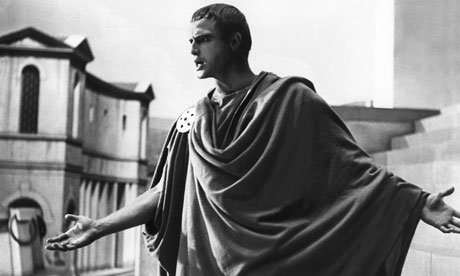
Marlon Brando as Mark Anthony in the 1953 film Julius Caesar
Marlon Brando as Mark Anthony in the 1953 film Julius Caesar. 'True persuasion is democratic.' Photograph: Cine Text/Allstar
It's the weekend and you are heading out to meet friends at the cinema. You are looking forward to seeing the new thriller by a favourite director. But then you discover that some of your friends would rather see the latest superhero movie, or some a new romantic comedy. Everybody pauses, uncertain how to proceed. You decide to get everyone to see the thriller. You won't force them – after all, they are your friends and unlikely to remain so if you threaten them. You could bribe them by offering to buy the tickets – but movie-going is expensive enough as it is, and you don't want to set a precedent. So you decide to try and persuade them – to get them to really want to go. But how?
You could begin by telling your friends about reviews you have read recommending your chosen film and trashing the others – or by pointing out the relative box office success of the movies on offer. But what reviewers do your friends trust? Do they want to see a hit movie or are they the sort of people who like to "discover" hidden gems?
Perhaps you should remind them that on previous visits to the cinema your choices have been good ones. And all you want is for everybody to have a good time. Alternatively you might explain just how much you have been looking forward to the movie after a really bad week. Are your friends likely to be moved by pity or should you appeal to other feelings?
Perhaps these appeals – to the authority of reviewers, your own character, and to your friends' emotions – seem too manipulative. You could try logic. Movie-going may not be an exact science but there are degrees of reasonableness. If a director's movies have been dire since that first breakout hit then it's a good bet that the new one will be weak. You might argue that the superhero blockbuster is good but the genre can never be truly great; that one of the movies has a lead actor with a bad track record; that the comedy is so long the bar will shut before it ends.
However strong your convictions about quality cinema may be, these alone will not win the day. You need to make an argument. And a successful argument must appeal not to just anyone in general but to your friends in particular. It must be adapted to their estimations of movie reviewers, feelings and beliefs about you and your character, and rely on rational claims of a kind they will recognise.
What is true of the cinema is – in this case – also true in public and political life. In a democracy, rather than force or bribe people to assent to our ideology, we try to win them over through persuasion. That can be a challenge. It requires us to understand where other people are coming from and to develop arguments that are outward-facing.
Not everyone thinks as we do. People have different experiences and possess different information; they have different values and do not always share our criteria of judgment. To persuade them we have to make connections with our audience – with what they might think, feel and be familiar with. This is not about tricking people or fooling them. It is about truly persuading them to share our views on a particular issue – and that means developing a relationship.
A glance at the newspapers and much of the internet demonstrates, however, that many people think the purpose of public communication is to reflect well on themselves – to announce their own importance, specialness or cleverness. An infamous academic chooses not to be convincing but to increase his brand value by performing provocatively; a troll communicates publicly but seeks only private "lulz"; shouting things your audience already believes, yet pretending that you're not allowed to say them, seems to be an easy route to success on talk radio or the op-ed pages. But the only thing such people are saying with their arguments is "look at me!"
Online communication makes easy the simple affirmation of our beliefs, the monetisation of strident "opinion" and the anonymous onanistic expression of inchoate hostility. And that means more arguments – but less persuasion.
True persuasion is democratic. In giving people reasons to act with us we recognise that they aren't inferiors who can be compelled but thinking, feeling and speaking beings. And true persuasion is an art. Contrary to the books on the self-help and business psychology shelves there are no magic "words that work". You have to cultivate an "eye", developing a feel for situations and empathy for those you want to persuade. The name of that art is "rhetoric".
Of course, you don't need to bother with any of this if you and your friends just go and see your favoured films separately. But that is to give up on society, politics and progress. If people cannot persuade or be persuaded then there can be no shared beliefs, co-ordinated collective action or intellectual evolution. The only change will come from force, bribery or manipulation.
In defiance of such a bleak outcome, Comment is free will over the coming week run a series on how to argue in the spirit of Isocrates, the ancient Greek philosopher and rhetorician: "the kind of art which can implant honesty and justice in depraved natures has never existed and does not exist … But I do hold that people can become better and worthier if they conceive an ambition to speak well, if they become possessed of the desire to be able to persuade their hearers."
----------

Part 2

How to judge your audience and remain true to your arguments

Being two-faced has had a bad rap recently. But to convince people of your argument you have to adapt it to your audience
Question Time
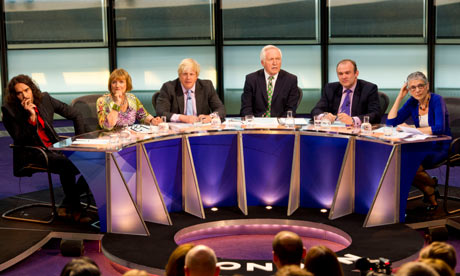
'On BBC Question Time Russell Brand is never going to persuade Melanie Phillips, and she will never sway him. They'd be foolish to try.' Photograph: Matt Crossick/PA
One of the greatest achievements of reality television gameshows has been the promotion of a distinctive ethical principle: that almost the worst thing you can do is be "two-faced". To say one thing to one group of people and something else to another is widely regarded as the epitome of dishonesty. And the very worst thing? The failure to be "true" to yourself – to moderate or modify your public appearance in response to the expectations of others.

Adapt to circumstances

But if you want to persuade people, or simply communicate clearly, the last thing you should do is say the same thing to everyone and refuse to adapt to circumstances. On the contrary, the first step in developing a good argument is to think about how to fit it to the situation in which you find yourself. It used to be that skill in this was considered a virtue. Rhetoricians called it "decorum".
Today we think of being "decorous" as conforming. But all it means is being "fitting" – using words and arguments that are "apt" given the situation. It is generally a bad idea to give an expletive-packed wedding speech that endlessly insults the bride, not because expletives and insults are always bad but because they are at odds with the mood of collective celebration characteristic of weddings.
Similarly, an economist explaining the Phillips curve ought to do so differently if talking to a niece taking business studies GCSE, the retired sales executive next door or a room full of trade unionists.

Know your audience

In making an argument you are trying to bring three things into alignment: yourself, your words and your audience. You are trying to move your audience so that it is in agreement with you – but to do that you need to move too. And between you – what moves you both – is a form of words and a set of arguments. If you are inflexible, using words and making references that are completely at odds with your audience you won't persuade anybody of anything (except of the view that you are unconvincing and unintelligible).
In practical terms this simply means that you need to know your audience. Cicero, the Roman philosopher, rhetorician and politician, believed that the perfect orator would have to master everything to do with the life of other citizens: laws and customs, traditions and general outlooks, "the way people usually think". In becoming familiar with the general outlooks of other people, as well as the particular outlook of specific groups, you are better placed to adapt your argument as needed.
A problem in the present day is that contemporary communications media make decorum extremely difficult, if not completely impossible. Politicians have long been aware that words said in one context may be rebroadcast in quite another. They have tended to deal with this by being bland and non-commital or by supplementing what they say with briefing and spin. In adopting such positions on the basis of opinion polls and focus groups politicians make the opposite mistake to the foul-mouthed best man. They forget their argument and give themselves over entirely to the audience (who, in turn, succumb to boredom).
It's not only politicians who can find their words taken and used in a quite unexpected context. These days any of us might be live-tweeted or filmed and put online. The examples are piling up of those who forgot that what they said on social media was not private but being said to everybody. On below-the-line comments boards – where most are anonymous or pseudonymous – it is difficult to be sure who one is talking to. This is one reason why people on Guardian comment threads often try to appeal to the (possibly imaginary) audience they know that exists: the moderators, subeditors, or "Guardian readers".

Pitching to the third party

But if you want to persuade you need to have a better idea of the audience you mean to reach. And it isn't the person whose comments you are attacking. On BBC Question Time Russell Brand is never going to persuade Melanie Phillips, and she will never sway him. They'd be foolish to try. They are trying to persuade the people watching them. It is the same online. Persuasive arguments will be pitched to a "third party" – the audience of readers.
Of course you don't know who that audience is. Are they old or young, male or female, new to the topic or experienced? Yet all of us, when we start to compose some kind of general argument, has in mind an "ideal" or "typical" audience. It is worth being clear to yourself who you think this is. It shouldn't be people who think exactly as you do – since those aren't people you need to persuade. Nor should it be a bunch of idiosyncratic types who think like nobody else.

Let's be reasonable

It needs to be something like generally "reasonable" people, neither fanatical nor obstinate, informed but not specialist. What views or outlooks can you assume they share? What are they likely to think decent, kind and reasonable and what might they think is unacceptable, unkind and daft? Be clear on this and you can start to think about how to argue your case. That means paying attention to, and thinking about, other people, their feelings and experiences. If you want to have a chance of persuading people then you need to have a lot more than two faces. Don't be true to yourself. Be true to your arguments.

---------
Part 3

How to use your anecdotes well – and sparingly

There's an art to telling stories to complement an argument without overdoing it – or making yourself the centre of attention
David Cameron, Nick Clegg and Gordon Brown
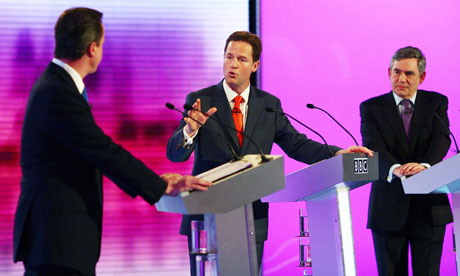
David Cameron, left, Nick Clegg and Gordon Brown all used anecdotes about people they had met during the 2010 leaders' debate. Photograph: Gareth Fuller/PA
The most memorable moment of the 2010 general election leaders' debate was when David Cameron tried to justify a point about immigration by citing the agreement of "a 40-year-old black man" he had met in Plymouth who had served in the Royal Navy for 30 years (thus enlisting at the age of 10).
This impossibly young seaman was not the only person called as a witness in that debate: Nick Clegg had been talking to a ward nurse in a short-staffed hospital and a burglary victim from London; Gordon Brown had met a trainee chef and received a letter from a recovered cancer patient; Cameron had also recently met a crime victim from Crosby, a drug addict from Witney and a man suffering from cancer of the kidney. The latter reappeared in Cameron's 2012 speech to his party conference, and in a recent speech on social security Ed Miliband told stories of meeting a young unemployed man in Long Eaton and "somebody who had worked all his life, for 40 years" in the scaffolding business.
Are such stories a good form of argument? They seem to be popular with political speech writers and advertising copywriters who often use them to lend colour and "human interest" to a speech. But as the leaders' debate demonstrated, they can also sound such a false note that they distract from the claims you want to advance. To work well, stories must be in harmony with, and contributing to, your overall argument.
One way they can do this is by bringing to your argument "witnesses" who provide evidence that supports a particular claim. In school we learn to quote supposed "authorities" – writers who lend support to our case not simply because of the veracity of their findings or the eloquence they lend to our words but also because they have some kind of recognised standing which we hope to add to our own.

Know your witnesses

Outside school such citations are useful, but the range of potential sources is greater and the usefulness of any single one cannot be taken for granted. Different audiences value different sorts of "authorities" and a fundamental mistake is to refer to something your audience cannot evaluate or will not evaluate positively. Far from strengthen your case this will weaken it.

Use your anecdotes sparingly

Even good witnesses should be used sparingly and carefully. Excessive and obvious reliance on them will make it seem as if you can't think for yourself. And it can easily seem pretentious. Someone trying to persuade you simply by dropping names of powerful people they have met or of authors they have read is, to put it mildly, annoying.

Make anecdotes tell stories

Stories can also serve as examples – instances of reality which are presented as proofs of some kind of norm. They invite people to make an induction – to conclude that there is some kind of general underlying rule at work and of which we must take heed. When a child points out that their friend doesn't have to go to bed so early, or a teenager insists to a parent that "nobody else has to visit Grandma every weekend", they are trying to illustrate the presence of a rule or a norm from which their parents are unreasonably or bizarrely departing. In a similar way Cameron wants us to conclude from a single dramatic example that the NHS is bad for patients and Miliband that apprenticeships are working out well.
Anecdotal examples of this sort are a necessary and valuable part of everyday, public and political argument. That is because (climate change partially excepted) such arguments are rarely about the nature of physical reality but often about social reality. They concern partial and practical judgments about some aspect of our varied and complex cultures: whether or not people are on the whole trustworthy; the likelihood that people receiving social security are "striving" or "skiving"; whether exams are getting easier or harder.
To make strong claims about the social reality of these things you will need to present examples and these can be made vivid if expressed in the form of stories. The most effective – combined with other evidence and information – help bring clearly to mind something you want the audience to think about more, to sympathise with or to see in a new way. They help to establish a picture of a situation and a definition of reality on the basis of which conclusions may be drawn.
Stories come in many genres. They may be little comedies or tragedies, homely confirmations of what "everybody knows" or unexpected revelations. It is important to be sure that your story is emotionally in tune with the rest of your argument (rather than a substitute for it). And it certainly must not dominate.

Don't make yourself the story

One of the more annoying techniques of politicians is to use purely personal experience as an anecdotal exemplar – as if, just because the politician "got on their bike", we must accept that everyone could or should do likewise. Stories about the speaker may be fine for entertaining dinner speeches (on the way to which a really funny thing happened), but they have a limited place in argumentative speeches where the good character of a speaker should be evident and not need explicit mention.
The problem with Cameron, Clegg, Brown and Miliband's stories is that often they aren't a contribution to the main argument but an attempt to convince the audience that these are great guys, men of the people, on our level. They have forgotten that a good argument is always about the audience to whom it is addressed and not the person making it. If you make yourself the story your argument will fail.

-----
Part 4

Ask yourself: what are you arguing about?

Life is not a well-set exam – the questions we ask may be ambiguous. Defining the dispute is itself part of the argument
Toasted Cheddar Cheese sandwich with the liquified cheese oozing out from between the bread
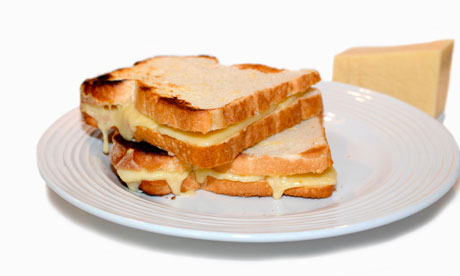
'When your flatmate accuses you of eating the last of the cheese your first reaction might be to refute the conjecture.' Photograph: CS-Stock / Alamy
The New Statesman columnist Mehdi Hasan recently addressed his online interlocutors thus: "Dear thickos on Twitter, for the 100th time: opposing arming the rebels does not make one 'pro-Assad'."
Now, there's a lot happening in this short rhetorical moment – including invective and hyperbole aimed at the refutation of a false syllogism. But overall it is an argument about arguments. Hasan wants to argue over the question "Should the UK arm the rebels in Syria?"; others would prefer the question: "Should the UK support Assad?" Although connected, these are two distinct questions. Which one is asked makes quite a difference to how a discussion about policy towards Syria will unfold. In any argument what we are arguing about may be the most important thing to dispute.

What are you arguing about?

Life is not a well-set examination. Our problems are not clearly specified and the questions we have to answer to ourselves are rarely unambiguous. Even something seemingly simple such as an argument about what music to play at a family party might also, possibly, be an argument about what kind of party it is to be, who the party should be for, or which members of the family deserve most respect. If you think the debate is about the relative merits of Britpop over glam rock, you might be in trouble if your partner thinks it is about your inability to respect your in-laws. In short, the point of a dispute isn't clear or fixed before an argument begins. It is one of the things established in and through the argument.
Understanding this can be emotionally important when organising the family get-together. It is of immense political importance when there is going to be a vote. Voters think lots of different things and they think them in all sorts of different ways.
Consequently, a vote will work out differently depending on how voters perceive an issue. For example, the renewal of Trident might be presented as purely a defence issue. People's views will then depend on how they think about threats to security and how they assess the usefulness of Trident in warding them off. But the issue can plausibly be construed as one of cost. In deciding on that question, the same people might take a different position. "Should we seek to deter nuclear attacks on the UK?" and "Are nuclear weapons your No 1 priority for government spending?" will lead to very different outcomes.

Four kinds of argument

In arguing, then, we need to think carefully about the explicit and implicit questions we are addressing and about the kind of argument that we want to have about them. Roman rhetoricians had a useful way of thinking about this. They used the term "stasis" for the "point" around which a dispute could or should turn, and identified four general kinds.

1. Fact

The first kind is "conjecture". This is the argument about fact – whether something is or is not the case. When your flatmate accuses you of eating the last of the cheese your first reaction might be to refute the conjecture – you were at work, you are allergic to dairy, your flatmate ate them last night when he had the munchies.

2. Definition

But suppose you did take the cheese and there is no denying it? The argument might then shift to "definition" – the name that should be given to your action. You might have taken the cheese thinking it was yours – in which case it wasn't "theft" but a "mistake".

3. Quality

Your third option is to make the argument one of "quality"; you admit the crime but argue that your action was a good one. You were aiding your flatmate in a diet, the cheese was almost out of date and you were avoiding waste, you gave it to someone who was really hungry.
These are all ways of shifting the terrain of a dispute. How you use them depends in part on whether or not you are in the position of prosecution or defence. A prosecutor wants to keep things narrow, presenting an audience with a simple choice of yes or no, guilty or not guilty. A defendant will want to open up a variety of arguments so as to sow reasonable doubt. The political conservative might want to keep things at conjecture so as to avoid challenges to "traditional values" while the political radical may want an argument about "quality" so as to show how an unconventional action expresses a higher moral code.
You can see how different stases work in many contemporary political arguments. Debate about the EU is an obvious example. "Sceptics" have successfully made the argument about a conjecture. They ask, implicitly, "who has given away British sovereignty?". They then resist any sort of nuance seeking only to bring forward as many examples as they can to prove the fact that sovereignty has been lost. "Europhiles" try to move on to a debate about definition (talking about "partnership" and so on) or over "quality", where they like to argue that since sovereignty is weakened by globalisation, joining a larger bloc is to enhance rather than give away power.

4. Place

There is a fourth "stasis" that the Romans referred to as "place". Here, the dispute is over jurisdiction – whether or not the issue is one that can legitimately be addressed. In Rome that meant disputing that it was something the court could hear. In politics this is usually a "reactionary" argument since it is intended to ward off disputes.
Thus, we hear often that government has no right to decide on same-sex marriage or tell people who they can and can't employ, and that courts cannot judge the content of newspapers. But in our crowded and cacophonous virtual public spheres we (like Mehdi Hasan) might all make good use of the stasis of place. The art of arguing involves knowing which questions to ask and how to ask them, learning how to answer the questions put and deciding which questions to ignore. Sometimes, just before the guests arrive is neither the time nor the place to start an argument.


-----
Part 5


Can you spot a rhetorical fallacy?

If you can identify the fallacies in arguments, you can undermine your opponent and demonstrate your own decency

'Authorities can also be used to bully opponents by suggesting that in failing to agree with some venerated source they must themselves be weak-minded. The "founding fathers" of the US constitution are often used in this way.' The Declaration of Independence (lithograph). Photograph: Museum of the City of New York/Corbis
Everybody knows that attack is the best form of defence. And what's true for war is also true for argument. Why devise artful persuasive tactics when all you need do is find the weakness in your opponent and exploit it?
It is vital then to know something about the fallacies – the linguistic equivocations, distorted appeals and misleading deductions that may be used to win arguments by means foul rather than fair. If you can identify these, point them out to your audience and make plain their implications, you not only inure yourself from their toxicity, you also undermine the character of your opponent, cast doubt on even their most sound arguments and demonstrate your own decency, rationality and clear-headedness.

The authority fallacy

A lot of fallacious forms of argument cluster around the use of "authorities". It is often necessary in argument to make use of some kind of authority – if only because we want to refer to facts and findings. But authorities can also be used as a way to bully opponents by suggesting that in failing to agree with some venerated source they must themselves be weak-minded, ignorant or wildly and dangerously at odds with common standards. The "founding fathers" of the US constitution are often used in this way. In the UK we regularly hear solemn citations of what "the British people" think, feel and believe. The implication is that to depart from their wisdom is to have lost touch with reality (perhaps even to be in thrall to foreign-born "cultural Marxists").

The "limits of debate" fallacy

An increasingly common variant of such a tactic takes the form of a self-designated umpire who joins in with online disputes by asserting their authority to police the limits of debate. They declare that if they (a typical, reasonable and fair-minded person) find something hard to understand then it must be wrong or mere sophistry; that if they find something too extreme it must be completely insane; that if they feel someone has gone too far then they must have. The "concern troll" is a seemingly benign manifestation of this fallacy and one to be watchful for.

The "unseen danger" fallacy

Commonly found in the more fevered corners of political ideology are the various fallacies of danger – those forms of argument that seek to stave off decision by conjuring up all manner of horrors that precipitate change might lead to (or, conversely, the disasters that delay will engender). The 19th-century political thinker and reformer Jeremy Bentham called this "the hobgoblin argument" since it warns of mythical horrors lurking unseen by all but the one kind enough to point them out to us. Thus we are told that same-sex marriage will lead to bestiality and incest, or that anything other than full austerity economics will force us to relive the nightmares of inter-war Weimar.
Bentham (perhaps foreseeing internet messageboards) believed that this was a deception "generally accompanied by personalities of the vituperative kind". This claim confirmed by the ceaseless use of fallacies of danger in arguments even vaguely related to Islam where it is often blended with apocalyptic fantasies that seem to bring great enjoyment to their dreamer.

Fallacy of unripe time

But one should be alert for a milder and thus more effective variant which often hides behind the seeming reasonableness of what Francis Cornford jokingly called the "principle of unripe time". Someone seems to agree with what you propose but urges that now is not the right time, that we pause in order to be sure, await more evidence lest we make mistakes in haste. Make no mistake indeed – this is but a more devious form taken by the hobgoblin.

Begging questions and euphemism

Another class of fallacies are those which (often but not always intentionally) sow confusion. These include the many ways of seeming to say a lot while saying nothing, of avoiding answers by question-begging and of obscuring things by giving them nicer sounding names (like "collateral damage"). A particularly destructive source of confusion is the use of generalities. We often hear how "government" is incapable of doing anything as if "government" were a specific, singular and easily identified bogeyman rather than a vast and varied collection of agencies doing very different things in very different ways with varying degrees of success. See also uses of "religion", "the market" and "the left".

The fallacy fallacy

Comment sections are often full not only of bad grammar and spelling but also all sorts of dubious reasoning: red herrings, bizarre analogies, ludicrous generalisations, ad hominem attacks, straw-men and of course a lot of emotion-laden bile. The exposure of fallacious arguments is a kind of disinfectant for this grubby part of the public sphere, cleansing our arguments and making them usable.
But like any cleansing agent it can be dangerous if applied indiscriminately. The denunciation of fallacies can itself become fallacious.
Ceaseless attack on authorities risks undermining any and all authority until it is impossible for anyone to refer to any prior facts or findings. Combined with fallacies of danger this gives birth to fallacies of mistrust for which anybody who makes any claim to knowledge or expertise is suspicious, most likely self-serving and a "producer interest". Thus we bar the lawyers from speaking about legal aid, the doctors from commenting on healthcare and the teachers from holding opinions about teaching.
Similarly, while generalities can mislead, without them it is impossible to say much about public affairs. The person who demands that you always be more specific and give nothing but particular examples is not taking part in the argument but trying to close it down.
In these respects, fallacy hunting is a conservative strategy. It gives the advantage to those who want only to cast doubt on new claims and criticisms rather than propose their own alternatives. Fallacies dog contemporary public discourse. But this has given birth to the dogged fallacy spotter. We must have good and clear arguments. But we must also be careful lest the purification of argument leads to its erasure.

Sunday, 8 September 2013

Keep the pause button on GM pressed


JACK A. HEINEMANN in The hindu
  

Questioning a technology, especially of the kind that has serious unknowns and lacks clear social benefits, is not an attack on science

Jairam Ramesh, former Environment Minister for India, made the brave decision in 2010 to tell his then apex regulator of genetically modified organisms (GEAC) that it had failed to properly use available science to determine the safety — to human health and the environment — of Bt brinjal, created using genetic modification (GM). His decision followed careful evaluation of the science.

I was involved in Ramesh’s review. I read first hand the scientific evidence in my area of expertise provided to the GEAC and its responses. I was heartened to see that his decision was validated by the esteemed scientists that made up the Supreme Court Technical Expert Committee who have advised the Court on the need for better research and better process before continuing to release GM crops into the environment or using them as food.

Creating confusion

G. Padmanaban (“Sow the wind, reap a storm,” The Hindu, September 2) believes that the events surrounding the evaluation of Bt brinjal and now extending to other kinds of GM plants is an assault on science. He confuses science with technology. Science is the process of knowledge creation (or discovery) whereas technology is the means of knowledge application. This confusion causes some scientists to defend technologies that are questioned because they perceive questions on the technology as an attack on science. It is not.

There is much knowledge discovered or to be discovered that cannot be applied wisely — at least not now. GM plants are among the technologies that have both serious scientific unknowns and lack a clear social benefit — at least for now.

For over 30 years, GM has been promised to produce plants that will resist the stresses of drought, heavy metals and salt, that will increase yield, reduce the use of toxic pesticides and even fix their own nitrogen. To be fair, some GM crops have reduced the use of some toxic insecticides for a brief period. To be precise, though, none of these promises has been sustainably delivered to farmers.

Why not? Well, it isn’t complex regulation holding them back. By the year 2005, over 1,000 applications were approved to field trial stress-tolerant GM plants in the United States alone. None ever progressed out of the testing phase. The explanation for this is likely because stress tolerance is not a solution to the causes of stress. No matter how tolerant you make the plant to drought, using it in soil low in organic matter and unable to hold water will eventually further deplete the soil of moisture and the plant will struggle or die. GM is an attempt to use genetics to overcome the environment. This never works for long. That is why some call GM a distraction from investing in real solutions to the problems faced by real farmers.

A symptom

Herbicide use is increasing in the U.S. since it adopted GM maize (corn), soybeans and cotton. Insecticide use is down by a small bit, but extremely high compared to countries such as France which do not use GM crops. Western Europe’s maize yields match or exceed the U.S.’ yields using less pesticide. The yields in wheat and oilseed rape are increasing at an even faster rate in Western Europe than in the U.S. and Canada. This indicates a dangerous trend: those countries choosing to innovate in agriculture using GM are demonstrating lower productivity increases and greater dependence on chemical inputs in all crops compared to economically and environmentally comparable countries choosing to not use GM crops.
What is it about investing in GM products that seems to undermine other technologies in agriculture? GM products attract the strictest intellectual property (IP) rights instruments possible in agriculture (e.g., process patents). The use of those instruments concentrates investment and drives out simple but even more effective technologies.

Now every government research centre and public university seeks to compensate for the fall in direct public investment through licensing royalties from IP and the creation of partnerships with the private sector. This necessarily changes the kinds of questions they favour being asked by their researchers, the kind that will be supported by institutional resources or rewarded with promotion. With these policies in place we shouldn’t be surprised that every problem looks like it has a GM solution even to researchers who claim to have no entrepreneurial motivations.

Prof. Padmanaban’s ambition for a crop that provides all nutritional needs and grows everywhere demonstrates the poverty of the GM approach to hunger and malnourishment. Such a crop would quickly become obsolete as it would also serve as a wonderful meal for every conceivable form of pest. Meanwhile, it would undermine both biological and agricultural diversity as it became a weed in its own right.

Instead of that approach, supporting communities with education on nutrition and farmers with technologies that build up their soils, manage pests with little or no application of pesticide and manufactured fertilizers gives them the means and independence to grow a variety of crops and livestock to meet their dietary needs and sell their surplus in local markets.

This investment in agriculture is not as good at making intellectual property, but better for growing food. To properly support India’s mainly small holder farming requires removing the penalties and incentives on the public scientist to develop primarily technologies that bring direct revenue to their institutions. Instead, invest in them with public money and measure their success by the yields of farmers, the reduction of pesticides and fertilizer they use, and the increase in their wealth and health.

No missed opportunities

India is not missing out on the benefits of GM. So far, there haven’t been any proven to exist, or proven to be sustainable. GM crops are not designed to increase intrinsic yield and the largest scale and longest term studies bear out that they don’t yield more. Meanwhile, the cost of GM seeds is the fastest growing expense for U.S. farmers who are simultaneously suffering from weeds resistant to the herbicides excessively used on GM crops and pests resistant to the insecticides over-used in Bt crops. That likely would be India’s experience had it commercialised Bt brinjal which was developed with the least effective form of Bt for the target pest.

In addition, the safety issue still lingers over these products. It shouldn’t. The science needed to establish their safety exists and is affordable but it must be applied dispassionately and transparently. That is all Jairam Ramesh asked.

Claiming that GM crops are demonstrated safe by the absence of specific health claims from Americans is glib. There are no validated health surveillance programmes in the U.S. which could both detect and diagnose the cause of the most likely manifestations of harm if they do exist.

Meanwhile, more research studies accumulate with evidence of adverse effects, some quite serious. These studies require replication, but they run into roadblocks or fail to find new funding. Most often these studies report low level health effects using animal feeding studies, so it is not clear whether the effect would be the same, more or less in humans and more or less likely to be caused using GM plants cooked and processed, as humans eat them, rather than raw or processed the way they are provided to test animals.

Hunger, pestilence, and economic failure are the images of fear increasingly being used to drive acceptance of GM crops. Ignorance, anti-science, ideology and hypocrisy are the insults used to counter questions about the safety of GM crops coming from scientists and the public. What is right for India’s agriculture is too important a question to leave to fear and insult to decide. I think that both Ramesh and the scientists of the Technical Expert 
Committee knew this when they asked India to pause on the use of GM products. Pause so that all voices can be heard. Reflect on what the problems are and whether technologies solve them or mask them for a time, or even make them worse later.