Search This Blog

Thursday, 28 July 2016

America's most prestigious colleges have always defined "merit" according to their institutional interests

Nov 24th 2005 in The Economist 


AMERICANS justify their country's comparatively high social inequality by emphasising its equality of opportunity. The implication is that it is talent and hard work, not inherited privilege, which separate the rich from the poor.


The linchpin of such a meritocratic perspective is the educational system, which effectively allows access to the top of the socioeconomic ladder through the process of university admissions. America's big three universities (Harvard, Yale and Princeton) have for centuries created and reproduced the national elite, and have long sworn fealty to the principle of egalitarian opportunity. But in “The Chosen”, an encyclopedic and engaging account of their admissions over the last century, Jerome Karabel, a professor of sociology at the University of California, Berkeley, demolishes their historical claim to be bastions of meritocracy. More provocatively, he questions the whole idea of whether you can define merit objectively, and instead uses painstaking archival research to prove that, over the years, the Ivy League universities have defined and redefined merit according to their shifting institutional priorities.
“The Chosen” highlights two critical turning points: the birth in the 1920s of selective admissions that introduced subjective non-academic merit as a criteria for acceptance, and the universities' dramatic shift in the direction of socioeconomic inclusivity in the 1960s, when they re-tooled the concept of merit to open their doors to racial minorities and women.

When Mr Karabel picks up the story shortly after 1900, the colleges were becoming increasingly concerned about the number of Jews who were passing the entrance exams. Since the Protestant upper classes who paid tuition bills had deserted other universities, notably Columbia, where “Hebrew” enrolments were deemed excessive, administrators regarded the increased Jewish presence as both a cultural insult and a threat to their institutional viability.

As a result, the colleges limited the size of their classes and began to reject students by creating a definition of merit that was expressly designed to justify quotas on Jewish applicants. Academic achievement would play second fiddle to the character and manliness thought to be inculcated by prestigious boarding schools. Jews (limited to 15% of the class at Harvard and 10% at Yale) were deemed lacking in these attributes. In the words of a former Harvard dean of admissions, Wilbur Bender, Jews were “effeminates, the precious and affected, the unstable”, while private school boys were “virile, masculine, red-blooded he-men”.

The three universities continued to find character almost exclusively in wealthy Protestant boys until the 1960s, when external social upheaval changed their institutional priorities. The student takeovers of university buildings and the violent race riots of that era caused administrators to fear for campus security, and they sought to avoid such disturbances by admitting (and, implicitly, co-opting) more black students. Since few black applicants had high test scores, the admissions definition of merit again had to be turned upside down. Character suddenly stemmed from socioeconomic adversity rather than privilege. Once the principle of diversity as merit was established, all-male Yale and Princeton were hardly in a position to reject the demands of the feminist movement for co-education, which they implemented around 1970.

The central thesis that Mr Karabel draws from this history is that the universities have always determined their merit criteria according to the admissions outcomes that would suit their institutional interests, rather than the other way around. Although he credits the three universities with becoming more accessible to the underprivileged, he notes that even today, the wealthy are still vastly overrepresented among their student bodies. This is partly due to the donation-friendly admissions preferences still given to athletes and children of alumni, which he concludes should be abolished.

But eliminating these practices won't turn these institutions into a meritocratic mecca because, as Mr Karabel argues, the concept of meritocracy itself is strategic and flexible, and often in outright conflict with egalitarian aims. “Those who are able to define ‘merit',” he writes, “will almost invariably possess more of it, and those with greater resources—cultural, economic, and social—will generally be able to ensure that the educational system will deem their children more meritorious.” Even today, efforts at Harvard to place more emphasis on the sciences (potentially replacing some wealthier white students with nerdy Asian-Americans) have attracted criticism that they might make the student body too one-dimensional instead of iconoclastic and well-rounded—exactly the same style of disparaging argument used to justify the Jewish quotas of yesteryear. As the book concludes, the unsettling lesson to be learned from a century of purported Ivy League meritocracy is that “the ideal of a meritocracy...is inherently unattainable.”


Wednesday, 20 July 2016

There could still be a second referendum in Britain – if EU leaders listen

Vernon Bogdanor in The Guardian


A change to free movement could persuade the British public to vote again. And it can be done: treaties that stand in the way of reality have been changed before.

 
EU flags flying at half mast at the European commission to mark the Bastille Day attack. ‘As Donald Tusk declared before the referendum, the EU needs to take a “long hard look at itself and listen to the British warning signal”.’ Photograph: Darko Vojinovic/AP


How should Britain leave the European Union? The question hangs over Theresa May’s new administration as it considers when to invoke article 50, which will lay out the procedure for a withdrawal agreement, and indicate what sort of future relationship Britain wants with the EU.

Will it be membership of the European Economic Area, like Norway? A trade agreement with the EU, or reliance on World Trade Organisation rules? Yet the future relationship depends not only on the conditions in Britain but also on developments in the EU. And in that respect there are encouraging signs that European leaders are, at long last, listening to what their peoples have been telling them.

 As Donald Tusk, president of the European council, declared before the referendum, the EU needs to take a “long hard look at itself and listen to the British warning signal”. After the vote for Brexit, that is needed more than ever. During the campaign much was made of the dangers of an overweening Europe, aiming to become a federal superstate. Yet things have changed following theeurozone and migration crises. 

Despite the rhetoric of ever closer union, the member states are no longer prepared to sacrifice more of their sovereignty. Germany has no appetite for fiscal union, and Wolfgang Schäuble, Germany’s finance minister, has said that integration has gone “too far”. Poland has no wish to adopt the euro; there is clearly little desire for a common migration policy; and anti-EU feeling is growing throughout the continent. The EU has become economically, politically and culturally too diverse for any drive towards ever closer union to be successful.

More often than not, a political union of separate states requires an act of will brought about by force or an external threat – as with the United States in the 18th century and Germany in the 19th. The EU is in no position to produce such strength of feeling, so it seems certain to remain an association of states committed, as the European federalist Andrew Duff has lamented, to “never closer union”. The trend towards intergovernmentalism rather than supranationalism – where a power greater than the states takes control – was vividly illustrated when the eurozone crisis was handled largely by the council, made up of EU heads of governments, rather than the commission, which has the sole power to initiate laws.

The EU must now face reality. That means formally recognising the council as the supreme executive of the union, downgrading the commission so that it becomes, as the Gaullists have long wanted, a secretariat of the council without the power to initiate legislation. That would undermine the arguments of Eurosceptics, who thrive on the anathema of an unelected and unaccountable legislative body, something that Britain found particularly difficult to accept.

Further, so long as the idea of “ever closer union” remains enshrined in the EU, it will give eurosceptics a handle for criticism; and it allows the European court of justice to extend its remit too widely. The court should be an arbiter, not a missionary to eliminate states’ rights. So the EU must state clearly that ever closer union is unlikely to occur in the foreseeable future.

The EU must also face reality on freedom of movement. That principle was first outlined in the 1950s in conditions very different from those of today, by six member states at a similar stage of economic development and before the era of inexpensive mass transit. It is no longer suitable when Europe consists of 27 member states at very different stages of economic development. It not only imposes strains on the more affluent countries, stimulating the growth of the radical right, but also deprives the less affluent members of their most able and energetic citizens. Modifying this principle would also help Britain to negotiate continued access to the internal market.

It is said that the treaties preclude any interference with freedom of movement. Yet treaties intended to enforce the stability and growth pact, designed to limit the power of national governments, have been disregarded when necessity required. Adoption of the euro was supposed to be irreversible; yet, it is claimed Schauble urged Greece to abandon the euro and leave the Eurozone. Treaties, after all, are human constructs. If they stand in the way of reality, members can and should agree to revise them.

The EU needs not only long-term reform but also immediate measures to prove its value to the ordinary citizen. Tusk has rightly said that Europeans want not more Europe, but better Europe. Many Europeans have benefited from the single market, most obviously in cheap airfares – now, as the banker Sir Martin Jacomb has argued, is surely the time for a radical extension of free market rules into the energy and digital areas, and an effort to ensure that professional qualifications are genuinely transferable across Europe. This would provide citizens with concrete benefits, which would do more than a host of declarations or institutional reforms to prove the value of the European project.


Frankfurt tries to tempt the bankers fleeing a post-Brexit Britain


The British contribution to Europe was always to insist that rhetoric is subordinated to reality. Realism is now desperately needed if the European project is to be rescued from the elitist and technocratic establishment which currently dominates it, and which is losing it the support of its people. Perhaps if EU leaders listen to what citizens are saying, it might even be possible to persuade the British public to have second thoughts in a second referendum.

Tuesday, 19 July 2016

What next for the BCCI?

Sharda Ugra in Cricinfo

There is no knowing whether anyone in the BCCI is a fan of either Charles Darwin, Benjamin Franklin or Albert Einstein. Supreme Court judges definitely are, going by the opening paragraphs of the 143-page judgement issued by the two-man bench of Chief Justice TS Thakur and Justice FMI Kalifullah. The three mighty minds were quoted when discussing humankind's resistance to change, with the bench recognising that the BCCI's strident objections to the Lodha committee recommendations were meant to protect a "continuance of the status quo".

The Supreme Court's final order directly addresses and proceeds to upturn the BCCI's objections to the Lodha recommendations, which detailed organisational reform within India's richest sporting body and cricket's strongest board. The court accepted both the Lodha report and its recommendations with a handful of minor "modifications and clarifications". This marks the end of three years of miscalculations by individual office-bearers, and collective decision-making by the BCCI that began with the arrest of three cricketers in May 2013.

What happens next? In real terms, the day-to-day operations of Indian cricket will keep running. Like the Lodha report, the Supreme Court order once again separates governance from operations. The operational BCCI continues on its way, now armed with a CEO, an ombudsman, an ethics officer, and a full-time professional auditor. What has been rigorously shaken, with nuts and bolts now left rattling, is the existing frame of the BCCI, which is less stainless steel and more rusted metal.

The order lays down a fairly watertight list of strictures for aspiring cricket officials, focusing on what posts they can hold in cricket administration, particularly at the highest level, and for how long. The much-advertised "love for cricket" of many seasoned, or indeed newly appointed, cricket officials will now be put to the test. The court has ordered that the recommendations be implemented within six months - by the time Justice TS Thakur serves his full term and hands charge for the BCCI's restructuring to the very individuals who held up a mirror to the board: Team Lodha.

The Supreme Court's order was fairly considerate when hammering home a few disputed recommendations. Fussed about how to fund a players' association? the court asked. The funding is your prerogative, but there has got to be an association. Angry about a "cooling-off period" between two terms in top BCCI posts? Arrive at a conclusion on how to handle this, but the cooling-off period stays. IPL franchises on the all-powerful IPL governing council? Let's ask the Lodha committee to work out if this is not a conflict of interest and then see what they say.

The court divorced itself from issuing unyielding orders on matters that were not strictly within the Lodha panel's reformative and recommendatory ambit. Like controlling the amount and nature of advertising on cricket broadcasts on television by reworking existing deals (this recommendation was dead on arrival on the grounds of common sense alone), or knotty legislative issues like legalising betting or placing the BCCI under the ambit of the Right to Information Act.

Weighty, monumental (and cataclysmic for the BCCI), the Lodha report order carries much significance. If the BCCI, a financially self-sufficient, self-sustaining and globally significant sports body - and therefore an anomaly among Indian sports bodies - can be made answerable to writ jurisdictions, its functioning taken apart in court, so can any other Indian national sports federation. These bodies that run India's Olympic sports, largely supported by public money, have previously been considered untouchable, backed as they are by political bigwigs and legal luminaries.

The Thakur-Kalifullah bench has cited the government's National Sports Development Code 2011 - which applies to all nationally recognised sports bodies - in setting an age limit of 70 for the BCCI's office-bearers. What applies to other sports bodies must work for the BCCI. So too, what has been ordered upon the BCCI, could be wrought upon any other Indian sports body.

An example has been made of the BCCI, until now considered well above these shambolically run associations, both financially and organisationally. No matter how much financial strength and global clout a sports body can acquire, it must work alongside with, rather than supplant, good governance, transparency and accountability.

The BCCI's response in this affair from the outset - despite the presence of many weighty shining legal lights on its roster and on its side - was heavy-handed. Both in court and in the public. The board's first response was to let out a few high-volume sound bites: that the recommendations were not binding, that the BCCI was a private body and so it could not be approached as if it were a public enterprise. It was this line of argument that occupied far too much of the court's time, and must have set the judges' teeth on edge.

One of the more revealing parts of the order says: "Neither BCCI nor anyone else has assailed the findings recorded by the Committee insofar as the deep rooted malaise that pervades in the working of the BCCI is concerned… either in the affidavits filed or in the course of arguments at the bar." Which in layman's language means that neither the BCCI nor anyone else has strongly criticised the Lodha committee's findings with reference to the flaws in the BCCI's functioning, neither in written affadavits filed or verbal arguments made before the bench. The BCCI was not righteously claiming to having been unfairly criticised with reference to its functioning. What it was saying to the highest court of the country - and the highest judge in that court - was that you do not have the right to tick us off.

The better option could have been to respond strategically to the Lodha committee report from the very beginning, by picking out early the recommendations they thought were the least amenable to implementation, or inconvenient, and work with that, approaching the court with humility rather than habitual hubris. They had a better chance of arguing the age limit and tenure continuity at length than they did about private vs public and the freedom of association as pertaining to the state associations. That too in a climate surrounding the BCCI's laissez faire attitude to the Goa Cricket Association's multiple scandals until the last month or so and theshenanigans of DDCA, also exposed in court.

The BCCI's legal eagles should also have been able to sense two moods - that the BCCI's public image was far from the best to start with, particularly in terms of its engagement with the judiciary. Secondly, in the past few years, India's courts have been particularly forceful in handing out judgements pertaining to governance or administration, a trend that has been referred to as "judicial activism" (or, in the words of policy academic Pratap Bhanu Mehta, "judicial exasperation"). For the BCCI it was certainly not the right time to show what would be called "attitude". But show it they did.

What might the BCCI's options now be? To start with, they could consider hiring a new legal team. A short-term response would be to disband the board and resume operations under a new name. Or dash off a letter to the ICC saying the Supreme Court has ordered them to accept government interference - in the form of the nominee from the Comptroller and Auditor General's Office - at both national or state levels. Or attempt some off-court filibustering in front of Lodha to try and stall any action, till Justice Thakur retires in January and they can begin the legal roundabout all over again.

But each of these counters has its counter-arguments. Besides, Monday's order says clearly that "should any impediments arise" the Supreme Court can be approached once again by a status report being filed.

Many within the BCCI - and there are several who are well-intentioned and committed - may find their positions now rendered non-existent and their powers severely curtailed, and may well ask, "How did we get here?" The answer to that is simple - one mistake at a time.

Southern is a story of rail failure. But the real agenda is to crush the unions


This is the most farcical privatisation even by the comedic standards of British railways – and the aim is to defeat one of the last holdouts of organised labour


Illustration by Nate Kitch


 Aditya Chakrabortty in The Guardian


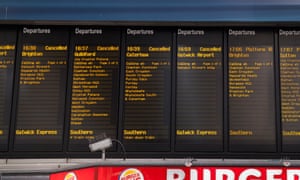
You work in an office, study at a further education college, want to visit your nan in her care home. Whoever you are, wherever you go, you rely on the trains to take you there. Except you can’t rely on them – not at all.

The only thing predictable about the service is that it’s always awful: the train you want is odds-on to be late or cancelled. If the next one is running, it’s so crammed you can’t get on. Every commute brims over with aggro. Wedged in overcrowded carriages, fellow passengers suffer panic attacks. The local newspaper reports how other commuters have missed work so often, they’ve lost their job; how students have missed exams or holidaymakers haven’t made flights.


Rail minister resigns as Southern commuter chaos continues


You read about a single mother forced to give up being a lawyer in London because dodgy trains mean she can never get home to put her son to bed. And you and everyone else are paying thousands each year for this shambles. To stand for dozens of miles and have extra hours, needless anxiety and gratuitous misery added on to your daily commutes.

If any of this sounds like you then my commiserations – for you are obviously a Southern Railway passenger.

At any other time, this summer’s chaos on the trains would have dominated the front pages. Even amid the turbulence of Brexit, it is still producing political ructions as big as the 50-foot hole that opened up under a south London track yesterday. This month, the transport select committee held an emergency sessionto find out why the service is in meltdown. Last week MPs staged an urgent debate in Westminster Hall, where they laid into Southern as a “joke”, “awful”, “terrible” and “rubbish”. Then they lambasted the government.

In turn, Claire Perry admitted she was “ashamed to be the rail minister”, but vowed to try to fix the situation “until I am kicked out”. The very next evening she quit. The new transport secretary, Chris Grayling, spent Monday hurriedly holding meetings on Southern, which is “top of [his] priority list”.

Britain is hardly short of political crises at the moment, but Southern surely counts as one. In an era of private-sector failure, this is one of the most extensive. Consider: Southern runs among the most economically important train services in the country. It manages 156 stations, covers 414 miles of track, and is responsible for around 600,000 journeys each day.

And it’s part of the largest train franchise in Britain, Govia Thameslink. Also known as GTR – majority owned by the Go Ahead group – it ferries commuters from across the south coast into London Bridge and Victoria. It takes tourists and business travellers to Gatwick and Luton airports. Its empire stretches from Peterborough to Tonbridge to Bognor Regis and Brighton. In a country that has, stupidly, bet everything on London, GTR is utterly crucial to the national economy.

And it does an appalling job. It cancels more trains than all the other rail firms in Britain put together. It boasts the worst record on significant lateness. It is the worst performing train operator of the lot. And it shows little sign of improving.

Its response last week to the cancellation of so many Southern trains was to issue a new timetable, removing one in six of its trains. Of all the oddities thrown up by rail privatisation, this must rank among the oddest: a train company in the business of running fewer trains.


Southern rail passengers protest at Victoria station, London, July 2016. Photograph: Matthew Chattle/Rex/Shutterstock

Perhaps the sheer stretch of GTR’s network is part of the problem, even though Perry claimed just two years ago that that would help it “deliver a step-change on key routes”. Running services into London Bridge during a botched overhaul hasn’t helped. And going by the evidence GTR has given to parliament, it also inherited investment-starved services. But GTR’s boss Charles Horton comes from failed franchise Connex. In his first interview in his current job, he advised passengers forced to stand to take a later or slower service. And with staff morale at rock bottom he has ended up in a huge clash with the unions.

Southern has been crippled by industrial action. Horton also regaled MPs with stories of “sick-note strikes”, although David Boyle – whose blogs on the Southern mess have become a must-read – has found no evidence to back that up. Boyle instead discovered that employees are so fed up they will no longer do voluntary overtime – leaving the company with too few staff for its advertised services.

But the fundamental problem must be the most farcical privatisation even by the comedic standards of British railways. Because this is privatisation in name only. GTR is paid billions by the government – which then takes their ticket receipts and even refunds customers if the trains are delayed. This makes it unlike any other train company in Britain – and gives GTR no incentive to attract more customers or to stop annoying them. In effect, Horton and his executives are government agents paid lavishly for failing to provide a service.


‘Southern cancels more trains than all the other rail firms in Britain put together.’ Photograph: Alicia Canter for the Guardian

We have a transport company that can’t really transport, and vast management fees paid to executives who clearly can’t manage. And the government acts as an apologist for a private company that’s meant to be providing a public service. Meanwhile, no apologies are forthcoming – in fact the boss of Go Ahead, David Brown, has just seen his annual pay soar above £2m, and the dividend payout to his shareholders has jumped to £37m. Someone is making a lot of money out of grotesque failure.

This is not just an issue for southern commuters, though – it’s a montage of everything wrong with business in Britain. Rather than strip GTR of its franchise, Tory ministers have instead made its conditions less onerous. Brown should be hauled in front of parliament to explain the chaos. Instead, he acts like an absentee landlord while officials at the Department for Transport say they couldn’t run the service as well as Southern does.

The question is why the government is going so easy on a failed train company. One answer comes from GTR’s dispute with the unions. The train firm wants to bring in driver-only trains, without guards to open and close the doors. The idea commands enthusiasm in Whitehall. It would certainly make rail management cheaper, if not safer.

But to strip trains of conductors requires the crushing of one of the last holdouts of organised labour. That’s not my extrapolation – it comes from DfT director Pete Wilkinson, who a few months ago told a public meeting, “We have got to break them [union members]. They have all borrowed money to buy cars and got credit cards. They can’t afford to spend too long on strike and I will push them into that place.”

Civil servants are supposed to be impartial, but this one wants to drive trade unions “out of my industry”. Mind you, Wilkinson has worked in Whitehall as well as in the City. He lives in Vienna but commutes to Britain. He’s a gamekeeper comfortable setting policy for the poachers. And he and his colleagues appear to be using Southern to take on the unions, in much the same way Thatcher used Ian MacGregor and the National Coal Board to break the miners.

An industrial dispute by proxy, a dysfunctional privatisation pushed by ideologues: our railways are in for an 80s revival for all the wrong reasons.