John Pilger in The Hindu
The majority vote by Britons to leave the European Union was an act of raw democracy. Millions of ordinary people refused to be bullied, intimidated and dismissed with open contempt by their presumed betters in the major parties, the leaders of the business and banking oligarchy and the media.
This was, in great part, a vote by those angered and demoralised by the sheer arrogance of the apologists for the “remain” campaign and the dismemberment of a socially just civil life in Britain. The last bastion of the historic reforms of 1945, the National Health Service, has been so subverted by Tory and Labour-supported privateers it is fighting for its life.
Nothing but blackmail
A forewarning came when the Treasurer, George Osborne, the embodiment of both Britain’s ancien regime and the banking mafia in Europe, threatened to cut £30 billion from public services if people voted the wrong way; it was blackmail on a shocking scale.
Immigration was exploited in the campaign with consummate cynicism, not only by populist politicians from the lunar right, but by Labour politicians drawing on their own venerable tradition of promoting and nurturing racism, a symptom of corruption not at the bottom but at the top. The reason millions of refugees have fled the Middle East — first Iraq, now Syria — are the invasions and imperial mayhem of Britain, the United States, France, the European Union and NATO. Before that, there was the wilful destruction of Yugoslavia. Before that, there was the theft of Palestine and the imposition of Israel.
The pith helmets may have long gone, but the blood has never dried. A nineteenth century contempt for countries and peoples, depending on their degree of colonial usefulness, remains a centrepiece of modern “globalisation”, with its perverse socialism for the rich and capitalism for the poor: its freedom for capital and denial of freedom to labour; its perfidious politicians and politicised civil servants. All this has now come home to Europe, enriching the likes of Tony Blair and impoverishing and disempowering millions. On 23 June, the British said no more.
The London class
The most effective propagandists of the “European ideal” have not been the far right, but an insufferably patrician class for whom metropolitan London is the United Kingdom. Its leading members see themselves as liberal, enlightened, cultivated tribunes of the 21st century zeitgeist, even “cool”. What they really are is a bourgeoisie with insatiable consumerist tastes and ancient instincts of their own superiority. In their house paper, the Guardian, they have gloated, day after day, at those who would even consider the EU profoundly undemocratic, a source of social injustice and a virulent extremism known as “neoliberalism”.
The aim of this extremism is to install a permanent, capitalist theocracy that ensures a two-thirds society, with the majority divided and indebted, managed by a corporate class, and a permanent working poor. In Britain today, 63 per cent of poor children grow up in families where one member is working. For them, the trap has closed. More than 600,000 residents of Britain’s second city, Greater Manchester, are, reports a study, “experiencing the effects of extreme poverty” and 1.6 million are slipping into penury.
Little of this social catastrophe is acknowledged in the bourgeois controlled media, notably the Oxbridge dominated BBC. During the referendum campaign, almost no insightful analysis was allowed to intrude upon the clichéd hysteria about “leaving Europe”, as if Britain was about to be towed in hostile currents somewhere north of Iceland.
On the morning after the vote, a BBC radio reporter welcomed politicians to his studio as old chums. “Well,” he said to “Lord” Peter Mandelson, the disgraced architect of Blairism, “why do these people want it so badly?” The “these people” are the majority of Britons.
The wealthy war criminal Tony Blair remains a hero of the Mandelson “European” class, though few will say so these days. The Guardian once described Mr. Blair as “mystical” and has been true to his “project” of rapacious war. The day after the vote, the columnist Martin Kettle offered a Brechtian solution to the misuse of democracy by the masses. “Now surely we can agree referendums are bad for Britain”, said the headline over his full-page piece. The “we” was unexplained but understood — just as “these people” is understood. “The referendum has conferred less legitimacy on politics, not more,” wrote Mr. Kettle. “…the verdict on referendums should be a ruthless one. Never again.”
The kind of ruthlessness Mr. Kettle longs for is found in Greece, a country now airbrushed. There, they had a referendum and the result was ignored. Like the Labour Party in Britain, the leaders of the Syriza government in Athens are the products of an affluent, highly privileged, educated middle class, groomed in the fakery and political treachery of post-modernism. The Greek people courageously used the referendum to demand their government sought “better terms” with a venal status quo in Brussels that was crushing the life out of their country. They were betrayed, as the British would have been betrayed.
Perpetual forgetfulness
On Friday, the Labour Party leader, Jeremy Corbyn, was asked by the BBC if he would pay tribute to the departed Mr. Cameron, his comrade in the “remain” campaign. Mr. Corbyn fulsomely praised Mr. Cameron’s “dignity” and noted his backing for gay marriage and his apology to the Irish families of the dead of Bloody Sunday. He said nothing about Mr. Cameron’s divisiveness, his brutal austerity policies, his lies about “protecting” the Health Service. Neither did he remind people of the war mongering of the Cameron government: the dispatch of British special forces to Libya and British bomb aimers to Saudi Arabia and, above all, the beckoning of world war three.
In the week of the referendum vote, no British politician and, to my knowledge, no journalist referred to Vladimir Putin’s speech in St. Petersburg commemorating the seventy-fifth anniversary of Nazi Germany’s invasion of the Soviet Union on 22 June, 1941. The Soviet victory — at a cost of 27 million Soviet lives and the majority of all German forces — won the Second World War.
Mr. Putin likened the current frenzied build up of NATO troops and war material on Russia’s western borders to the Third Reich’s Operation Barbarossa. NATO’s exercises in Poland were the biggest since the Nazi invasion; Operation Anaconda had simulated an attack on Russia, presumably with nuclear weapons. On the eve of the referendum, the quisling secretary-general of NATO, Jens Stoltenberg, warned Britons they would be endangering “peace and security” if they voted to leave the EU. The millions who ignored him and Mr. Cameron, Mr. Osborne, Mr. Corbyn, Mr. Obama and the man who runs the Bank of England may, just may, have struck a blow for real peace and democracy in Europe.
Geoffrey Robertson in The Guardian
It’s not over yet. A law that passed last year to set up the EU referendum said nothing about the result being binding or having any legal force. “Sovereignty” – a much misunderstood word in the campaign – resides in Britain with the “Queen in parliament”, that is with MPs alone who can make or break laws and peers who can block them. Before Brexit can be triggered, parliament must repeal the 1972 European Communities Act by which it voted to take us into the European Union – and MPs have every right, and indeed a duty if they think it best for Britain, to vote to stay.
It is being said that the government can trigger Brexit under article 50 of the Lisbon treaty, merely by sending a note to Brussels. This is wrong. Article 50 says: “Any member state may decide to withdraw from the Union in accordance with its own constitutional requirements.” The UK’s most fundamental constitutional requirement is that there must first be the approval of its parliament.
Britain, absurdly, is the only significant country (other than Saudi Arabia) without a written constitution. We have what are termed “constitutional conventions”, along with a lot of history and traditions. Nothing in these precedents allots any place to the results of referendums or requires our sovereign parliament to take a blind bit of notice of them.
It was parliament that voted to enter the European Economic Community in 1972, and only three years later was a referendum held to settle the split in Harold Wilson’s Labour party over the value of membership. Had a narrow majority of the public voted out in 1975, Wilson would still have had to persuade parliament to vote accordingly – and it is far from certain that he would have succeeded.
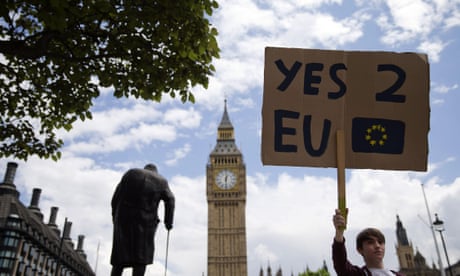
Petition for second EU referendum may have been manipulated
Our democracy does not allow, much less require, decision-making by referendum. That role belongs to the representatives of the people and not to the people themselves. Democracy has never meant the tyranny of the simple majority, much less the tyranny of the mob (otherwise, we might still have capital punishment). Democracy entails an elected government, subject to certain checks and balances such as the common law and the courts, and an executive ultimately responsible to parliament, whose members are entitled to vote according to conscience and common sense.
Many countries, including Commonwealth nations – vouchsafed their constitutions by the UK – have provisions for change by referendums. But these provisions are carefully circumscribed and do not usually allow change by simple majority.
In Australia, for example, a referendum proposal must pass in each of the six states (this would defeat Brexit, which failed in Scotland and Northern Ireland). In other countries, it must pass by a very clear majority – usually two-thirds. In some US states that permit voting on public legislative proposals, there are similar safeguards. In the UK (except, under a 2011 act in the case of an EU expansion of power), referendum results are merely advisory – in this case, advising MPs that the country is split almost down the middle on the wisdom of EU membership.
So how should MPs vote come November, when Prime Minister Boris Johnson introduces the 2016 European Communities Act (Repeal) Bill? Those from London and Scotland should happily vote against it, following their constituents’ wishes. So should Labour MPs – it’s their party policy after all.
By November, there may be other very good reasons for MPs to refuse to leave Europe. Brexit may turn out to be just too difficult. Staying in the EU may be the only way to stop Scotland from splitting, or to rescue the pound. A poll on Sunday tells us that a million leave voters are already regretting their choice: a significant public change of mind would amply justify a parliamentary refusal to Brexit. It may be, in November, that President Donald Trump becomes the leader of the free world – in which case a strong EU would become more necessary than ever. Or it may simply be that a majority of MPs, mindful of their constitutional duty to do what is best for Britain, conscientiously decide that it is best to remain.
There is no point in holding another referendum (as several million online petitioners are urging). Referendums are alien to our traditions, they are inappropriate for complex decision-making, and without careful incorporation in a written constitution, the public expectation aroused by the result can damage our democracy. The only way forward now depends on the courage, intelligence and conscience of your local MP. So have your say in the traditional way: lobby him or her to vote against the government when it tries to Brexit, because parliament is sovereign.
Opinion of The Guardian
Britain’s 27 erstwhile European partners will meet next week to discuss the UK’s future with the country itself locked outside the room. The constitutional ground-rules of our democracy are in contention as never before, with arguments raging about whether or not Westminster can block Nicola Sturgeon’s mooted Scottish referendum, or Ms Sturgeon can deploy procedural weaponry at Holyrood to frustrate the UK-wide referendum decision. Meanwhile the grave economic consequences are coming into view, with the Institute of Directors suggesting that a quarter of companies will cease hiring and a fifth may shift operations overseas.
What is so damaging for the orderly conduct of business is not only the prospect of a messy divorce from the continent, but an immediate political crisis. After David Cameron’s post-dated resignation, nobody knows who is in charge, still less what happens next. The Brexit brigade stormed to victory without a manifesto, or even agreement on what “leaving the EU” involves. Some, including Michael Gove, would cut loose from the single market, and damn the vast economic cost; others now concede the UK will have to stay in the market, even though that would betray the campaign promise to “take control” of regulation and migration. Wider pre-election promises have turned to dust at great speed. At sunrise on Friday, while the final few votes were still being counted, Nigel Farage conceded that it had been “a mistake” for Vote Leave to pretend that there would be an extra £350m a week for the NHS; at sundown, leading leaver Daniel Hannan MEP killed the other central campaign promise by conceding free movement of labourmight continue. Lesser gimmicks, such as Boris Johnson and Michael Gove’s promise to scrap VAT on energy bills, were always going to be hard to honour with an economy that is set to slow; they seem entirely irrelevant when we don’t know who will be presenting the next budget.
A country in peril, without a functioning government, needs an office-ready opposition – to ask the awkward questions, warn against wild swerves, and force somebody on the government side to explain what is going on. Britain, however, is saddled with a second party so beset by schisms, that – even as the union strains, the government crumbles, and the economy teeters – the thing making the headlines is Labour’s disintergation. Hilary Benn’s “sacking”, a dubious description seeing as the shadow foreign secretary constructed his own dismissal, was followed by the self-sacrifice of no fewer than 11 shadow cabinet ministers by late evening on 26 June, a run of career suicide bombs all detonated with the single aim of forcing Jeremy Corbyn out, just nine months after the leftwinger secured an almighty mandate from party members, taking more than thrice the votes of any of his three rivals, from the party’s centre and right.
This is a dismal pass that Labour was always likely to reach, because the overwhelming bulk of MPs have, from the off, been convinced that Mr Corbyn would drive them off a cliff. Many members are understandably furious with parliamentarians who never allowed him a chance. But there is no escaping that the day-to-day work of a party leader is fronting the efforts of a team of MPs. And when he was initially backed by fewer than one in 10 of that team, and not much interested in compromises to win more over, it was a job he was always going to struggle to do effectively. After the attempted coup, Mr Corbyn may attempt to fill his top team with other MPs. But there is now a real question about whether he can function in the job at all.
The PLP putsch looks shoddy for various reasons. For those MPs who have done nothing but plot since September, moving against him now is opportunism pure and simple. For others, it is an emotional spasm, made in rage against the painful loss of Britain’s place in Europe. But Mr Corbyn did not ask for this referendum, and it seems perverse to blame him for David Cameron’s loss. While Labour’s pro-Europeans were convinced they would win, many rather admired his qualified call for a remain vote, hoping that it might win do more to win over Eurosceptics than EU cheerleading. Even now, they should pause and ask whether a smooth-talking Europhile would have done more harm or good in Newport and Barnsley last week. One can argue that either way, but now – with the votes counted – anything that looks like pro-European regime change could appear disdainful of the public. Even more fundamentally, third-way social democracy has been in crisis ever since the crash. After the spectacular failure of the “mainstream” candidates last year, Labour’s centre-right should have earned its way back into contention with a fundamental rethink. Sadly, it hasn’t done that.
Set against this is the continuing failure of Jeremy Corbyn to look serious about becoming prime minister. There are fair-minded MPs who despair at the fact that so many constituents can never envisage their leader in No 10. It becomes harder to ignore such concerns after the Brexit vote, amid speculation that the next general election, which had not been scheduled until 2020, may now be brought forward to this autumn. This is the context in which deputy leader Tom Watson, who has his own mandate, is demanding talks about “the way forward”.
These are perilous times for progressive politics, perhaps the most perilous since the 1930s. It is incumbent on everybody to think before acting. Jeremy Corbyn needs to look into his soul and ask himself if he really wants to be PM, and get out of the way if not. His critics need to get on the phone and establish whether or not they can build the strength in the grassroots to topple him. Some say members are moving post-referendum; others dispute this. If the members remain loyal, then the mutineers could wound but not kill. The result would be to split the parliamentary party and the movement asunder, which would give the Tories a free run on a Brexit plaform.
Make the wrong call, and the results could be as ruinous as in 1931, when Ramsay MacDonald clung to office by giving up on the Labour movement, and a party of government was reduced to a rump of 52 seats. A half-complete coup would be worse than a clean defenestration or uniting behind Mr Corbyn. If the activists have moved, his time is up; if not, it is the MPs who must back off. Labour has sometimes failed dismally at moments of national crisis, as in 1931. But at others – think 1940 – it has proved equal to the hour. With an intolerant right wing on the rise, every progressive must be hoping that, whoever prevails in the left’s faction fighting, it will be finished soon.
Jon Henley in The Guardian

When David Cameron delivered his resignation speech outside No 10 on Friday, he said he would leave the task of triggering article 50 of the Lisbon treaty – the untested procedure governing how an EU member state leaves the bloc – to his successor.
This has prompted much speculation – and a glimmer of hope for those who want Britain to remain in the European Union. Cameron, they argue, had repeatedly said during the campaign that article 50 would be triggered immediately if Vote Leave were to win the Brexit referendum.
By not doing so, the theory is, and by bequeathing the responsibility to whoever succeeds him, Cameron has handed the next prime minister a poisoned chalice. Given the dramatic reaction to Brexit – on world stock markets, on the foreign exchanges, in Scotland, across Europe – and with the enormity of the consequences of leaving the EU now plain, who will dare pull the trigger?
One consequence of this, as a below-the-line commenter argued on the Guardian website, is that Cameron has effectively snookered the Brexit camp: they may have won the referendum, but they cannot use the mandate they have been given because if they do so they will be seen to be knowingly condemning the UK to recession, breakup and years of pain.
This could mean, as lawyer and writer David Allen Green has suggested in a blogpost, that “the longer article 50 notification is put off, the greater the chance it will never be made ... As long as the notification is not sent, the UK remains part of the EU. And there is currently no reason or evidence to believe that, regardless of the referendum result, the notification will be sent at all.”
Is this feasible? Certainly, leading Brexit campaigners, including Boris Johnson and Matthew Elliott, who ran Vote Leave, have said very clearly they are in no hurry to push the button.
They argue it is far more sensible to hold informal talks with Brussels, and other member states, in order to arrive at the outline of a possible settlement before locking Britain into the strict two-year timeframe within which article 50 negotiations must be concluded (and if they are not, Britain risks having to leave the EU with no deal at all).
In Brussels and other EU capitals, the UK’s heel-dragging is already causing great frustration. European foreign ministers and EU leaders have lined up this weekend to impress on Britain the need for urgency. Brexit talks must begin “immediately”, they said, so as to avoid a sustained period of uncertainty and instability that, with Euroscepticism on the rise across the continent, could do great damage to the already weakened bloc.
 © Reuters
Martin Schulz, the president of the European parliament, expects Cameron to formally announce Britain’s EU exit on Tuesday evening.But there seems to be no immediate legal means out of the stalemate. It is entirely up to the departing member state to trigger article 50, by issuing formal notification of intention to leave: no one, in Brussels, Berlin or Paris, can force it to. But equally, there is nothing in article 50 that obliges the EU to open talks – including the informal talks the Brexit leaders want – before formal notification has been made.
“There is no mechanism to compel a state to withdraw from the European Union,” said Kenneth Armstrong, professor of European law at Cambridge University. “Article 50 is there to allow withdrawal, but no other party has the right to invoke article 50, no other state or institution. While delay is highly undesirable politically, legally there is nothing that can compel a state to withdraw.”
The president of the European parliament, Martin Schulz, has said he expects Cameron to initiate the process on Tuesday evening, making the formal announcement that Britain intends to exit the EU at the summit dinner he is due to address before going home and leaving – for the first time – the other 27 member states to discuss Britain’s situation without him the following day.
The European council has confirmed that notification does not have to be in writing, but could be in the form of a formal statement to the summit – so Cameron had better be careful about what exactly he says.
 © PA 10 highest votes for LeaveBut reports in German newspaper
Süddeutsche Zeitung, among others, that an increasingly frustrated EU could, if push comes to shove, decide to consider the referendum result itself as “an official wish to leave” seem unreliable. “The notification of article 50 is a formal act and has to be done by the British government to the European council,” an EU official told Reuters.
“It has to be done in an unequivocal manner, with the explicit intent to trigger article 50. Negotiations to leave and on the future relationship can only begin after such a formal notification. If it is indeed the intention of the British government to leave the EU, it is therefore in its interest to notify as soon as possible.”
Carl Bildt, the former Swedish prime minister, has said “de facto ejection” is a possibility unless Britain gets a move on, but it is unclear on what grounds that could happen. Article 7 of the Lisbon treaty allows the EU to suspend a member if it deems it to be in breach of basic principles of freedom, democracy, equality and rule of law. But that would be the nuclear option.
The situation could get quite nasty, quite quickly. Politically, the pressure on Cameron – and on his successor, whoever that may be – could be extreme. But legally, there does not appear to be any easy way out. If Britain so chooses, this could become a standoff that could drag on for years.