Search This Blog

Friday, 15 May 2015

A matter of Life and Trust

Like so many others, the activities of the last couple of days have left me in despair about cricket in England.  That the ECB can invoke a question of trust in their carefully rehearsed PR speak was roundly met with hollow laughs amongst professionals, amateurs and supporters alike.  So much of the focus has been on Kevin Pietersen for obvious reasons, yet the ECB will be perversely pleased by that, because it avoids the wider questions and the wider problems.
That Pietersen has been treated dreadfully is a given even amongst those who are not remotely his fans – and let’s nail this particular straw man argument right here, there are a tiny number of people who are proper, out and out Pietersen fans.  Most of the others are England fans who may or may not think the side would be better with him in it, but believe a team should be selected from its best players, and who know a stitch up when they see one.
There is no doubt at all that Graves told him it was a clean slate, not just from his public pronouncements, but in two phone calls.  Pietersen responded to that by giving up his IPL contract to come and play county cricket.   He did what was asked of him.  Pietersen might be wealthy, but making someone give up a contract worth hundreds of thousands is not a small matter.  There have been some comments that Graves is just one person and that no guarantees were given.  This is sophistry of the highest order.  That one person is the incoming chairman of the ECB, and Pietersen trusted what he said.  More than that, if he has gone out on a limb then there was plenty of opportunity for the likes of Tom Harrison to talk to him and tell him that was not ECB policy.  He didn’t do so.
Let’s call this what it is – a lie.  They lied to him, an action of both commission and omission.  Pietersen might be a controversial figure, but he did not and does not deserve that.  At no point yesterday has there been so much as a hint of an apology for that.  That is outrageous behaviour.  Whataboutery concerning Pietersen is not the issue at hand here – it wasn’t him that kept banging on about trust.  The ECB are the organisation comprised of people that promptly leaked the outcome of Pietersen’s meeting with Strauss and Harrison minutes after it happened, the organisation on whose watch the coach Peter Moores found out he was being sacked via the media before they’d bothered to tell him (leaks or otherwise is irrelevant to this – it’s what happened), who backed Alastair Cook vocally two days before sacking him as ODI captain, who allowed a private memo from the England captain in 2009 to leak to the press.  What Pietersen has or has not done over the years does not for a single second justify any of this.  To talk about trust is a sick joke.
Nasser Hussain tried to make the point that trust has to go both ways, and Strauss’s response that he isn’t blaming anyone for the breakdown of it simply isn’t good enough.  He can refuse to talk about where Pietersen is at fault, that’s his prerogative, but he cannot avoid the complicity of the ECB, the organisation he works for.  Tom Harrison apologised to Peter Moores for how he found out about his sacking.  An apology to Kevin Pietersen for being led up the garden path is the very minimum that is needed.
It’s not going to happen of course.  The arrogance of the ECB knows no limits.  Over a year later they still haven’t addressed the realities of the “Outside Cricket” jibe and the utter contempt that signified for those who buy tickets and play the game.  And here is the fundamental question of trust as it really is, not as the ECB would like it to be.  There is none for the ECB.  The way Pietersen has been treated – and indeed the way Moores was treated – are indicative of an organisation that considers human beings to be commodities and nothing more.  Losing the trust of individuals barely scratches at the surface of the problem, because despite the ECB’s apparent belief, the public are not stupid.  They can see how this translates into a wider lack of interest or concern for anyone that doesn’t fit into their narrow field of vision.
The media response has been  fairly predictable in the way it has gone down the usual lines.  What the ones who loathe Pietersen fail to understand is that it is not about that, it is entirely within their rights to despise him and not want him anywhere near the England team while at the same time recognising that the ECB have behaved poorly.  The inability of some of them to see things through anything other than a Pietersen prism is the reason they attract such contempt.  If Pietersen is a side show to the wider issue, then deal with the wider issue.  Being an apologist for awful ECB conduct is not journalism, it is cheerleading.  Let’s put it a different way, if it was someone other than Pietersen who was the central player in the drama, would there be such fawning coverage of the ECB itself? This goes to the crux of the matter, because if not, then it means that they need to ask themselves about the job they are doing – their loathing of Pietersen is blinding them to what are far more important questions.
It is abundantly clear Pietersen is not coming back.  So given that, it raises a whole series more questions about where we go from here.
The first thing that Strauss and Harrison talked about was the plan for 2019.  In itself, this is hardly surprising – all new arrivals give themselves a nebulous target some time in the distant future, usually when they’re fairly certain the near term is going to be catastrophic and don’t want to be blamed for it.  But there are a couple of things about that.  By focusing so relentlessly on it, they invite ridicule that it’s tantamount to a Soviet Five Year Plan that was simply replaced by another Five Year Plan when the previous one went wrong.  In one day cricket, England cleared the decks for the World Cup, moved the Ashes with spectacular – in one sense anyway – results.  Yet now they are telling us not to worry, there’s another new plan coming along, and this one will be a belter.
Ah, but we should trust them we are told.  Why?  For what reason should we trust these people who have made a monumental mess of everything they have touched.  Trust needs to be earned, as  Strauss himself banged on about with that terrified look in his eye, but he apparently again didn’t grasp that the horrible masses don’t believe him.
It’s nothing more than a permanent offer of jam tomorrow.  That can work for a bit, yet they drew much greater attention to it by self-evidently rejecting a player who might be of value in the here and now.  Anyone over the age of about 15 can remember rotten England teams, but it’s been a fair while since having a weakened side was specific policy.
The Ashes this summer are not sold out.  It’s not disastrously so, but it’s not brilliant either.  Next summer we have Sri Lanka (again – though doubtless they’ll compensate for that by not playing them again until about 2030) and Pakistan.  If ticket sales are struggling for this year, what on earth is going to be like next year?  The blasé talk about what happens in four years time is surely not a deliberate writing off of the near term, but once again it does give the impression of it, which is exceptionally clumsy, even if not intended.  Those who have bought tickets are perfectly entitled to ask what the point of going is if the current team is not the focus.  It can’t especially cheer up the players either.
Buried in the detail was the sacking of Ian Bell as vice captain and Stuart Broad as T20 captain. Poor Bell.  He seems to be the favoured whipping boy, there’s no question that he has been briefed against – when Cook’s position came under scrutiny for captaincy (not exactly a rare event) there were a slew of articles talking about how badly Bell had done in team building events to make it clear he wasn’t a viable alternative.  This is a minor matter in relative terms, but once again a player suffers in certain media quarters when the status quo is under threat.  Broad’s removal as T20 captain is less surprising in itself, but replacing him with Eoin Morgan perhaps is, given his recent troubles.  Broad might wonder quite how he has been booted while the Test captain is so strongly backed.
As for Cook himself, although at first sight it seems he’s been thoroughly backed, in reality he’s already been given notice on his captaincy.  The appointment of Root as his second in command is the first time the ECB have deliberately chosen someone who they feel (the “they” is important here) can take over.  The ECB are plainly not optimistic about this summer, and Cook now appears to be in place as a firebreak for when it all goes horribly wrong.  Not remotely the first time they’ve used this tactic, and whatever the opinions on Cook, it seems quite likely he is the next sacrificial lamb.  What that does suggest though, is that the Ashes themselves are not regarded as the priority.  It may also just be dawning on Cook that if he doesn’t win this summer, he’s probably out (it is the ECB of course.  So they could decide to grant him life tenure – funny how we don’t trust them…), and therefore if Vaughan is right and Cook said he would resign if Pietersen was recalled, then he’s signed his own death warrant by refusing to include a player who might give them a better chance, and thus him a better chance of keeping the captaincy.
And then we come to the question of the coach.  The sacking of Moores was nothing other than a panic response.  That he shouldn’t have been appointed in the first place doesn’t alter the truth that Moores had a point when he complained he hadn’t been given enough time.  Although you could equally argue he’d had far too much time given the results were pretty dire, if you are going to appoint a coach with a brief to build a new team, and then sack him a year later when the said new team doesn’t do too well then you’ve sold him a pup.
Both Strauss and Harrison responded to questions about Jason Gillespie by saying that he is certainly one of those they will want to talk to.  In ECB speak, this is tantamount to openly saying he hasn’t got a prayer, because the front runner never seems to get the job with them.
The Pietersen affair has rightly re-opened the question as to what sort of coach will take on a role where certain players are denied to them through policy.  It may well be the case that Gillespie wouldn’t want Pietersen anywhere near the team, but there has to be significant risk that he will feel having that principle enforced at a level above him will be considered an interference in his ability to do his job.  There remains the feeling that the lack of high profile coaches applying last time was directly related to interference in team selection.  And here’s the rub – if by their actions against Pietersen they have limited their ability to obtain the best coach, that is a far wider impact than a single player, and a direct failure on the part of the ECB to do their job.   This has already happened with the choice of Director, Cricket (I wonder how much it cost to have the consultants decide on that format?) where Vaughan hinted, and Stewart openly stated, that they would want to select from all players.  Repeating this with the coach is an abrogation of their responsibilities to English cricket to play the best team, with the best support staff, to give them the best chance of winning.
The ECB have tried to pretend the Pietersen omnishambles is a discrete issue.  It isn’t, it pervades everything they are doing and everything they have done.  The consequences of it are ongoing and extremely deep.  If high quality coaches are uninterested in the England job because of how they’ve dealt with Pietersen, that is appalling mismanagement not of a single player, but of the entire England structure.
The question must be posed, what is the ECB actually for?  If it is a governing body of cricket domestically, then their lack of interest in the game below the exalted professional level is a savage indictment of them not doing their job in any way.  Participation levels have dropped, viewing figures for England on Sky are now lower than they are for darts.  There are huge swathes of supporters disaffected and disillusioned.  Ed Smith’s ridiculous attempt to claim that all those NOT using social media are silently delighted with the ECB merely reinforces the cosy image of those Inside Cricket, talking amongst themselves.  They don’t see the anger, and are taken aback by it, because they don’t understand why.  The ECB hierarchy see the world through the prism of their own experiences, while the media have absolutely no idea whatever about the supporters and their world.  When did any of the journalists last queue for 90 minutes to get a beer?  When did they last find themselves squeezed into a tiny seat with inadequate legroom?  When did they discover that lunchtime is a terrible time to try and get some food at a Test?
They have no idea about any of this, because it’s not part of their world.  The reaction to the Pietersen debacle is one of puzzlement as much as anything else – the confusion of people for whom the masses might as well be speaking a different language.  There is simply no doubt the ECB have succeeded in keeping the bulk of the cricket press onside, while at the same time driving a huge wedge between them and the wider cricketing public.  Bloggers, commenters and tweeters might not be representative of the wider public (although they might well be too), but they are extremely important for one reason alone – they tend to be the kind who care sufficiently to consider buying tickets.   How many bilious inadequates not attending does it take to become noticeable?  One for you to work out Ed.
It’s a matter of trust we are told.  There is none.  And the worst part of it is, they don’t even realise why it is, or what they’ve done wrong.  That’s why there are some English cricket fans actively hoping for Australia to hammer England this summer.  Think about that.  That’s the ECB legacy.  Well done chaps.
Thursday, 14 May 2015

'Take us with you, Scotland' say thousands in North of England

BBC Trending


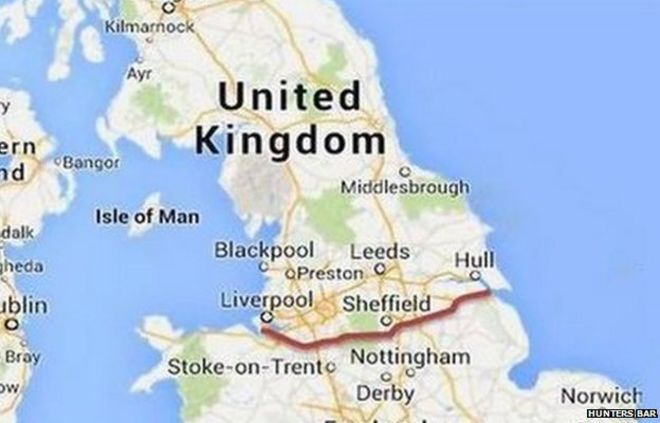
Map of the UK with a line drawn across it
This map, created in 2014, has been widely shared again
Thousands of people in the North of England have been using the hashtag "take us with you Scotland" to express their upset about the result of last week's general election, and the Scottish nationalists are welcoming this English minority with open arms.
Since last Thursday's general election in Britain the phrase "take us with you Scotland" has been used more than 24,000 times. Cities in the North of England have traditionally been a stronghold of the Labour party who retained many of them in the recent vote, but won 232 seats overall, 26 fewer seats than they won in 2010. Voters in the region also returned Conservative MPs - including Chancellor George Osborne who is today setting out a plan for greater devolution to northern cities. For obvious reasons, the left-leaning Scottish National Party didn't stand in the region - but won nearly all the seats in Scotland.
On Sunday afternoon left-leaning voters in Yorkshire and Lancashire started to use the hashtag to express their upset at this situation. "#TakeUsWithYouScotland genuinely beginning to wonder if the North of England becoming a part of Scotland would be better for us, I really am" tweeted Aaron Miller from Yorkshire. Some cracked more jokes under the tag after the North West Motorway Police account, which gives traffic updates, announced that they had "picked up a pedestrian on the M62 who was trying to walk to Scotland".
Joke tweet
After the initial spike of jokes on Sunday evening, the hashtag really took off when users start to mobilise around a year old petition on change.org, which is titled "allow the north of England to secede from the UK & join Scotland". The petition's creator, a Sheffield resident who calls himself "Stu Dent", set it up to coincide with last year's Scottish independence referendum. A map created by Dent imagining the boundary of a "Scotland plus the north" was also widely shared.
Dent runs the Twitter account Hunters Bar, named after an area of southwest Sheffield which is very popular with students and which also happens to sit on the edge of the Sheffield Hallam constituency - represented by the former leader of the Liberal Democrats, Nick Clegg. Despite having thousands of followers on Twitter, when Dent first posted his map last year, the image was shared less than 100 times - but in the past week it's been retweeted by thousands.
Dent told BBC Trending that he was surprised at how popular his petition had become. "In hindsight, perhaps I shouldn't have been," he said. "There is a huge frustration in parts of the UK about the things that have happened since 2010."
"I think people need a place to go where they can say 'not in my name! This is not the England I want'," he added.
I love scotland poster
Thousands of people in the North of England have been petitioning for the region to be allowed to join Scotland
So why has the trend grown so big now? The election results are clearly one factor, but there may be another: the power of the Scottish Nationalists on Twitter and their ability to influence the discussion on the platform. What started as a post-election joke in the North of England was quickly embraced by the so-called "Cyber Nats" and they were able to push the image and petition up the Twitter trending list.
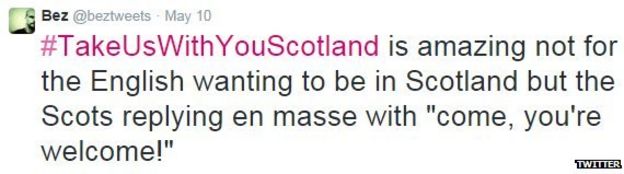
Tweet which reads "take us with you scotland is amazing not for the English wanting to be in Scotland but the Scots replying en masse with "come your welcome".
This tweet was retweeted 450 times and favourited more than 400 times by both Scottish and English users
More than 12,000 people from Scotland and Northern England have signed the petition and the map has now been retweeted more than 3,000 times. The SNP's social media strategist Ross Colquhoun expressed the party's mood about the hashtag best, in a post which was shared more than 500 times. "2014: #LetsStayTogether 2015: #TakeUsWithYouScotland What a difference a year makes" he tweeted.

The troubling flaws in forensic science

by Linda Geddes in BBC Future

“It has long been an axiom of mine that the little things are infinitely the most important.” So said the fictional detective, Sherlock Holmes. Armed with his finely honed skills of backwards reasoning, his trademark ability to solve unsolvable crimes often hinged on his revealing evidence too small to be noticed.
Holmes was an inspiration for the very founders of modern day forensic science. As the decades passed and the tools in their armoury grew, so too did the sheen of invincibility that surrounded their discipline. But there was a crucial chink in their methods that had been overlooked: subjectivity.
While the likes of Holmes’s successors in detective fiction may lead us to believe that forensic evidence is based on precise deduction, all too often it relies on a scientist’s personal opinion, rather than hard fact.
Science on trial
Consider the following case. In December 2009, Donald Gates walked out of his Arizona prison with $75 and a bus ticket to Ohio. After serving 28 years for a rape and murder he didn’t commit, he was a free man. Now the spotlight began to shift to the forensic technique that put him there: microscopic hair analysis.
Human hair is one of the most common types of evidence found at crime scenes. During the 80s and 90s, forensic analysts in the US and elsewhere often looked to the physical differences between hairs to determine whether those found at a crime scene matched hairs from a suspect – like Donald Gates.
When he stood trial in 1982, an FBI analyst called Michael Malone testified that hairs found on the body of the murder victim – a Georgetown University student called Catherine Schilling – were consistent with Donald Gates’ hairs. He added that the probability they came from anyone else was one in 10,000.
“That’s very compelling evidence, particularly when it comes from a witness wearing a white laboratory coat,” says Peter Neufeld, co-founder of the Innocence Project, a New York-based non-profit organisation that uses DNA evidence to overturn wrongful convictions.
DNA testing evidence on a pair of trousers
The FBI is now reviewing several thousand cases as DNA testing sheds new light on the truth (Credit: Getty Images)
However, hair analysis is not purely objective; I might think two hairs look identical, but you might disagree. Even if we agree that two hairs match, no-one has ever figured out how many other hairs might be similarly indistinguishable from one another. “When a person says that the probability is one-in-10,000, that’s simply a made-up number,” says Neufeld. “There’s no data to support it.”
Donald Gates was finally exonerated when DNA testing revealed that the hairs didn’t belong to him after all. Two similar exonerations followed soon afterwards. As a result of these cases, the FBI is now reviewing several thousand cases in which its scientists may have offered similarly misleading testimony. Last month, it announced that of the 268 cases it has reviewed so far that went to trial, 96% them involved scientifically invalid testimony or other errors by FBI agents. Among those convicted, 33 received death sentences, and nine have already been executed.
The FBI’s review won’t necessarily overturn the convictions, but it does mean that they need to be reconsidered carefully. Lawyers scrutinising these cases must work out what other evidence was presented in court; if they hinged on flawed hair testimony, retrials and exonerations may follow. In cases where the original physical evidence still exists, that DNA testing may shed new light on the truth.
Damning report
Even trusted lines of evidence, such as fingerprint analysis, are not water-tight. Research has shown that the same fingerprint expert can reach a different conclusion about the same fingerprints depending on the context they’re given about a case.
Based in part on these findings, in 2009 the National Academy of Sciences in the US published a report on the state of forensic science. Commissioned in response to a string of laboratory scandals and miscarriages of justice, its conclusions were damning. “Testimony based on faulty forensic science analyses may have contributed to the wrongful conviction of innocent people,” it said. “In a number of disciplines, forensic science professionals have yet to establish either the validity of their approach or the accuracy of their conclusions.”
The report was a wake-up call, not just for forensic scientists in the US, but around the world. “What it exposed were significant scientific deficiencies across many of the different methods that we use, both to examine and interpret different types of evidence,” says Nic Daeid, a professor of forensic science at the University of Dundee in Scotland. 
Of all lines of forensic evidence, DNA analysis was considered to be the most objective. Resting on complex chemical analysis, it seems stringently scientific – a gold-standard for how forensic science should be done. Yet perhaps juries should not be too quick to trust the DNA analyses they see in court.
Fingerprints on a sheet of paper
Even trusted lines of evidence, such as fingerprint analysis, are not water-tight (Credit: Thinkstock)
In 2010, while working as a reporter for New Scientist magazine, I teamed up with Itiel Dror from University College London, and Greg Hampikian from Boise State University in Idaho, to put this idea of DNA’s objectivity to the test.
We took DNA evidence from a real-life case – a gang-rape in Georgia, US – and presented it to 17 experienced analysts working in the same accredited government lab in the US.
In the original case, two analysts from the Georgia Bureau of Investigation concluded that the man who was ultimately convicted of the crime, Kerry Robinson, "could not be excluded" from the crime scene sample, based on his DNA profile. But when the evidence was shown to our 17 analysts, they reached very different conclusions; just one analyst agreed that Robinson "cannot be excluded". Four analysts said the evidence was inconclusive and 12 said he could be excluded.
Yet just because forensic science is subjective, this doesn’t mean it should be disregarded; it can still yield vital clues that can help to catch and convict murderers, rapists, and other criminals. “Subjectivity isn’t a bad word,” says Dror. “It doesn’t mean that the evidence isn’t reliable, but it is open to bias and contextual influences.”
Blind judgement
What’s needed are additional safeguards to shield forensic examiners against irrelevant information that might skew their judgement. A first step is to ensure they aren’t given irrelevant information, such as knowing that witnesses have placed the suspect at the crime scene, or that he has previous convictions for similar crimes. Another safeguard is to reveal the relevant information sequentially – and only when it is needed. “We need to give them the information that they need to do their job when they need it, but not extra information that’s irrelevant to what they’re doing and which could influence their perception and judgement,” says Dror.
In the US at least, this is starting to happen: a national commission on forensic science has been established, with the goal of strengthening the field – and this includes looking at human factors like cognitive bias. But similar strategies are needed elsewhere if forensic science is to rebuild its tattered reputation.
When it comes to deduction and proof, there is still much we can learn from Arthur Conan Doyle’s hero. As Sherlock Holmes also once said: "Eliminate all other factors, and the one which remains must be the truth."

Wednesday, 13 May 2015

England's breakdown of trust

Andrew Miller in Cricinfo

They came to offer clarity on Kevin Pietersen, not to praise him. But they left without achieving either.

To be fair to Andrew Strauss and Tom Harrison, the incoming ECB director and chief executive, they tried so hard to be upfront. They did the media rounds with great diligence - upstairs, downstairs, inside and out - tirelessly traversing the Lord's pavilion to repeat themselves to TV, radio, digital and written press ad nauseam.

They presaged their words with woolly preambles about how sorry they were that Peter Moores had been shafted, and how excited they were about their organisation's new beginnings, and how now was the time to build a better future for English cricket.

But no matter how passionately they expressed their platitudes, or how multi-layered they made their appeals for a reassessment of the team's priorities, the white noise of corporate bullshit was precisely the last thing that we, the working media, and by extension, them, the disenfranchised masses so odiously dismissed by the previous regime as being "outside cricket", needed to hear.

Strauss and Harrison tried so desperately to move the issue along, but they might as well have been Ben Raine and Jigar Naik for all the plausible resistance they offered in the face of Pietersen's onslaught. And the net result was that today's grand unveiling was a desperate and troubling disappointment.

Fifteen months ago, a culture of silence enveloped the ECB after Paul Downton's catastrophic decision to sack Pietersen, accompanied by a cryptic press release, the contents of which could not be expanded upon because of an accompanying confidentiality agreement:

"We have decided the time is right to look to the future and start to rebuild not only the team but also team ethic and philosophy."

Leaving aside the energetic posturing and magnanimous looking-in-the-eye that Strauss and Harrison managed in the ECB's second attempt to set the record straight, today's utterancescould feel every bit as cold, flat and insulting to many cricket followers when laid out for digestion in tomorrow's papers.

"We've offered clarity today on the ECB position with respect to KP in the short- to medium-term," said Harrison. "We are drawing a line under it to say this is where we're going."

Really? Pietersen has not been sacked, but he won't be selected, and Alastair Cook, incidentally, has the full and unequivocal backing of the board. He probably deserves it after a year in which the old regime used him as a human shield, but that doesn't even begin to scratch the surface of the issues that demand to be addressed.

The ECB continue to believe that the primary issue at stake is a breakdown in trust between themselves and Pietersen. They could not be more wrong.

The more frightening breakdown is the one between the ECB and its once-devoted public, a hardy and by-and-large educated breed, who stuck with the team through thin and thinner in the 1980s and 90s but whose faith has been eroded by every wrong decision imaginable.

On Monday afternoon, cricket stood still as a Division Two County Championship fixture involving a team that has not won a match for two years became the most talked-about live event in the country.


Andrew Strauss smiles through a media interrogation © Getty Images

By Tuesday morning, the new director of England cricket was telling the public to move along, there's nothing to see here. Such a stance is an outrage. Leaving aside the characters involved - and that, clearly, has not been possible to do - what sort of a perverse world does English cricket inhabit if the hyper-promotion of a match involving its most endangered county is suddenly deemed a bad thing?

Pietersen's decision to turn his back on the IPL's group stages was, admittedly, made easier by the less-than-favourable terms he had been offered by Sunrisers Hyderabad. But he was merely responding to the apparent olive branch he had been offered by the incoming ECB chairman, Colin Graves.

Pietersen has fulfilled his side of the bargain, sometimes thrillingly, and as a by-product he has dragged stupendous levels of interest to every ground he has visited, not least a crowd of 2,000 for a non-first-class warm-up in The Parks. As Alec Stewart, his director of cricket at Surrey, stated in very sanguine fashion on Surrey TV, "Kevin is very entitled to feel let down."

And so is the rest of England's cricket family, for want of a better catch-all term. Harrison, to be fair, recognises the urgent need for the ECB to re-engage with its drifting public, to enhance participation and, tellingly, to stop "patronising" those who expect better from their sport.

But there are better ways to go about rebuilding those bridges than estranging the one man about whom everyone in the sport (and even those outside it) holds an opinion.

It would help if the new management team could avoid coating their explanations in precisely the sort of boardroom jargon that most white-collar sports lovers seek to escape when attending a cricket match

It would also help if the new management team could avoid coating their explanations in precisely the sort of boardroom jargon that most white-collar sports lovers seek to escape when attending a cricket match.

"It's important to have a successful team to address participation issues but there are numerous ways participation can be affected," Harrison said. "One of the reasons we've taken this decision is to bring clarity and stability to the England set-up."

Of course, it's not impossible that the ECB are right, that - much like the Conservative Party's attitude to the economy - steering a firm course through the choppy waters is the only way to reach that long-promised new beginning.

Strauss's insistence that Joe Root was ready to take on greater responsibility chimed with a sense that, even in defeat, there's a hardcore of campaigners being forged within this new England team. If, by some miracle, they can extend their 14-year unbeaten run in home Ashes series this summer, then all sins will be forgiven.

And Strauss, let's not forget, picked up the pieces after the first KP-Moores debacle in 2009 and returned the urn by the end of that summer.

But the invisibility of, and the indifference to, the current England team is frightening. Moeen Ali, the break-out star of last year's Test series win against India, failed even to receive a BBC Sports Personality of the Year nomination, when Lizzy Yarnold (with the greatest respect to the skeleton bob fraternity) did.

And that's the other great sadness of the treatment of KP. With the exception of Ian Bell, who played a walk-on role in the greatest Ashes summer of them all, Pietersen is the last of the free-to-air heroes of 2005.

Harrison insisted it was important not to link his box-office marketability with that fact, but who could have witnessed Pietersen's 355 not out at The Oval this week without winding the mind back to that ludicrous assault on Brett Lee ten years ago? The ECB are expecting England's fans to unmake their memories for the betterment of the here-and-now. History, unfortunately, doesn't work like that.

It is, of course, possible that the furious masses railing on Twitter against the ECB's actions are not as representative of the national mood as they might like to think - last week's General Election set a precedent in that respect, a point that one or two members of the media have picked up on this week.

But if they are not representative, then why not? There is plenty to be furious about in English cricket at present, from the paucity of recent results, to the over-coaching of fast bowlers, to the decline in the recreational game, to the lack of transparency in the sport's global governance.

The ECB say they want to set out a five-year plan for the reinvigoration of the sport. But has anyone stopped to ask for whom is it making these plans? The general public have yet to be invited back into the fold. Or if they have, the message has been lost in the doublespeak.

-----

Strauss' Ishoos

Simon Barnes in Cricinfo


"Ishoos".

It was always going to come down to them. Because England cricket has become a subplot in the Kevin Pietersen Story and with Pietersen, there are always "ishoos". He has "ishoos", and as a result, everybody he touches has "ishoos" with him.

Andrew Strauss gave his first public performance as England's new director of cricket on Tuesday and revealed that Pietersen was not coming back to play for the England "in the short-term". Meaning not this summer. That's just to make it sound a bit less apocalyptic than his sacking last year.

So to clarify: Pietersen has been sacked as an England cricket player, and now he has been unsacked. "He's not barred from the side," Strauss said on Tuesday. It's just that he's not been selected. Which is quite a different matter. He could be reselected again at any time. That's disregarding the small point that he's not going to be.

And the reason for this? "Massive trust ishoos." Which is interesting enough. Though one point that Strauss didn't make was that he was not crazy enough to commence his stint in charge of England cricket by building his team round a 34-year-old. That would be a barmy notion even in an "ishoo"-free scenario.

We've all admired Pietersen's timing over the years. It's one of those natural instincts. If there is the remotest possibility of making trouble, or of finding trouble and making it worse, or of taking on a kerfuffle and turning it into a first-class row, then KP's yer man.

Strauss's job is England v New Zealand and then England v Australia, and he has made his decision about that. As yet, it's neither the right decision nor the wrong decision

So while all this was going on at Lord's, Pietersen was scoring loony amounts of runs for Surrey. He had been told to find a county and score runs if he wanted to return to the England team: you can't say that a triple-century, to which he was adding while Strauss's problem with trust issues was being coyly half-revealed to the public, doesn't add another pint of bat's blood to the witch's cauldron.

I suppose England did. After all, they picked him. Back then he was a South African cricketer with a reputation for mixing trouble and talent in more or less equal quantities. These days he's an ex-England player whose talent for trouble has outstripped his talent for talent.

It is a basic given of team management that any player, if sufficiently talented, can be accommodated in any team. If he makes the team better, it is the team's job to make it work. It's also the individual's job to fit in. So the point is that everybody has failed here. And now it seems that everybody has issues with that failure.

Poor Kevin. It's hard not to feel sorry for an egomaniac when people stop humouring him. Pietersen always wanted to be treated differently to everyone else: now he has been. First he was the only player in the history of England cricket ever to be sacked, and now he's the only England player ever to be unsacked and simultaneously unselected.

Perhaps Strauss's predecessor, Paul Downton - though the titles and the roles are subtly different - was wrong to make an issue of sacking Pietersen. Certainly it was a decision that made a sporting problem into a moral issue. And that put intolerable pressure on the captain, Alastair Cook.

Cook was forced to play the good boy, like Ralph in Lord of the Flies, while Pietersen revelled in his role as bad Jack. And while that makes a fine morality tale worthy of being studied by A level students across the cricketing world, it didn't help England win cricket matches. In fact, it's created a sorry mess.

Kevin Pietersen and Andrew Strauss in happier times © Getty Images


It's not in Strauss's power to undo that. He can't wind back the clock to the point when England fell apart in Australia, or to when the England players started giggling disloyally over the wounding fake-Twitter account that lampooned Pietersen, or to when Pietersen started sending derogatory texts about his own team to the South African cricketers.

No. By accepting the job Strauss has accepted that he has to deal with a few "ishoos". And though he dealt strongly and confidently with the England Test captaincy - Cook uber alles - and with the one-day captaincy - Eoin Morgan's your man - and with the question of the coach - Jason Gillespie is "one of the candidates ... I want to listen to their philosophy of cricket" - this was a day when the old scene-stealer stole the scene once again.

Pietersen finished with 355 not out for Surrey on Tuesday: a mischief-maker's delight. That stupendous score opens a whole new can of issues. Sometimes it seems that the whole world is united in trying to service Pietersen's personal myth: he was dropped half-a-dozen times on the way to that impressive total.

But Strauss's job is England v New Zealand and then England v Australia this summer, and he has made his decision about that. It's neither the right decision nor the wrong decision. It will be the right decision if England score lots of runs, especially Cook, and it will be wrong if they don't. It really is as simple - and as illogical - as that.

So there is Pietersen, playing the misunderstood innocent after producing what is possibly the nastiest and certainly the ghastliest book in the woeful history of ghosted sporting autobiographies, one in which score-settling was top of the agenda and love of cricket nowhere. If you choose to write a book like that you can expect people to have issues with it.

The real KP story is an enthralling tale about the nature of teams, the chemistry within them, when is a team not a team and at what point a nonpareil becomes an intolerable burden on resources. And that's all very well for us, but for Strauss, it's not about the moral agenda or the philosophy of sport.

For Strauss, it's a sporting "ishoo". He's made his decision: now he must pray that England have a decent summer and that Pietersen eases up a little on the triple-centuries. If those two things don't happen, there'll be more "ishoos" for us all to face in the autumn.