Search This Blog

Tuesday, 2 December 2014

Economic dishonesty is the deadliest deficit of all


Chancellor George Osborne will disguise the harm he means to do in the autumn statement, but Labour and the Lib Dems are trapped in me-too territory

EU bill
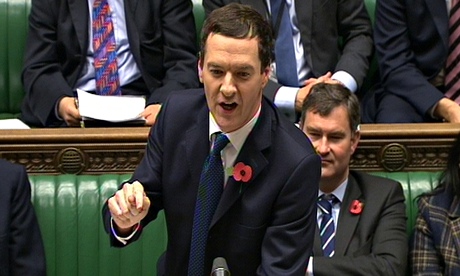
George Osborne will deliver the autumn statement on Wednesday. ‘On all sides barely an honest word will be ­spoken.’ Photograph: PA
Never – probably – in the history of political conflict will so many be misled by so few as in Wednesday’s autumn statement. If the chamber had a polygraph and a Geiger counter to measure radioactive levels of untruth, the place would bleep so loud nothing else would be heard. On all sides barely an honest word will be spoken, including the ifs and the buts.
Yet if the public groans that the yah-booing parties are “all the same”, they would be wrong. Far from it – the parties will be lying about very different things for different reasons. Rarely have they been so far apart in true intentions.
George Osborne will disguise the harm he means to do with his unmentionable £48bn cuts, for fear of frightening voters. Labour will lie about the relative good they mean to do, for fear that fiscal laxity frightens them too. Osborne will be the wolf in sheep’s clothing, bearing sham gifts to the NHS, road users and, maybe, orchestras. Labour will struggle to look wolfish enough, hiding plans to protect public services from the worst by cutting the deficit more slowly. How mad is this?
Here’s Osborne’s situation: he will trumpet 3% growth and falling unemployment while rattling past rising debt and deficit – targets missed by light years as benefits spending shoots up due to housing costs and low pay. Empty Treasury coffers will be slid past, as his “miracle jobs” pay too little to contribute tax. His bold-faced claim that he can afford an NHS bung (not new money) because growth has yielded rewards is just, well, a lie. The Institute for Fiscal Studies, the Resolution Foundation and others warn that Osborne’s cuts will feel far deeper and harsher, wiping out whole departments and leaving councils with only their statutory spending.
This time, as Gavyn Davies warns in the Financial Times, there will be no quantitative easing to smooth the path. Austerity unbound awaits. Even the tactfully conservative estimate of the Office for Budget Responsibility says Osborne’s austerity wiped 1% off growth: his next dose could do even more damage. That’s why the Oxford economics professor Simon Wren-Lewis finds these plans “scarcely credible”. The only possible explanation is ideological, not economic, he says. It “represents a shrinking of the UK state that is unprecedented”.
Cuts Osborne dare not speak are listed by the ConservativeHome website: abolish whole departments, cut more public jobs and pay. An affordability commission will monitor fairness between generations (not between rich and poor) as cover for trimming pensioner perks so far guarded by David Cameron, even the cripplingly costly “triple lock” for rich and poor pensioners alike. The Tory MP Dominic Raab, writing in the Telegraph, expects £20bn to be stripped from Whitehall’s “sprawling bureaucracy”(already cut by a third and denuded of capability) and reduced benefits and public-sector pay, despite five years of cuts.
But Osborne won’t explain how he can make a £100bn deficit vanish in three years, Tommy Cooper-style, just like that. You could accuse him of double-bluff: neither the IFS nor many economists outside the Tory omerta think he can do it – or that he should. It would cause government-terminating rebellion. Osborne has slipped his timetable by several years, but it has brought none of the disasters he warned of in Labour’s “less deep, less fast” plans. Markets happily buy British debt: losing that triple AAA credit rating had no consequences. He can pass his own fiscal responsibility nonsense law – but so what? All such declaratory laws are unworkable – including Labour’s child poverty and equality acts. This is no trap for Labour: Osborne has blithely ignored them all, as inequality rises and social mobility falls.
Now he plans to take from the poor to gift the rich. The Resolution Foundation shows how his raising of the personal tax allowance and higher rate thresholds will give £35 a year to the bottom tenth and £649 to the top, with most money going to the top half. Worse still, on The Andrew Marr Show Osborne said its £7bn cost would be seized from benefits.
Also look out for Osborne in an even more preposterous disguise – George, champion of the north. With hair flattened from hard-hat photo ops, he will promise investment that doesn’t begin to repair his harrowing of the north. David Blunkett, speaking for Sheffield, was spitting teeth last week at Osborne’s abolition of the regional development agency only to rebadge the remaining third as his “growth fund”. Worse, Osborne not only shifted council funding from poorer to richer areas, but Blunkett shows Osborne has taken EU funds specifically granted for poorer places away from Sheffield (cut by 61%) and Liverpool (cut by 57%) to give to better-off areas. Northern investment will be no more than a veneer over previous cuts. Nor will £15bn for road and rail – destined for the marginals – be new money.
Labour should be in clover. Watch Ed Balls gloat at every hideous debt and deficit reveal. But one day’s glee comes at a high cost, if mocking Osborne’s failure to cut more pretends Labour is on the same path. In fact, as Wren-Lewis spells out, there has rarely been a wider gap between the two parties: Labour has taken a £30bn leeway on current spending, more on capital borrowing to invest, but dare not say so. A typical example of Labour pretending to mimic the Tories is its own tax cut, reintroducing the 10p tax rate, which uses the same fiction that it’s for low earners, though most goes to the top. But here’s the key difference: it’s a very small gesture. The Tories will spend £5bn on tax cuts for the well off, Labour less than £1bn.
Labour is trapped, not by Osborne’s fantasy law which they should vote against, but by staying in the me-too rhetorical territory on the deficit, cuts and taxes. If they win, they have no intention of following Tory plans, but – beyond taxing the rich more – dare not say so. They have left it perilously late to chart the opposite course: to say that more borrowing would do little harm for now, that capital borrowing is good for a huge boost to housing, or to warn that austerity is the real danger to growth.
Labour, the Tories and the Lib Dems all agree that the public can’t take much honesty. The truth will kill those who try it, they fear. The Tories won’t admit to £48bn cuts, with which the Lib Dems mostly concur; Labour dare not trust voters with their more gentle plans, for fear of looking fiscally soft. And so the cycle of mistrust between people and politics ratchets up. One economist calls this the “candour deficit” – and in the end, that may be the deadliest political poison of all.

Monday, 1 December 2014

Falling oil prices offer the west a great chance to refashion itself. Let’s seize it


With the black stuff cheaper than it has been in years, Europe’s governments must invest in their infrastructure
Will Hutton
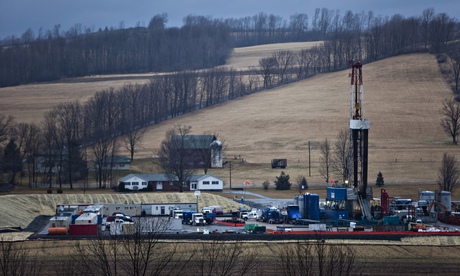
A fracking drill rig in America, which is now the world’s biggest oil producer. Photograph: Jim Lo Scalzo/ EPA/Corbis
For the past 18 months, the world’s biggest oil producer has been the US. Saudi Arabia, eat your heart out. Courtesy of the fracking revolution, the US will maintain this new standing for the foreseeable future, according to official projections.
The world as we’ve known it for the past 50 years is being stood on its head. Which provides cause for optimism. But an international landscape increasingly dominated by nationalist firebrands, conservative zealots and policy makers in thrall to austerity economics is always apt to waste opportunities.
One first good result of this oil price shift, however, was witnessed at Opec’s meeting in Vienna last week. The once feared cartel of oil-exporting countries, with Saudi Arabia at its core, a cartel that at one time commanded more than half of global production, is now a shadow of its former self. Opec’s members were unable to agree to cut production because most are strapped for cash and had no choice but to maintain levels.
With the US needing to buy less oil on international markets and China’s growth sinking to its lowest mark for 40 years, there is now, amazingly, the prospect of an oil glut. The oil price instantly nosedived to its lowest level for four years, around $70 a barrel – down more than a third in three months. On Friday, there was mayhem in the markets as investors reassessed the sober prospects for oil companies, and banks suddenly realised that they were exposed to a new round of write-offs to distressed energy companies and even to governments. But although particular companies may lose out, the first-round effect of this fall should provide good news. High oil prices depress economic activity. They suck money from consumer spending and redirect it to oil-exporting countries, which typically hoard it in elephantine foreign exchange reserves or unspent  bank deposits. It is a tax by the few on the many.
It should be no surprise, then, that in the past rising oil prices were associated with recessions and falling oil prices with booms. If the oil price carries on falling back towards $50 a barrel, and if history is any guide, the western economy should respond – to the good. Already, petrol prices are below 120p a litre, with supermarkets announcing another 2p off.
The European economy, in particular, dependent on oil imports, is an obvious and immediate potential beneficiary. Suddenly, the balance of economic advantage with Russia, no less dependent on oil and gas exports, will flip. Russia’s 2014 budget was based on an oil price of $100 a barrel. At $70 a barrel, the economy will contract by at least 3% in 2015, the country will run a balance of payments deficit and the government’s finances will spin out of control.
The doubts about Putin’s foreign policy within the Russian financial, political, security and business establishment will surely increase: his hold on power is becoming less secure. The chances of Russia sustaining a surrogate war in Ukraine have suddenly been reduced. All good news.
But western governments cannot hope that economic benefits will arrive automatically. These are new times. It has been obvious since the 2008 financial crisis that the economic landscape is wholly different. Digitisation is gnawing away at established companies’ business models and empowering new insurgents at an escalating pace. And this is happening in a world in which there is a massive overhang of private debt and where banks are still nursing damaged balance sheets.
Uncertainty and fear abound. Interest rates in Britain alone have been pegged at 0.5% for more than five years. But still business is reluctant to invest, not knowing what technologies to back or not knowing how much demand there will be for new products and services. We live in an era of stagnation, “secular stagnation”, as former US treasury secretary Larry Summers has described it.
So falling oil prices offer the world economy a great opportunity. But if it is not leapt upon purposefully by aggressively expansionary economic policy, secular stagnation might worsen. Because energy prices affect all goods and services, their fall could reinforce the trend for the general price level to fall further and so accelerate deflation and all the ills that go with it.
This is the moment for the EU and the European Central Bank to throw down the gauntlet to Germany. Last week, the European Commission launched a plan with at least an eye-catching top line – to trigger an additional ¤300bn spending on vital infrastructure across the continent. Except it was a phantom ¤300bn, with Germany insistent that it should involve no extra spending by the commission, nor by governments, nor extra borrowing by the European Investment Bank. Why? Because there was an alleged risk of inflation.
However, with oil prices falling by a third in a few months, the risk is non-existent. Rather, the problem is of the opposite order: not seizing the moment to launch a genuine economic stimulus of some scale.
The world needs to be no less purposeful about how Middle Eastern politics will now play out. US engagement in the region has been driven by the need to secure its oil supplies: as it becomes an oil exporter, that need is removed. The US has played its role as global policeman unevenly and often counterproductively. But at least it has played it, acting as some constraint on Israel, mindful that war will damage the flow of oil to the US.
An isolationist, disengaged US would be much more worrying. Into the vacuum would step a new array of nationalists, terrorists and religious fundamentalists. China will become the new great power in the Middle East, involving itself in a region with now declining oil revenues, intensifying rivalries and endemic religious enmities.
Ukip and the Tory Eurosceptic right complacently invite Britain to deal with the world as it once was, in an imagined utopian past. No need to counter stagnation either as a country or together with others; we British can act alone in a world where economic growth is certain. No need to marshal what remains of British power together with others to create international architecture that forces common responses to common problems. The world is safe and everybody is our potential trading partner. An oil price that falls a third in a few months is a reminder of just how perilous our new world is – and how vital it is to have friends.

Does Britain really want to be the country nobody would migrate to?


When net migration falls, David Cameron can take the credit: for making Britain poor, hostile and pessimistic
Fresson illustration
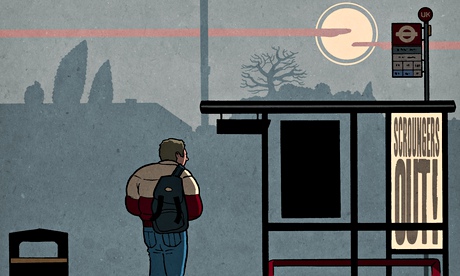
‘Migrants are less likely to be on benefits than non-migrants, not more likely.’ Illustration by Robert G Fresson
In 2011, I interviewed a Polish barista in a Starbucks: it wasn’t about what had brought him to London, nobody was obsessed with that then. It was about what life was like in Krakow. But those two things are, necessarily, related: he told me how much a kilo of sugar was, and how long you’d have to wait for a bus. He said some things were better, but overall, life was quite hard. In fact, I was writing about feminism in Europe, and was just interviewing him to be polite, while I waited for his female colleague: but it stayed with me for the immediacy of the image. It tells you everything you need to know, about why people choose to live in prosperous nations over poor ones: how much of your life are you going to spend waiting for things?
The immigrant of David Cameron’s imagination, who roams the continent looking for the taxpayers who will most generously fund his idleness, doesn’t exist. The strongest the Labour party has been, in its alarmingly mild response to a wave of sudden, strident xenophobia, is to point out that the numbers are wrong.
Migrants are less likely to be on benefits, not more likely. The benefits they do claim tend to be in-work benefits, made necessary by a bizarre new status quo in which it’s possible for huge numbers of people to work full time and still need a cash benefit to pay rent. But it would be nice to hear someone in mainstream politics say that benefit tourism doesn’t exist because … who does that? What scheming fainéant uproots himself, slogs across Europe to forge a new life in an unfamiliar land, just to be work-shy on somebody’s sofa? It doesn’t make sense on a human level. How does the bold, optimistic person who took the risk become the lazy, withdrawn person who’s on the make?
The political stage is peopled with characters who wouldn’t get past a script meeting in Emmerdale: the woman who has an abortion at 28 weeks because she’s suddenly not that into the idea; the perfectly well person who would rather fake debilitating depression than get a job; the homo economicus who goes to a food bank even though he can afford food, because it’s free. The standard opposition is nerdy: we crunch the numbers and say, that only applies in 0.7% of cases, or we can only find 0.01 examples. A better retort would be: this characterisation is too senseless and implausible to warrant our attention. Go back to the drawing board, and rejoin the debate when you have concocted a bogeyman who at least has his arms and legs in the correct place.
All of us understand perfectly what would make this country look attractive to other EU nationals. Bus waiting times are a handy reckoner of the infrastructure, but they are also a metaphor for economic vigour – is this a place where the hardworking can thrive? Or is everyone constantly thwarted by circumstances they can’t control, which slow them down? Does this place look as though it would welcome strangers and present them with opportunities, or is it closed, narrow-minded, suspicious and racist? Do people earn enough not to worry about the price of sugar?
In fact, whatever Nigel Farage tells you, whatever hot anxiety spews out of Migration Watch, the government is doing a brilliant job at making the UK a place where nobody would ever want to live. While London remains the most prosperous city in Europe,nine out of the 10 poorest places in northern Europe are all in the UK, according to Inequality Briefing. Wages are low, housing costs are high – two-thirds of the people who found jobs last year were earning less than a living wage. Incomes at the bottom have dropped 10% in real terms over the past decade. Sugar prices have stayed pretty constant, but I don’t imagine that’s much consolation.
Far more off-putting than the grinding poverty, though, is the prevailing attitude of hatred and paranoia. Ukip wants to refashion the children of migrants as “hidden migrants”, even though this includes one of their two MPs and the offspring of their leader. Elderly racists are being dragged out of the conservative closet and dusted down to give their answering views on what kind of migration we should welcome.
Norman Tebbitt has suggested a new test – who did your grandfather fight for in the second world war? This is the man who argued that organ donors ought to be able to dictate, in the event of their death, that their kidneys are only given to white people. “Of course,” he wrote in 2000, “the race relations industry will come out beating its racist drum if a white person says their body may only be used to help others of their ethnic origin.” The only people making the case for immigration are doing so on the basis of their tax receipts and how much business depends upon them, which is code for “depends upon low wages”. Who would go to a country that talks about foreigners like that? What does it say about how they see their own people, that their politicians can make a business case but can’t make a human case?
The only thing maintaining the flow of migrants is that nobody reads the Daily Mail until they arrive, and only then do they realise how coarse and brutal our politics have become, how pessimistic. Why is a country that claims to be booming behaving like a country in the grip of a depression? Are its leaders lying about the boom, or failing to distribute its fruits? A bit of both, in proportions we can analyse at leisure. Meanwhile, when net migration starts to fall, as I have no doubt it will, David Cameron will be right to take the credit. He couldn’t cap the moths, so he put out the flame.

How to take back the NHS, before it’s too late


The coalition’s 2012 health reform act was disastrous. It can be overturned – but time is running out
The NHS as celebrated in the 2012 Olympics opening ceremony
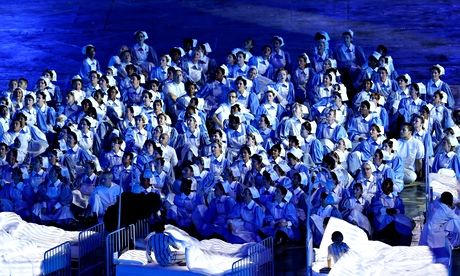
National treasure: the NHS as celebrated in the 2012 Olympics opening ceremony. Photograph: Clive Rose/Getty Images
The Health and Social Care Act 2012 – engineered by the former health secretary Andrew Lansley – was a massive blunder, and even senior Conservative ministers now admit the scale of its disastrous repercussions.
The main thrust of the Lansley project was to take the NHS down the American healthcare route, creating an external market and mandating the compulsory marketisation and commercialisation of services.
Michael Gove, now government chief whip, has claimed that no privatisation of the NHS has taken place but this is plainly wrong. A deplorable example was the sale in July 2013 of Plasma Resources UK which turns plasma into blood products, a particularly sensitive area in healthcare, to the US private equity company Bain and Company. Another example: when advertising for a new chair for NHS Blood and Transplant it was made clear that candidates should have privatisation experience.
Having now established a clear-cut precedent for further privatisation, there is every expectation among private contractors that when contract renewals come up they will be able to tender proposals for a transfer to private ownership. Some of these contracts are massive, such as the 10-year contract in Staffordshire for vital cancer services and end-of-life care worth £1.2bn.
These acts of privatisation will not, unfortunately, be the last if the Conservatives continue in government after the next general election. The companies competing for contracts may even hope to invoke the controversial investor state dispute settlement procedures being negotiated as part of the next big EU-US trade agreement, theTransatlantic Trade and Investment Partnership (TTIP), which was championed by the present NHS chief executive when in America, which could enable them to challenge the law in order to hold on to their contracts.
For 68 years, the NHS has provided the level of healthcare that our parliament has decided we can afford. The truth is that healthcare, whether public or private, in a very real sense is infinite: unlimited sums of private money can be – and in many countries are – poured into healthcare by those who can afford it. Money for the NHS is determined by public choice, and relative to what we choose to spend on education, housing, welfare, defence, all of which are legitimate demands on the public purse.
George Osborne is to announce another £2bn for the NHS on Wednesday, a welcome move, which should be used to create a new NHS investment fund with charitable status to centrally handle PFI contracts.
But healthcare, if publicly provided, inevitably has to be constrained. Traditionally, that rationing process within the NHS is flexible, professional and democratically accountable to parliament. British voters could have chosen a different system – they exist in many parts of the world – but no major political party has ever felt brave or foolish enough to put such a choice to them. Nor was it a choice put to the electorate in 2010 by either of the coalition parties.
Yet we know of David Cameron’s close involvement with Lansley before the election. Nicholas Timmins – in Never Again? The Story of the Health and Social Care Act 2012, a study for the Kings Fund – writes: “It is far from the case that the senior Conservatives – Cameron, Osborne and Letwin, for example – were ignorant about what Lansley was up to … He and Oliver Letwin helped write the green papers.” Guilt may be the explanation for Cameron’s current attempt to give the former health secretary a job running humanitarian affairs in the UN.
The far more expensive model based on the US is, after just two years, already having a deep and damaging impact on behaviour in the NHS and depressing standards of care. It is challenging the very nature of the vocational aspect of medicine for nurses, doctors and everyone who works in the NHS. It may be happening slowly, but the dynamics of this market model over the years will carry their own momentum.
Despite much-publicised scandals, such as that which enveloped the Mid Staffordshirehospital, the NHS remains extraordinarily popular among the public, and the only explanation I have is that people know that all demands for ever more expensive healthcare cannot be met. They understand that there have to be financial disciplines; that we cannot abolish all charging or market elements or private contractors in such a large concern.
People do believe, however, that an organisation that carries the brand name NHS has to practise under a fair trade description, and that means that the preferred provider should be the NHS. They like the NHS because they sense that its care choices are broadly fair and they prize its comprehensive cover. Most families have their own reasons to bless the NHS. They can complain, they can get angry with it and they are demanding, rightly, to be better able to influence its rationing process. But what they are rightly fearful of is that, once the service is driven by market principles, the rationing will cease to be fair and their care will become determined by profit.
Such a grave mistake as Lansley’s reform must be corrected. A reinstated NHS would be far better placed to provide a comprehensive, cost-effective healthcare service for England, which is similar, although not the same, in all parts of the UK. Repealing the 2012 act is not a realistic political option but its worst aspects can and must be excised, and the best opportunity to secure a commitment to doing that is before the 2015 election.
As individuals we can exercise our democratic rights over the NHS in ways that would have been impossible before the internet. Using www.nhsbill2015.org we are already opening up old-style political campaigning to new means of persuasion. This is not about money. No, what is required is a vast commitment, in terms of time taken to convey the complexities of the NHS, time taken to lobby MPs and parliamentary candidates, and the persistence not to let candidates escape behind generalised party political messages and manifestos devised by talking to focus groups. There is a new democratic way of exercising the power of the people and we saw its beginning during the Scottish referendum.
We must not forget that in September 2014 the Scottish independence referendum brought the UK perilously close to splitting apart. Those elements that we share, that help create a sense of common purpose, should become ever more precious as we try to unify our nation.
The end of the NHS as we have known and understood it in England will take place before 2020 if the 2012 legislation is not changed. The exact moment of its passing may not even be clear, because it will go with a whimper not a bang, to borrow from TS Eliot. The NHS is not a “religion”, as has often been claimed, nor is it the preserve of one political party, nor one country within our United Kingdom. It belongs to all of us and we let something of ourselves go if we don’t fight to save it.