Monday, 14 November 2022
How Financial Markets sabotage governments: Sunak says higher taxes and spending cuts needed to satisfy markets
UK PM and chancellor argue that financial markets have settled because they expect deep cuts to spending write Aletha Adu and Jessica Elgot in The Guardian
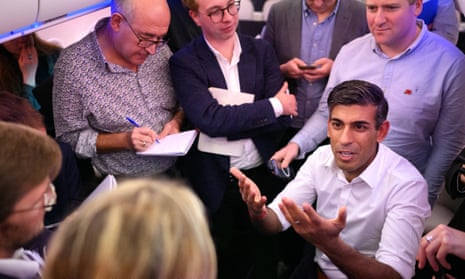
The prime minister and the chancellor have attempted to prepare the ground for a bleak autumn statement, saying that everybody should expect higher taxes and arguing that financial markets were expecting deep cuts to public spending.
Speaking en route to the G20 in Bali, Rishi Sunak told reporters that the reason financial markets were no longer in turmoil was because they expected the government to clamp down on borrowing and squeeze spending.
“Financial conditions in the UK have stabilised clearly, but they have stabilised because people expect the government to take the decisions that will put our public finances on a sustainable trajectory, and it’s the government’s job to deliver on that,” Sunak said. “And that’s what the chancellor will do.”

Jeremy Hunt: everyone will be paying more tax after autumn statement
Read more
Sunak and Hunt have not committed to preserving the pensions triple lock or to uprating benefits in line with inflation, but the prime minister said he was “cognisant of supporting the most vulnerable”.
But he added that they must “crucially [be] delivering on the expectations of international markets, especially to make sure that our fiscal position is on a more sustainable trajectory.”
His comments came after Jeremy Hunt told Sky News’s Sophie Ridge on Sunday that he hoped to make the coming recession, forecast to be the longest in history, “as short and shallow as possible”, and that the government would be “asking everyone for sacrifices”.
Asked by the BBC if taxes were going to go up, he said: “We are going to see everybody paying more tax, we are going to see spending cuts, but I think it’s very important to say that we are a resilient country.
“I think that as Simon Schama would say, we have faced bigger challenges in our history in the past and we are also a compassionate country.”

All capital spending under review ahead of Jeremy Hunt’s autumn statement
Read more
He told Sky news: “I think what people recognise is that if you want to give people confidence about the future, you have to be honest about the present. And you have to have a plan.
“This will be a plan to help bring down inflation, help control high energy prices and also get our way back to growing healthily, which is what we need so much.”
Sunak said he wanted to use the UK’s presence at the G20 to underline the group’s foundation as an economic forum formed in the 2008 crisis and to renew that purpose of international cooperation on the economy, despite Russia’s presence at the summit overshadowing much of the achievable business.
He said the UK was not the only nation facing economic turmoil, a refrain he is set to use throughout the buildup to the autumn statement to link the UK’s problems to global issues such as Ukraine and energy prices.
Labour has said the UK is alone in G7 nations in using austerity as the prescription to tackle potential recession. Despite a third of the world predicted to be in recession, Labour said the UK was experiencing particularly low growth because of Conservative policies, seeing the UK fall to the worst growth in the OECD behind Chile, Italy and Mexico.
Asked if the UK should be prepared for a prolonged and painful recession, Sunak said that the autumn statement would set out how the UK would recover. “Part of our job is not just to bring stability back to the system, which we will do, but it’s also to lay the foundations for the economy to recover and grow,” he said.
“Ultimately, that’s what we all want to see. That’s how we’re going to be able to cut people’s taxes over time and support public services. And you’ll hear that side of the equation from the chancellor as well.”
Sign up to First Edition
Free daily newsletter
Archie Bland and Nimo Omer take you through the top stories and what they mean, free every weekday morning
Privacy Notice: Newsletters may contain info about charities, online ads, and content funded by outside parties. For more information see our Privacy Policy. We use Google reCaptcha to protect our website and the Google Privacy Policy and Terms of Service apply.
John Glen, the chief secretary to the Treasury, said ministers would be seeking to make savings through “rooting out waste”.
He said the government could be made “more efficient” by accelerating the sale of under-used buildings, particularly “expensive central London properties”, and “turbo-charging” plans to digitise public services.
Writing in the Sunday Telegraph, he said: “To continue delivering the things people care about in the face of inflationary pressures, without making the problem worse through extra spending across the board, we have to take difficult decisions and make government more efficient. That means rooting out waste.
“It’s outrageous that public money – your money – is being soaked up by the system when it could be channelled towards areas that really need it.”
The shadow chancellor, Rachel Reeves, warned that “public services are already on their knees”. “Seven million people are waiting for an NHS operation or support … I don’t believe that austerity 2.0 after the austerity that we’ve gone through for the last 12 years is the right approach,” she said.
Sunak will arrive in Indonesia on Monday evening for the G20 summit which has been overshadowed by the presence of Russia, though President Vladimir Putin has pulled out of attending.
He will tell assembled world leaders that Russia’s war in Ukraine has affected “every household on the planet” because of rising global food prices caused by choking off Ukrainian grain supplies as well as surging energy bills.
Presenting a five-point plan on the global economy, the prime minister will say that support is still needed for the most vulnerable – including international aid – but foreshadowed the end of more widespread support for middle income families struggling with the cost of living including on energy bills or mortgages ahead of the autumn statement.
As the architect of the UK’s furlough scheme, Sunak will say now that governments must “direct government support to where it’s most needed … using government support effectively to prioritise the most vulnerable, both in our own countries and internationally”.
The prime minister and the chancellor have attempted to prepare the ground for a bleak autumn statement, saying that everybody should expect higher taxes and arguing that financial markets were expecting deep cuts to public spending.
Speaking en route to the G20 in Bali, Rishi Sunak told reporters that the reason financial markets were no longer in turmoil was because they expected the government to clamp down on borrowing and squeeze spending.
“Financial conditions in the UK have stabilised clearly, but they have stabilised because people expect the government to take the decisions that will put our public finances on a sustainable trajectory, and it’s the government’s job to deliver on that,” Sunak said. “And that’s what the chancellor will do.”
Jeremy Hunt: everyone will be paying more tax after autumn statement
Read more
Sunak and Hunt have not committed to preserving the pensions triple lock or to uprating benefits in line with inflation, but the prime minister said he was “cognisant of supporting the most vulnerable”.
But he added that they must “crucially [be] delivering on the expectations of international markets, especially to make sure that our fiscal position is on a more sustainable trajectory.”
His comments came after Jeremy Hunt told Sky News’s Sophie Ridge on Sunday that he hoped to make the coming recession, forecast to be the longest in history, “as short and shallow as possible”, and that the government would be “asking everyone for sacrifices”.
Asked by the BBC if taxes were going to go up, he said: “We are going to see everybody paying more tax, we are going to see spending cuts, but I think it’s very important to say that we are a resilient country.
“I think that as Simon Schama would say, we have faced bigger challenges in our history in the past and we are also a compassionate country.”
All capital spending under review ahead of Jeremy Hunt’s autumn statement
Read more
He told Sky news: “I think what people recognise is that if you want to give people confidence about the future, you have to be honest about the present. And you have to have a plan.
“This will be a plan to help bring down inflation, help control high energy prices and also get our way back to growing healthily, which is what we need so much.”
Sunak said he wanted to use the UK’s presence at the G20 to underline the group’s foundation as an economic forum formed in the 2008 crisis and to renew that purpose of international cooperation on the economy, despite Russia’s presence at the summit overshadowing much of the achievable business.
He said the UK was not the only nation facing economic turmoil, a refrain he is set to use throughout the buildup to the autumn statement to link the UK’s problems to global issues such as Ukraine and energy prices.
Labour has said the UK is alone in G7 nations in using austerity as the prescription to tackle potential recession. Despite a third of the world predicted to be in recession, Labour said the UK was experiencing particularly low growth because of Conservative policies, seeing the UK fall to the worst growth in the OECD behind Chile, Italy and Mexico.
Asked if the UK should be prepared for a prolonged and painful recession, Sunak said that the autumn statement would set out how the UK would recover. “Part of our job is not just to bring stability back to the system, which we will do, but it’s also to lay the foundations for the economy to recover and grow,” he said.
“Ultimately, that’s what we all want to see. That’s how we’re going to be able to cut people’s taxes over time and support public services. And you’ll hear that side of the equation from the chancellor as well.”
Sign up to First Edition
Free daily newsletter
Archie Bland and Nimo Omer take you through the top stories and what they mean, free every weekday morning
Privacy Notice: Newsletters may contain info about charities, online ads, and content funded by outside parties. For more information see our Privacy Policy. We use Google reCaptcha to protect our website and the Google Privacy Policy and Terms of Service apply.
John Glen, the chief secretary to the Treasury, said ministers would be seeking to make savings through “rooting out waste”.
He said the government could be made “more efficient” by accelerating the sale of under-used buildings, particularly “expensive central London properties”, and “turbo-charging” plans to digitise public services.
Writing in the Sunday Telegraph, he said: “To continue delivering the things people care about in the face of inflationary pressures, without making the problem worse through extra spending across the board, we have to take difficult decisions and make government more efficient. That means rooting out waste.
“It’s outrageous that public money – your money – is being soaked up by the system when it could be channelled towards areas that really need it.”
The shadow chancellor, Rachel Reeves, warned that “public services are already on their knees”. “Seven million people are waiting for an NHS operation or support … I don’t believe that austerity 2.0 after the austerity that we’ve gone through for the last 12 years is the right approach,” she said.
Sunak will arrive in Indonesia on Monday evening for the G20 summit which has been overshadowed by the presence of Russia, though President Vladimir Putin has pulled out of attending.
He will tell assembled world leaders that Russia’s war in Ukraine has affected “every household on the planet” because of rising global food prices caused by choking off Ukrainian grain supplies as well as surging energy bills.
Presenting a five-point plan on the global economy, the prime minister will say that support is still needed for the most vulnerable – including international aid – but foreshadowed the end of more widespread support for middle income families struggling with the cost of living including on energy bills or mortgages ahead of the autumn statement.
As the architect of the UK’s furlough scheme, Sunak will say now that governments must “direct government support to where it’s most needed … using government support effectively to prioritise the most vulnerable, both in our own countries and internationally”.
Saturday, 12 November 2022
Saturday, 5 November 2022
Shane Watson: 'In teams that focus on results instead of processes, players start playing for themselves'
Shane Watson in Cricinfo
There are environments where the leaders talk about how big this game is, how important this game is, and say, "If we lose this game we are out." I have been in plenty of these team environments. There are also environments where leaders talk about how performance in this game will dictate selection, and that underperformance might lead to players getting dropped. I have heard from leaders of a number of teams that I have played in say things like, "Spots are up for grabs in the game" or "If you don't perform, you will get dropped."
So guess what people are thinking in those environments? "Don't lose. I really need to perform today. I need to score runs. We need to win. Don't get out. Don't bowl badly. Don't stuff up, otherwise I might be gone." All of these focus on results and fear of failure.
These environments can work for a shorter period of time, where fear of failure can drive individuals to be ready to lock in for one very important game. But these environments are not sustainable at all as stress and anxiety builds up to a point where the whole team implodes and I have been a part of these environments on a few occasions too. The telltale signs are that everyone starts to only play for themselves, for their individual spots, and as long as they do enough to get picked for the next game, they are happy. This always leads to an incredibly toxic team environment where the enjoyment factor of playing the game that you love evaporates and it turns into every person for themselves. We should be doing all that we can to do the opposite of this, as the best and most successful team environments always have a fun and enjoyment aspect to them as a very important undercurrent to all that they do.
Other environments I have been a part of are ones where there is a clear focus on the process and leaders ask the players to just bring the best version of themselves every time and to do it over and over again. They reiterate that if we all do this, we give ourselves the best chance of coming out on top. This is exactly what a championship mindset looks like!
This is what made Ricky Ponting such a good captain. He always said to the team in the lead-up to big games that the team whose individuals do the basics better and for longer will be the team that will come out on top. It focused our minds on the process, on doing the basics, controlling the A factors.
Paddy Upton for Rajasthan Royals built a process-driven environment that took all of the anxiety and stress out of a very pressurised tournament where performance and results were so important. The other team environment where this was done incredibly well was at Chennai Super Kings in the IPL under captain MS Dhoni and coach Stephen Fleming. I never heard either of them say, "We need to win this game today", or "If you don't score runs today or take wickets, you will be getting dropped."
My second year with CSK really stuck with me. There was no chopping and changing in selection. In other teams I had been with, players were turned over constantly. If a player didn't perform for a couple of games, selectors would think he wasn't good enough and would replace him immediately. This meant that everyone started looking over their shoulders and thinking, "Gosh, if I don't perform in a couple of games, then I could be gone too."
No matter who we are, we are always going to have times in our lives where we are in a "results-focused" environment. By understanding the mental-skills framework in this book, we know that this is the opposite of where we want to be mentally for us to be at our best both individually and collectively. We need to listen to what is being said by the leaders in this environment and we need to redirect their words ourselves to say, "I am not going to let their results focus influence the correct mindset I need for me to be at my best." This can be much easier said than done when players are being chopped and changed from one game to the next without any rhyme or reason, apart from someone not performing in one game. But understanding this will be a powerful tool for you to use throughout your life to ensure a negative environment doesn't infiltrate your thinking and pull you out of your high-performance mindset.
I've been a victim of a negative team environment. After the retirement of Ricky Ponting and Mike Hussey, the Australian team drifted significantly. Pressure to perform began to affect confidence and consistency. Players, myself included, began to look over our shoulders. I didn't have knowledge of the mental skills I needed to redirect my thoughts to the right things at the right times to consistently bring the best version of myself into every performance, instead of being overcome with fear and overwhelmed by a need for results, which saw my performances go downhill throughout that time. And this was all at a time where I was in my prime, performing really well in the IPL in an incredibly enjoyable, process-driven team environment. But as soon as I went back into this other environment, my kryptonite, my performances started to tank again and the enjoyment factor of playing the game that I loved evaporated very quickly.
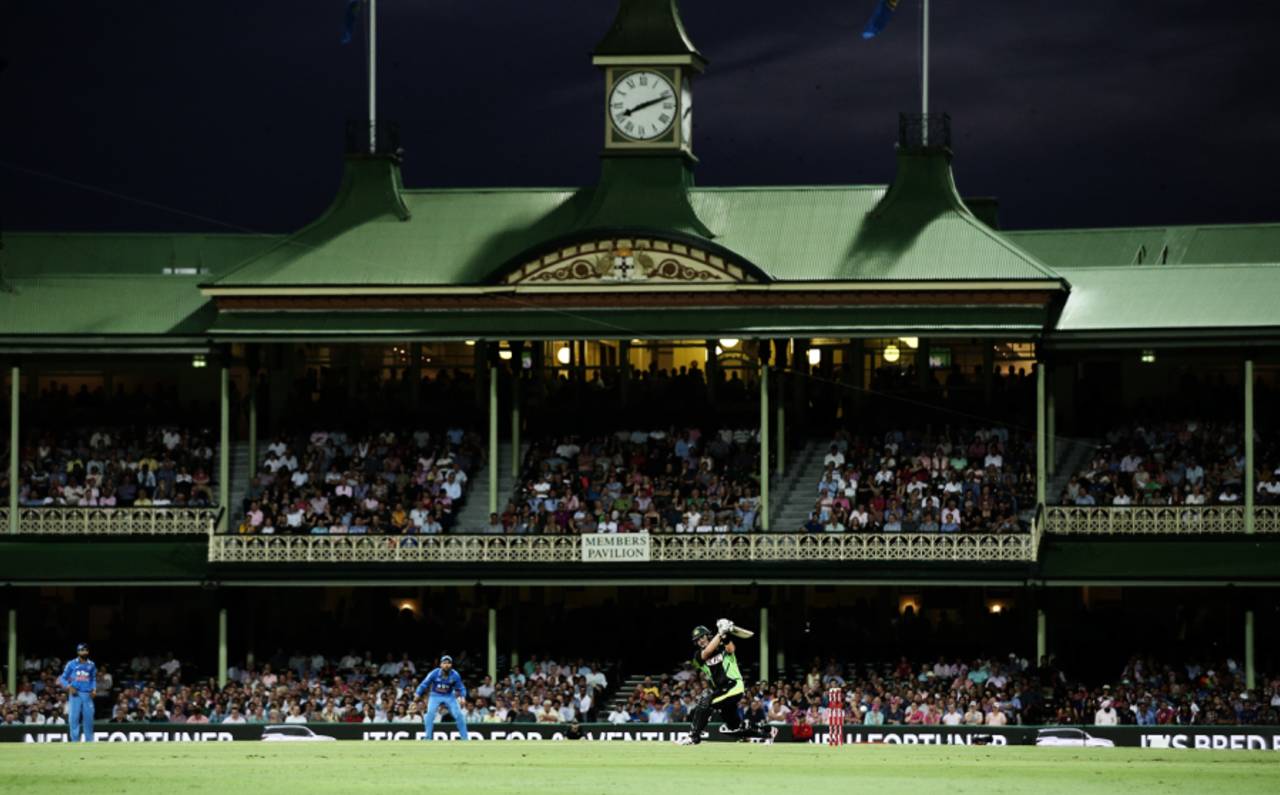
When Watson was able to let go of the negative mindset that gripped the team, he was able to play with freedom and the results automatically followed•Craig Golding/AFP/Getty Images
My last three months with the Australia T20 team from early January 2016 through to the T20 World Cup in India was another example of one of those environments. We played India in a three-match T20 International series, where the selectors picked a really big squad and chopped and changed the team significantly from game to game, and then this flowed on to a T20 series in South Africa before we headed to India for the T20 World Cup. The conversations and actions around the group from the leaders - that being the coach, captain, selectors - were consistent messaging like, "All spots are up for grabs if you want to play in the T20 World Cup" and "You need to perform in this game as you might only have one opportunity to press your claim."
As soon as I heard and saw this, I immediately acknowledged in my own mind what this ridiculous situation was creating. This time I opted out. I knew the importance of preparation and focus. The result was that I bowled as well as I had in T20 cricket for Australia, played one of the games of my life at the SCG as captain, and retired at the end of the T20 World Cup as the No. 1 T20I allrounder in the world.
Surprise surprise, we lost to India in the quarter final knockout game. We left a few runs on the table and didn't execute that well with the ball against an Indian team that had barely changed their XI from the first game that we played against them during the series in Australia, three months before.
But the attitudes I saw in that T20 World Cup are everywhere. I saw it recently in a game of junior cricket. The result of the match was important as a place in the grand final was riding on it. A number of the parents had really built this game up as being a knockout game and had stressed to the kids how important it was to win to make the final. Then one of the calmest kids in the team went out to bat with two overs to go and one of the parents said, "Don't get out, otherwise we will lose" as he walked out to bat. And guess what happened. This poor young kid ended up getting out, and because of all of the build-up of importance for this game by the parents and kids around him, the calmest child on the field lost the plot, throwing their gear everywhere in disappointment of letting the team down. It was so sad to see and something that should never happen if the parents around the team simply understood the fundamentals of how to create the optimal environment. Reinforcement of the correct mindset would then filter down to all of the young kids.
It is so easy to allow the "live or die by results" environment to infiltrate your mindset and start to corrupt it. It is easy to start to move your thinking to fear of failure and how important it is to perform and get the results. But by understanding all of the mental skills in this book, you will be armed with all that you need to be mentally tough enough to create a super-strong cocoon around yourself, to just direct your thoughts to continually creating your optimal mental environment to bring the best version of you, no matter what team environment that you are in.
We need to do all that we can in our power to help with creating the best team environment possible, so that individuals don't have to feel like they are rebelling against the team leadership just to stay process-driven, to bring their best A game possible, game in game out. I'm convinced that more and more teams should be open to allowing players to manage their own mental and physical preparation. Everyone is different; everyone comes to know what best suits them; just as a lot of cricket is individual, so should a lot of the preparation be too. Understanding this will create so many more high-performing team environments, higher-performing individuals and most importantly, much more enjoyable team environments too, so that we never lose the fun and joy that we get playing the game that we love.
There are environments where the leaders talk about how big this game is, how important this game is, and say, "If we lose this game we are out." I have been in plenty of these team environments. There are also environments where leaders talk about how performance in this game will dictate selection, and that underperformance might lead to players getting dropped. I have heard from leaders of a number of teams that I have played in say things like, "Spots are up for grabs in the game" or "If you don't perform, you will get dropped."
So guess what people are thinking in those environments? "Don't lose. I really need to perform today. I need to score runs. We need to win. Don't get out. Don't bowl badly. Don't stuff up, otherwise I might be gone." All of these focus on results and fear of failure.
These environments can work for a shorter period of time, where fear of failure can drive individuals to be ready to lock in for one very important game. But these environments are not sustainable at all as stress and anxiety builds up to a point where the whole team implodes and I have been a part of these environments on a few occasions too. The telltale signs are that everyone starts to only play for themselves, for their individual spots, and as long as they do enough to get picked for the next game, they are happy. This always leads to an incredibly toxic team environment where the enjoyment factor of playing the game that you love evaporates and it turns into every person for themselves. We should be doing all that we can to do the opposite of this, as the best and most successful team environments always have a fun and enjoyment aspect to them as a very important undercurrent to all that they do.
Other environments I have been a part of are ones where there is a clear focus on the process and leaders ask the players to just bring the best version of themselves every time and to do it over and over again. They reiterate that if we all do this, we give ourselves the best chance of coming out on top. This is exactly what a championship mindset looks like!
This is what made Ricky Ponting such a good captain. He always said to the team in the lead-up to big games that the team whose individuals do the basics better and for longer will be the team that will come out on top. It focused our minds on the process, on doing the basics, controlling the A factors.
Paddy Upton for Rajasthan Royals built a process-driven environment that took all of the anxiety and stress out of a very pressurised tournament where performance and results were so important. The other team environment where this was done incredibly well was at Chennai Super Kings in the IPL under captain MS Dhoni and coach Stephen Fleming. I never heard either of them say, "We need to win this game today", or "If you don't score runs today or take wickets, you will be getting dropped."
My second year with CSK really stuck with me. There was no chopping and changing in selection. In other teams I had been with, players were turned over constantly. If a player didn't perform for a couple of games, selectors would think he wasn't good enough and would replace him immediately. This meant that everyone started looking over their shoulders and thinking, "Gosh, if I don't perform in a couple of games, then I could be gone too."
No matter who we are, we are always going to have times in our lives where we are in a "results-focused" environment. By understanding the mental-skills framework in this book, we know that this is the opposite of where we want to be mentally for us to be at our best both individually and collectively. We need to listen to what is being said by the leaders in this environment and we need to redirect their words ourselves to say, "I am not going to let their results focus influence the correct mindset I need for me to be at my best." This can be much easier said than done when players are being chopped and changed from one game to the next without any rhyme or reason, apart from someone not performing in one game. But understanding this will be a powerful tool for you to use throughout your life to ensure a negative environment doesn't infiltrate your thinking and pull you out of your high-performance mindset.
I've been a victim of a negative team environment. After the retirement of Ricky Ponting and Mike Hussey, the Australian team drifted significantly. Pressure to perform began to affect confidence and consistency. Players, myself included, began to look over our shoulders. I didn't have knowledge of the mental skills I needed to redirect my thoughts to the right things at the right times to consistently bring the best version of myself into every performance, instead of being overcome with fear and overwhelmed by a need for results, which saw my performances go downhill throughout that time. And this was all at a time where I was in my prime, performing really well in the IPL in an incredibly enjoyable, process-driven team environment. But as soon as I went back into this other environment, my kryptonite, my performances started to tank again and the enjoyment factor of playing the game that I loved evaporated very quickly.
When Watson was able to let go of the negative mindset that gripped the team, he was able to play with freedom and the results automatically followed•Craig Golding/AFP/Getty Images
My last three months with the Australia T20 team from early January 2016 through to the T20 World Cup in India was another example of one of those environments. We played India in a three-match T20 International series, where the selectors picked a really big squad and chopped and changed the team significantly from game to game, and then this flowed on to a T20 series in South Africa before we headed to India for the T20 World Cup. The conversations and actions around the group from the leaders - that being the coach, captain, selectors - were consistent messaging like, "All spots are up for grabs if you want to play in the T20 World Cup" and "You need to perform in this game as you might only have one opportunity to press your claim."
As soon as I heard and saw this, I immediately acknowledged in my own mind what this ridiculous situation was creating. This time I opted out. I knew the importance of preparation and focus. The result was that I bowled as well as I had in T20 cricket for Australia, played one of the games of my life at the SCG as captain, and retired at the end of the T20 World Cup as the No. 1 T20I allrounder in the world.
Surprise surprise, we lost to India in the quarter final knockout game. We left a few runs on the table and didn't execute that well with the ball against an Indian team that had barely changed their XI from the first game that we played against them during the series in Australia, three months before.
But the attitudes I saw in that T20 World Cup are everywhere. I saw it recently in a game of junior cricket. The result of the match was important as a place in the grand final was riding on it. A number of the parents had really built this game up as being a knockout game and had stressed to the kids how important it was to win to make the final. Then one of the calmest kids in the team went out to bat with two overs to go and one of the parents said, "Don't get out, otherwise we will lose" as he walked out to bat. And guess what happened. This poor young kid ended up getting out, and because of all of the build-up of importance for this game by the parents and kids around him, the calmest child on the field lost the plot, throwing their gear everywhere in disappointment of letting the team down. It was so sad to see and something that should never happen if the parents around the team simply understood the fundamentals of how to create the optimal environment. Reinforcement of the correct mindset would then filter down to all of the young kids.
It is so easy to allow the "live or die by results" environment to infiltrate your mindset and start to corrupt it. It is easy to start to move your thinking to fear of failure and how important it is to perform and get the results. But by understanding all of the mental skills in this book, you will be armed with all that you need to be mentally tough enough to create a super-strong cocoon around yourself, to just direct your thoughts to continually creating your optimal mental environment to bring the best version of you, no matter what team environment that you are in.
We need to do all that we can in our power to help with creating the best team environment possible, so that individuals don't have to feel like they are rebelling against the team leadership just to stay process-driven, to bring their best A game possible, game in game out. I'm convinced that more and more teams should be open to allowing players to manage their own mental and physical preparation. Everyone is different; everyone comes to know what best suits them; just as a lot of cricket is individual, so should a lot of the preparation be too. Understanding this will create so many more high-performing team environments, higher-performing individuals and most importantly, much more enjoyable team environments too, so that we never lose the fun and joy that we get playing the game that we love.
‘I want to open a window in their souls’: Haruki Murakami on the power of writing simply
From The Guardian
My first novel, Hear the Wind Sing, published in 1979, is fewer than 200 pages long. Yet it took many months and much effort to complete. Part of the reason, of course, was the limited time I had to work on it. I ran a jazz cafe, and I spent my 20s labouring from morning to night to pay off debts. But the real problem was that I hadn’t a clue how to write a novel. To tell the truth, although I had been absorbed in reading all kinds of stuff – my favourites being translations of Russian novels and English-language paperbacks – I had never read modern Japanese novels (of the “serious” variety) in any concerted way. Thus I had no idea what kind of Japanese literature was being read at the time or how I should write fiction in Japanese.
For several months, I operated on pure guesswork, adopting what seemed to be a likely style and running with it, but when I read through the result I was far from impressed. “Good grief,” I moaned, “this is hopeless.” What I had written seemed to fulfil the formal requirements of a novel, yet it was rather boring and, as a whole, left me cold.
In retrospect, it was only natural that I was unable to produce a good novel. It was a big mistake to assume that a guy like me who had never written anything in his life could spin out something brilliant right off the bat. Maybe it had been a mistake to try to write something “novelistic” in the first place. “Give up trying to create something sophisticated,” I told myself. “Why not forget all those prescriptive ideas about ‘the novel’ and ‘literature’ and set down your feelings and thoughts as they come to you, freely, in a way that you like?”
While it was easy to talk about setting down one’s impressions freely, though, actually doing it wasn’t that simple. To make a fresh start, the first thing I had to do was ditch my stack of manuscript paper and my fountain pen. As long as they were sitting in front of me, what I was doing felt like “literature”. In their place, I pulled out my old Olivetti typewriter from the closet. Then, as an experiment, I decided to write the opening of my novel in English. What the hell, I figured. If I was going to do something unorthodox, why not go all the way?
Writing in a foreign language taught me to express thoughts and feelings with a limited set of words
Needless to say, my ability in English composition didn’t amount to much. My vocabulary was severely limited, as was my command of English syntax. I could only write in short, simple sentences. Which meant that, however complex and numerous the thoughts running around in my head, I couldn’t even attempt to set them down as they came to me. The language had to be simple, my ideas expressed in an easy-to-understand way, the descriptions stripped of all extraneous fat, the form made compact, and everything arranged to fit a container of limited size. The result was a rough, uncultivated kind of prose. As I struggled to express myself in that fashion, however, a distinctive rhythm began to take shape.
I was born and raised in Japan, so the vocabulary and patterns of Japanese – in short, the language’s contents – had filled the system that was me to bursting. When I sought to put my thoughts and feelings into words, those contents began to swirl like mad, and the system sometimes crashed. Writing in a foreign language, with all the limitations that it entailed, removed this obstacle. It also led me to the realisation that I could express my thoughts and feelings with a limited set of words and grammatical structures, as long as I combined them effectively and linked them together in a skilful manner. Ultimately, I learned that there was no need for a lot of difficult words – I didn’t have to try to impress people with beautiful turns of phrase.
Much later, I found out that the writer Ágota Kristóf had written a number of wonderful novels in a style that had a very similar effect. Kristóf was a Hungarian citizen who left Hungary in 1956 during the upheaval there for Switzerland, where she began to write in French. She did so partly out of necessity, since there was no way she could make a living writing novels in Hungarian. Yet it was through writing in a foreign language that she succeeded in developing a style that was new and uniquely hers. It featured a strong rhythm based on short sentences, diction that was never roundabout but always straightforward, and description that was to the point and free of emotional baggage. Her novels were cloaked in an air of mystery hinting at important matters hidden beneath the surface. Later, when I first encountered her work, it made me feel quite nostalgic, although her literary inclinations are obviously different from mine.
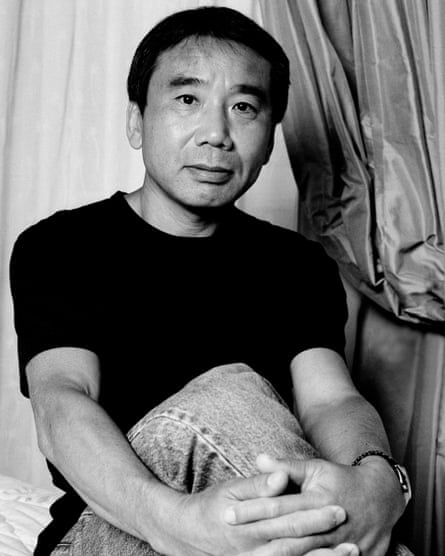
Having discovered the curious effect of composing in a foreign language, thereby acquiring a creative rhythm distinctly my own, I returned my Olivetti to the closet and once more pulled out my sheaf of manuscript paper and my fountain pen. Then I sat down and “translated” the chapter or so that I had written in English into Japanese. Well, “transplanted” might be more accurate, since it wasn’t a verbatim translation. In the process, inevitably, a new style of Japanese emerged. The style that became mine, one that I had discovered. “Now I get it,” I thought. “This is how I should be doing it.” It was a moment of true clarity.
I rewrote the “rather boring” novel I had just finished from top to bottom in the new style that I had just developed. Although the storyline remained more or less intact, the mode of expression was entirely different. Different, too, was its impact on the reader. It was, of course, the short novel Hear the Wind Sing. I wasn’t entirely satisfied with the way it turned out. When I reread it, I found it immature and riddled with faults. Only 20-30% of what I was trying to say came across. Yet it was my first novel, and I had managed to write in a form that somehow worked, so I was left with the feeling that I had taken a big first step.
Writing in my new style felt more like performing music than composing literature, a feeling that stays with me today. It was as if the words were coming through my body instead of from my head. Sustaining the rhythm, finding the coolest chords, trusting in the power of improvisation – it was tremendously exciting. When I sat down at the kitchen table each night and went back to work on my novel (if that’s what it was) using my new style, I felt like I was holding a new, cutting-edge tool in my hands. Boy oh boy, was it fun! And it filled the spiritual void that had loomed with the approach of my 30th birthday.
From the outset, I had a pretty clear idea of the novels I wanted to create. It seems that I discovered my “original” voice and style, not by adding to what I already knew but subtracting from it. Think how many things we pick up in the course of living. Whether we choose to call it information overload or excess baggage, we have that multitude of options to choose from, so that when we try to express ourselves creatively, all those choices collide with each other and we shut down, like a stalled engine. We become paralysed. Our best recourse is to clear out our information system by chucking all that is unnecessary into the bin, allowing our mind to move freely again.
How, then, can we distinguish between those contents that are crucial, those that are less necessary, and those that are entirely unnecessary?
One rule of thumb is to ask yourself, “Am I having a good time doing this?” If you’re not enjoying yourself when you’re engaged in what seems important to you, if you can’t find spontaneous pleasure and joy in it, then there’s likely something wrong. When that happens, you have to go back to the beginning and start discarding any extraneous parts or unnatural elements.
Right after Hear the Wind Sing won a Japanese literary prize for new writers, a high-school classmate of mine stopped by my jazz cafe to offer his comments on my novel. “If something that simple can make it, I could write a novel, too,” he sniffed, and left. I was a little put out, of course, but I also knew what he meant. “The guy may not be entirely off the mark,” I thought. “Perhaps anybody could turn out something as good.” All I had done was sit down and riff on whatever came into my head. There were no complicated words, no elaborate phrases, no elegant style. I had just thrown it together as I went along. If that classmate of mine did go home and write a novel, however, I never heard about it. Maybe he figured there was no need for him to write in a world where novels as half-baked as mine could pass muster. If so, it probably showed good judgment on his part.
Looking back, however, it strikes me that for an aspiring writer, writing “something that simple” may not be so simple. It’s easy enough to think and talk about ridding your mind of unnecessary things, but actually doing it is hard. I think that I was able to pull it off without too much fuss because I had never been obsessed by the idea of being a writer, so I was not hindered by that ambition.
If there is indeed something original about my novels, I think it springs from the principle of freedom. I had just turned 29 when, for no particular reason, I thought, “I feel like writing a novel!” I had never planned to be a writer and had never given serious thought to what sort of novel I should be writing, which meant that I was under no particular constraints. I just wanted to write something that reflected what I was feeling at the time. There was no need to feel self-conscious. In fact, writing was fun – it let me feel free and natural.
I think (or hope) that free and natural sensibility lies at the heart of my novels. That is what has spurred me to write. My engine, as it were. It is my belief that a rich, spontaneous joy lies at the root of all creative expression. What is originality, after all, but the shape that results from the natural impulse to communicate to others that feeling of freedom, that unconstrained joy?
Perhaps pure impulse brings with it its own form and style in a natural, involuntary way. Form and style are, in that sense, far from artificial. A brilliant person may use every ounce of his intelligence to develop form and style, may diagram every step, but if he lacks that natural impulse he is likely to fail or, if not fail, produce something that will not last. It will be like a plant whose roots are not firmly set in the earth: if there is too little rain it will lose its vitality and wither, while if it rains too hard it will be swept away with the topsoil.
This is purely my opinion, but if you want to express yourself as freely as you can, it’s probably best not to start out by asking “What am I seeking?” Rather, it’s better to ask “Who would I be if I weren’t seeking anything?” and then try to visualise that aspect of yourself. Asking “What am I seeking?” invariably leads you to ponder heavy issues. The heavier that discussion gets, the farther freedom retreats, and the slower your footwork becomes. The slower your footwork, the less lively your prose.
When that happens, your writing won’t charm anyone – possibly even you.
The you who is not seeking anything, by contrast, is as light and free as a butterfly. All you have to do is uncup your hands and let it soar. Your words will flow effortlessly. People normally don’t concern themselves with self-expression – they just live their lives. Yet, despite that, you want to say something. Perhaps it is in the natural context of “despite that” where we unexpectedly catch sight of something essential about ourselves.
I have been writing fiction for more than 40 years; yet I have never experienced what is commonly known as “writer’s block”. Wanting to write but being unable to is unknown to me. That may make it sound as if I am overflowing with talent, but the actual reason is much simpler: I never write unless I really want to, unless the desire to write is overwhelming. When I feel that desire, I sit down and set to work. When I don’t feel it, I usually turn to translating from English. Since translation is essentially a technical operation, I can pursue it on a daily basis, quite separate from my creative desire; yet at the same time it is a good way to hone my writing skills. If I am in the mood, I may also turn to writing essays. “What the heck,” I defiantly tell myself as I peck away at those other projects. “Not writing novels isn’t going to kill me.”
After a while, however, the desire to write begins to mount. I can feel my material building up within me, like spring melt pressing against a dam. Then one day (in a best-case scenario), when I can’t take that pressure any more, I sit down at my desk and start to write. Worry about editors impatiently awaiting a promised manuscript never enters the picture. I don’t make promises, so I don’t have deadlines. As a result, writer’s block and I are strangers to each other. As you might expect, that makes my life much happier. It must be terribly stressful for a writer to be put in the position of having to write when he doesn’t feel like it. (Could I be wrong? Do most writers actually thrive on that kind of stress?)
When I think about “originality” I am transported back to my boyhood days. I can see myself in my room sitting in front of my little transistor radio listening for the first time to the Beach Boys (Surfin’ USA) and the Beatles (Please Please Me). “Wow!” I’m thinking. “This is fantastic! I’ve never heard anything like this!” I am so moved. It is as if their music has thrown open a new window in my soul, and air of a kind I have never breathed before is pouring in. I feel a sense of profound wellbeing, a natural high. Liberated from the constraints of reality, it is as if my feet have left the ground. This to me is how “originality” should feel: pure and simple.
I came across this line recently in the New York Times, written about the American debut of the Beatles: “They produced a sound that was fresh, energetic and unmistakably their own.” These words may provide the best definition of originality available. “Fresh, energetic, and unmistakably your own.”
Originality is hard to define in words, but it is possible to describe and reproduce the emotional state it evokes. I try to attain that emotional state each time I sit down to write my novels. That’s because it feels so wonderfully invigorating. It’s as if a new and different day is being born from the day that is today.
If possible, I would like my readers to savour that same emotion when they read my books. I want to open a window in their souls and let the fresh air in. This is what I think of, and hope for, as I write – purely and simply.
My first novel, Hear the Wind Sing, published in 1979, is fewer than 200 pages long. Yet it took many months and much effort to complete. Part of the reason, of course, was the limited time I had to work on it. I ran a jazz cafe, and I spent my 20s labouring from morning to night to pay off debts. But the real problem was that I hadn’t a clue how to write a novel. To tell the truth, although I had been absorbed in reading all kinds of stuff – my favourites being translations of Russian novels and English-language paperbacks – I had never read modern Japanese novels (of the “serious” variety) in any concerted way. Thus I had no idea what kind of Japanese literature was being read at the time or how I should write fiction in Japanese.
For several months, I operated on pure guesswork, adopting what seemed to be a likely style and running with it, but when I read through the result I was far from impressed. “Good grief,” I moaned, “this is hopeless.” What I had written seemed to fulfil the formal requirements of a novel, yet it was rather boring and, as a whole, left me cold.
In retrospect, it was only natural that I was unable to produce a good novel. It was a big mistake to assume that a guy like me who had never written anything in his life could spin out something brilliant right off the bat. Maybe it had been a mistake to try to write something “novelistic” in the first place. “Give up trying to create something sophisticated,” I told myself. “Why not forget all those prescriptive ideas about ‘the novel’ and ‘literature’ and set down your feelings and thoughts as they come to you, freely, in a way that you like?”
While it was easy to talk about setting down one’s impressions freely, though, actually doing it wasn’t that simple. To make a fresh start, the first thing I had to do was ditch my stack of manuscript paper and my fountain pen. As long as they were sitting in front of me, what I was doing felt like “literature”. In their place, I pulled out my old Olivetti typewriter from the closet. Then, as an experiment, I decided to write the opening of my novel in English. What the hell, I figured. If I was going to do something unorthodox, why not go all the way?
Writing in a foreign language taught me to express thoughts and feelings with a limited set of words
Needless to say, my ability in English composition didn’t amount to much. My vocabulary was severely limited, as was my command of English syntax. I could only write in short, simple sentences. Which meant that, however complex and numerous the thoughts running around in my head, I couldn’t even attempt to set them down as they came to me. The language had to be simple, my ideas expressed in an easy-to-understand way, the descriptions stripped of all extraneous fat, the form made compact, and everything arranged to fit a container of limited size. The result was a rough, uncultivated kind of prose. As I struggled to express myself in that fashion, however, a distinctive rhythm began to take shape.
I was born and raised in Japan, so the vocabulary and patterns of Japanese – in short, the language’s contents – had filled the system that was me to bursting. When I sought to put my thoughts and feelings into words, those contents began to swirl like mad, and the system sometimes crashed. Writing in a foreign language, with all the limitations that it entailed, removed this obstacle. It also led me to the realisation that I could express my thoughts and feelings with a limited set of words and grammatical structures, as long as I combined them effectively and linked them together in a skilful manner. Ultimately, I learned that there was no need for a lot of difficult words – I didn’t have to try to impress people with beautiful turns of phrase.
Much later, I found out that the writer Ágota Kristóf had written a number of wonderful novels in a style that had a very similar effect. Kristóf was a Hungarian citizen who left Hungary in 1956 during the upheaval there for Switzerland, where she began to write in French. She did so partly out of necessity, since there was no way she could make a living writing novels in Hungarian. Yet it was through writing in a foreign language that she succeeded in developing a style that was new and uniquely hers. It featured a strong rhythm based on short sentences, diction that was never roundabout but always straightforward, and description that was to the point and free of emotional baggage. Her novels were cloaked in an air of mystery hinting at important matters hidden beneath the surface. Later, when I first encountered her work, it made me feel quite nostalgic, although her literary inclinations are obviously different from mine.
Having discovered the curious effect of composing in a foreign language, thereby acquiring a creative rhythm distinctly my own, I returned my Olivetti to the closet and once more pulled out my sheaf of manuscript paper and my fountain pen. Then I sat down and “translated” the chapter or so that I had written in English into Japanese. Well, “transplanted” might be more accurate, since it wasn’t a verbatim translation. In the process, inevitably, a new style of Japanese emerged. The style that became mine, one that I had discovered. “Now I get it,” I thought. “This is how I should be doing it.” It was a moment of true clarity.
I rewrote the “rather boring” novel I had just finished from top to bottom in the new style that I had just developed. Although the storyline remained more or less intact, the mode of expression was entirely different. Different, too, was its impact on the reader. It was, of course, the short novel Hear the Wind Sing. I wasn’t entirely satisfied with the way it turned out. When I reread it, I found it immature and riddled with faults. Only 20-30% of what I was trying to say came across. Yet it was my first novel, and I had managed to write in a form that somehow worked, so I was left with the feeling that I had taken a big first step.
Writing in my new style felt more like performing music than composing literature, a feeling that stays with me today. It was as if the words were coming through my body instead of from my head. Sustaining the rhythm, finding the coolest chords, trusting in the power of improvisation – it was tremendously exciting. When I sat down at the kitchen table each night and went back to work on my novel (if that’s what it was) using my new style, I felt like I was holding a new, cutting-edge tool in my hands. Boy oh boy, was it fun! And it filled the spiritual void that had loomed with the approach of my 30th birthday.
From the outset, I had a pretty clear idea of the novels I wanted to create. It seems that I discovered my “original” voice and style, not by adding to what I already knew but subtracting from it. Think how many things we pick up in the course of living. Whether we choose to call it information overload or excess baggage, we have that multitude of options to choose from, so that when we try to express ourselves creatively, all those choices collide with each other and we shut down, like a stalled engine. We become paralysed. Our best recourse is to clear out our information system by chucking all that is unnecessary into the bin, allowing our mind to move freely again.
How, then, can we distinguish between those contents that are crucial, those that are less necessary, and those that are entirely unnecessary?
One rule of thumb is to ask yourself, “Am I having a good time doing this?” If you’re not enjoying yourself when you’re engaged in what seems important to you, if you can’t find spontaneous pleasure and joy in it, then there’s likely something wrong. When that happens, you have to go back to the beginning and start discarding any extraneous parts or unnatural elements.
Right after Hear the Wind Sing won a Japanese literary prize for new writers, a high-school classmate of mine stopped by my jazz cafe to offer his comments on my novel. “If something that simple can make it, I could write a novel, too,” he sniffed, and left. I was a little put out, of course, but I also knew what he meant. “The guy may not be entirely off the mark,” I thought. “Perhaps anybody could turn out something as good.” All I had done was sit down and riff on whatever came into my head. There were no complicated words, no elaborate phrases, no elegant style. I had just thrown it together as I went along. If that classmate of mine did go home and write a novel, however, I never heard about it. Maybe he figured there was no need for him to write in a world where novels as half-baked as mine could pass muster. If so, it probably showed good judgment on his part.
Looking back, however, it strikes me that for an aspiring writer, writing “something that simple” may not be so simple. It’s easy enough to think and talk about ridding your mind of unnecessary things, but actually doing it is hard. I think that I was able to pull it off without too much fuss because I had never been obsessed by the idea of being a writer, so I was not hindered by that ambition.
If there is indeed something original about my novels, I think it springs from the principle of freedom. I had just turned 29 when, for no particular reason, I thought, “I feel like writing a novel!” I had never planned to be a writer and had never given serious thought to what sort of novel I should be writing, which meant that I was under no particular constraints. I just wanted to write something that reflected what I was feeling at the time. There was no need to feel self-conscious. In fact, writing was fun – it let me feel free and natural.
I think (or hope) that free and natural sensibility lies at the heart of my novels. That is what has spurred me to write. My engine, as it were. It is my belief that a rich, spontaneous joy lies at the root of all creative expression. What is originality, after all, but the shape that results from the natural impulse to communicate to others that feeling of freedom, that unconstrained joy?
Perhaps pure impulse brings with it its own form and style in a natural, involuntary way. Form and style are, in that sense, far from artificial. A brilliant person may use every ounce of his intelligence to develop form and style, may diagram every step, but if he lacks that natural impulse he is likely to fail or, if not fail, produce something that will not last. It will be like a plant whose roots are not firmly set in the earth: if there is too little rain it will lose its vitality and wither, while if it rains too hard it will be swept away with the topsoil.
This is purely my opinion, but if you want to express yourself as freely as you can, it’s probably best not to start out by asking “What am I seeking?” Rather, it’s better to ask “Who would I be if I weren’t seeking anything?” and then try to visualise that aspect of yourself. Asking “What am I seeking?” invariably leads you to ponder heavy issues. The heavier that discussion gets, the farther freedom retreats, and the slower your footwork becomes. The slower your footwork, the less lively your prose.
When that happens, your writing won’t charm anyone – possibly even you.
The you who is not seeking anything, by contrast, is as light and free as a butterfly. All you have to do is uncup your hands and let it soar. Your words will flow effortlessly. People normally don’t concern themselves with self-expression – they just live their lives. Yet, despite that, you want to say something. Perhaps it is in the natural context of “despite that” where we unexpectedly catch sight of something essential about ourselves.
I have been writing fiction for more than 40 years; yet I have never experienced what is commonly known as “writer’s block”. Wanting to write but being unable to is unknown to me. That may make it sound as if I am overflowing with talent, but the actual reason is much simpler: I never write unless I really want to, unless the desire to write is overwhelming. When I feel that desire, I sit down and set to work. When I don’t feel it, I usually turn to translating from English. Since translation is essentially a technical operation, I can pursue it on a daily basis, quite separate from my creative desire; yet at the same time it is a good way to hone my writing skills. If I am in the mood, I may also turn to writing essays. “What the heck,” I defiantly tell myself as I peck away at those other projects. “Not writing novels isn’t going to kill me.”
After a while, however, the desire to write begins to mount. I can feel my material building up within me, like spring melt pressing against a dam. Then one day (in a best-case scenario), when I can’t take that pressure any more, I sit down at my desk and start to write. Worry about editors impatiently awaiting a promised manuscript never enters the picture. I don’t make promises, so I don’t have deadlines. As a result, writer’s block and I are strangers to each other. As you might expect, that makes my life much happier. It must be terribly stressful for a writer to be put in the position of having to write when he doesn’t feel like it. (Could I be wrong? Do most writers actually thrive on that kind of stress?)
When I think about “originality” I am transported back to my boyhood days. I can see myself in my room sitting in front of my little transistor radio listening for the first time to the Beach Boys (Surfin’ USA) and the Beatles (Please Please Me). “Wow!” I’m thinking. “This is fantastic! I’ve never heard anything like this!” I am so moved. It is as if their music has thrown open a new window in my soul, and air of a kind I have never breathed before is pouring in. I feel a sense of profound wellbeing, a natural high. Liberated from the constraints of reality, it is as if my feet have left the ground. This to me is how “originality” should feel: pure and simple.
I came across this line recently in the New York Times, written about the American debut of the Beatles: “They produced a sound that was fresh, energetic and unmistakably their own.” These words may provide the best definition of originality available. “Fresh, energetic, and unmistakably your own.”
Originality is hard to define in words, but it is possible to describe and reproduce the emotional state it evokes. I try to attain that emotional state each time I sit down to write my novels. That’s because it feels so wonderfully invigorating. It’s as if a new and different day is being born from the day that is today.
If possible, I would like my readers to savour that same emotion when they read my books. I want to open a window in their souls and let the fresh air in. This is what I think of, and hope for, as I write – purely and simply.
Subscribe to:
Comments (Atom)