Search This Blog

Wednesday, 27 July 2022

There is a global debt crisis coming – and it won’t stop at Sri Lanka

Foreign capital flees poorer countries at the first sign of instability. The pandemic and Ukraine war ensure there is plenty of that around writes Jayati Ghosh in The Guardian


This January, even before Sanjana Mudalige’s salary as a sales worker in a shopping mall in Colombo, Sri Lanka, was slashed in half, she had pawned her gold jewellery to try to make ends meet. Ultimately, she quit her job, because the travel costs alone exceeded the pay. Since then, she has shifted from using gas for cooking to chopping firewood, and eats just a quarter of what she did before. Her story, reported in the Washington Post, is one of many in Sri Lanka, where people are watching their children go hungry and their elderly relations suffer for lack of medicines.

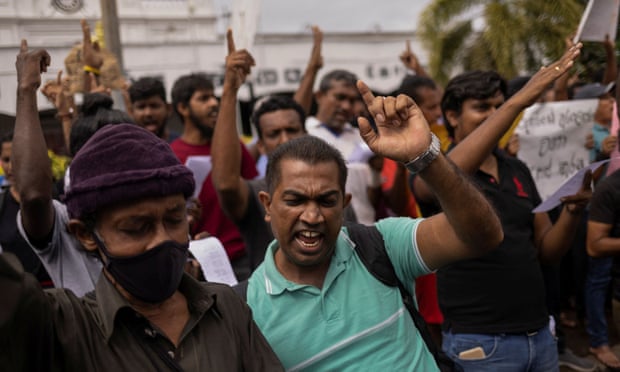
The human costs of the crisis only really captured international attention when the massive popular upsurge earlier this month, known as Aragalaya (Sinhalese for “struggle”), led to the peaceful overthrow of President Gotabaya Rajapaksa. His family had ruled Sri Lanka with an iron fist, albeit with electoral legitimacy, for more than 15 years, and is now being blamed by both national and international media for the desperate economic mess the country is in.

But blaming the Rajapaksas alone is too simple. Certainly, the aggressive majoritarianism that they unleashed, along with the alleged corruption and major economic policy disasters of recent years (such as drastic tax cuts and bans on fertiliser imports), were crucial elements of the economic debacle. But this is only part of the story. The deeper and underlying causes of the crisis in Sri Lanka are barely mentioned by most mainstream commentators, perhaps because they reveal uncomfortable truths about the way the global economy works.

This is not a crisis created by a few recent external and internal factors, it has been decades in the making. Ever since its “open economic policy” was adopted in the late 1970s, Sri Lanka has been Asia’s poster boy for neoliberal reform, much like Chile in Latin America. The strategy was the now-familiar one of making exports the basis for economic growth, supported by foreign capital inflows. This led to a significant increase in foreign currency debt, something the IMF and the Davos crowd actively encouraged. 

In the period after the 2008 global financial crisis, as low interest rates in advanced economies led to the availability of cheap credit, the Sri Lankan government relied on international sovereign bonds to finance its own spending. Between 2012 and 2020, the debt to GDP ratio doubled to around 80%, with a growing share of this in bonds. The payments due on these debts kept rising in relation to what Sri Lanka could earn from exports and the money sent back home by Sri Lankans working abroad. The disruptions caused by the pandemic and the war in Ukraine made matters much worse, by causing export earnings to fall and sharply increasing the price of essential imports including food and fuel. Foreign exchange reserves plummeted – but the government had to keep paying interest even when it could not import essential fuel.

Looked at in this light, it is clear that Sri Lanka is not alone; if anything, it’s just a harbinger of a coming storm of debt distress in what economists call the “emerging markets”. The past period of incredibly low interest rates in the advanced economies meant that more funds flowed to “emerging” and “frontier” markets from the richer world. While this found cheerleaders in the international financial institutions (IFIs), it was always a problematic process. This is because, unlike in places such as the EU and US, capital leaves low- and middle-income countries (LMICs) at the first sign of any problem.

And these countries were much more battered economically by the pandemic. Advanced economies were able to provide massive countercyclical measures – think of the UK’s furlough programme – because financial markets effectively allowed and even encouraged them to do so. By contrast, LMICs were prevented from increasing fiscal spending by much – because of those same financial markets, which threatened the possibility of credit downgrades and capital flight as government deficits grew larger. Plus they faced significant declines in export and tourism revenues and tighter balance of payments constraints. As a result, their economic recovery has been much more muted and economic conditions remain mostly dire.

The half-hearted attempts at debt relief, such as the moratorium on debt servicing in the first part of the pandemic, only postponed the problem. There has been no meaningful debt restructuring at all. The IMF bewails the situation and does almost nothing, and both it and World Bank add to the problem through their own rigid insistence on repayments and the appalling system of surcharges imposed by the IMF. The G7 and “international community” have been missing in action, which is deeply irresponsible given the scale of the problem and their role in creating it.

The sad truth is that “investor sentiment” moves against poorer economies regardless of the real economic conditions in specific countries. Private credit rating agencies amplify the problem. This means that contagion is all too likely, and it will affect not just economies that are already experiencing difficulties, but a much wider range of LMICs that will face real difficulties in servicing their debts. Lebanon, Suriname and Zambia are already in formal default; Belarus is on the brink; and Egypt, Ghana and Tunisia are in severe debt distress.

Many countries with lower per-capita income and significant absolute poverty are facing stagflation. Billions of people are increasingly unable to afford a basic nutritious diet, and cannot meet basic health expenses. Material insecurity and social tensions are inevitable.

The situation can still be resolved, but it requires urgent action, especially on the part of the IFIs and G7. Speedy and systematic debt resolution actions to bring in private creditors and other creditors, such as China, are needed, as is IFIs doing their own bit to provide debt relief and ending punitive measures such as surcharges. In addition, policies to limit speculation in commodity markets and profiteering by big food and fuel companies must be put in place. Finally, the recycling of special drawing rights (SDRs) – essentially “IMF coupons” – by countries that will not use them to countries that desperately need them is vital, as is another release of SDRs equating to about $650bn to provide immediate relief.

Without these minimal measures, the post-Covid, post-Ukraine global economy is likely to be engulfed in a dystopia of debt defaults, increasing poverty and sociopolitical instability.

Monday, 25 July 2022

Strict inflation targets for central banks have caused economic harm

 Edward Chancellor in The FT

A great experiment in monetary policy is drawing to a close. Last week, the European Central Bank announced its largest rate hike in two decades, taking its benchmark rate back to just zero per cent. Never before, over the course of some 5,000 years of lending, have interest rates sunk so low. Those who rue the consequences of easy money are quick to blame central bankers. But the problem originates with the strict inflation mandates they are required to follow. 

In 1990, the Reserve Bank of New Zealand became the first central bank to adopt a formal target. In 1997 a newly independent Bank of England was also given a target, as was the ECB when it opened for business a year later. After the global financial crisis, both the Federal Reserve and Bank of Japan jumped on board. What BOJ governor Haruhiko Kuroda called the “global standard” — an inflation target in the range of 2 per cent — performed several functions: providing central banks with a clearly defined benchmark, anchoring inflation expectations and relieving politicians of responsibility for monetary policy. 

The trouble is that whenever an institution is guided by a specific target, critical judgment tends to be suspended. As the late political scientist Donald Campbell wrote, “the more any quantitative social indicator is used for social decision-making”, the higher the risk it will distort and corrupt the processes involved. This problem is well known in monetary policymaking circles. In the 1970s Charles Goodhart of the London School of Economics noted that whenever the BoE targeted a specific measure of the money supply, this measure’s earlier relationship to inflation broke down. Goodhart’s Law states that any measure used for control is unreliable. 

Inflation-targeting runs true to form. Thanks in large measure to globalisation and technological advances, inflationary pressures abated in the 1990s, allowing central bankers to lower interest rates. After the dotcom bust at the turn of the century, fears of deflation induced the Federal Reserve to set its Fed funds rate at a postwar low of 1 per cent. A global credit boom followed. The ensuing bust unleashed even stronger deflationary pressures. The Fed proceeded to cut its policy rate to zero. In Europe and Japan, rates turned negative for the first time in history. 

Throughout the following decade, central bankers justified their actions by reference to their inflation targets. Yet these targets produced a number of corruptions and distortions. Ultra-low interest rates pushed the US stock market to near record valuations and provided the impetus for the “everything bubble” in a wide variety of assets ranging from cryptocurrencies to vintage cars. Forced to “chase yield”, investors assumed more risk. The fall in long-term rates hurt savings and triggered a massive increase in pension deficits. Easy money kept zombie businesses afloat and swamped Silicon Valley with blind capital. Companies and governments availed themselves of cheap credit to take on more debt. 

Most economists assume that interest rates simply reflect what’s going on in what they call the “real economy”. But, as Claudio Borio at the Bank for International Settlements argues, the cost of borrowing both reflects and, in turn, influences economic activity. In Borio’s view, the era of ultra-low interest rates pushed the global economy far from equilibrium. As he puts it, low rates begot even lower rates. 

During the pandemic central bankers were still striving to meet their inflation targets when they lowered interest rates and printed trillions of dollars, much of which was used by their governments to meet the extraordinary costs of lockdowns. Now, inflation is back and central banks are scrambling to regain control without crashing the economy or inducing yet another financial crisis. The fact that policy rates trail far below inflation, on both sides of the Atlantic, suggests that monetary policymakers are no longer blindly following their inflation targets to the exclusion of all other considerations. 

This is welcome. But elected politicians cannot continue to shirk responsibility. They need to reconsider central banks’ mandates, taking into account the impact of monetary policy not just on near-term inflation, but on asset valuations (especially real estate), leverage, financial stability and investment. The experiment with zero and negative rates has done considerable harm. It must never be repeated. As Mervyn King, the former BoE governor, says: “We have not targeted those things which we ought to have targeted and we have targeted those things which we ought not to have targeted, and there is no health in the economy.”

Saturday, 23 July 2022

Pakistan - Caught in the Debt Trap

Sultan Ali Allana in The Dawn


THE 22nd IMF programme, circular debt, G2G loans and an imminent 23rd programme lurking around the corner. It reminds one of Jaws the movie, where danger creeps unseen and dread is prevalent amongst all. ‘Borrow more to borrow even more’ versus ‘earn more to borrow less’. Two very different courses, yet interchangeably deployed, admittedly intermittently, in varying blends, over the past 40 to 50 years, have shackled the nation to the debt trap.

Omnipresent in this murky blend, not unlike other debt-laden markets, are what the West terms as ‘economic hitmen’, who pursue self-interests, ostensibly for the greater good. These interests are then propagated scientifically, justified, and then, with the clever manipulation of economic data, communicated to every handheld device.

While economists and financial experts take turns at solving what has now become a complex equation, perhaps it’s time to go back to the basics, which may be termed as Solution 101 — ‘earn more and borrow less’ — a solution which is admittedly easier to state than actualise. It is a course which may well require our urgent attention and, most importantly, political convergence that entails all major political parties, irrespective of their manifestos, unanimously agreeing to sign off on a ‘charter of economy’ that marks milestones at five-year intervals — starting with ‘earn more and borrow less’ to ‘earn more and not borrow at all’ to, ultimately, ‘earn more and build reserves’.

Simply put, this charter may be a 15-year plan for this nation’s way forward and a performance measure to determine the economic achievements of each successive government. Politics and the economy must at all costs be separated in the interest of the nation.

Pakistan’s debt story is interwoven with the country’s 75-year journey. We entered the first IMF programme in 1958 and, since then, it has been one programme after another, while institutional and G2G debts have continued to grow simultaneously. As of Dec 31, 2021, combined foreign currency loans are more than $90.5 billion. The story of Pakistan’s debt is incomplete without taking into account domestic debt, which by the end of December 2021 had crossed Rs26.7 trillion (roughly $151.5bn based on the Dec 31, 2021, closing rate), resulting in total debt in excess of $242bn or around 77 per cent of GDP. There is also the circular debt, which grew from Rs161bn in 2008 to over Rs2.46tr by March 2022. It continues to grow, putting, oil, gas and power supply at risk.

A consolidated picture of Pakistani debt on a per person basis depicts the debt journey. Each Pakistani, irrespective of age and gender, carries upon their shoulders a debt burden of nearly Rs190,000, while devaluation and interest adds to this figure by the day. Pakistan must borrow to pay back its borrowings and borrow to pay back the interest on its borrowings. Bluntly put, we are no longer borrowing for growth, but to service and repay borrowings.

The government may be able to service local currency debt by raising taxes, at the cost of stunting growth; however, foreign currency earnings will have to be significantly enhanced through exports, remittances, privatisation and foreign investments, and imports will have to be managed to make the equation work. Without a balancing act, the debt cycle will grow to untenable levels.

Tough decisions and belt-tightening are essential. The country’s policy framework, which has relied on imports, belies the requirements of a paradigm shift in thinking. The emphasis needs to shift to the development of a robust agro economy, making Pakistan not just self-sufficient in food, thus ensuring future food security, but also a country that can be a global supplier of food. If oil can be extracted (at a cost) and countries can rise to heights unthinkable in the 1960s, surely, agro extraction (at a cost, undoubtedly) can become a source for sustaining growth, which in due course can accelerate industrial growth for a balanced economic model.

The cycle of boom-and-bust can only be broken if there is a meaningful shift in the policy framework. Granting subsidies without assessing the long-term consequences, or imposing heavy taxation regimes, which impair growth, must be examined and thought through. To quote Winston Churchill: “I contend that for a nation to try to tax itself into prosperity is like a man standing in a bucket and trying to lift himself up with the handles.” While building a strong SME and labour-intensive industrial base, with the aim of capitalising on the shifting industrial trend in China, is equally important, a focused approach, which entails start-to-finish government support — some call this the ‘ease of doing business’ — must be given top priority.

Competitive markets drive global agendas where Pakistan will have to situate itself and measure its competitiveness. What has not worked before will certainly not work going forward. It is imperative that we plan for future generations to provision for a fulfilling and debt-free life of progress, prosperity and security. We have heard the endless discussions of experts and also novices who have little understanding but who use economic jargon to impress with ‘solutions’. But why has nothing, or very little, worked? Framing policies, ensuring competency and challenging dogma require political consensus and hard work.

Freedom comes at a price and it’s a price we must pay someday. Climate change is upon us, where food security and water management will remain on top of the global agenda for decades to come. Gainful employment for our ever-growing and young population will be challenging. With over 366 million mouths to feed by 2050, surely this must be our primary concern. Debt and more debt are certainly not a solution. It is the problem!

The Shiv Sena - It's History & Future


Friday, 22 July 2022

Rich Indians turn secessionist, giving up citizenship. ‘Nationalism’ poor man’s burden

There are some obvious explanations for the rich and endowed Indians, who benefit the most from Indian democracy, leaving their own country writes  Dilip Mondal in The Print


Successful Indians are giving up their Indian passport. What started as a trickle, now involves a much bigger volume. In 2020-21, 1.63 lakh Indians renounced their citizenship to take up foreign citizenship. This number is double compared to where it stood five years ago. The US was the preferred destination in 2021. Over 78,000 Indians acquired the American citizenship. Other preferred destinations are also mostly western countries — Australia (23,533), Canada (21,597), UK (14,637), Italy (5,986) and so on.

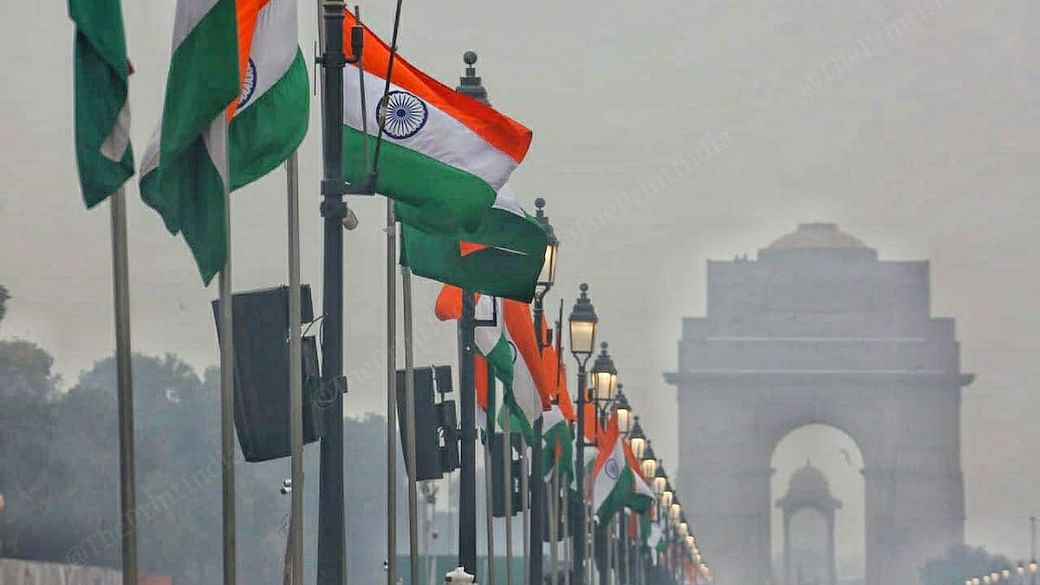
The question is why are these people giving up the Indian passport at a time when we are entering the ‘Amrit Kaal’, the nomenclature Narendra Modi government is using to define the period between India’s 75th Independence Day and the 100th in 2047? Don’t they love India and the Indian flag? Why are they opting to be adopted sons and daughters? 

The obvious reasons

One thing is for sure: this is not a push migration. Barring exceptions, the people who decided to move are highly educated, rich and privileged. They are not making this choice because they are persecuted, or there is famine or civil war in India.

According to a report of by the London-based global citizenship and residence advisory Henley & Partners (H&P), around 8,000 High Networth Individuals or HNIs will leave India this year. And this is the exodus of the rich and educated.

There are some obvious explanations for the rich and endowed Indians, who benefited most from the Indian democracy, to be giving up citizenship. The most common explanation is that the grass is greener on the other side. Pursuit of economic gains can be a big reason for such decisions. Quality of life is also better in the West and pollution is less menacing.

Another possible reason is that, in countries like the UAE and Singapore, individual tax rates are lower than India.

When the Modi government decided to crack down on black money and tax evaders, many Indians had applied this trick — let family members remain abroad for 182 or more days. This, by rule, made them “non-residents” with foreign accounts and businesses, which could be used by family members to stash money.

Affirmative action policies in India are also blamed for the exodus of Indians and that gives a hint that which social group is mostly migrating. The Economist has written in one of its commentaries that the Brahmins are forced to leave the country because of affirmative-action policies in India. Though this argument doesn’t hold good because affirmative action is only for the government jobs, which constitutes a miniscule percentage of the entire job market. In high-paying jobs, that percentage is further reduced.

Many may also be converting their H1B visas because India doesn’t allow dual citizenship.

Having the ‘means’ to an ‘end’

My explanation for this exodus from the status of being an Indian citizen is twofold. One, successful Indians already have strong secessionist tendencies and two, they leave because only such people have means to leave.

If we check the urban elite spaces, we can easily see those secessionist tendencies of the rich. Their colonies or apartments have their own security systems, reverse osmosis water supply, private power generator sets, and even private recreational spaces. These colonies, in a way, function as separate micro nations. Their interaction with the State is manifested only when some crime or calamity happens. Most of these colonies are gated communities and RWAs are like a government there. In many metropolitan towns, RWAs in elite colonies erect gates at public roads and limit access to public parks and other government facilities.

In this case, there is a class in India that has actually become “independent” or “autonomous.” This class almost never uses government hospitals or educational facilities. It’s a big problem that they have to breathe the same air, but air purifiers have solved this problem also. Covid-19 proved to be a leveller when the elites were forced to share these spaces with the underclass, but that is one of exceptions. Under normal circumstances, there is a separate private infrastructure to cater to their requirements. This class goes abroad to spend holidays. This class sends their kids to the schools affiliated to international boards. Global citizenship and global village is not some distant idea or concept for them. There are people in India who live these concepts and migrate at the first opportunity.

Being part of this group is not at all bad. The fact is that the underclass aspires to enter these spaces not as trespassers but as legitimate members. Rich people are their role models. I am of the view that this aspiration is good and brings hope. ‘Satisfaction’ or ‘contentment’ is the word I hate. Only problem is that the Nehruvian Model of socialism never facilitated such transitions for the masses. Because of the extremely slow growth of the Indian economy in the formative decades of the nation, socialism became a model to distribute poverty. There was, in fact, not much to trickle down. The entrepreneurial potential of the nation was curbed.

I am not blaming any person for that economic catastrophe. Early years after Independence were tumultuous and the decision makers must be keeping many factors while making economic decisions. But we must admit that the State socialism model failed to produce a big middle class. Rather, large masses remained poor and lacked capacity to uplift their life. In rural India, by and large, the feudal structure continued. As contribution of agriculture in the GDP declined and population load on the agrarian economy did not reduce substantially, rural prosperity remained elusive for a large swath of masses. Despite change in course in economic policy in the 1990s, the size of Indian middle class continued to remain small. This should be a matter of utmost concern for the present policy makers. Increase in the size of the middle class is important as this will democratise the process of migration. This is an opportunity which should be available to one and all.

This brings us to the second question.

As granting citizenship in the western world, especially in the top-5 destinations for Indians, has been tightened over the years, one must have a certain financial and educational threshold to migrate to these countries. That threshold itself will put this group in the top one per cent of the Indian population. Especially, in the US, which accounts for almost 50 per cent of Indians migrating, H1B visa or other modes of long-term and permanent residency is mostly given to the highly skilled and highly paid individuals. This restriction acts as a barrier for most Indians to even think of migrating to that country.

In any case, as rich Indians are picking foreign passports and others are probably dreaming to renounce their Indian citizenship at the first opportunity, the sanctimoniousness of discourses like ‘national pride’ and ‘love for one’s own nation’ should be reframed.

With India integrating with the global economies, the national boundaries may blur more and more. Till then, the poor and underclass in India has to carry the burden of flag-waving nationalistic pride. Their role models are leaving.


Shapeshifter Liz Truss on a roll as version 3.0 hits Tory sweet spot

It’s exhausting, keeping up with her journey. It’s almost as if she doesn’t believe in anything at all writes John Crace in The Guardian


Listen to Liz Truss for long enough and she’ll tell you she’s been on a journey. The inexorable rise of a girl who went from a rough Leeds comprehensive to frontrunner for the next Conservative prime minister. Via a brief spell in the Lib Dems. We all make mistakes.

Examine the journey more carefully, though, and it begins to look even more remarkable. The human flotsam who just happens to be carried downstream to the doors of No 10. A journey without any ideas or purpose other than to adapt to her surroundings and rise to the top. The failures have been spectacular, yet also spectacularly successful. Each time, she emerges into a more powerful iteration. Samuel Beckett could only stand back and applaud. She is literally living his dream.

Take Version 1.0 of Radon Liz. She’s a gas, but she’s inert. This was back in the early days of David Cameron’s leadership. No one was more socially liberal than Truss. No one ever hugged a husky tighter. Or embraced austerity harder. As and when required.

This Liz was also an ardent remainer. I can remember meeting her in the spin room of a televised debate during the referendum campaign. She bent my ear at length about how Vote Leave was based on lies and that remain was going to win at a canter. No sweat. No bother. That was probably the first time I seriously entertained the idea that the UK was going to leave the EU. Her reward for failure was promotion.

Radon Liz 2.0 turned out to be a passionate leaver. Far more so than many people who had supported Brexit all along. It wasn’t that she now reckoned what was done was done, there was no going back and we just had to make the best of it. It was that remaining in the EU was wrong. A thought crime. A mortal sin. This was the Truss who draped herself in the union jack for photographs at every available opportunity. Who was never happier than when cosplaying Margaret Thatcher in a tank. While the economy also tanked. This version was also rewarded with ever more governmental baubles.

The newest version, Liz 3.0, is almost incomprehensible. She has slid so far through the looking-glass to the Tory right that in some parallel universes she appears to have adopted Marxist economics. Dialectics has never been so confusing. She both reveres Boris Johnson’s memory, saying she wouldn’t have changed a thing, yet trashes the record of the government. Her prescription for getting the economy back on track is to reverse the national insurance hikes and to cut personal and corporation tax. How she would do this, she hasn’t said. Right now it’s enough just to talk in riddles.

It is exhausting, though. To keep up with Radon Liz’s journey, you have to be able to run fast. She is the anti-ideologue. The anti-conviction politician. Not so much a set of ideas looking for their natural home as vaulting ambition in search of some ideas. Any ideas. If you don’t like hers, she’s got some others.

Because here’s the thing. Truss is a tabula rasa – a dodgy 1980s computer with a screen that is permanently buffering. Someone capable of reinventing herself almost at will. And it just so happens that every time she needs some new ideas, she comes up with a set that exactly mirrors those that are needed to enable her to rise still higher in the Tory party. It’s one hell of a coincidence. Imagine one person having that much luck. It’s almost as if she doesn’t believe in anything at all. The ultimate shapeshifter. “Tonight, Matthew, I will be whatever you want me to be.”

For reasons not entirely clear to anyone, Truss has struck paydirt with version 3.0. It’s all but a certainty that her journey is now complete. No one is yet calling the next seven weeks a pointless extended coronation, but we’re not far off that point. Radon Liz’s latest incarnation has hit the Tory members’ sweet spot. Partly by not being Rish! – there are plenty who will never forgive him for betraying the Convict – but mainly by telling them what they want to hear.

Were she a bit brighter, she too would be amazed that so many people could forget that Rish! didn’t increase public borrowing and increase taxes because he’s a socialist. He did so because the country was falling apart in a pandemic. But when you’re on a roll, you’re on a roll. And Liz is living her best life as the prime minister in waiting. So much so that she’s almost relaxed. As relaxed as AI gets.

Her interview with Nick Robinson on the Today programme passed off with few alarms. She even found her way into the building and navigated her way out without having to call security. A vast improvement on her launch event the previous week. And she even managed to talk the usual bollocks without sounding too robotic. Close your eyes and you could almost imagine she was human.

She knew her plan for unfunded tax cuts wasn’t inflationary because Patrick Minford had told her so. This was the economist who had forecast that Brexit would increase GDP by 7% and that food prices would fall. Bring on the Nobel prize.

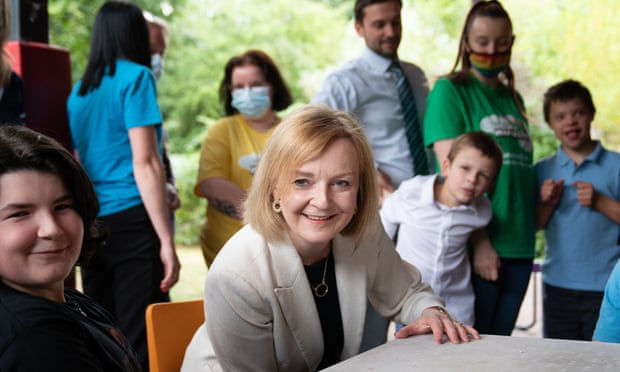
Later on Thursday afternoon, Radon Liz was at Little Miracles, a charity for children with life-limiting and other disabilities, and looked quite at ease. She must have made countless visits like this as a constituency MP. She chatted to the kids for a while about the hassle of being followed around by the media. She looked pointedly at the collection of sketch writers. But there was kindness and laughter in her eyes. She can at least see the absurdity of someone like her becoming prime minister. And she does believe in a free press. Unlike Rish!.

Truss then moved on to the parents and listened as they shared their experiences. Afterwards, I asked two of them, Wendy and Brian – neither Tory voters – what they thought. Nice enough, they said. Though the proof would be in the delivery. If Truss were to spend proper money on social services, that would be a first.

By then Radon Liz had moved on. Just time to say she was all in favour of a new royal yacht, provided it was funded by Tesco, and that she was Labour’s worst nightmare. Wet dream more like. But she’s entitled to her delusions. And with that she was off. Job done. It had been the quintessential Liz experience. Charmingly superficial. Little Miracles would still be short of funds and the parents would still struggle to get the services their children needed. But more importantly, Truss would be in Downing Street. She left as she came. Without a trace. On brand to the last.