Search This Blog

Friday, 22 July 2022

Shapeshifter Liz Truss on a roll as version 3.0 hits Tory sweet spot

It’s exhausting, keeping up with her journey. It’s almost as if she doesn’t believe in anything at all writes John Crace in The Guardian


Listen to Liz Truss for long enough and she’ll tell you she’s been on a journey. The inexorable rise of a girl who went from a rough Leeds comprehensive to frontrunner for the next Conservative prime minister. Via a brief spell in the Lib Dems. We all make mistakes.

Examine the journey more carefully, though, and it begins to look even more remarkable. The human flotsam who just happens to be carried downstream to the doors of No 10. A journey without any ideas or purpose other than to adapt to her surroundings and rise to the top. The failures have been spectacular, yet also spectacularly successful. Each time, she emerges into a more powerful iteration. Samuel Beckett could only stand back and applaud. She is literally living his dream.

Take Version 1.0 of Radon Liz. She’s a gas, but she’s inert. This was back in the early days of David Cameron’s leadership. No one was more socially liberal than Truss. No one ever hugged a husky tighter. Or embraced austerity harder. As and when required.

This Liz was also an ardent remainer. I can remember meeting her in the spin room of a televised debate during the referendum campaign. She bent my ear at length about how Vote Leave was based on lies and that remain was going to win at a canter. No sweat. No bother. That was probably the first time I seriously entertained the idea that the UK was going to leave the EU. Her reward for failure was promotion.

Radon Liz 2.0 turned out to be a passionate leaver. Far more so than many people who had supported Brexit all along. It wasn’t that she now reckoned what was done was done, there was no going back and we just had to make the best of it. It was that remaining in the EU was wrong. A thought crime. A mortal sin. This was the Truss who draped herself in the union jack for photographs at every available opportunity. Who was never happier than when cosplaying Margaret Thatcher in a tank. While the economy also tanked. This version was also rewarded with ever more governmental baubles.

The newest version, Liz 3.0, is almost incomprehensible. She has slid so far through the looking-glass to the Tory right that in some parallel universes she appears to have adopted Marxist economics. Dialectics has never been so confusing. She both reveres Boris Johnson’s memory, saying she wouldn’t have changed a thing, yet trashes the record of the government. Her prescription for getting the economy back on track is to reverse the national insurance hikes and to cut personal and corporation tax. How she would do this, she hasn’t said. Right now it’s enough just to talk in riddles.

It is exhausting, though. To keep up with Radon Liz’s journey, you have to be able to run fast. She is the anti-ideologue. The anti-conviction politician. Not so much a set of ideas looking for their natural home as vaulting ambition in search of some ideas. Any ideas. If you don’t like hers, she’s got some others.

Because here’s the thing. Truss is a tabula rasa – a dodgy 1980s computer with a screen that is permanently buffering. Someone capable of reinventing herself almost at will. And it just so happens that every time she needs some new ideas, she comes up with a set that exactly mirrors those that are needed to enable her to rise still higher in the Tory party. It’s one hell of a coincidence. Imagine one person having that much luck. It’s almost as if she doesn’t believe in anything at all. The ultimate shapeshifter. “Tonight, Matthew, I will be whatever you want me to be.”

For reasons not entirely clear to anyone, Truss has struck paydirt with version 3.0. It’s all but a certainty that her journey is now complete. No one is yet calling the next seven weeks a pointless extended coronation, but we’re not far off that point. Radon Liz’s latest incarnation has hit the Tory members’ sweet spot. Partly by not being Rish! – there are plenty who will never forgive him for betraying the Convict – but mainly by telling them what they want to hear.

Were she a bit brighter, she too would be amazed that so many people could forget that Rish! didn’t increase public borrowing and increase taxes because he’s a socialist. He did so because the country was falling apart in a pandemic. But when you’re on a roll, you’re on a roll. And Liz is living her best life as the prime minister in waiting. So much so that she’s almost relaxed. As relaxed as AI gets.

Her interview with Nick Robinson on the Today programme passed off with few alarms. She even found her way into the building and navigated her way out without having to call security. A vast improvement on her launch event the previous week. And she even managed to talk the usual bollocks without sounding too robotic. Close your eyes and you could almost imagine she was human.

She knew her plan for unfunded tax cuts wasn’t inflationary because Patrick Minford had told her so. This was the economist who had forecast that Brexit would increase GDP by 7% and that food prices would fall. Bring on the Nobel prize.

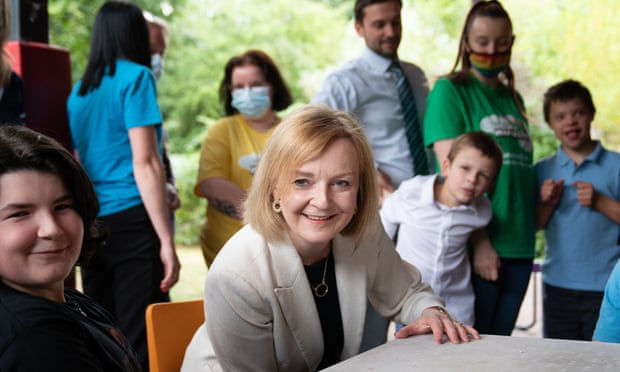
Later on Thursday afternoon, Radon Liz was at Little Miracles, a charity for children with life-limiting and other disabilities, and looked quite at ease. She must have made countless visits like this as a constituency MP. She chatted to the kids for a while about the hassle of being followed around by the media. She looked pointedly at the collection of sketch writers. But there was kindness and laughter in her eyes. She can at least see the absurdity of someone like her becoming prime minister. And she does believe in a free press. Unlike Rish!.

Truss then moved on to the parents and listened as they shared their experiences. Afterwards, I asked two of them, Wendy and Brian – neither Tory voters – what they thought. Nice enough, they said. Though the proof would be in the delivery. If Truss were to spend proper money on social services, that would be a first.

By then Radon Liz had moved on. Just time to say she was all in favour of a new royal yacht, provided it was funded by Tesco, and that she was Labour’s worst nightmare. Wet dream more like. But she’s entitled to her delusions. And with that she was off. Job done. It had been the quintessential Liz experience. Charmingly superficial. Little Miracles would still be short of funds and the parents would still struggle to get the services their children needed. But more importantly, Truss would be in Downing Street. She left as she came. Without a trace. On brand to the last.
Thursday, 21 July 2022

Scrutinising the Indian Parliament's Performance


The investment drought of the past two decades is catching up with us

Martin Sandbu in The FT


In all the talk of “building back better” and making economies “match fit”, “strategically autonomous” and “resilient”, there is an unstated but tragic premise. For decades, most advanced economies did not build their future but languished in an investment drought, the scandal of which is greater for being unacknowledged. 

Between 1970 and 1989, the share of gross domestic product devoted to investment by six of the world’s seven biggest economies averaged from 22.6 per cent for the US to 24.8 per cent for Germany. The seventh, Japan, was an outlier with 35 per cent. 

Of the G7, only Canada has sustained this level of investment: its 22.5 per cent in this millennium is barely down from 22.8 back then. All the others have only managed to match their 1970-89 investment levels in four instances: the US in the boom years of 2000 and 2005-06, and France in 2021. 

Yet these past 20 years have been the era of lower-than-ever financing costs, first because of market exuberance, then thanks to central banks’ ultra-lax monetary policy. And what do we have to show for all that cheap credit? Two lost decades for investment. As economics writer Annie Lowrey concisely puts it, “we blew it”. 

France and the US have invested nearly two percentage points of GDP less this century than they did in the 1970s and 1980s; Germany and Italy about 4.5 points less; the UK and Japan 6 and 10 percentage points less respectively. These are enormous numbers. The G7 account for about $45tn in annual GDP. Restoring their investment ratios could fill nearly half the global shortfall to the $4tn the International Energy Agency calls for in annual clean technology investment if we are to meet net zero by 2050. 

Those are total investment numbers, but a similar story holds for the public sector on its own. In the US, net government investment (after accounting for depreciation of the existing public capital stock) fell by almost two-thirds in the decade to 2014, when it dropped to 0.5 per cent of GDP. 

In the eurozone, net public investment went negative in the same year, thanks to extreme fiscal austerity in the eurozone periphery and chronic under-investment in Germany. 

Some will be tempted by claims that we need not worry. It is normal to invest less as you get richer — so one argument goes — because adding to an already large capital stock is increasingly useless. The cost of capital goods has fallen, so the same money buys you more real investment, goes another. A third is that the current economy needs intangible, not physical capital, and while this is harder to measure, countries seem to be doing better on that front. 

Yet such reassurances, even if factually true, are no use. No one who takes a close look at most western countries’ physical infrastructure can think it fit for purpose — not when that purpose expands to include decarbonising our industries and energy and transport systems. 

Why have we lived for so long off past investments and failed to make enough new ones? Financing costs have clearly not been the problem, with interest rates at record lows. (Crisis-hit eurozone countries in the sovereign debt crisis were the exception, but even Spain and Italy have out-invested Britain for decades.) 

More likely culprits are a lack of demand and cheap labour. Businesses that don’t expect enough demand to absorb expanded output have no reason to invest. And when they are permitted to treat workers as cheap and disposable, they may choose that over irreversible capital investments. This is why faster wage growth and the so-called “labour shortages” (really competition for workers) are something we should embrace if we are to prod businesses into productive investments. 

Something similar may have been true for cheap energy in Europe. The 2010s were a time of unusually low-cost natural gas and hence electricity. This may have undermined the urgency of investing in both greater renewable generation and geopolitically safe natural gas developments. Oil prices, too, were low for much of the decade. 

But underneath these economic factors, I think our failure to invest is profoundly political. Raising the investment-to-GDP ratio, whether through boosts to private or public investment, or both, means that a smaller ratio of GDP is left over for consumption. Even if this prepares a better future, it can feel like a measlier existence today. And that is something a generation of politicians across the rich world have been afraid to inflict on their voters. 

That is true in good times, when transfer payments, tax cuts and immediate public goods are all politically more attractive than capital investment. (Something equivalent is at work in the private sector: witness companies’ choice to return cash to owners through share buybacks rather than invest in their own growth.) It has also been true in bad times, when investment is the easiest expenditure for belt-tightening governments and companies to cut. 

European countries have come to rue how they used the “peace dividend” of 1989 to cut defence spending. The same moment pushed the west as a whole to forget the broader idea of short-term sacrifice for a more prosperous future. But this is not inevitable, as exceptions such as Canada and the Nordics’ sustained investment show. Western voters and governments have both unlearned the virtue of delayed gratification. They have to relearn it, and fast.

Wednesday, 20 July 2022

Message from Sri Lanka

Jawed Naqvi in The Dawn

ONE can see a few instructive lessons from the painful turbulence underway in Sri Lanka. The most crucial of these for neighbours and beyond is the resounding message that there are limits to socially divisive policies any government or state can pursue, particularly to mask the distress brought about by bad economic prescriptions. In other words, sooner or later people catch on.

The jostling is already on between narratives about the crisis. The dominant narrative about an economic collapse as the trigger for mass protests is a tautology. Another perspective, inevitably, is focusing on the ousted Rajapaksa government’s refusal to vote with the US against Russia over Ukraine. The last-minute call to Vladimir Putin for help, chiefly with oil, will be interpreted in myriad ways.

There will be comments also about the need for the IMF to fix things urgently. The problem is this had happened to India when the Gulf War induced economic instability with oil prices nudging a veteran pro-Soviet India into becoming a darling of the West. The prescription the IMF gave Manmohan Singh required secrecy. It had to be kept away from parliamentary scrutiny. The Ayodhya movement of L.K. Advani was activated to occupy the nation’s attention, away from the IMF-induced pain that inevitably comes with its trickle-down economic advisory.

Be that as it may, Ranil Wickremesinghe looks the man of the moment for the US. Never mind that he lost the last election when his party couldn’t win a single seat. He came into parliament through the backdoor, the national list.

Would that work for the purpose of evicting China from its perch in Colombo? If the Western purpose falters, there could be worse awaiting the hapless country. So, here we are. The president who courted China’s economic worldview and refused to vote against Russia has fled. (Remember Kyiv in 2014?) And Wickremesinghe, nephew of Sri Lanka’s first pro-US president J.R. Jayewardene, has taken charge, and is threatening to quell the protests by force if necessary.

There’s always a backup script if things go wrong. The ousted president was a close ally of the Bodu Bala Sena. The Sinhalese chauvinist group has cast itself in the image of India’s RSS, a Muslim and Christian-hating Buddhist clone of the Hindutva order. Other similarities between India and Sri Lanka are eerier. Remember how prime minister Solomon Bandaranaike was assassinated by a Buddhist monk angered by his quest for a friendly pact with the minority Tamils? The murder bore an uncanny resemblance to Gandhi’s assassination by Hindu supremacists hostile to his alleged appeasement of Muslims. 

Certain things about Sri Lanka’s heart-wrenching mess one can do little about, among them being the fact that Covid-19 waylaid the tourism industry, the island nation’s economic backbone. Small-scale entrepreneurs, critically the garment exporters, took a hit. The resultant cap on foreign imports coupled with an outlandish nationwide move to switch to organic farming, (mainly to mask the slashing of fertiliser imports) wrecked the prospects of an early recovery from pandemic-induced setbacks. The horror could strike Sri Lanka whose human development indices are far ahead of its neighbours.

Decades before Gen Musharraf sealed his military support against the Tamil Tigers, India and Sri Lanka bonded as close friends. Former president Chandrika Kumaratunga particularly treasures an old picture of Nehru hoisting her in the air. Later Indira Gandhi stopped Sirimavo Bandaranaike from quitting during a Sinhalese communist insurrection in 1971, the year Mrs Gandhi would go to war with Pakistan. “Indu called me to say under no circumstances was I to resign.” The Janatha Vimukthi Peramuna insurrection would have rattled any government. It was the first of two unsuccessful armed revolts conducted by the communist group against the socialist United Front Government of Sri Lanka. The revolt lasted two months before Indian troops helped quell it.

I met Mrs Bandarnaike when she was in the wheelchair with paralysed toes. It was a peep into the India-Sri Lanka backstage. Her son Anura Bandaranaike was a devotee of India’s healer-guru Sai Baba of Pattapurthi. On his advice, the mother flew to Puttaparthi. The Sai Baba promised quick recovery but it was a tall claim. The Buddhist press was up in arms over the leader of their country falling prey to the ‘mumbo jumbo’ of an Indian guru.

It didn’t help that India was firmly in the Soviet camp while its neighbours had cosy ties with China and the US, both allies against Moscow. Pakistan, Bangladesh, Nepal and Sri Lanka led the movement for Saarc, the South Asian club that met in Dhaka for the first summit in 1985. Gen Ershad, its host, would later tell me that it was a collective effort by India’s neighbours to deal with Delhi jointly. “We were allergic to India,” Ershad told me bluntly in a TV interview. “So we decided to deal with India jointly.”

Sri Lanka is in a serious quandary today and does not have the emotional wherewithal to deal with the IMF’s conditionality that always comes. The protesters represent Sri Lanka’s multicultural bouquet. There’s just no room for dividing them again. Nor is there stomach for more IMF pills.

Palitha Kohona, Sri Lanka’s ambassador in Beijing shared the fears with the Global Times. The patience is running thin.

“In some cases, it’s difficult because the belt is already on the last notch. Sri Lanka has a state-funded healthcare system from birth to death. Some are worried that the IMF might recommend that we tighten the healthcare system. Our education system is also free from grade one to university level. This might be another area that the IMF might recommend pruning. But these may add to the unrest, which is already hampering the recovery of the country and unsettle any government, which takes over in the next few weeks. We have to deal with these issues, and it’s not going to be easy for Sri Lanka.”

Monday, 18 July 2022

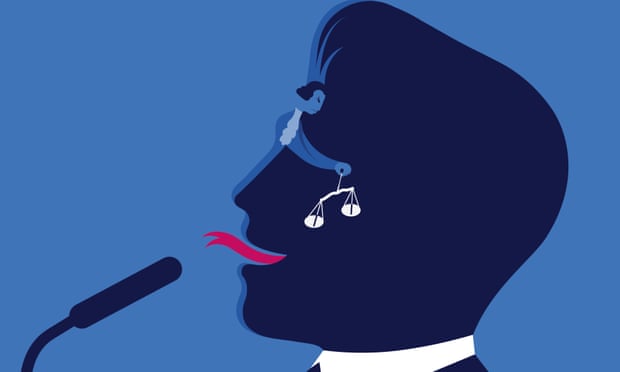
Should we have a ‘truth law’?

Today’s politicians mislead with impunity – could we legislate to stop them lying? asks Sam Fowles in The Guardian


For months the British government has floated the idea of unilaterally breaking the so-called Northern Ireland protocol, part of the withdrawal treaty it agreed with the European Union. That would undermine the Good Friday agreement, reanimate the prospect of sectarian violence and damage the UK’s international reputation. Such action demands a weighty justification and ministers have one, with the attorney general arguing that “Northern Ireland’s economy is lagging behind the rest of the UK”.

Except it’s not. Statistics show that Northern Ireland is outstripping every part of the UK except London.

In recent years politicians have repeatedly based the case for historic changes on lies. These have ranged from the infamous “Brexit bus”, which promised £350m a week for the NHS, to government framing of recent rail strikes as “selfish” because, as Boris Johnson told one interviewer: “Train drivers are on £59,000 and some are on £70,000.” (The average wage of a striker is below £36,000.) Politicians consistently mislead about issues of national importance. I know this first-hand – I was part of the legal team that proved Johnson’s prorogation of parliament in 2019 was unlawful.

Truth is democracy’s most important moral value. We work out our direction, as a society, through public discourse. Power and wealth confer an advantage in this: the more people you can reach (by virtue of enjoying easy access to the media, or even controlling sections of it), the more likely you are to bring others round to your point of view. The rich and powerful may be able to reach more people but, if their arguments are required to conform to reality, we can at least hold them to account. Truth is a great leveller.

The problem is that our public discourse has become increasingly divorced from reality. The pollster Ipsos Mori conducts regular surveys on what the British public believes about the facts behind frequently discussed issues. In one memorable study it discovered that, in the words of one headline, “the British public is wrong about nearly everything”. Among the concerns was benefit fraud: people surveyed estimated that around £24 of every £100 of benefits was fraudulently claimed, whereas the actual figure was 70p. When asked about immigration, people estimated that 31% of the population were born outside the UK, when in truth it was 13%.

Members of parliament have played a prominent role in getting us to this point. They make and vote on laws, help set the political agenda and influence the national conversation. Of course, politicians have always had a tendentious relationship with the truth. From the Zinoviev letter to the Profumo affair, history is littered with scandals that result from lies being exposed. Profumo resigned because he misled parliament once. Today’s ministers regularly do the same with impunity.

Commentators often paint Johnson as uniquely mendacious, but he is merely the latest prime minister to embrace lying for political gain. David Cameron won two elections by misleading the country about the causes of the financial crash and the economic impacts of austerity. Theresa May built her early career in government on dubious anti-immigration rhetoric, notably the lie that one immigrant had been allowed to stay in the country because he had a pet cat.

Democracy cannot function properly in this environment and an existential problem demands a radical solution. So, MPs (and peers in the House of Lords) should be formally required to tell the truth: in the debating chamber, on TV, in print and on social media. To publish a statement that wilfully or negligently misrepresents information should be classed as misconduct in public office (a criminal offence). In other words: we need a truth law.

Ensuring the offence captures both “wilful” and “negligent” misrepresentation will obviate spurious defences such as Johnson’s claim that he thought the Downing Street parties were “work events”. With researchers and civil servants at their disposal, parliamentarians have no excuse for misrepresenting the facts. Even so, I suggest that they should not be prosecuted if they correct the record and apologise in parliament within seven days.

Radical as it may seem, we already have all the tools to make this work within established law. “Publish” has a clear legal meaning (essentially “to make public”). Tests of wilfulness or negligence are frequently applied across civil and criminal law. Determining whether someone has “misrepresented information” (ie, not told the truth) is often the core business of the courts. The penalty for misconduct can go all the way up to life imprisonment. While some may find that rather satisfying, I suggest limiting it, in this class of cases, to a fine. The courts should also have the power to refer an offender to the Standards Committee for further parliamentary sanction. 

I imagine that there will be two main objections to this idea. First, it may have a chilling effect on parliamentarians’ free expression. But parliamentarians are not ordinary citizens. They hold a special position of trust and power, which they assume voluntarily, and for which they are rewarded handsomely. It’s right that that they should be subject to stricter rules. Many professions limit the freedom of expression of their members in the public interest. As a barrister I am subject to “truth telling” rules which, if breached, could end my career (and potentially lead to a prosecution for contempt of court). Politicians’ words have more influence than barristers’, so it’s fair to subject them to more exacting standards.

Second, any truth law would breach “parliamentary privilege”. This guarantees that MPs will not be prosecuted for anything they say in parliament. That rule was developed to stop monarchs persecuting their political opponents. It was never intended to be a licence to lie. We now have an independent prosecution authority and independent courts: it’s time we addressed today’s challenges to democracy, not ones that were last relevant centuries ago.

My proposal won’t eradicate lying in public life. But it’s an important first step. Imagine, for a moment, that we could genuinely trust our elected representatives. That shouldn’t be a utopian ideal – and in the law, we have the means to make it a reality.

Sunday, 17 July 2022

The US’s selfish war on inflation will tip the world into recession

Phillip Inman in The Guardian


As the Fed raises interest rates, dollar-denominated loans become an unsustainable burden to states around the globe

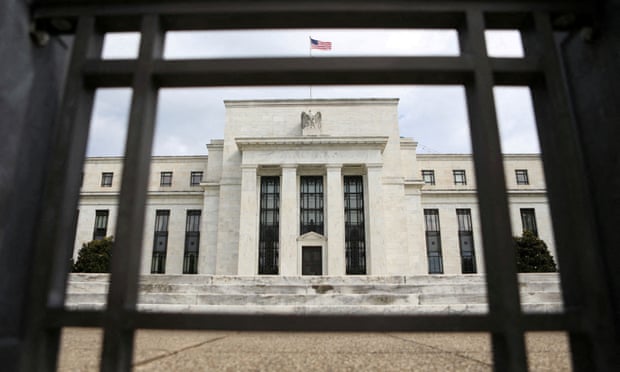
The Federal Reserve is planning a second interest rate rise in a year this month. Photograph: Chris Wattie/Reuters 


Later in July US interest rates are expected to jump for a second time this year, and that’s going to wreck any chance of a global recovery.

The Federal Reserve could push its base rate up by as much as a full percentage point, ending 15 years of ultra-cheap money, intended to promote growth.

This jump, to a range of 2.5%-2.75%, would take the cost of borrowing money in the US to more than double the Bank of England’s 1.25%. And yet the Fed could just be taking a breather as it contemplates even higher rates.

This column, though, is not about the US. It is concerned with the terrible impact on Britain and countries across the world of America’s selfish disregard when it decides to tackle high inflation with higher borrowing costs. Britain is already feeling the effects of the Fed’s pledge to tackle inflation until it is “defeated”, come what may.

Higher interest rates in the US make it a more attractive place for investors to store their money. To take full advantage, investors must sell their own currency and buy dollars, sending the price of dollars rocketing higher.

In July the US dollar increased in value against a basket of six major currencies to a 20-year high. The euro has slipped below parity with the dollar in the last few days. The pound, which has plunged by more than 10% this year to below $1.20, is losing value with every week that passes.

In Japan, the central bank has come under huge pressure to act after the yen tumbled to its lowest level against the dollar since 1998.

There are two important knock-on effects for those of us that live and work outside the US.

The first is that goods and raw material priced in dollars are much more expensive. And most commodities are priced in dollars, including oil.

Borrowing in dollars also becomes more expensive. And while getting a loan from a US bank is beyond the average British household, companies do it all the time, and especially those in emerging economies, where funds in their backyard can be in short supply.

The Bank of England interest-rate setter Catherine Mann recently said that her main motivation for wanting significant increases in the UK’s lending rates was her fear that the widening gap with the dollar was pushing up import prices. And higher import prices meant higher inflation.

If only she could persuade her colleagues on the Bank’s monetary policy committee that the devaluation of the pound was a serious issue, maybe they would push up the Bank’s base rate in line with the Fed rate increases. After the Fed makes its move, more may join her.

Until January this year, Britain’s inflation surge was on course to be short-lived. Now it seems the Russian invasion of Ukraine and a splurge of untargeted handouts by the Biden administration during the pandemic, which have served to push up prices in America, will keep inflation in the UK high into next year. 

Those governments that have borrowed in dollars face a double whammy. Not only will they need to raise domestic interest rates to limit the impact of import price rises, they will also face a massive jump in interest payments on their dollar borrowings.

Emerging markets and many developing-world countries will be broke when these extra costs are combined with a loss of tourism from the Covid pandemic. Sri Lanka has already gone bust and many more could follow.

For the past three decades, western banks have marketed low-cost loans across the developing world as a route to financial freedom.

Zambia’s government borrowed heavily before the pandemic to become self-sufficient in electricity. It is a laudable aim, but has left the central African state with a ratio of debt to national income (GDP) much the same as France’s – about 110%.

The problem for Zambia is not the same as for France, which pays an interest rate of 1.8% to finance its debts, measured by the yield on its 10-year bonds. The Zambian 10-year bond commands a rate of 27%. Now Zambia, like France and so many other countries, must borrow simply to live. To invest is to borrow more.

There is no sign that the US will change course. Joe Biden is in a panic about the midterm elections, when fears of spiralling inflation could favour the Republicans. This panic has spilled over to the Fed, which has adopted hysterical language to persuade consumers and businesses that higher rates are coming down the track and to curb their spending accordingly.

The Fed knows inflation is a problem born of insufficient supply that only governments can tackle. But that doesn’t look like stopping it from pushing the US economy, and everyone else’s, into recession.