Search This Blog

Sunday, 26 June 2022

A wave of unrest is coming

Soaring food and fuel prices are adding to pre-existing grievances writes The Economist


Jesus said that man does not live by bread alone. Nonetheless, its scarcity makes people furious. The last time the world suffered a food-price shock like today’s, it helped set off the Arab spring, a wave of uprisings that ousted four presidents and led to horrific civil wars in Syria and Libya. Unfortunately, Vladimir Putin’s invasion of Ukraine has upended the markets for grain and energy once again. And so unrest is inevitable this year, too. 

Soaring food and fuel prices are the most excruciating form of inflation. If the prices of furniture or smartphones rise, people can delay a purchase or forgo it. But they cannot stop eating. Likewise, transport costs are baked into every physical good, and most people cannot easily walk to work. So when food and fuel grow dearer, standards of living tend to fall abruptly. The pain is most intense for city dwellers in poor countries, who spend a huge part of their income on bread and bus fares. Unlike rural folk, they cannot grow their own crops—but they can riot.

Many governments want to ease the pain, but are indebted and short of cash after covid-19. The average poor country’s public debt-to-gdp ratio is nearly 70% and it is climbing. Poor countries also pay higher interest rates, which are rising. Some of them will find this unsustainable. The imf says that 41 are in “debt distress” or at high risk of it.

Sri Lanka has already defaulted and melted down. Angry and hungry mobs have set fire to vehicles, invaded government buildings and spurred their reviled president into pushing out the prime minister, who is his brother. Riots have erupted in Peru over living standards, and India over a plan to cut some jobs-for-life in the army, which rankles when so many yearn for security. Pakistan is urging its citizens to drink less tea to save hard currency. Laos is on the brink of default. Anger at the cost of living doubtless contributed to Colombia’s election of a left-wing radical as president on June 19th.

The Economist has built a statistical model to examine the relationship between food- and fuel-price inflation and political unrest. It reveals that both have historically been good predictors of mass protests, riots and political violence. If our model’s findings continue to hold true, many countries can expect to see a doubling of unrest this year .

The greatest risk is in places that were already precarious: countries such as Jordan and Egypt that depend on food and fuel imports and have rickety public finances. Many such places are badly or oppressively governed. In Turkey the supply shock has accelerated ruinous inflation caused by dotty monetary policy. Around the world, the cost-of-living squeeze is adding to people’s grievances and raising the chance that they will take to the streets. This is more likely to turn violent in places with lots of underemployed, single young men. As their purchasing power falls, many will conclude that they will never be able to afford to marry and have a family. Frustrated and humiliated, some will feel they have nothing to lose if they join a riot.

Another way inflation destabilises societies is by fostering graft. When wages do not keep up with prices, officials with needy relatives find it even more tempting to extort money from the powerless. This infuriates those who are preyed on. Recall that the trigger for the Arab spring was the suicide of a Tunisian hawker, who set himself ablaze to protest against constant demands for pay-offs from dirty cops.

If unrest spreads this year, it could add to the economic pain. Investors dislike riots and revolutions. One study finds that a big outbreak of political violence typically knocks a percentage point off gdp 18 months later. The damage is worse when protesters are angry about both politics and the economy combined.

Averting the coming explosions will be hard. A good start would be to scrap policies that discourage food production, such as price controls and export curbs. Farmers in countries like Tunisia leave fertile land unploughed because they have to sell their crop to the state for a pittance. Governments should let farmers reap what they sow. Also, far less grain should be wastefully burned as biofuel.

Several countries are asking for bail-outs. International financial institutions must strike a tricky balance. Saying no could spell chaos—and do lasting harm. But so could bailing out woeful governments, by entrenching bad and unsustainable policies. Bodies such as the imf, whose negotiators arrived in Sri Lanka and Tunisia this week, should be generous but insist on reforms. They should continue to monitor carefully how their money is spent. And they should act swiftly. The longer all this anger is allowed to fester, the more likely it is to explode.
Time to Finish Off Pakistan


SC: The Gujarat Govt not responsible for 2002 riots


Sampat Saral


Saturday, 25 June 2022

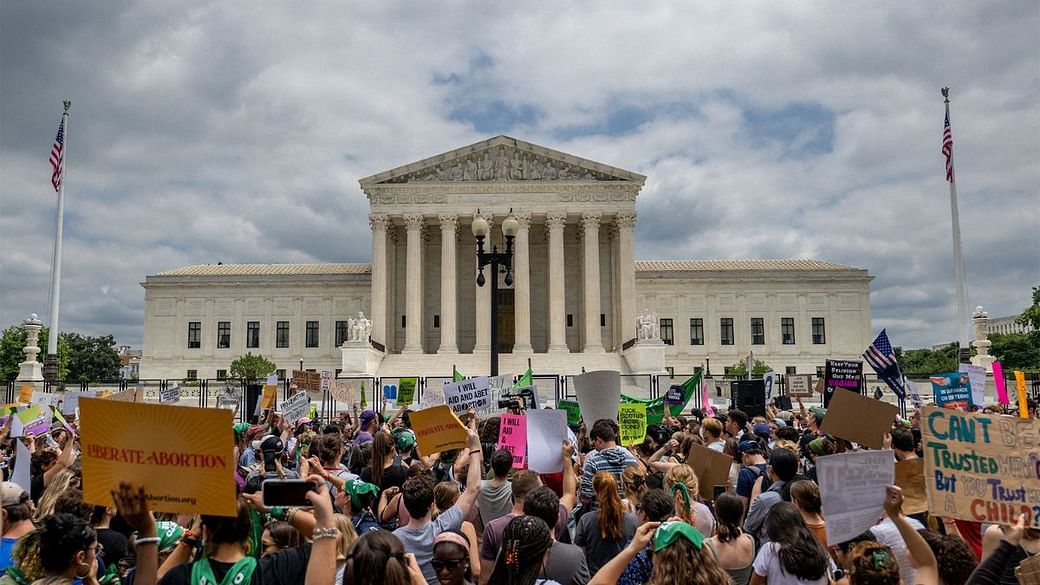
Everything you need to know about US Supreme Court’s abortion decision

LINDA C. MCCLAIN and NICOLE HUBERFELD in The Print 


After half a century, Americans’ constitutional right to get an abortion has been overturned by the Supreme Court.

The ruling in Dobbs v. Jackson Women’s Health Organization – handed down on June 24, 2022 – has far-reaching consequences. The Conversation asked Nicole Huberfeld and Linda C. McClain, health law and constitutional law experts at Boston University, to explain what just happened, and what happens next.

 
What did the Supreme Court rule?

The Supreme Court decided by a 6-3 majority to uphold Mississippi’s ban on abortion after 15 weeks of pregnancy. In doing so, the justices overturned two key decisions protecting access to abortion: 1973’s Roe v. Wade and Planned Parenthood v. Casey, decided in 1992.

The court’s opinion, written by Justice Samuel Alito, said that the Constitution does not mention abortion. Nor does the Constitution guarantee abortion rights via another right, the right to liberty.

The opinion rejected Roe’s and Casey’s argument that the constitutional right to liberty included an individual’s right to privacy in choosing to have an abortion, in the same way that it protects other decisions concerning intimate sexual conduct, such as contraception and marriage. According to the opinion, abortion is “fundamentally different” because it destroys fetal life.

The court’s narrow approach to the concept of constitutional liberty is at odds with the broader position it took in the earlier Casey ruling, as well as in a landmark marriage equality case, 2015’s Obergefell v. Hodges. But the majority said that nothing in their opinion should affect the right of same-sex couples to marry.

Alito’s opinion also rejected the legal principle of “stare decisis,” or adhering to precedent. Supporters of the right to abortion argue that the Casey and Roe rulings should have been left in place as, in the words of the Casey ruling, reproductive rights allow women to “participate equally in the economic and social life of the Nation.”

The ruling does not mean that abortion is banned throughout the U.S. Rather, arguments about the legality of abortion will now play out in state legislatures, where, Alito noted, women “are not without electoral or political power.”

States will be allowed to regulate or prohibit abortion subject only to what is known as “rational basis” review – this is a weaker standard than Casey’s “undue burden” test. Under Casey’s undue burden test, states were prevented from enacting restrictions that placed substantial obstacles in the path of those seeking abortion. Now, abortion bans will be presumed to be legal as long as there is a “rational basis” for the legislature to believe the law serves legitimate state interests.

In a strenuous dissent, Justices Stephen Breyer, Elena Kagan and Sonia Sotomayor faulted the court’s narrow approach to liberty and challenged its disregard both for stare decisis and for the impact of overruling Roe and Casey on the lives of women in the United States. The dissenters said the impact of the decision would be “the curtailment of women’s rights, and of their status as free and equal citizens.” They also expressed deep concern over the ruling’s effect on poor women’s ability to access abortion services in the U.S.

Where does this decision fit into the history of reproductive rights in the US?

This is a huge moment. The court’s ruling has done what reproductive rights advocates feared for decades: It has taken away the constitutional right to privacy that protected access to abortion.

This decision was decades in the making. Thirty years ago when Casey was being argued, many legal experts thought the court was poised to overrule Roe. Then, the court had eight justices appointed by Republican presidents, several of whom indicated readiness to overrule in dissenting opinions.

Instead, Republican appointees Anthony Kennedy, Sandra Day O’Connor and David Souter upheld Roe. They revised its framework to allow more state regulation throughout pregnancy and weakened the test for evaluating those laws. Under Roe’s “strict scrutiny” test, any restriction on the right to privacy to access an abortion had to be “narrowly tailored” to further a “compelling” state interest. But Casey’s “undue burden” test gave states wider latitude to regulate abortion.

Even before the Casey decision, abortion opponents in Congress had restricted access for poor women and members of the military greatly by limiting the use of federal funds to pay for abortion services.

In recent years, states have adopted numerous restrictions on abortion that would not have survived Roe’s tougher “strict scrutiny” test. Even so, many state restrictions have been struck down in federal courts under the undue burden test, including bans on abortions prior to fetal viability and so-called “TRAP” – targeted regulation of abortion provider – laws that made it harder to keep clinics open.

President Donald Trump’s pledge to appoint “pro-life” justices to federal courts – and his appointment of three conservative Supreme Court justices – finally made possible the goal of opponents of legal abortion: overruling Roe and Casey.

What happens next?

Even before Dobbs, the ability to access abortion was limited by a patchwork of laws across the United States. Republican states have more restrictive laws than Democratic ones, with people living in the Midwest and South subject to the strongest limits.

Thirteen states have so-called “trigger laws,” which greatly restrict access to abortion. These will soon go into effect now that the Supreme Court has overturned Roe and Casey, requiring only state attorney general certification or other action by a state official.

Nine states have pre-Roe laws never taken off the books that significantly restrict or ban access to abortion. Altogether, nearly half of states will restrict access to abortion through a variety of measures like banning abortion from six weeks of pregnancy – before many women know they are pregnant – and limiting the reasons abortions may be obtained, such as forbidding abortion in the case of fetal anomalies.

Meanwhile, 16 states and the District of Columbia protect access to abortion in a variety of ways, such as state statutes, constitutional amendments or state Supreme Court decisions.

None of the states that limit abortion access currently criminalize the pregnant person’s action. Rather, they threaten health care providers with civil or criminal actions, including loss of their license to practice medicine.

Some states are creating “safe havens” where people can travel to access an abortion legally. People have already been traveling to states like Massachusetts from highly restrictive states.

The court’s decision may drive federal action, too.

The House of Representatives passed the Women’s Health Protection Act, which protects health care providers and pregnant people seeking abortion, but Senate Republicans have blocked the bill from coming up for a vote. Congress could also reconsider providing limited Medicaid payment for abortion, but such federal legislation also seems unlikely to succeed.

President Joe Biden could use executive power to instruct federal agencies to review existing regulations to ensure that access to abortion continues to occur in as many places as possible. Congressional Republicans could test the water on nationwide abortion bans. While such efforts are likely to fail, these efforts could cause confusion for people who are already vulnerable.

What does this mean for people in America seeking an abortion?

Unintended pregnancies and abortions are more common among poor women and women of color, both in the U.S. and around the world.

Research shows that people have abortions whether lawful or not, but in nations where access to abortion is limited or outlawed, women are more likely to suffer negative health outcomes, such as infection, excessive bleeding and uterine perforation. Those who must carry a pregnancy to full term are more likely to suffer pregnancy-related deaths.

The state-by-state access to abortion resulting from this decision means many people will have to travel farther to obtain an abortion. And distance will mean fewer people will get abortions, especially lower-income women – a fact the Supreme Court itself recognized in 2016.

But since 2020, medication abortion – a two-pill regimen of mifepristone and misoprostol – has been the most common method of ending pregnancy in the U.S. The coronavirus pandemic accelerated this shift, as it drove the Food and Drug Administration to make medication abortions more available by allowing doctors to prescribe the pills through telemedicine and permitting medication to be mailed without in-person consultation.

Many states that restrict access to abortion also are trying to prevent medication abortion. But stopping telehealth providers from mailing pills will be a challenge. Further, because the FDA approved this regimen, states will be contradicting federal law, setting up conflict that may lead to more litigation.

The Supreme Court’s rolling back a right that has been recognized for 50 years puts the U.S. in the minority of nations, most of which are moving toward liberalization. Nevertheless, even though abortion is seen by many as essential health care, the cultural fight will surely continue.

''Our independence was accelerated due to World War-2's toll on UK': Shashi Tharoor Full Conversation


Friday, 24 June 2022

Stunted imagination - Is there no alternative to Pakistan joining the IMF program?

Aasim Sajjad Akhtar in The Dawn

FOR weeks extending into months, Pakistan’s intellectual and political mainstream has insisted that there is no option but to revive the IMF loan programme. The frank admission made by members of the treasury benches in parliament that this is an ‘IMF budget’ that the country had to take on simply confirms what is purportedly unchallenged common sense: there is no alternative (TINA).

The acronym TINA came into widespread circulation in the late 1990s when virtually one-size-fits-all IMF- and World Bank-dictated economic policies were foisted upon much of Latin America, Africa and Asia. Until the end of the Cold War, the state acted at least to some extent in favour of labour by regulating capital, but generations that have come of age after the mid-1990s have been made to believe that there is now only one workable economic model — neoliberalism.

Make no mistake: TINA was a concerted ideological project that continues to this day, despite the fact that neoliberal economic fantasies peddled by a globalised class of profiteers and states have deepened inequality, led to dispossession of working masses from jobs, housing and life itself, and wreaked havoc on the natural environment.

TINA is based around the fact that we do not export enough to cover our imports, while our revenues are perpetually less than our expenditures, and so we need loans to get by. Insofar as ‘structural reform’ entails increasing our exports, global creditors like the IMF ‘encourage’ local producers to become outsourcing partners of MNCs by treating workers like serfs. When it comes to reducing expenditures, they never flinch when our oligarchic rulers slash pro-poor subsidies, health, education and other social sector spending.

By the TINA metric, the US should take more IMF loans and adopt conditionalities than any other country. In 2021 alone, the US fiscal deficit was almost $3 trillion. But Washington will never go to the IMF and beg for loans and then take on policy conditionalities accordingly because the dollar is the world’s reserve currency and the rest of us fund its deficit. In short, ‘structural reform’ is essentially a rinse-and-repeat political slogan that serves the interests of global investors, firms and the most powerful states.

TINA fiction continues to thrive in Pakistan because our political and economic imagination has been stunted by ‘experts’ who claim to be acting on the basis of ‘objective’ economic facts which, in fact, are largely ideological. None of the explicitly political players in this nauseatingly repetitive story is interested in putting the brakes on unrestrained capital accumulation and the pillage of what remains of the commons.

In our case, all parties who have held the reins of government in recent times, and of course their khaki patrons, prefer to engage in blame games against one another rather than offer substantive visions of an alternative economic order.

The IMF pretends to be politically uninterested and offer what it claims only to be ‘technocratic’ solutions. All donors — including the Chinese whose ‘Beijing Consensus’ is often described as a direct challenge to the ‘Washington Consensus’ — demand ‘structural reforms’ to suit them whilst claiming they have no political interests of their own.

Progressive movements in Latin America offer a clear counterfactual: there are meaningful alternatives to neoliberal orthodoxy that can repeal at least some of the privileges of financial oligarchs and state elites and thus meet the needs of the mass of people, whilst also making some concessions to future generations. Even in North America and Western Europe, where progressive discourses have made a comeback, TINA slogans are increasingly passé and redistribution is back on the agenda.

Yet Western states and multilateral donors continue to outsource neoliberal orthodoxy to Asia and Africa, even as the contradictions of our prevailing political-economic order become acute. We are supposed not to link the growing intensity of earthquakes, forest fires, cyclones and floods to the no-holds-barred accumulation regime that links domestic and global profiteers alike.

We are supposed not to ask too many difficult questions about the hundreds of millions of pounds that have been given back to real estate moguls like Malik Riaz through the collusion of Pakistani and Western officialdom. We are supposed to take for granted that only Russian oligarchs are bad, while all others are to be cheered on in the interests of ‘nation’ and its ‘development’.

News that the IMF programme was being restored was swiftly followed by Chinese and Saudi guarantees. Is this cause for celebration? Our ruling class, khakis at the helm, do not want young people to imagine politics as anything more than dole-outs, profiteering and hateful rhetoric. But the unbridled power of oligarchs, home and abroad, will not remain unchallenged forever.