Saturday, 12 March 2022
Friday, 11 March 2022
‘People Like Us’ – The Reporting On Russia’s War In Ukraine Has Laid Bare Western Media Bias
"Marred with racial prejudice, the coverage of the war tends to normalise such tragedy in other parts of the world," writes Mohammad Jamal Ahmed in The Friday Times

Charlie D’Agata, a CBS news correspondent, commenting on the conflict described Ukraine as a “relatively civilized, relatively European” place in comparison with Iraq and Afghanistan. Such a framing propagates the narrative that wars and conflicts are unacceptable in Europe where the people have “blond hair and blue eyes” and “look like us”, but justifiable elsewhere. After his comments went viral, Charlie D’Agata did issue an apology but this was far from an isolated incident in the bigger picture. There are far too many examples reflecting the prevalent biased mentality in Western journalism.
In the same vein, Daniel Hannan of the Telegraph wrote, “They seem so like us. That is what makes it so shocking. Ukraine is a European country. Its people watch Netflix and have Instagram accounts, vote in free elections, and read uncensored newspapers. War is no longer something visited upon remote and impoverished locations”. Philippe Corbe of BFM TV, a France-based channel, reported, “We are not talking here about Syrian fleeing the bombing of Syrian regime backed by Putin, we are talking about Europeans leaving in cars that look like ours to save their lives.”
When Western interests are at stake, the resistance is labeled as “gallant, brave people fighting for their freedom.” Otherwise, they are mere “barbaric savages” or “terrorists”
This orientalist signalling relies on the notion that our looks and economic factors play a role in determining who is “civilised” or “uncivilised” and whether the war is somehow normal and expected in other areas of the world.
Even Al Jazeera, a Doha-based news outlet, could not refrain from such insensitive and irresponsible comments. Although they did apologise for the comments made by Al Jazeera English commentator Peter Dobbie about how Ukrainians do not “look like refugees” because of how they are dressed and look “middle class”, it shows how deeply ingrained such stereotypes and preconceived notions really are.
The Arab and Middle Eastern Journalists Association issued a statement categorically condemning such “comparisons that weigh the significance or imply justification of one conflict over another.”
Mehdi Hassan, a political analyst, on his show on MSNBC, bluntly called out this blatant hypocrisy, “when they say, ‘Oh, civilised cities’ and, in another clip, ‘Well-dressed people’ and ‘This is not the Third World,’ they really mean white people, don’t they?”
However, this imprudent emergence of biases is not just restricted to journalists.
Santiago Abascal, the leader of Spain’s VOX party, said in parliament, “Anyone can tell the difference between them (Ukrainian refugees) and the invasion of young military-aged men of Muslim origin who have launched themselves against European borders in an attempt to destabilize and colonize it.” Such commentaries enable the expression of racism pervading in the Western society. The mere existence of “men of Muslim origin” is conflated with a threat in itself.
The far-right French presidential candidate Marie Le Pen, rightfully, and very conveniently, recalled the Geneva Convention when posed the question about Ukrainian refugees. However, when she had to acknowledge the plight of the Syrian families seeking refuge in France, she defended her disapproval by stating that France does not have the means and if she were from a war-torn country, she would have stayed and fought.
Bulgaria’s Prime Minister Kiril Petkov said, “These are not the refugees we are used to. They are Europeans, intelligent, educated people… this is not the usual refugee wave of people with an unknown past. No European country is afraid of them.”
Such comments are not unprecedented, they have been emboldened by years of biased coverage of geopolitical events that serve western interests normalizing such narratives.
When America invaded Iraq under the garb of threat from weapons of mass destruction, it was done to “free the Iraqi people” from themselves. It was done in the name of liberation. The Economists’ May 2003 edition was titled “Now the waging of peace”. All it did, however, was leave a trail of destruction and chaos in the region.
The biggest humanitarian crisis is ongoing as you read this, and it is being perpetrated by American bombs and funding to Saudia Arabia. The United Nations Food Agency warns that 13 million Yemenis – nearly half children – are on the brink of starvation. All because of the genocidal US-backed war, yet no outrage on this catastrophe.
In 2014, when Israel killed over 2,300 people in Gaza with their incessant bombing of more than 500 tons of explosives, there was not a single outcry in the Western media outlets. Moreover, Google even allowed games like ‘Bomb Gaza’ to be sold from the play store. Earlier this year, Amnesty International even declared “the only democracy in the Middle East” an apartheid state, yet Western journalists and politicians flocked to its defense.
Just last year, even Ukraine president Volodymyr Zelenksyy defended Israeli apartheid aggression against Palestine. The United States and the European Union continue to support and uphold this “cruel system of domination and crime against humanity”, yet hardly are there any calls for collective action against the perpetrators.
When Western interests are at stake, the resistance is labeled as “gallant, brave people fighting for their freedom.” Otherwise, they are mere “barbaric savages” or “terrorists.”
The framing of the current crisis at the expense of others is abhorrent, at the least. We must show solidarity with civilians under military assault all over the world regardless of their socio-economic factors; for selective justice is injustice.
Tuesday, 8 March 2022
Despite all the punditry, the BJP's "likely" to win UP
Yogendra Yadav in The Print
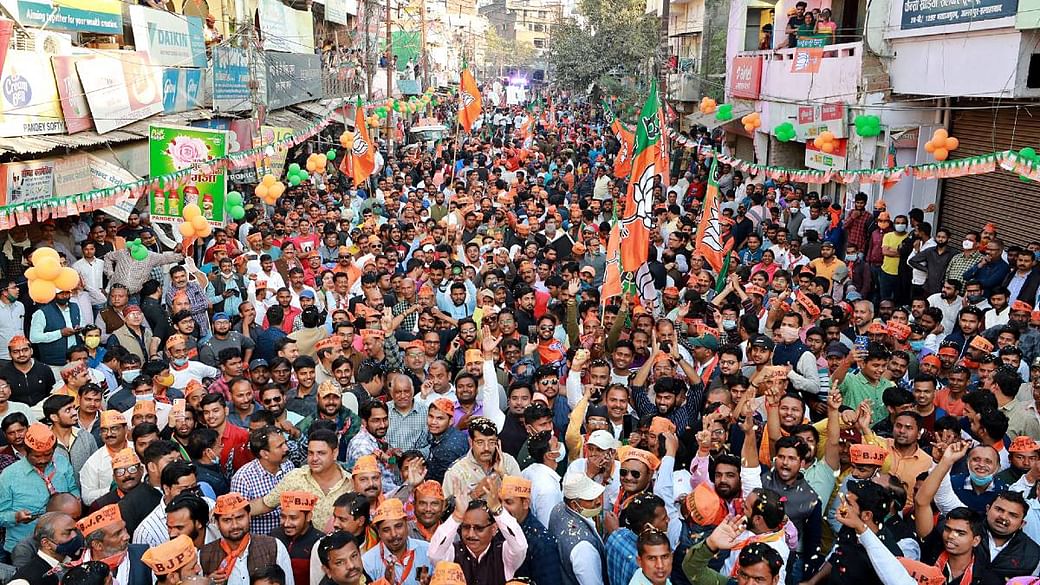
I thought of Philip da as I watched the exit polls for the 2022 Uttar Pradesh assembly election. The forecast of another term for the Bharatiya Janata Party was distressing, but it did not surprise me. The margin of the BJP’s victory projected by some – 300 plus seats and double digit lead in vote share – was and still is shocking. But I was not surprised by the broad direction and the operational conclusion of most of the exit polls. An article by Philip Oldenburg three decades ago had prepared me for such shocks.
This is not how my friends see it. Most of my friends, fellow travellers and comrades have been expecting nothing short of a rout for the BJP. For the last two months they have shared stories about how the BJP was wiped out in Western UP, seat-by-seat analysis of the decimation of the BJP in Poorvanchal and videos of how Akhilesh Yadav is drawing big crowds all over the state. I understand their sense of shock over the exit polls now. If a mediocre government with a cardboard of a leader manages to win popular approval, and that too within a year of one of the worst public health disasters followed by a powerful anti-government farmers’ movement, it should surprise anyone.
I was cured of this surprise over the last six weeks, as I travelled through Uttar Pradesh. I had heard about popular discontent against the Yogi Adityanath government. I had expected anger against its poor record on development, welfare and law-and-order. I thought people would never forget the hardship faced by migrant workers during the lockdown or at least the callousness they suffered during the second wave of the Covid-19 pandemic. We had documented how the BJP reneged on its entire manifesto promises to the farmers of UP. I had seen the power of the farmers’ movement in the Western UP.
Yet, on the ground, I did not find an anti-incumbency mood in the state. Not because everyone was happy. I encountered a vast range of deep disappointments, complaints against the officials and political leaders and intense anxieties about their life and livelihood. But this did not translate into popular anger against the BJP government. There was a “commonsense” shared by ordinary voters, everyone except Yadavs, Jatavs and Muslims.
Capturing the ‘commonsense’
This commonsense would come out in a typical conversation in rural UP. You ask the people about their conditions, and you hear a litany of complaints (which the unsuspecting journalist mistakes for intense anti-incumbency): ‘Things are really bad. Our family income has fallen over the last two years. There is no work for the educated youth. So many of us lost the jobs we had. Children could not study during the pandemic. Many old people in our village died without any medical support. We could not sell our crops for the official (MSP) price.’ Any mention of stray cattle invites a tirade: Naak me dam kar diya hai (bane of our existence). And mehngai (price rise)? Don’t even start talking about it.
Now you expect them to blame it all on the rulers. But a question about the performance of the Adityanath government gets a surprisingly positive response: “Achhi sarkar hai, theek kaam kiya hai (It’s a decent government, has done good work).” Before you can ask, they recount two benefits. Everyone got additional foodgrain, over and above the standard quota, plus cooking oil and chana. And almost everyone, including many Samajwadi Party (SP) voters, mentions improved law and order. “Hamari behen betiyan surakshit hain (our women are safe)” is a standard refrain.
But what about all the problems they just recounted? You ask this question and they get into rationalising on the BJP’s behalf. ‘What can the government do about these things? Coronavirus was global, so was inflation. Things would have been worse but for Modiji. Is he responsible for not feeding cows once they get old?’ While every small achievement of the BJP, real or imagined, was known to every voter, the SP could not make some of the biggest pain points into election issues. I hardly met any voter who would know some of the main poll planks of Akhilesh Yadav’s party.
It would be a mistake to place this commonsense in the standard register of pro- or anti-incumbency. This is not about a routine assessment of the work done by a government. The voters seem to have made up their mind before they start reasoning. They are not judges, but advocates. They know which side of the argument they stand, who stands with them. The BJP has set up an emotional bond with a vast segment of the voters. They are willing to suspend disbelief, condone misgovernance, undergo material suffering and still stay with their ‘own’ side. They do not mention Ayodhya or Kashi temple on their own, but the Hindu-Muslim divide is very much a subtext of this shared commonsense.
What about caste? Needless to say, this commonsense does not fully cut across all castes and communities. Yet the caste arithmetic does not work to the SP’s advantage. No doubt, the Yadavs were fully mobilised behind the SP, “110 per cent” as they say in Hindi. The Muslims had virtually no choice except the SP, notwithstanding the attractive rhetoric of Asaduddin Owaisi. The SP played smart by giving fewer tickets to Yadavs and Muslims. The Muslim voters in turn played wise by keeping a low profile, though Yadav support for SP was visible and aggressive. The Yadavs and Muslims refused to share the pro-incumbent commonsense. They would pick holes in every pro-government rationalisation. Their polarisation no doubt helped the SP, but that was never going to be enough.
Illusory SP wave?
I discovered that my friends had seriously over-estimated support for the SP among non-Yadav, non-Muslim voters. The famed disaffection of the Brahmins from the Thakur rule of CM Adityanath did not translate into anything on the ground. The so-called ‘upper’ castes continue to be the strongest caste vote bank for the BJP. There was some erosion among the farming communities like Jats, Kurmis and Mauryas, but much less than my friends imagined. With a few exceptions – Nishads at certain places, for example — the lower Other Backward Classes (OBCs) stayed solidly with the BJP. Every SP supporter counted on the Bahujan Samaj Party (BSP)’s disaffected voters going to the SP. I found little evidence of that, except among a few Pasis. If anything, the former BSP voters and the ex-Congress supporters turned more towards the BJP than the SP.
So, was this impression of a wave in favour of Akhilesh Yadav and his party completely illusory? Not quite. There was, undoubtedly, a surge for the SP everywhere. The massive crowds for Akhilesh’s public meetings were for real. Exit polls suggest that the SP will better its best ever performance of 29 per cent in terms of votes. It needed to improve its 2017 performance by around 15 percentage points and bring the BJP down by at least 5 points to win this election. That was always a Herculean ask. While everyone noted, rightly, that the SP was gaining, not many asked the real question: how much and wide were its gains?
In a bipolar election, the threshold of victory goes up. The SP’s best was not going to be good enough. Also, the SP’s gains were not automatically the BJP’s losses. Exit polls confirm that a shift from multi-cornered contests to a two-horse race meant that while the SP has gained, the BJP has managed to retain or better its vote share. While those who shifted away from the BJP were visible and voluble, those who stayed with or shifted towards the BJP remained silent. The India Today-Axis My India exit poll reports a massive advantage to the BJP among women voters. Most observers, including this writer, missed this major factor.
Talk to voters
While I continue to believe and hope that the race is closer than predicted by the exit polls, I have one piece of advice for my friends. If the BJP wins this election, please don’t jump to conclusions about poll rigging. Not that the BJP is above such manipulation or that the Election Commission is in any position to withstand it. But in this instance, it is not about EVM rigging; it is about rigging the screen of our TV and smartphones. It is not booth capturing, but mindscape capturing, an effective capture of the moral and political commonsense.
This brings me to Philip Oldenburg, or Philip da as I call him, one of the most insightful though less celebrated scholars of Indian politics. In 1988 he wrote an article why most ‘political pundits’ and political activists failed to anticipate the Congress wave in the 1984 Lok Sabha election. His argument is very simple: a triad of political leaders, journalists and local informants keep speaking to one another about election trends and manufacture a consensus about the likely electoral outcome. The problem is that none of them deigns to speak to ordinary voters. This is what pollsters do and that is why they tend to get it right.
As I travelled through Uttar Pradesh across the last few weeks, this lesson came back to me again and again. I wish my friends would stop speaking to one another, stop listening to media noise and simply go out to speak to ordinary citizens. Our political challenge is to connect to and intervene into the shared moral and political commonsense of the voters. It is not too late to learn this lesson. We are still two years from 2024.
I thought of Philip da as I watched the exit polls for the 2022 Uttar Pradesh assembly election. The forecast of another term for the Bharatiya Janata Party was distressing, but it did not surprise me. The margin of the BJP’s victory projected by some – 300 plus seats and double digit lead in vote share – was and still is shocking. But I was not surprised by the broad direction and the operational conclusion of most of the exit polls. An article by Philip Oldenburg three decades ago had prepared me for such shocks.
This is not how my friends see it. Most of my friends, fellow travellers and comrades have been expecting nothing short of a rout for the BJP. For the last two months they have shared stories about how the BJP was wiped out in Western UP, seat-by-seat analysis of the decimation of the BJP in Poorvanchal and videos of how Akhilesh Yadav is drawing big crowds all over the state. I understand their sense of shock over the exit polls now. If a mediocre government with a cardboard of a leader manages to win popular approval, and that too within a year of one of the worst public health disasters followed by a powerful anti-government farmers’ movement, it should surprise anyone.
I was cured of this surprise over the last six weeks, as I travelled through Uttar Pradesh. I had heard about popular discontent against the Yogi Adityanath government. I had expected anger against its poor record on development, welfare and law-and-order. I thought people would never forget the hardship faced by migrant workers during the lockdown or at least the callousness they suffered during the second wave of the Covid-19 pandemic. We had documented how the BJP reneged on its entire manifesto promises to the farmers of UP. I had seen the power of the farmers’ movement in the Western UP.
Yet, on the ground, I did not find an anti-incumbency mood in the state. Not because everyone was happy. I encountered a vast range of deep disappointments, complaints against the officials and political leaders and intense anxieties about their life and livelihood. But this did not translate into popular anger against the BJP government. There was a “commonsense” shared by ordinary voters, everyone except Yadavs, Jatavs and Muslims.
Capturing the ‘commonsense’
This commonsense would come out in a typical conversation in rural UP. You ask the people about their conditions, and you hear a litany of complaints (which the unsuspecting journalist mistakes for intense anti-incumbency): ‘Things are really bad. Our family income has fallen over the last two years. There is no work for the educated youth. So many of us lost the jobs we had. Children could not study during the pandemic. Many old people in our village died without any medical support. We could not sell our crops for the official (MSP) price.’ Any mention of stray cattle invites a tirade: Naak me dam kar diya hai (bane of our existence). And mehngai (price rise)? Don’t even start talking about it.
Now you expect them to blame it all on the rulers. But a question about the performance of the Adityanath government gets a surprisingly positive response: “Achhi sarkar hai, theek kaam kiya hai (It’s a decent government, has done good work).” Before you can ask, they recount two benefits. Everyone got additional foodgrain, over and above the standard quota, plus cooking oil and chana. And almost everyone, including many Samajwadi Party (SP) voters, mentions improved law and order. “Hamari behen betiyan surakshit hain (our women are safe)” is a standard refrain.
But what about all the problems they just recounted? You ask this question and they get into rationalising on the BJP’s behalf. ‘What can the government do about these things? Coronavirus was global, so was inflation. Things would have been worse but for Modiji. Is he responsible for not feeding cows once they get old?’ While every small achievement of the BJP, real or imagined, was known to every voter, the SP could not make some of the biggest pain points into election issues. I hardly met any voter who would know some of the main poll planks of Akhilesh Yadav’s party.
It would be a mistake to place this commonsense in the standard register of pro- or anti-incumbency. This is not about a routine assessment of the work done by a government. The voters seem to have made up their mind before they start reasoning. They are not judges, but advocates. They know which side of the argument they stand, who stands with them. The BJP has set up an emotional bond with a vast segment of the voters. They are willing to suspend disbelief, condone misgovernance, undergo material suffering and still stay with their ‘own’ side. They do not mention Ayodhya or Kashi temple on their own, but the Hindu-Muslim divide is very much a subtext of this shared commonsense.
What about caste? Needless to say, this commonsense does not fully cut across all castes and communities. Yet the caste arithmetic does not work to the SP’s advantage. No doubt, the Yadavs were fully mobilised behind the SP, “110 per cent” as they say in Hindi. The Muslims had virtually no choice except the SP, notwithstanding the attractive rhetoric of Asaduddin Owaisi. The SP played smart by giving fewer tickets to Yadavs and Muslims. The Muslim voters in turn played wise by keeping a low profile, though Yadav support for SP was visible and aggressive. The Yadavs and Muslims refused to share the pro-incumbent commonsense. They would pick holes in every pro-government rationalisation. Their polarisation no doubt helped the SP, but that was never going to be enough.
Illusory SP wave?
I discovered that my friends had seriously over-estimated support for the SP among non-Yadav, non-Muslim voters. The famed disaffection of the Brahmins from the Thakur rule of CM Adityanath did not translate into anything on the ground. The so-called ‘upper’ castes continue to be the strongest caste vote bank for the BJP. There was some erosion among the farming communities like Jats, Kurmis and Mauryas, but much less than my friends imagined. With a few exceptions – Nishads at certain places, for example — the lower Other Backward Classes (OBCs) stayed solidly with the BJP. Every SP supporter counted on the Bahujan Samaj Party (BSP)’s disaffected voters going to the SP. I found little evidence of that, except among a few Pasis. If anything, the former BSP voters and the ex-Congress supporters turned more towards the BJP than the SP.
So, was this impression of a wave in favour of Akhilesh Yadav and his party completely illusory? Not quite. There was, undoubtedly, a surge for the SP everywhere. The massive crowds for Akhilesh’s public meetings were for real. Exit polls suggest that the SP will better its best ever performance of 29 per cent in terms of votes. It needed to improve its 2017 performance by around 15 percentage points and bring the BJP down by at least 5 points to win this election. That was always a Herculean ask. While everyone noted, rightly, that the SP was gaining, not many asked the real question: how much and wide were its gains?
In a bipolar election, the threshold of victory goes up. The SP’s best was not going to be good enough. Also, the SP’s gains were not automatically the BJP’s losses. Exit polls confirm that a shift from multi-cornered contests to a two-horse race meant that while the SP has gained, the BJP has managed to retain or better its vote share. While those who shifted away from the BJP were visible and voluble, those who stayed with or shifted towards the BJP remained silent. The India Today-Axis My India exit poll reports a massive advantage to the BJP among women voters. Most observers, including this writer, missed this major factor.
Talk to voters
While I continue to believe and hope that the race is closer than predicted by the exit polls, I have one piece of advice for my friends. If the BJP wins this election, please don’t jump to conclusions about poll rigging. Not that the BJP is above such manipulation or that the Election Commission is in any position to withstand it. But in this instance, it is not about EVM rigging; it is about rigging the screen of our TV and smartphones. It is not booth capturing, but mindscape capturing, an effective capture of the moral and political commonsense.
This brings me to Philip Oldenburg, or Philip da as I call him, one of the most insightful though less celebrated scholars of Indian politics. In 1988 he wrote an article why most ‘political pundits’ and political activists failed to anticipate the Congress wave in the 1984 Lok Sabha election. His argument is very simple: a triad of political leaders, journalists and local informants keep speaking to one another about election trends and manufacture a consensus about the likely electoral outcome. The problem is that none of them deigns to speak to ordinary voters. This is what pollsters do and that is why they tend to get it right.
As I travelled through Uttar Pradesh across the last few weeks, this lesson came back to me again and again. I wish my friends would stop speaking to one another, stop listening to media noise and simply go out to speak to ordinary citizens. Our political challenge is to connect to and intervene into the shared moral and political commonsense of the voters. It is not too late to learn this lesson. We are still two years from 2024.
Subscribe to:
Comments (Atom)