Tuesday, 15 February 2022
Monday, 14 February 2022
‘Get into bed and see what happens’ – and nine other tips to revive a tired relationship
Nell Frizzell in The Guardian
At what point do you think a relationship becomes a long-term relationship?” I ask my boyfriend, while sitting on the toilet having a post-dinner wee. He is in front of the mirror, trimming the single thick black hair that grows out from a mole on his cheek. Our son is in the bath next to us, squirting water from one stainless steel mixing bowl into the other using a Calpol syringe.
“About here,” he says, gesturing towards the room, past my naked thighs, with a pair of nail scissors.
After nearly two years of intermittent lockdowns, working from home, reduced opportunities for travel, socialising and, in many cases, making money, and more illness, a lot of long-term relationships are looking a little tired, a little frayed. Tempers have run short; desire has faded. Especially on this most “romantic” of days, many us will be thinking that we need to address things. To freshen up. To repair. This calls for more than a box of chocolates and a bunch of flowers.
But where to start? I’ve been gleaning advice from those who have gone before me – from friends, relationship counsellors, old colleagues, writers and philosophers, even my family.

Photograph: 10’000 Hours/Getty Images
Lower your expectations
Your partner is not psychic: they cannot know what you think and feel and want at every turn. Nor is your partner an extension of you: they will frequently and unconsciously contradict you. So lower your expectations and try, as much as possible, to be kind. Standing at the hob, cooking yet another vat of soup (my partner and I have both decided that we need to eat fewer meals centred on butter and flour), I re-read Alain de Botton’s famous New Yorker essay Why You Will Marry the Wrong Person: “We need to swap the Romantic view for a tragic (and at points comedic) awareness that every human will frustrate, anger, annoy, madden and disappoint us – and we will (without any malice) do the same to them. There can be no end to our sense of emptiness and incompleteness. But none of this is unusual or grounds for divorce. Choosing whom to commit ourselves to is merely a case of identifying which particular variety of suffering we would most like to sacrifice ourselves for.” I add some salt. And a knob of butter. Well, come on…
Mind your language
My sister’s dad (who, for the genealogists in the room, is not my dad) once told me that people don’t break up over big things; they break up over how they talk to each other. Yes, in the end, your partner might sleep with someone else or steal your rent. But in most cases, the damage is done when you stop saying goodbye at the end of phone calls, stop saying thank you for dinner, stop asking the other person how their day was.
However, blaming someone else’s behaviour is unlikely to change it. “People could really do with saying what they need, not what they think the other partner should do,” says Relate counsellor Josh Smith, who has been working with couples and families for more than five years. “Also, set a time and space when you’re going to talk about things but give it a time limit. A person who is feeling anxious might want to talk about an issue, but their partner might be more inclined to avoid difficult conversations and worried it will go on for ever. So you could say: ‘Let’s talk for half an hour and then stop.’” Smith also recommends giving yourself a timeout during those exhausting, essential conversations. “When our nervous system gets very aroused, we might say things we don’t mean, or not be able to say very much at all and disconnect emotionally. Being able to take a timeout, with a planned time to return to [the discussion], will help you listen.”
Go to counselling while you still like each other
When you hear counsellors talk about their clients, says Smith, the one thing that comes up time and time again is that they wish they’d come sooner – before the fight-or-flight response got so ingrained and the conflict so advanced that partners could no longer hear each other. So, to use a rather threadbare analogy, maybe treat relationship counselling like going to the gym: something that you use regularly to keep things healthy, to nip small problems in the bud, rather than turn to when things have seriously gone to seed. It is a privilege that many people can’t afford, of course, but it might also be money well spent.

Get into bed and see what happens
Sex is a pretty fundamental (and free) way to cement intimacy in a relationship. It can also act as a microcosm for the relationship: when people are feeling stressed, anxious, avoidant, low in self-esteem, bored or overlooked, it will almost inevitably lead to a drop-off in bouncing bedsprings. “For most of the couples I see, sex is an issue,” says Smith. “It’s not unusual for people in long-term relationships to have very little sex.” Well, who’d have guessed? “But that’s not a problem if it’s not a problem,” he adds. “Don’t let normative ideas about sex get in the way.”
That doesn’t mean you have to give up just yet. When I asked my family WhatsApp group how to reboot a long-term relationship, one cousin replied: “Actively listen, be nice to each other and have sex even in times you might not feel like it (and then remember how much you do actually like it).”
Flirt with other people
If you still need a little boost, remember what the psychotherapist Esther Perel says about desire in her Ted Talk, The Secret to Desire in a Long-Term Relationship: “If there is a verb, for me, that comes with love, it’s ‘to have’. And if there is a verb that comes with desire, it is ‘to want’.” The journalist Katie Antoniou puts it like this: “Go to a party and watch your partner flirt with other people and remember why you find them hot. And flirt with other people and remember people find you hot. Then go home together.”
Do at least one thing separately every day

One of the great challenges in a long-term relationship is judging how much time to actually spend together. “During the pandemic, I noticed that people’s lives became a bit enmeshed,” says Smith, in possibly the greatest understatement of 2022. “Having different experiences and being able to bring those back into the relationship can be really healthy.”
As Perel points out: “We come to one person, and we are basically asking them to give us what once an entire village used to provide.” We want security, companionship, perhaps children, a best friend, a trusted confidante, a red-hot lover and someone to help us fulfil our daily domestic tasks. This is, probably, an unfair expectation of any single person. Put too many eggs in the long-term partner basket and cracks are going to show, if not yolk and leaking albumen. So don’t be afraid to look outside your relationship for other connections. It is not a criticism of your romantic relationship to go on holiday, share childcare, work, go to dinner, play football and watch films with other people. And, whether it’s a hobby, a shed or a separate bed, don’t be afraid to carve out a private sphere within your relationship. My greatest – and possibly only – bit of advice about sustaining a long-term relationship is to share a bed but have two separate duvets. The Germans, as is so often the case, have the answer.
Feel the fear …
“Long-term relationships aren’t like warm baths; they’re like holding a tiger by the tail.” I’m on the phone to a friend who has been in his current relationship – I say “current” because, honestly, who am I to say? – for a mere 43 years. When it comes to relationship advice, as he admits, his understanding of dating, casual sex, breakups and asking people out is minimal. “She moved in when I was 19 and that was it, really.” But he is rather useful on the long-term front. “There are two main approaches, as I see it,” he says. “There is the passive state, which some people can find very sustaining, when it would basically be such a faff to split up that you’re staying together.” I think of my mortgage and our son and the fact that I still cannot replace my brake pads. “Or there is the active approach, where you’re always opting in. That’s what I chose.”
The reason he and his partner didn’t marry for the first 42 years of their relationship, he says, is that they always wanted to know that they were together because they were choosing to be so. “I quite liked the jeopardy,” he says. “It’s a constant dialogue between exhilaration and exhaustion. At any time, I could have walked away. We had made no promise; there was no contract. Which meant that, every day, I knew I was there because I wanted to be there.”
But what about the days when you don’t want to be there, I ask, picking a used teabag off the lid of the compost bin and putting it into the compost bin. “Well, that’s when the exhaustion comes in,” he says. “And you have to have those conversations about where you are and what you want.”
… but don’t be afraid of all change
A priest once told me that, over a lifetime, you will be married several times – and if you’re lucky, that will be to the same person. Children, work, where you live, money, health: the things that change your life will change your relationship too. So do the work to make those changes happen with, and in parallel to, your partner. Talk to each other about the ways you are developing and how you can adapt the dimensions and texture of your relationship to fit. Few of us would really want to be the person we were 10 years ago (in my case: single, recently redundant and staying in my mum’s spare room), so don’t expect your partner or your relationship to be held in aspic either.
It is also worth pointing out that the things that bring you stress outside your relationship – money worries, illness, unemployment, housing insecurity, the demands of parenting, grief and moving home – will create stress within your relationship. So check if there are things you can do to improve your own situation before blaming your partner.
Make time for quality time (even if you hate the phrase)

Date nights worked for the Obamas, who once famously flew to New York, took a limo to dinner, watched a Broadway show and then flew home all in one night, during his presidency. And it was noticeable to me that the first time my partner and I spent a night away together since our son was born four years ago, we ended up not only sleeping in a bedroom covered in photographs of someone else’s whippets, but getting engaged. It doesn’t have to involve money, travel or Instagram. Time spent together away from your usual domestic coexistence – even if it’s just a swim, or a train journey, or a trip to a new launderette – can make a huge difference to how you see your partner.
Remember the little joys
Finally, having picked up my partner’s socks from the floor, made the bed, rehung the damp, onion-smelling towel he had flung in a heap over the door, and wiped the peanut butter off my forehead, I asked my old English teacher for his advice. This, after all, is the man who taught Philip Larkin’s An Arundel Tomb, with its description of the stone earl and his lady countess, who rigidly persisted, “linked, through lengths and breadths of time”. More to the point, he’s been with his partner since they met at a party aged 20, more than 40 years ago. He must, I reasoned, have some ideas about what sustains and revives a long-term relationship.
The reply comes back mere minutes later: “Amnesia, dogged optimism, a robust and shared sense of the contemptibility of public figures, alternating phases of heartfelt loyalty and shameless disloyalty with regard to friends and birth families, lonesome sheds with tools in them, compatible levels of existential angst, sunsets, recreational stimulants, utterly selfish projects, wholly unshared obsessions, a poor sense of smell, frequently sleeping in separate beds, frequently sleeping together, children, finding each other ridiculous, plant life, lakes, oceans, rock pooling, books, solvency, knowing who’s better at what, dreaming of elsewhere, avoiding all board games and exercising dictatorial authority over territories in different areas of daily mundanities.” His wife, he later tells me, probably had a better list. I would happily marry either of them.
Oh, and one final note: in all my research, nobody mentioned shutting the door when you’re on the toilet. But I’d say give it a try.
English football: why are there so few black people in senior positions?
Simon Kuper in The FT

Possibly the only English football club run mostly by black staff is Queens Park Rangers, in the Championship, the English game’s second tier.
QPR’s director of football, Les Ferdinand, and technical director, Chris Ramsey, have spent their entire careers in the sport watching hiring discrimination persist almost everywhere else. Teams have knelt in protest against racism, but Ferdinand says, “I didn’t want to see people taking the knee. I just wanted to see action. I’m tired of all these gestures.”
Now a newly founded group, the Black Footballers Partnership (BFP), argues that it is time to adopt compulsory hiring quotas for minorities. Voluntary measures have not worked, says its executive director, Delroy Corinaldi.
The BFP has commissioned a report from Stefan Szymanski (economics professor at the University of Michigan, and my co-author on the book Soccernomics) to document apparent discrimination in coaching, executive and scouting jobs.
It is a dogma of football that these roles must be filled by ex-players — but only, it seems, by white ones. Last year 43 per cent of players in the Premier League were black, yet black people held “only 4.4 per cent of managerial positions, usually taken by former players” and 1.6 per cent of “executive, leadership and ownership positions”, writes Szymanski.
Today 14 per cent of holders of the highest coaching badge in England, the Uefa Pro Licence, are black, but they too confront prejudice. Looking ahead, the paucity of black scouts and junior coaches is keeping the pipeline for bigger jobs overwhelmingly white. Corinaldi hopes that current black footballers will follow England’s forward Raheem Sterling in calling for more off-field representation.
There have been 28 black managers in the English game since the Football League was founded in 1888, calculates Corinaldi. As for the Premier League, which has had 11 black managers in 30 years, he says: “Sam Allardyce [an ex-England manager] has had nearly as many roles as the whole black population.” The situation is similar in women’s football, says former England international Anita Asante.
Ramsey, who entered coaching in the late 1980s, when he says “there were literally no black coaches”, reflects: “There’s always a dream that you’re going to make the highest level, so naively you coach believing that your talent will get you there, but very early on I realised that wasn’t going to happen.”
Reluctant to hire
He says discrimination in hiring is always unspoken: “People hide behind politically correct language. They will take a knee, and say, ‘I’m all for it’. You’re just never really seen as able to do the job. And then people sometimes employ people less qualified than you. Plenty of white managers have failed, and I just want to have the opportunity to be as bad as them, and to be given an opportunity again. You don’t want to have to be better just because you’re black.”
When Ferdinand’s glittering playing career ended, he worried that studying for his coaching badges might “waste five years of my life”, given that the white men running clubs were reluctant to hire even famous black ex-players such as John Barnes and Paul Ince. In Ferdinand’s first seven years on the market, he was offered one managerial job. “People tend to employ what looks, sounds and acts like them,” he shrugs. Yet he says he isn’t angry: “Anger’s not the right word, because that’s unfortunately how they see a lot of young black men, as angry.”
He suspects QPR hired him in part because its then co-chair, the Malaysian Tony Fernandes, is a person of colour. After the two men met and began talking, recalls Ferdinand, “he said, ‘Why are you not doing this job [management] in football?’ I said, ‘Because I’ve not been given the opportunity.’ The conversations went from there. Had he not been a person of colour, I perhaps wouldn’t have had the opportunity to talk to him in the way that I did.”
Szymanski can identify only two black owners in English football, both at small clubs: Ben Robinson of Burton Albion, and Ryan Giggs, co-owner of Salford City.
Szymanski believes discrimination persists for managerial jobs in part because football managers have little impact on team performance — much less than is commonly thought. He calculates that over 10 seasons, the average correlation between a club’s wage bill for players and its league position exceeds 90 per cent. If the quality of players determines results almost by itself, then managers are relatively insignificant, and so clubs can continue to hire the stereotype manager — a white male ex-player aged between 35 and 55 — without harming their on-field performance.
For about 20 years, English football has launched various fruitless attempts to address discrimination. Ramsey recalls the Football Association — the national governing body — inviting black ex-players to “observe” training sessions. He marvels: “You’re talking about qualified people with full badges standing and watching people train. And most of them have been in the game longer than the people they’re watching.”
Modest though that initiative was, Ferdinand recalls warning FA officials: “A certain amount of people at St George’s Park [the FA’s National Football Centre], when you tell them this is the initiative, their eyes will be rolling and thinking, ‘Here we go, we’re doing something for them again, we’re trying to give them another opportunity.’ What those people don’t realise is: we don’t get opportunities.”
Rooney Rule
After the NFL of American gridiron football introduced the Rooney Rule in 2003, requiring teams to interview minority candidates for job openings, the English ex-player Ricky Hill presented the idea to the League Managers Association. Ramsey recalls, “Everyone said, ‘God, this is brilliant’.” Yet only in the 2016/2017 season did 10 smaller English clubs even pilot the Rooney Rule. Ramsey says: “We are expected to accept as minority coaches that these things take a long time. I have seen this train move along so slowly that it’s ridiculous.” He mourns the black managerial careers lost in the wait.
In 2019 the Rooney Rule was made mandatory in the three lower tiers of English professional football, though not in the Premier League or anywhere else in Europe. Clubs had to interview at least one black, Asian or minority ethnic (Bame) candidate (if any applied) for all first team managerial, coaching and youth development roles. Why didn’t the rule noticeably increase minority hiring? Ferdinand replies, “Because there’s nobody being held accountable to it. What is the Rooney Rule? You give someone the opportunity to come through the door and talk.” Moreover, English football’s version of the rule has a significant loophole: clubs are exempt if they interview only one candidate, typically someone found through the white old boys’ network.
Nor has the Rooney Rule made much difference in the NFL. In 2020, 57.5 per cent of the league’s players were black, but today only two out of 32 head coaches are, while one other identifies as multiracial. This month, the former Miami Dolphins coach Brian Flores filed a lawsuit against the NFL and three clubs, accusing them of racist and discriminatory practices. He and other black coaches report being called for sham interviews for jobs that have already been filled, as teams tick the Rooney Rule’s boxes.
Voluntary diversity targets
In 2020 England’s FA adopted a voluntary “Football Leadership Diversity Code”. Only about half of English professional clubs signed it. They committed to achieving percentage targets for Bame people among new hires: 15 per cent for senior leadership and team operations positions, and 25 per cent for men’s coaching — “a discrepancy in goals that itself reflects the problem”, comments Szymanski. Clubs were further allowed to water down these targets “based on local demographics”.
The FA said: “The FA is deeply committed to ensuring the diversity of those playing and coaching within English football is truly reflective of our modern society.
“We’re focused on increasing the number of, and ongoing support for, coaches who have been historically under-represented in the game. This includes a bursary programme for the Uefa qualifications required to coach in academy and senior professional football.”
A report last November showed mixed results. Many clubs had missed the code’s targets, with several Premier League clubs reporting zero diversity hires. On the other hand, more than 20 per cent of new hires in men’s football were of Bame origin, which was at least well above historical hiring rates.
Do clubs take the code seriously? Ferdinand smiles ironically: “From day one I didn’t take it seriously. Because it’s a voluntary code. What’s the repercussions if you don’t follow the voluntary code? No one will say anything, no one will do anything about it.”
The BFP and the League Managers Association have called for the code’s targets to be made compulsory. Ferdinand cites the example of countries that set mandatory quotas for women on corporate boards of listed companies.
Asante says it takes minorities in positions of power to understand the problems of minorities. “If you are a majority in any group, when are you ever thinking about the needs of others?” Corinaldi adds: “When you have a monoculture in any boardroom, you only know what you know, and it tends to be the same stories you heard growing up.” He predicts that once football has more black directors and senior executives, they will hire more diversely.
The BFP’s model for English football is the National Basketball Association in the US, a 30-team league with 14 African-American head coaches. For now, that feels like a distant utopia. Ramsey warns: “If there is no revolutionary action, we’ll be having this same conversation in 10 years’ time.” And he remembers saying exactly those words 10 years ago.
Sunday, 13 February 2022
Saturday, 12 February 2022
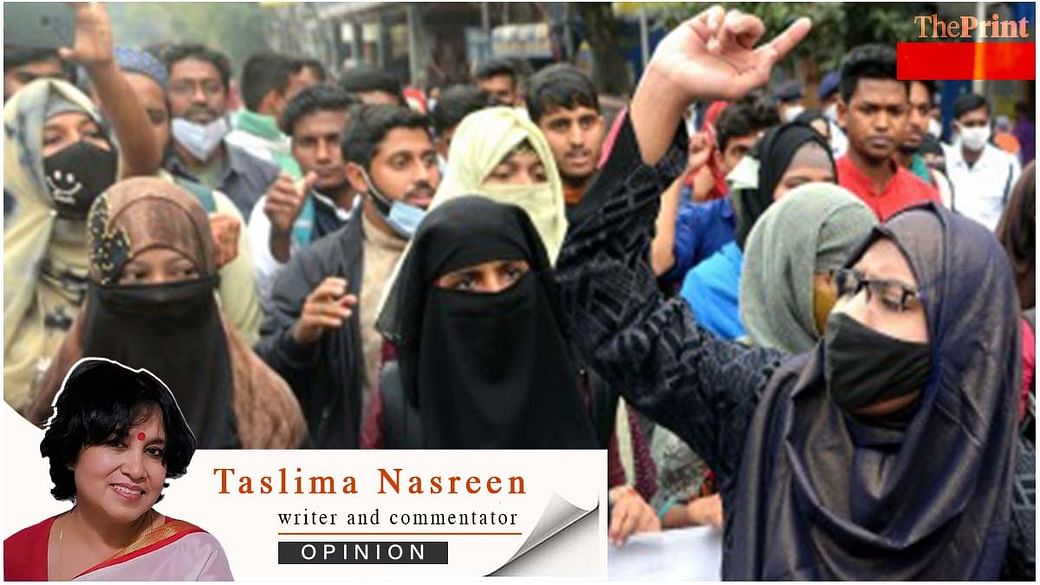
Muslim women must see burqa is just like chastity belt of dark ages, Taslima Nasreen writes
Taslima Nasreen in The Print
Text Size:
There is practically no difference between a Jewish, Christian, Muslim or Hindu fundamentalist. They are all primarily ‘intolerant’. Standing next to the mortal remains of playback singer Lata Mangeshkar, Muslims have prayed to Allah, Hindus to Bhagwan, and Christians to their almighty God. Seeing Bollywood icon Shah Rukh Khan lifting his hands in prayer and blowing on her body, some Hindu extremists thought that he was spitting. Then social media mayhem descended.
I have noticed that in India, while Muslims are largely aware of Hindu rituals and practices, most Hindus are ignorant about Muslims ones. Similarly in Bangladesh, Hindus understand Muslim rituals more than what Muslims know of Hindus.
To a large extent, intolerance stems from ignorance. As we saw in the Shah Rukh Khan incident, people from all religions stood behind him. In fact, there are enough liberal and rational people in the Hindu community to oppose the extremists.
The row over hijab
An unnecessary controversy over hijab has erupted in another part of the country, Karnataka. After authorities raised objection to female students from wearing hijab to colleges, the protest by Muslim students started. Then, a group of students donning saffron scarves, took to the streets protesting against the burqa. Chief Minister Basavaraj Bommai ordered schools and colleges to remain shut for a few days. But this is not a solution. If the state fears riots, then violence can erupt when schools and colleges reopen. To prevent riots, the mindset needs to change, and hatred and fear for each other need to be washed clean. In this regard, the Karnataka High Court’s interim order makes sense. I believe, uniform civil code and uniform dress code are necessary to stop conflicts. Right to religion is not above the right to education.
The distance between Hindus and Muslims has not been bridged even after 75 years of Partition. Pakistan has separated from India and has turned into a religious state. But India never wanted to become a Pakistan. Or it could have easily turned into a Hindu State 75 years ago. The Indian Constitution upholds secularism, not religion. This country, with a majority Hindu population, is home to the second largest Muslim population in the world. The laws of India give equal rights to people from all religions, castes, languages, creeds, and cultures.
It is perfectly all right for an educational institution in a secular country to mandate secular dress codes for its students. There is nothing wrong in such a message from the school/college authority that states that religion is to be practised within the confines of the home. Educational institutions, meant for fostering knowledge, are not influenced by religion or gender. It is education that can lift people from the abyss of bigotry, baseness, conservativeness and superstitions into a world where the principles of individual freedom, free-thinking, humanism and rationality based on science is valued highly.
In that world, women do not feel pride in their shackles of subjugation but rather break free from them, they do not perceive covering themselves in a burqa as a matter of right but as a symbol of female persecution and cast them away. Burqas, niqabs, hijabs have a singular aim of commodifying women as sex objects. The fact that women need to hide themselves from men who sexually salivate at the sight of women is not an honourable thought for both women and men.
Education is supreme
Twelve years ago, a local newspaper in Karnataka published an article of mine on burqa. Some Muslim fundamentalists vandalised the office and burnt it down. They also burnt down shops and businesses around it. Hindus also hit the streets in protest. Two people died when the police opened fire. A simple burqa can still cause fire to burn in this state. Riots can still break out over burqas.
A burqa and hijab can never be a woman’s choice. They have to be worn only when choices are taken away. Just like political Islam, burqa/hijab is also political today. Members of the family force the woman to wear the burqa/hijab. It is a result of sustained brainwashing from a tender age. Religious apparel like the burqa/hijab can never be a person’s identity, which is created by capabilities and accomplishments. Iran made hijab compulsory for women. Women stood on the streets and threw away their hijabs in protest. The women of Karnataka, who still consider hijab as their identity, need to strive harder to find a more meaningful and respectable identity for themselves.
When a woman’s right to education is violated on the pretext of her wearing a hijab, when someone forces a woman out of hijab as a precondition to education, I stand in favour of education even in hijab. At the same time, when a woman is forced to wear a hijab, I stand in favour of throwing the hijab away. Personally I am against hijab and burqa. I believe it is a patriarchal conspiracy that forces women into wearing burqa. These pieces of clothing are symbols of oppression and insult to women. I hope women soon realise that burqa is not different from the chastity belt of the dark ages that was used to lock in women’s sexual organs. If chastity belts are humiliating, why not burqa?
Some say that the furore over the burqa in Karnataka is not spontaneous and is supported by political forces. This sounds very familiar to saying that riots do not happen, but are manufactured — mostly before elections and almost always between Hindus and Muslims. Apparently they do count for a few votes. I, too, was thrown out of West Bengal for a few votes.
It is heartening that riots do not happen. It would be frightening if they did happen spontaneously. Then we would have surmised that Hindus and Muslims are born enemies and can never live with each other peacefully.
I believe that even the Partition riots didn’t happen on their own but were made to happen.
A new India
I have heard some Hindu fanatics call for India to be turned into a Hindu Rashtra, where non-Hindus will be converted to Hinduism or be forced to leave the country.
I really do not know if such people are big in numbers. I know India as a secular state and love it that way. I have confidence in the country. Is India changing? Will it change? I am aware of the liberality of Hinduism as a religion. One is free to follow or not follow it. Unlike in Islam, Hinduism does not force one to follow its practices. Hinduism doesn’t prescribe people to torture, imprison, behead, hack or hang someone to death for blasphemy. Superstitions still exist in Hinduism, even though a lot has waned with time. But, India will be a country only for Hindus, anyone criticising Hindus or Hindutva will be killed — are statements that are new to me.
I have been critically scrutinising all religions and religious fundamentalism in order to uphold women’s rights and equality for more than three decades now. My writings on Hinduism and religious superstitions suppressing women’s rights have been published in Indian newspapers/magazines and have also been appreciated. But today, as soon as I pose a question like, “Why do men not observe Karva Chauth for the welfare of women?” hundreds of Hindus hurl personal attacks and abuse on me demanding my expulsion from the country. This is a new India. An India that I cannot imagine. I find their behaviour similar to Muslim fundamentalists. Utterly intolerant.
If India was a Hindu Rashtra, will all fundamentalists and liberal Hindus be able to live peacefully? Will there be no discontent among the dominant and oppressed castes, no discrimination between men and women? A state only for Hindus? Perhaps. Just the way Jews have carved a state for themselves, and Muslims have Pakistan.
I will have to leave a Hindu Rashtra too because I cannot become a Hindu. I am an atheist and a humanist, and I choose to stay that way. Gauri Lankesh, I believe, was a humanist. She was not fit for a Hindu Rashtra, nor will I be.
Subscribe to:
Posts (Atom)