Thursday, 17 June 2021
Friday, 11 June 2021
Obscurantist India: Mired in the Past, Messing with the Present, Muddled about the Future
Parakala Prabhakar (Telugu: పరకాల ప్రభాకర్; born 2 January 1959) is an Indian political economist, political commentator, economic, and social affairs. He served as Communications Advisor, held a cabinet rank position in Andhra Pradesh Government between July 2014 and June 2018. For several years he presented a current affairs discussion programme on television channels of Andhra Pradesh. His programmes, Pratidhwani on ETV2 and Namaste Andhra Pradesh on NTV.[1] He was also a former spokesman and one of the founding general secretaries of Praja Rajyam Party.[2] In the early 2000s, Parakala was the spokesperson of the Andhra Pradesh unit of the BJP.[3] He is the spouse of the incumbent union Minister of Finance and Corporate Affairs of India, Nirmala Sitharaman.
Source: Wikipedia
Thursday, 10 June 2021
Government Pensions subject to 'Good Behaviour'
Lt. Gen. H.S Panag (retd.) in The Print
On 31 May, the Ministry of Personnel, Public Grievances and Pensions, which is headed by Prime Minister Narendra Modi, issued a gazette notification amending Rule 8 — “Pension subject to future good conduct” — of the Central Civil Services (Pension) Rules 1972. The amendment prohibits retired personnel who have worked in any intelligence or security-related organisation included in the Second Schedule of the Right to Information Act 2005 from publication “of any material relating to and including domain of the organisation, including any reference or information about any personnel and his designation, and expertise or knowledge gained by virtue of working in that organisation”, without prior clearance from the “Head of the Organisation”. An undertaking is also supposed to be signed to the effect that any violation of this rule can lead to withholding of pension in full or in part.
There are 26 organisations included in the Second Schedule of the RTI Act, including the Intelligence Bureau, Research & Analysis Wing, Directorate of Revenue Intelligence, Central Bureau of Investigation, Narcotics Control Bureau, Border Security Force, Central Reserve Police Force, Indo-Tibetan Border Police and Central Industrial Security Force. These organisations are excluded from the RTI Act. Ironically, the armed forces, which are responsible for the external and at times internal security, are covered by the Act.
In 2008, Rule 8 was first amended to make more explicit the existing restrictions under the Official Secrets Act by barring retired officials from publishing without prior permission from Head of the Department any sensitive information, the disclosure of which would “prejudicially affect the sovereignty and integrity of India, the security, strategic, scientific or economic interests of the State or relation with a foreign State or which would lead to incitement of an offence.” An undertaking similar to the present amendment was also required to be signed.
The scope of the 31 May amendment is all-encompassing and its ambiguity leaves it open for vested interpretation and virtually bars retired officers who have served in the above-mentioned organisations from writing or speaking, based on their experience in service or even using the knowledge and expertise acquired after retirement. There is an apprehension that in future, the rules of other government organisations, including the armed forces, may also be amended to incorporate similar provisions.
The motive behind the amendment
All governments are legitimately concerned with safeguarding national security. Almost all countries have laws for the same. However, political dispensations often use these provisions to stifle criticism of the government, particularly by retired government officials who, based on their domain knowledge and experience, enjoy immense credibility with the public.
Originally, Rule 8 allowed withholding/withdrawal of pension or part thereof, permanently/for a specified period if the pensioner was convicted of a serious crime or was found guilty of grave misconduct. “Serious crime” included crime under Official Secrets Act 1923 and “grave misconduct” also covered communication/disclosure of information mentioned in Section 5 of the Act.
There was no requirement of prior permission before publication of any book or article, and prosecution under Official Secrets Act was necessary before any action could be taken. No undertaking was required to be given by the retiree officials. There is no noteworthy case in which this provision was invoked.
The motive behind the 2008 amendment by the UPA and the present amendment by the NDA, was/is to crack down on dissent by retired officials without the due process of law. This, when despite recommendations of the Law Commission and Second Administrative Reforms Commission, no effort has been made to amend the 98-year-old Official Secrets Act to cater for current requirements of national security. The only difference between the two amendments is that the latter makes the rule more absolute by adding the ambiguous rider regarding publication without permission “of any material relating to and including ‘domain of the organisation’, including any reference or information about any personnel and his designation, and expertise or knowledge gained by virtue of working in that organisation.”
The amendment to Rule 8 is unlikely to withstand the scrutiny of law. The Supreme Court and the high courts have repeatedly upheld the principle that “pension is not a bounty, charity or a gratuitous payment but an indefeasible right of every employee”. The government cannot take away the right merely by giving a show cause notice to a retired official for having used “domain knowledge or expertise” while writing an article/book or speaking at any forum. Any application of this amendment will be thrown out by the courts. No wonder that there has been no known application of the amended rule since 2008. There has been no alarming increase in cases under the Official Secrets Act. Between 2014 and 2019, 50 cases have been filed in the country and none against a government official. And if a government official is actually guilty of violating national security, then is withdrawal of pension an adequate punishment?
What does the government then gain by this amendment? Simple, the new amendment acts as deterrent against criticism by retired officials. Which self-respecting retired government official would like to seek permission from her/his former junior or fight a prolonged legal battle to get his pension restored? The government’s will, thus, prevail not by the wisdom of its decision but by default.
Loss to the nation
All major democracies make optimum use of the experience of their retired government officials. While some become part of the government, others contribute by educating the public and throwing up new ideas/suggestions for the consideration of the government. The domain expert keeps a check on a majoritarian government facing a weak opposition by publicly speaking and writing. All governments try to hide failures and scrutiny for inefficiency. With a weak opposition and government-friendly media, the Bharatiya Janata Party dispensation is more worried about the perceived threat from the retired officials with domain expertise than an ill-informed opposition.
Given the Modi government’s obsession with respect to national security and its lackadaisical performance in its management, it is my view that in the near future, the government will incorporate similar provision in the pension rules of other government departments and the armed forces.
A case in point is the attempt by the Modi government to deny/obfuscate the intelligence failure and the preemptive Chinese intrusions. To date no formal briefing has been given about the actual situation in Eastern Ladakh. Doctored information has been fed to the media through leaks by government/military officials. Three retired defence officers, including the author, brought the real picture before the public through articles and media interviews. All were careful to safeguard operational security. A concerted campaign was launched to discredit these retired officers through government-friendly media and pliant defence analysts until the events overtook their detractors to prove them right. The author extensively used his knowledge of the terrain in Eastern Ladakh to bring the truth before the public. In a similar situation in future, these officers may well be battling in courts to safeguard their pensions.
Imagine a situation that in future when no historical accounts of our wars, counter insurgency/terrorism campaigns and communal riots can be written by retired government and armed forces officers. No retired official will be eligible to head our security related thinks tanks or speak in international forums about our experience. Despite provision of Section 8(3) of the RTI Act to declassify documents after 20 years, the government never does so except to score political points as in the case of Netaji Files.
The amendment to Rule 8 of Central Civil Services (Pension) Rules 1972 is nothing more than a blatant, overarching and draconian gag order against retired officials to manage the public narrative for political interests under the garb of safeguarding national security.
It safeguards the interests of the political dispensation and not the nation. It must be challenged in the courts and in the interim disregarded with contempt.
On 31 May, the Ministry of Personnel, Public Grievances and Pensions, which is headed by Prime Minister Narendra Modi, issued a gazette notification amending Rule 8 — “Pension subject to future good conduct” — of the Central Civil Services (Pension) Rules 1972. The amendment prohibits retired personnel who have worked in any intelligence or security-related organisation included in the Second Schedule of the Right to Information Act 2005 from publication “of any material relating to and including domain of the organisation, including any reference or information about any personnel and his designation, and expertise or knowledge gained by virtue of working in that organisation”, without prior clearance from the “Head of the Organisation”. An undertaking is also supposed to be signed to the effect that any violation of this rule can lead to withholding of pension in full or in part.
There are 26 organisations included in the Second Schedule of the RTI Act, including the Intelligence Bureau, Research & Analysis Wing, Directorate of Revenue Intelligence, Central Bureau of Investigation, Narcotics Control Bureau, Border Security Force, Central Reserve Police Force, Indo-Tibetan Border Police and Central Industrial Security Force. These organisations are excluded from the RTI Act. Ironically, the armed forces, which are responsible for the external and at times internal security, are covered by the Act.
In 2008, Rule 8 was first amended to make more explicit the existing restrictions under the Official Secrets Act by barring retired officials from publishing without prior permission from Head of the Department any sensitive information, the disclosure of which would “prejudicially affect the sovereignty and integrity of India, the security, strategic, scientific or economic interests of the State or relation with a foreign State or which would lead to incitement of an offence.” An undertaking similar to the present amendment was also required to be signed.
The scope of the 31 May amendment is all-encompassing and its ambiguity leaves it open for vested interpretation and virtually bars retired officers who have served in the above-mentioned organisations from writing or speaking, based on their experience in service or even using the knowledge and expertise acquired after retirement. There is an apprehension that in future, the rules of other government organisations, including the armed forces, may also be amended to incorporate similar provisions.
The motive behind the amendment
All governments are legitimately concerned with safeguarding national security. Almost all countries have laws for the same. However, political dispensations often use these provisions to stifle criticism of the government, particularly by retired government officials who, based on their domain knowledge and experience, enjoy immense credibility with the public.
Originally, Rule 8 allowed withholding/withdrawal of pension or part thereof, permanently/for a specified period if the pensioner was convicted of a serious crime or was found guilty of grave misconduct. “Serious crime” included crime under Official Secrets Act 1923 and “grave misconduct” also covered communication/disclosure of information mentioned in Section 5 of the Act.
There was no requirement of prior permission before publication of any book or article, and prosecution under Official Secrets Act was necessary before any action could be taken. No undertaking was required to be given by the retiree officials. There is no noteworthy case in which this provision was invoked.
The motive behind the 2008 amendment by the UPA and the present amendment by the NDA, was/is to crack down on dissent by retired officials without the due process of law. This, when despite recommendations of the Law Commission and Second Administrative Reforms Commission, no effort has been made to amend the 98-year-old Official Secrets Act to cater for current requirements of national security. The only difference between the two amendments is that the latter makes the rule more absolute by adding the ambiguous rider regarding publication without permission “of any material relating to and including ‘domain of the organisation’, including any reference or information about any personnel and his designation, and expertise or knowledge gained by virtue of working in that organisation.”
The amendment to Rule 8 is unlikely to withstand the scrutiny of law. The Supreme Court and the high courts have repeatedly upheld the principle that “pension is not a bounty, charity or a gratuitous payment but an indefeasible right of every employee”. The government cannot take away the right merely by giving a show cause notice to a retired official for having used “domain knowledge or expertise” while writing an article/book or speaking at any forum. Any application of this amendment will be thrown out by the courts. No wonder that there has been no known application of the amended rule since 2008. There has been no alarming increase in cases under the Official Secrets Act. Between 2014 and 2019, 50 cases have been filed in the country and none against a government official. And if a government official is actually guilty of violating national security, then is withdrawal of pension an adequate punishment?
What does the government then gain by this amendment? Simple, the new amendment acts as deterrent against criticism by retired officials. Which self-respecting retired government official would like to seek permission from her/his former junior or fight a prolonged legal battle to get his pension restored? The government’s will, thus, prevail not by the wisdom of its decision but by default.
Loss to the nation
All major democracies make optimum use of the experience of their retired government officials. While some become part of the government, others contribute by educating the public and throwing up new ideas/suggestions for the consideration of the government. The domain expert keeps a check on a majoritarian government facing a weak opposition by publicly speaking and writing. All governments try to hide failures and scrutiny for inefficiency. With a weak opposition and government-friendly media, the Bharatiya Janata Party dispensation is more worried about the perceived threat from the retired officials with domain expertise than an ill-informed opposition.
Given the Modi government’s obsession with respect to national security and its lackadaisical performance in its management, it is my view that in the near future, the government will incorporate similar provision in the pension rules of other government departments and the armed forces.
A case in point is the attempt by the Modi government to deny/obfuscate the intelligence failure and the preemptive Chinese intrusions. To date no formal briefing has been given about the actual situation in Eastern Ladakh. Doctored information has been fed to the media through leaks by government/military officials. Three retired defence officers, including the author, brought the real picture before the public through articles and media interviews. All were careful to safeguard operational security. A concerted campaign was launched to discredit these retired officers through government-friendly media and pliant defence analysts until the events overtook their detractors to prove them right. The author extensively used his knowledge of the terrain in Eastern Ladakh to bring the truth before the public. In a similar situation in future, these officers may well be battling in courts to safeguard their pensions.
Imagine a situation that in future when no historical accounts of our wars, counter insurgency/terrorism campaigns and communal riots can be written by retired government and armed forces officers. No retired official will be eligible to head our security related thinks tanks or speak in international forums about our experience. Despite provision of Section 8(3) of the RTI Act to declassify documents after 20 years, the government never does so except to score political points as in the case of Netaji Files.
The amendment to Rule 8 of Central Civil Services (Pension) Rules 1972 is nothing more than a blatant, overarching and draconian gag order against retired officials to manage the public narrative for political interests under the garb of safeguarding national security.
It safeguards the interests of the political dispensation and not the nation. It must be challenged in the courts and in the interim disregarded with contempt.
Wednesday, 9 June 2021
Monday, 7 June 2021
Benford’s Law detects data fudging. So we ran it through Indian states’ Covid numbers
DINESH SINGH and AJAY KUMAR in the Print look at the Covid data from the US, UK and several Indian states. Some very interesting insights emerge:
 A healthcare worker collects sample for Covid testing. Assam has a caseload of 3.15 lakh and a total of 1,984 people have died of Covid in the state. (Representational image) | PTI
During this global pandemic, several nations across different geographical regions, have had the accuracy of their Covid-19 data records looked at with a healthy dose of questioning. For instance, even with the best of intentions, some western nations have had difficulties in classifying their Covid-19 data. This does not necessarily imply deliberate misrepresentation of the data on part of the agencies responsible. It is just that a pandemic that has left the world shaken in so many ways will also, doubtless, affect data keeping. At the same time, when it comes to data records, it is of utmost importance to endeavour towards maintaining accuracy to the extent possible.
In such a situation, it is useful to try and gauge the accuracy or reliability of the data through various methods. One such fairly reliable means of measuring the accuracy of numeric data sets is a simple mathematical law that was discovered many decades ago and is generally known as the Benford’s Law. This easy to state and just as easy to understand law deals with gauging the reliability or accuracy of large data sets consisting of numeric data that has occurred in natural or non-artificial ways. In other words, the data set must consist of plenty of numbers and these numbers should have arisen without deliberate interference or manipulation. It is generally accepted that the law is meaningfully applicable in instances where the number of data points is at least 500. Also, the meaning of ‘naturally occurring data’ is best understood through illustrations such as of the type related to stock markets or tax records or population data.
Benford’s Law and its application
The law was discovered, actually rediscovered, by Charles Benford in 1938. To grasp this simple law, we need to understand the meaning of the term ‘leading digit’. Given any number, say 813, its leading or first digit is 8. Obviously, we can have only 9 leading digits in any combination viz. 1, 2, 3, 4, 5, 6, 7, 8 and 9. The law says that given a naturally arising collection of very, many numbers, the number of times each leading digit occurs as a percentage of the entire lot of leading digits is fixed. In other words, in the entire collection of leading digits arising from a naturally occurring collection of numbers associated with a phenomenon, the number 1 must occur about 30 per cent of the time; the digit 2 about 17 per cent of the time and so on in a certain decreasing order for the other 7 digits where 9 occurs 4.6 per cent of the time. Hence, if the data is true then in about 1000 numbers, 1 occurs as a leading digit about 300 times and so on. This is best illustrated through the following precisely stated table and also pictorially by the succeeding graphs.
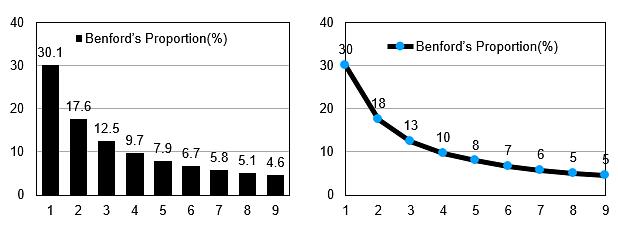

What happens when in a given data set of leading digits, arising from numbers denoting a natural phenomenon, is not in conformity with the law? The answer is simple; there is a very high chance that the data is not reliable either because of inaccurate records or because of manipulation.
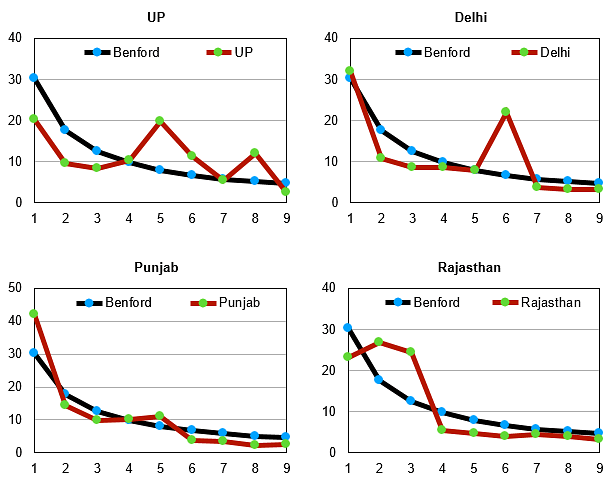
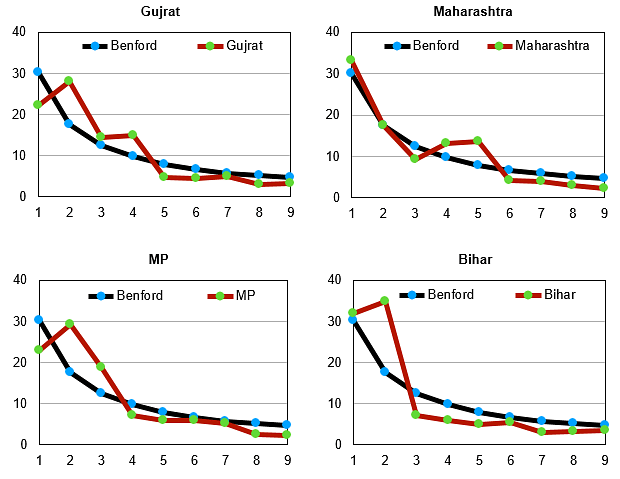
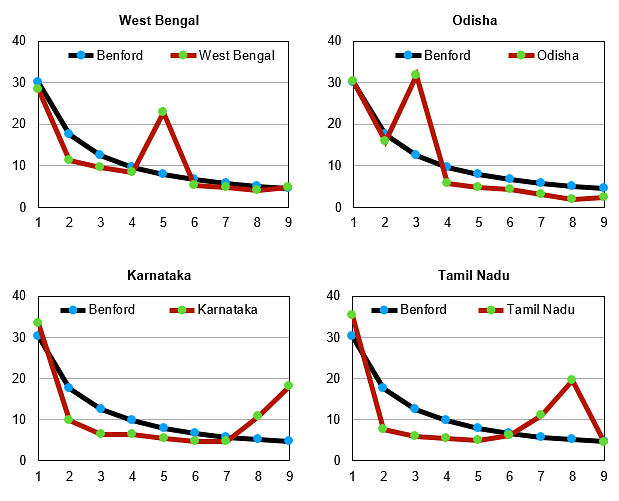
One of the best ways to contrast the actual data against that prescribed by Benford’s Law is visually, through a graph. That is precisely what we shall be doing for all figures in the article. We shall superimpose the curve given by the actual data (always in red) over the standard curve prescribed by Benford’s Law (always in black). The Benford curve shall look like a slide descending from the right to the left. The deviations of the curve representing the actual data vis a vis the Benford’s curve shall reveal unreliability of the data set.
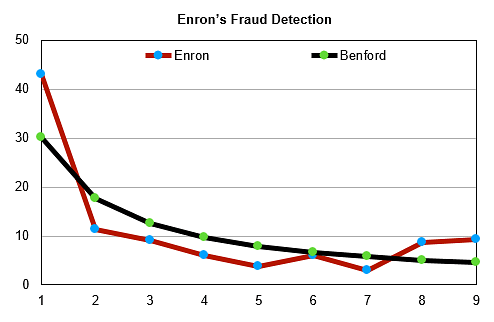
The prowess of the law is best gauged by a look at the financial data of the now defunct former energy giant Enron Corporation. It is now well known that Enron had been fudging its financial data. This can be seen in the figure below where the data curve for Enron’s revenues is a very bad fit over the Benford curve. It is actually a no brainer to infer that Enron had heavily manipulated its financial data as can be seen by the number of significant deviations of the Enron data curve from the standard Benford curve.
Testing Covid data
We have in this article attempted to look at the data arising from Covid-19 cases across countries and across several states of India. Some very interesting insights emerge.
For instance, the global data for Covid-19 daily infections is fairly reliable as it fits Benford’s curve quite nicely.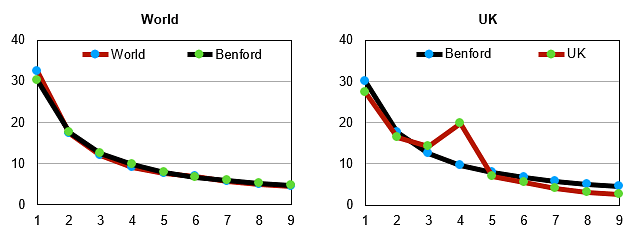
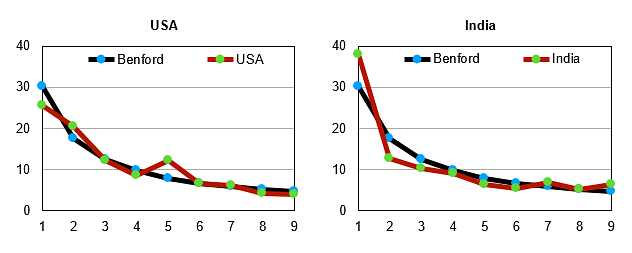
Each of the two graphs (immediately above, clockwise second and fourth) represent the combined data for deaths and infections. The second graph represents UK data and the fourth one gives us US data. Both these graphs are in reasonable conformity with Benford’s curve. The US data seems to be a notch more reliable. Interestingly, the data for the for the UK has some issues since the digit 4 occurs as leading digit far more often than prescribed by the Benford curve. But in general, it is a good fit.
Henceforth we are examining statewide data for India and have merged — for each graph — the data for daily infections, daily deaths and daily recoveries. Thus, if the graph shows deviations from Benford’s Law, the implication will be that at least one of the three recordings of data categories has errors in it. But if this combined data curve fits Benford’s curve, then the inference is that all three sets of data are reliable. Merging the data points for the three categories helps bring greater clarity to the verification.
The India data
When it comes to India, the data for the entire nation has some issues but in general there is a passable fit. We must clarify that this indicates inaccuracy of data but does not necessarily indicate fraudulent recording. However, in general, when it comes to accuracy of data in India — for any kind of data — invariably issues and concerns arise. The sooner India learns the art and science of accurate data keeping the better it shall be for the nation.
Kerala’s data is quite reliable as it fits Benford’s curve quite nicely. Punjab also has fairly accurate data indicated by a very good fit between the Benford curve and the curve for its data. The biggest offenders seem to be Haryana and Uttar Pradesh. The curves for these two states are quite off the mark as can be seen by their graphs. Rajasthan and West Bengal are also not very encouraging. However, the one redeeming feature for so many of these states is the fact that several of their data points do seem to be in conformity with the Benford’s curve. This ultimately helps keep India’s curve in reasonable conformity with Benford’s curve. We leave the question of whether any of this data is fudged to the reader but certainly much of the statewide data is unreliable.
A healthcare worker collects sample for Covid testing. Assam has a caseload of 3.15 lakh and a total of 1,984 people have died of Covid in the state. (Representational image) | PTIDuring this global pandemic, several nations across different geographical regions, have had the accuracy of their Covid-19 data records looked at with a healthy dose of questioning. For instance, even with the best of intentions, some western nations have had difficulties in classifying their Covid-19 data. This does not necessarily imply deliberate misrepresentation of the data on part of the agencies responsible. It is just that a pandemic that has left the world shaken in so many ways will also, doubtless, affect data keeping. At the same time, when it comes to data records, it is of utmost importance to endeavour towards maintaining accuracy to the extent possible.
In such a situation, it is useful to try and gauge the accuracy or reliability of the data through various methods. One such fairly reliable means of measuring the accuracy of numeric data sets is a simple mathematical law that was discovered many decades ago and is generally known as the Benford’s Law. This easy to state and just as easy to understand law deals with gauging the reliability or accuracy of large data sets consisting of numeric data that has occurred in natural or non-artificial ways. In other words, the data set must consist of plenty of numbers and these numbers should have arisen without deliberate interference or manipulation. It is generally accepted that the law is meaningfully applicable in instances where the number of data points is at least 500. Also, the meaning of ‘naturally occurring data’ is best understood through illustrations such as of the type related to stock markets or tax records or population data.
Benford’s Law and its application
The law was discovered, actually rediscovered, by Charles Benford in 1938. To grasp this simple law, we need to understand the meaning of the term ‘leading digit’. Given any number, say 813, its leading or first digit is 8. Obviously, we can have only 9 leading digits in any combination viz. 1, 2, 3, 4, 5, 6, 7, 8 and 9. The law says that given a naturally arising collection of very, many numbers, the number of times each leading digit occurs as a percentage of the entire lot of leading digits is fixed. In other words, in the entire collection of leading digits arising from a naturally occurring collection of numbers associated with a phenomenon, the number 1 must occur about 30 per cent of the time; the digit 2 about 17 per cent of the time and so on in a certain decreasing order for the other 7 digits where 9 occurs 4.6 per cent of the time. Hence, if the data is true then in about 1000 numbers, 1 occurs as a leading digit about 300 times and so on. This is best illustrated through the following precisely stated table and also pictorially by the succeeding graphs.
What happens when in a given data set of leading digits, arising from numbers denoting a natural phenomenon, is not in conformity with the law? The answer is simple; there is a very high chance that the data is not reliable either because of inaccurate records or because of manipulation.
One of the best ways to contrast the actual data against that prescribed by Benford’s Law is visually, through a graph. That is precisely what we shall be doing for all figures in the article. We shall superimpose the curve given by the actual data (always in red) over the standard curve prescribed by Benford’s Law (always in black). The Benford curve shall look like a slide descending from the right to the left. The deviations of the curve representing the actual data vis a vis the Benford’s curve shall reveal unreliability of the data set.
The prowess of the law is best gauged by a look at the financial data of the now defunct former energy giant Enron Corporation. It is now well known that Enron had been fudging its financial data. This can be seen in the figure below where the data curve for Enron’s revenues is a very bad fit over the Benford curve. It is actually a no brainer to infer that Enron had heavily manipulated its financial data as can be seen by the number of significant deviations of the Enron data curve from the standard Benford curve.
Testing Covid data
We have in this article attempted to look at the data arising from Covid-19 cases across countries and across several states of India. Some very interesting insights emerge.
For instance, the global data for Covid-19 daily infections is fairly reliable as it fits Benford’s curve quite nicely.
Each of the two graphs (immediately above, clockwise second and fourth) represent the combined data for deaths and infections. The second graph represents UK data and the fourth one gives us US data. Both these graphs are in reasonable conformity with Benford’s curve. The US data seems to be a notch more reliable. Interestingly, the data for the for the UK has some issues since the digit 4 occurs as leading digit far more often than prescribed by the Benford curve. But in general, it is a good fit.
Henceforth we are examining statewide data for India and have merged — for each graph — the data for daily infections, daily deaths and daily recoveries. Thus, if the graph shows deviations from Benford’s Law, the implication will be that at least one of the three recordings of data categories has errors in it. But if this combined data curve fits Benford’s curve, then the inference is that all three sets of data are reliable. Merging the data points for the three categories helps bring greater clarity to the verification.
The India data
When it comes to India, the data for the entire nation has some issues but in general there is a passable fit. We must clarify that this indicates inaccuracy of data but does not necessarily indicate fraudulent recording. However, in general, when it comes to accuracy of data in India — for any kind of data — invariably issues and concerns arise. The sooner India learns the art and science of accurate data keeping the better it shall be for the nation.
Kerala’s data is quite reliable as it fits Benford’s curve quite nicely. Punjab also has fairly accurate data indicated by a very good fit between the Benford curve and the curve for its data. The biggest offenders seem to be Haryana and Uttar Pradesh. The curves for these two states are quite off the mark as can be seen by their graphs. Rajasthan and West Bengal are also not very encouraging. However, the one redeeming feature for so many of these states is the fact that several of their data points do seem to be in conformity with the Benford’s curve. This ultimately helps keep India’s curve in reasonable conformity with Benford’s curve. We leave the question of whether any of this data is fudged to the reader but certainly much of the statewide data is unreliable.
Israel - A PSYCHOTIC BREAK FROM REALITY?
Nadeem F. Paracha in The Dawn
 Illustration by Abro
The New York Times, in its May 28, 2021 issue, published a collage of photographs of 67 children under the age of 18 who had been killed in the recent Israeli air attacks on Gaza and by Hamas on Tel Aviv. Two of the children had been killed in Israel by shrapnel from rockets fired by Hamas. It is only natural for any normal human being to ask, how can one kill children?
Similar collages appear every year on social media of the over 140 students who were mercilessly gunned down in 2014 at the Army Public School in Peshawar. The killings were carried out by the militant organisation the Tehreek-i-Taliban Pakistan (TTP). Most Pakistanis could not comprehend how even a militant group could massacre school children. But there were also those who questioned why the children were targeted.
The ‘why’ in this context is apparently understood at an individual level when certain individuals sexually assault children and often kill them. Psychologists are of the view that such individuals — paedophiles — are mostly men who have either suffered sexual abuse as children themselves, or are overwhelmed by certain psychological disorders that lead to developing questionable sexual urges.
In the 1982 anthology Behaviour Modification and Therapy, W.L. Marshall writes that paedophilia co-occurs with low self-esteem, depression and other personality disorders. These can be because of the individual’s own experiences as a sexually abused child or, according to the 2008 issue of the Journal of Psychiatric Research, paedophiles may have different brain structures which cause personality disorders and social failings, leading them to develop deviant sexual behaviours.
But why do some paedophiles end up murdering their young victims? This may be to eliminate the possibility of their victims naming them after the assault, or the young victims die because their bodies are still not developed to accommodate even the most basic sexual acts. According to a 1992 study by the Behavioural Science Unit of the Federal Bureau of Investigation (FBI) in the US, some paedophiles can also develop sadism as a disorder, which eventually compels them to derive pleasure by inflicting pain and killing their young victims.
Why did Israel kill so many children in its bombardment of Gaza? Could it be that it has something in common with apocalyptic terror groups, for whom killing children is simply collateral damage in a divinely ordained cosmic battle?
Now the question is, are modern-day governments, militaries and terrorist groups that knowingly massacre children, also driven by the same sadistic impulses? Do they extract pleasure from slaughtering children? It is possible that military massacres that include the death of a large number of children are acts of frustration and blind rage by soldiers made to fight wars that are being lost.
The March 1968 ‘My Lai massacre’, carried out by US soldiers in Vietnam, is a case in point. Over 500 people, including children, were killed in that incident. Even women who were carrying babies in their arms, were shot dead. Just a month earlier, communist insurgents had attacked South Vietnamese cities held by US forces. The insurgents were driven out, but they were able to kill a large number of US soldiers. Also, the war in Vietnam had become unpopular in the US. Soldiers were dismayed by stories about returning US marines being insulted, ridiculed and rejected at home for fighting an unjust and immoral war.
Indeed, desperate armies have been known to kill the most vulnerable members of the enemy, such as children, in an attempt to psychologically compensate for their inability to fight effectively against their adult opponents. But what about the Israeli armed forces? What frustrations are they facing? They have successfully neutralised anti-Israel militancy. And the Palestinians and their supporters are no match against Israel’s war machine. So why did Israeli forces knowingly kill so many Palestinian children in Gaza?
A May 21, 2021 report published on the Al-Jazeera website quotes a Palestinian lawyer, Youssef al-Zayed, as saying that Israeli forces were ‘intentionally targeting minors to terrorise an entire generation from speaking out.’ Ever since 1987, Palestinian children have been in the forefront of protests against armed Israeli forces. The children are often armed with nothing more than stones.
What Israel is doing against its Arab population, and in the Palestinian Territories that are still largely under its control, can be called ‘democide.’ Coined by the American political scientist Rudolph Rummel, the word democide means acts of genocide by a government/ state against a segment of its own population. Such acts constitute the systematic elimination of people belonging to minority religious or ethnic communities. According to Rummel, this is done because the persecuted communities are perceived as being ‘future threats’ by the dominant community.
So, do terrorist outfits such as TTP, Islamic State and Boko Haram, for example, who are known to also target children, do so because they see children as future threats?
In a 2018 essay for the Journal of Strategic Studies, the forensic psychologist Karl Umbrasas writes that terror outfits who kill indiscriminately can be categorised as ‘apocalyptic groups.’ According to Umbrasas, such groups operate like ‘apocalyptic cults’ and are not restrained by the socio-political and moral restraints that compel non-apocalyptic militant outfits to only focus on attacking armed, non-civilian targets. Umbrasas writes that apocalyptic terror groups justify acts of indiscriminate destruction through their often distorted and violent interpretations of sacred texts.
Such groups are thus completely unrepentant about targeting even children. To them the children, too, are part of the problem that they are going to resolve through a ‘cosmic war.’ The idea of a cosmic war constitutes an imagined battle between metaphysical forces — good and evil — that is behind many cases of religion-related violence.
Interestingly, this was also how the Afghan civil war of the 1980s between Islamist groups and Soviet troops was framed by the US, Saudi Arabia and Pakistan. The cosmic bit evaporated for the three states after the departure of Soviet troops, but the idea of the cosmic conflict remained in the minds of various terror groups in the region.
The moral codes of apocalyptic terror groups transcend those of the modern world. So, for example, on May 9 this year, when a terrorist group targeted a girls’ school in Afghanistan, killing 80, it is likely it saw girl students as part of the evil side in the divinely ordained cosmic war that the group imagines itself to be fighting.
This indeed is the result of a psychotic break from reality. But it is a reality that apocalyptic terror outfits do not accept. To them, this reality is a social construct. There is no value of the physical human body in such misshaped metaphysical ideas. Therefore, even if a cosmic war requires the killing of children, it is just the destruction of bodies, no matter what their size.
Illustration by AbroThe New York Times, in its May 28, 2021 issue, published a collage of photographs of 67 children under the age of 18 who had been killed in the recent Israeli air attacks on Gaza and by Hamas on Tel Aviv. Two of the children had been killed in Israel by shrapnel from rockets fired by Hamas. It is only natural for any normal human being to ask, how can one kill children?
Similar collages appear every year on social media of the over 140 students who were mercilessly gunned down in 2014 at the Army Public School in Peshawar. The killings were carried out by the militant organisation the Tehreek-i-Taliban Pakistan (TTP). Most Pakistanis could not comprehend how even a militant group could massacre school children. But there were also those who questioned why the children were targeted.
The ‘why’ in this context is apparently understood at an individual level when certain individuals sexually assault children and often kill them. Psychologists are of the view that such individuals — paedophiles — are mostly men who have either suffered sexual abuse as children themselves, or are overwhelmed by certain psychological disorders that lead to developing questionable sexual urges.
In the 1982 anthology Behaviour Modification and Therapy, W.L. Marshall writes that paedophilia co-occurs with low self-esteem, depression and other personality disorders. These can be because of the individual’s own experiences as a sexually abused child or, according to the 2008 issue of the Journal of Psychiatric Research, paedophiles may have different brain structures which cause personality disorders and social failings, leading them to develop deviant sexual behaviours.
But why do some paedophiles end up murdering their young victims? This may be to eliminate the possibility of their victims naming them after the assault, or the young victims die because their bodies are still not developed to accommodate even the most basic sexual acts. According to a 1992 study by the Behavioural Science Unit of the Federal Bureau of Investigation (FBI) in the US, some paedophiles can also develop sadism as a disorder, which eventually compels them to derive pleasure by inflicting pain and killing their young victims.
Why did Israel kill so many children in its bombardment of Gaza? Could it be that it has something in common with apocalyptic terror groups, for whom killing children is simply collateral damage in a divinely ordained cosmic battle?
Now the question is, are modern-day governments, militaries and terrorist groups that knowingly massacre children, also driven by the same sadistic impulses? Do they extract pleasure from slaughtering children? It is possible that military massacres that include the death of a large number of children are acts of frustration and blind rage by soldiers made to fight wars that are being lost.
The March 1968 ‘My Lai massacre’, carried out by US soldiers in Vietnam, is a case in point. Over 500 people, including children, were killed in that incident. Even women who were carrying babies in their arms, were shot dead. Just a month earlier, communist insurgents had attacked South Vietnamese cities held by US forces. The insurgents were driven out, but they were able to kill a large number of US soldiers. Also, the war in Vietnam had become unpopular in the US. Soldiers were dismayed by stories about returning US marines being insulted, ridiculed and rejected at home for fighting an unjust and immoral war.
Indeed, desperate armies have been known to kill the most vulnerable members of the enemy, such as children, in an attempt to psychologically compensate for their inability to fight effectively against their adult opponents. But what about the Israeli armed forces? What frustrations are they facing? They have successfully neutralised anti-Israel militancy. And the Palestinians and their supporters are no match against Israel’s war machine. So why did Israeli forces knowingly kill so many Palestinian children in Gaza?
A May 21, 2021 report published on the Al-Jazeera website quotes a Palestinian lawyer, Youssef al-Zayed, as saying that Israeli forces were ‘intentionally targeting minors to terrorise an entire generation from speaking out.’ Ever since 1987, Palestinian children have been in the forefront of protests against armed Israeli forces. The children are often armed with nothing more than stones.
What Israel is doing against its Arab population, and in the Palestinian Territories that are still largely under its control, can be called ‘democide.’ Coined by the American political scientist Rudolph Rummel, the word democide means acts of genocide by a government/ state against a segment of its own population. Such acts constitute the systematic elimination of people belonging to minority religious or ethnic communities. According to Rummel, this is done because the persecuted communities are perceived as being ‘future threats’ by the dominant community.
So, do terrorist outfits such as TTP, Islamic State and Boko Haram, for example, who are known to also target children, do so because they see children as future threats?
In a 2018 essay for the Journal of Strategic Studies, the forensic psychologist Karl Umbrasas writes that terror outfits who kill indiscriminately can be categorised as ‘apocalyptic groups.’ According to Umbrasas, such groups operate like ‘apocalyptic cults’ and are not restrained by the socio-political and moral restraints that compel non-apocalyptic militant outfits to only focus on attacking armed, non-civilian targets. Umbrasas writes that apocalyptic terror groups justify acts of indiscriminate destruction through their often distorted and violent interpretations of sacred texts.
Such groups are thus completely unrepentant about targeting even children. To them the children, too, are part of the problem that they are going to resolve through a ‘cosmic war.’ The idea of a cosmic war constitutes an imagined battle between metaphysical forces — good and evil — that is behind many cases of religion-related violence.
Interestingly, this was also how the Afghan civil war of the 1980s between Islamist groups and Soviet troops was framed by the US, Saudi Arabia and Pakistan. The cosmic bit evaporated for the three states after the departure of Soviet troops, but the idea of the cosmic conflict remained in the minds of various terror groups in the region.
The moral codes of apocalyptic terror groups transcend those of the modern world. So, for example, on May 9 this year, when a terrorist group targeted a girls’ school in Afghanistan, killing 80, it is likely it saw girl students as part of the evil side in the divinely ordained cosmic war that the group imagines itself to be fighting.
This indeed is the result of a psychotic break from reality. But it is a reality that apocalyptic terror outfits do not accept. To them, this reality is a social construct. There is no value of the physical human body in such misshaped metaphysical ideas. Therefore, even if a cosmic war requires the killing of children, it is just the destruction of bodies, no matter what their size.
Subscribe to:
Comments (Atom)