Search This Blog

Friday, 15 February 2013

Secret funding helped build vast network of climate denial thinktanks


Anonymous billionaires donated $120m to more than 100 anti-climate groups working to discredit climate change science 

• How Donors Trust distributed millions to anti-climate groups
Funding climate deniersnn :  Americans For Prosperity
Climate sceptic groups are mobilising against Obama’s efforts to act on climate change in his second term. Photograph: Justin Sullivan/Getty Images
Conservative billionaires used a secretive funding route to channel nearly $120m (£77m) to more than 100 groups casting doubt about the science behind climate change, the Guardian has learned.
The funds, doled out between 2002 and 2010, helped build a vast network of thinktanks and activist groups working to a single purpose: to redefine climate change from neutral scientific fact to a highly polarising "wedge issue" for hardcore conservatives.
The millions were routed through two trusts, Donors Trust and the Donors Capital Fund, operating out of a generic town house in the northern Virginia suburbs of Washington DC. Donors Capital caters to those making donations of $1m or more.
Whitney Ball, chief executive of the Donors Trust told the Guardian that her organisation assured wealthy donors that their funds would never by diverted to liberal causes.
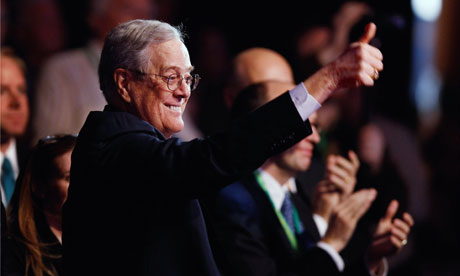
Koch Industries Executive Vice President David H. Koch : Funding climate chang deniers The funding stream far outstripped the support from more visible opponents of climate action such as the oil industry or the conservative billionaire Koch brothers. Photograph: Chip Somodevilla/Getty Images
"We exist to help donors promote liberty which we understand to be limited government, personal responsibility, and free enterprise," she said in an interview.
By definition that means none of the money is going to end up with groups like Greenpeace, she said. "It won't be going to liberals."
Ball won't divulge names, but she said the stable of donors represents a wide range of opinion on the American right. Increasingly over the years, those conservative donors have been pushing funds towards organisations working to discredit climate science or block climate action.
Donors exhibit sharp differences of opinion on many issues, Ball said. They run the spectrum of conservative opinion, from social conservatives to libertarians. But in opposing mandatory cuts to greenhouse gas emissions, they found common ground.
"Are there both sides of an environmental issue? Probably not," she went on. "Here is the thing. If you look at libertarians, you tend to have a lot of differences on things like defence, immigration, drugs, the war, things like that compared to conservatives. When it comes to issues like the environment, if there are differences, they are not nearly as pronounced."
By 2010, the dark money amounted to $118m distributed to 102 thinktanks or action groups which have a record of denying the existence of a human factor in climate change, or opposing environmental regulations.
The money flowed to Washington thinktanks embedded in Republican party politics, obscure policy forums in Alaska and Tennessee, contrarian scientists at Harvard and lesser institutions, even to buy up DVDs of a film attacking Al Gore.
The ready stream of cash set off a conservative backlash against Barack Obama's environmental agenda that wrecked any chance of Congress taking action on climate change.
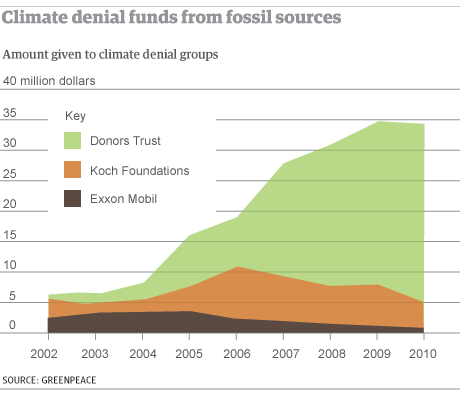
Graphic: climate denial funding Graphic: climate denial funding
Those same groups are now mobilising against Obama's efforts to act on climate change in his second term. A top recipient of the secret funds on Wednesday put out a point-by-point critique of the climate content in the president's state of the union address.
And it was all done with a guarantee of complete anonymity for the donors who wished to remain hidden.
"The funding of the denial machine is becoming increasingly invisible to public scrutiny. It's also growing. Budgets for all these different groups are growing," said Kert Davies, research director of Greenpeace, which compiled the data on funding of the anti-climate groups using tax records.
"These groups are increasingly getting money from sources that are anonymous or untraceable. There is no transparency, no accountability for the money. There is no way to tell who is funding them," Davies said.
The trusts were established for the express purpose of managing donations to a host of conservative causes.
Such vehicles, called donor-advised funds, are not uncommon in America. They offer a number of advantages to wealthy donors. They are convenient, cheaper to run than a private foundation, offer tax breaks and are lawful.
That opposition hardened over the years, especially from the mid-2000s where the Greenpeace record shows a sharp spike in funds to the anti-climate cause.
In effect, the Donors Trust was bankrolling a movement, said Robert Brulle, a Drexel University sociologist who has extensively researched the networks of ultra-conservative donors.
"This is what I call the counter-movement, a large-scale effort that is an organised effort and that is part and parcel of the conservative movement in the United States " Brulle said. "We don't know where a lot of the money is coming from, but we do know that Donors Trust is just one example of the dark money flowing into this effort."
In his view, Brulle said: "Donors Trust is just the tip of a very big iceberg."
The rise of that movement is evident in the funding stream. In 2002, the two trusts raised less than $900,000 for the anti-climate cause. That was a fraction of what Exxon Mobil or the conservative oil billionaire Koch brothers donated to climate sceptic groups that year.
By 2010, the two Donor Trusts between them were channelling just under $30m to a host of conservative organisations opposing climate action or science. That accounted to 46% of all their grants to conservative causes, according to the Greenpeace analysis.
The funding stream far outstripped the support from more visible opponents of climate action such as the oil industry or the conservative billionaire Koch brothers, the records show. When it came to blocking action on the climate crisis, the obscure charity in the suburbs was outspending the Koch brothers by a factor of six to one.
"There is plenty of money coming from elsewhere," said John Mashey, a retired computer executive who has researched funding for climate contrarians. "Focusing on the Kochs gets things confused. You can not ignore the Kochs. They have their fingers in too many things, but they are not the only ones."
It is also possible the Kochs continued to fund their favourite projects using the anonymity offered by Donor Trust.
But the records suggest many other wealthy conservatives opened up their wallets to the anti-climate cause – an impression Ball wishes to stick.
She argued the media had overblown the Kochs support for conservative causes like climate contrarianism over the years. "It's so funny that on the right we think George Soros funds everything, and on the left you guys think it is the evil Koch brothers who are behind everything. It's just not true. If the Koch brothers didn't exist we would still have a very healthy organisation," Ball said.

Thursday, 14 February 2013

When did being lowly paid become a criminal offence?


Increasingly, corporations and politicians treat the poor with distrust. That's why this week's ruling on workfare was important
Matt Kenyon 14022013
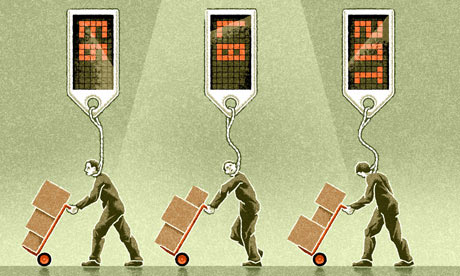
‘In the ruling in favour of Cait Reilly and Jamieson Wilson the judges were clear: these people were treated dishonestly.' Illustration by Matt Kenyon

Inside Amazon's flagship factory in Rugeley, Staffordshire, a new way of working is evolving. There is a strong topnote of distrust, evinced by the full-body scanners that workers have to pass, every time they leave, to prove they haven't stolen anything. The profound insecurity built into the employment model is dressed up as discipline – which is to say, Amazon expects huge seasonal fluctuations in the number of people it needs, yet likes to mask their dismissals behind a misdeameanour, so a lot of people get axed for crimes like being ill. There's a lifesized blonde lady made of cardboard at the entrance, with a think bubble coming out of her head that says, "This is the best job I've ever had!" If that detail alone is enough to make your blood run cold, marry it to the testimony of the chairman of nearby Lea Hall Miners Welfare Centre and Social Club: "The feedback we're getting is that it's like being in a slave camp."

Of all the details revealed by the Financial Times, the one that sank my spirits was the electronic tagging – workers have a handheld device directing them to goods. But these devices also measure their productivity in real time. If they lag behind, the machine bugs them. They are issued with constant warnings not to talk to one another or tarry for any reason. A lot of people find it quite stressful. Call them crazy. (Amazon counters: "Like most companies, we have performance expectations for every Amazon employee, and we measure actual performance against those expectations.")

Meanwhile, in Tesco's Donabate distribution centre in Dublin, workers wearing these tags are awarded percentages for their speediness (100% if they perform a task in the time estimated, 200% if they're twice as fast, and so on), but claim they are docked if they take a loo break; afterwards, they find they have to work much faster – to get back up to their 100%. To put it in context, workers routinely scoring 110% are reported to be sweating quite hard for most of the day. So making up your targets is no walk in the park. Tesco insists that their tag is turned off while workers are in the toilet.

Anybody who's ever worked in a very repetitive, menial job will recognise this suspicious atmosphere – the less enjoyable a job is, the more people there are who suspect you of trying to get out of it. That's reasonable, I suppose, though if people were treated less like robots to begin with, they might not need so much surveillance. But the fabled "innovation" of the private sector never seems to be able to extend itself towards making jobs more self-determining and satisfying. Presumably this is because there's always a danger that self-determining, satisfied people might distinguish themselves in some way, might cease to be interchangeable and might want – indeed, deserve – more than the paltry wage they might be being paid.

But there is innovation here, in a new shamelessness. Let's be honest, tagging is what you do to criminals. Criminals often don't mind this, because the alternative for them is prison. The understanding, however, is that there's already been a significant breakdown of respect between the authority and the person before anybody's movements are electronically monitored. It used to be taken as read that you wouldn't do that to a person until you already had good reason to suspect that they wouldn't tell you the truth.

I am reminded here of the Conservative MP Alec Shelbrooke calling for people's benefits to be delivered on a card, rather than cash, for the easier prohibition of the purchase of booze, fags, Sky+ and trips to Tenerife. Again, the government has form with this idea –certain categories of asylum seeker are given their sustenance on a card, with which they are banned from buying condoms and (obscurely) sanitary products.

A friend of mine stood behind an asylum seeker once while she was turned down for the purchase of some crayons. It's not a system I'd want on my conscience, but its development has some deterrence rationale to it: that is, to make conditions so unpleasant that the bogus claimant gives up of his or her own accord. So when did that become OK – to exclude benefit claimants from the mainstream economy, to humiliate them? Does Shelbrooke hope to deter them all from living here? Where does he propose they go?

What I cannot help noticing is a failure of normal human respect for the people at the bottom of the heap – Tuesday's ruling in favour of Cait Reilly and Jamieson Wilson has had its bones picked over for what it does or doesn't say about slavery, and yet the judges were clear: these people were treated dishonestly. They were treated as though, being unemployed, they could be parcelled about at the whim of the secretary of state.
A similar belief pervades the suggestion that those on benefits need to be ritually humiliated every time they go into a shop; or those on low wages, by dint of their low status, need to be monitored like criminals. Across the piece, having a low financial status is now elided, by politicians and by corporations, with being untrustworthy.

They may have different motives; Shelbrooke is hoping to make political capital out of the contempt in which he holds the poor; Tesco and Amazon's contempt is just a byproduct of their drive for profit. But the wellspring doesn't matter; what matters is that this is a frighteningly divisive worldview.

Wednesday, 13 February 2013

Is compulsory coupledom really the best way to live?


We are in thrall to the amped-up rhetoric of romance, but the primacy of the couple has political and social consequences
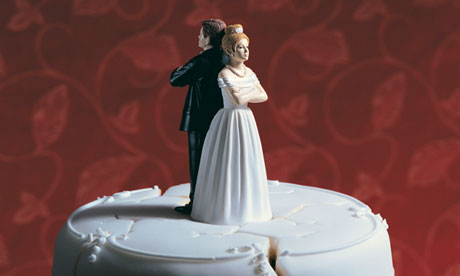
A Wedding Cake, bride and groom standing back to back
'What we rarely do is question whether pairing off into hypothetically permanent monogamous units … are really where we must all want to end up.' Photograph: Mode Images Limited/Alamy
 
Now that parliamentary sanction finally extends to gay couples who wish to marry, could the floor be opened for a different sort of discussion? As the 10 Best Knickers recommendations, the dinner-for-two vouchers, and well-meaning How-to-Survive-Valentine's-Day-If-You-Don't-Have-a-Date advice tumble out of newspaper pullouts and special "love-and-marriage" issues this week, riffing on poet Adrienne Rich's resonant phrase "compulsory heterosexuality", I think we should talk about "compulsory coupledom".

In this country, we tend to flinch at the mention of "arranged marriages", that process whereby family and friends hunt out a compatible mate for you based on social, religious, lifestyle and economic indicators, or at least, offer you one to choose from a bouquet of options they come up with. Yet we are riveted by reality shows or blind date wedding triumphs, which offer us versions of this controlled mate-choosing but accompanied by the amped-up rhetoric of romance, sexual attraction and individual choice. An economist has just written a book about how market principles might be applied to romance, which people find a bit disturbing because we like to tell ourselves that rationality doesn't enter into the process.

Stories of other people's marriages, whether royal, rich and impossibly perfect or dismally toxic and dysfunctional, keep us in thrall. What we rarely do, though, is question whether pairing off into hypothetically permanent monogamous or even serially polygamous units are really where we must all want to end up. Given its less than inspiring statistical showing: a 50% failure rate and that's not counting unhappy marriages that carry on – the ugly end of the Huhne-Pryce marriage provided the depressing counter-notes to the chorus of joy over gay matrimony – should permanent coupledom really continue to be touted as the best possible way of organising our emotional, sexual and social lives? With tax breaks likely for all who obtain state-regulated matrimony, gay or straight, and with pressure to extend civil partnerships to straight couples – are there any dissident relationship possibilities left?

In her bracing polemic, Against Love – required reading for anyone desperately seeking an antidote to this week's excesses of retail heavy breathing – Laura Kipnis observes that refusing to participate in the required regimen of modern love and its elevation of the couple form is seen as both tragic and abnormal. To not conform willingly to the curiously uniform arrangements of modern coupledom is to be not so much dissident – you are certainly not accorded the dignity of choice – as either psychologically deficient or, in benevolent Channel 4 lingo, "undateable" (though that can be remedied, they say). Labour-intensive mantras now permeate the language of relationships. To refuse to "work" on achieving or preserving couple status is to be an irresponsible skiver, an emotional benefits cheat who undermines the social good.

To question the unchallenged primacy of the couple form isn't about advocating 60s-style "free love" or hip polyamory (itself not necessarily a radical option). Human beings, after all, have infinite ways of expressing love and being committed to ideals. But the way we are made to think about the right ways to love and establish relationships has decisive social and political consequences. It is unlikely to be an accident that a government that wishes to be seen as progressive in its extension of traditional matrimonial domesticity to all, seeks at the same time to viciously target those who are simultaneously economically vulnerable and living outside of the cosy middle-class ideal of two parents with a small posse of putatively well-behaved children. The disgrace that is the bedroom tax will overwhelmingly penalise those whose domestic arrangements fall outside of the idealised format – single parents, the widowed, the elderly, the disabled and carers.

The narrowly defined "love" and "commitment" touted by David Cameron and his ministers is so severely contingent on economic privilege and security that it is nothing more than rampant individualism in pairs with the recommended option of reproducing. You can certainly choose to be single if you can pull it off economically – no mean feat. The most gutting Valentine you will read this year is to Cameron from a fibromyalgia patient called Julia Jones who will now lose the 1.5-bedroom bungalow she shared with her husband who died of cancer and whose ashes are buried in the garden. Childless and living on £70 a week, she cannot afford the punitive tax to stay on and retain her loving local support network.

It is a given that people should be able to love whom and how they want and if pairing off for any length of time is what appeals, then that's fine. But it's time that coupledom stopped being touted as the best option, an idea reinforced not just by state approval and resource allocation, but also by religion, the market, popular culture, assorted therapists and our own anxieties.

Resisting the consolidation of invidious forms of social exclusion, it's time to get beyond the notion that yoking together love, coupling, marriage and reproduction is the only way to achieve happiness. The scare stories about single people dying earlier or loneliness becoming a pandemic must be seen in the larger context of a social order that is hostile to non-couples and an economic order to which the collective good seems to be anathema. Our own imaginations – and hearts – can come up with better.

Relax! You’ll Be More Productive


THINK for a moment about your typical workday. Do you wake up tired? Check your e-mail before you get out of bed? Skip breakfast or grab something on the run that’s not particularly nutritious? Rarely get away from your desk for lunch? Run from meeting to meeting with no time in between? Find it nearly impossible to keep up with the volume of e-mail you receive? Leave work later than you’d like, and still feel compelled to check e-mail in the evenings? 

Golden Cosmos
Golden Cosmos
More and more of us find ourselves unable to juggle overwhelming demands and maintain a seemingly unsustainable pace. Paradoxically, the best way to get more done may be to spend more time doing less. A new and growing body of multidisciplinary research shows that strategic renewal — including daytime workouts, short afternoon naps, longer sleep hours, more time away from the office and longer, more frequent vacations — boosts productivity, job performance and, of course, health. 

“More, bigger, faster.” This, the ethos of the market economies since the Industrial Revolution, is grounded in a mythical and misguided assumption — that our resources are infinite.

Time is the resource on which we’ve relied to get more accomplished. When there’s more to do, we invest more hours. But time is finite, and many of us feel we’re running out, that we’re investing as many hours as we can while trying to retain some semblance of a life outside work.

Although many of us can’t increase the working hours in the day, we can measurably increase our energy. Science supplies a useful way to understand the forces at play here. Physicists understand energy as the capacity to do work. Like time, energy is finite; but unlike time, it is renewable. Taking more time off is counterintuitive for most of us. The idea is also at odds with the prevailing work ethic in most companies, where downtime is typically viewed as time wasted. More than one-third of employees, for example, eat lunch at their desks on a regular basis. More than 50 percent assume they’ll work during their vacations.

In most workplaces, rewards still accrue to those who push the hardest and most continuously over time. But that doesn’t mean they’re the most productive.

Spending more hours at work often leads to less time for sleep and insufficient sleep takes a substantial toll on performance. In a study of nearly 400 employees, published last year, researchers found that sleeping too little — defined as less than six hours each night — was one of the best predictors of on-the-job burn-out. A recent Harvard study estimated that sleep deprivation costs American companies $63.2 billion a year in lost productivity.

The Stanford researcher Cheri D. Mah found that when she got male basketball players to sleep 10 hours a night, their performances in practice dramatically improved: free-throw and three-point shooting each increased by an average of 9 percent.

Daytime naps have a similar effect on performance. When night shift air traffic controllers were given 40 minutes to nap — and slept an average of 19 minutes — they performed much better on tests that measured vigilance and reaction time.

Longer naps have an even more profound impact than shorter ones. Sara C. Mednick, a sleep researcher at the University of California, Riverside, found that a 60- to 90-minute nap improved memory test results as fully as did eight hours of sleep.

MORE vacations are similarly beneficial. In 2006, the accounting firm Ernst & Young did an internal study of its employees and found that for each additional 10 hours of vacation employees took, their year-end performance ratings from supervisors (on a scale of one to five) improved by 8 percent. Frequent vacationers were also significantly less likely to leave the firm.

As athletes understand especially well, the greater the performance demand, the greater the need for renewal. When we’re under pressure, however, most of us experience the opposite impulse: to push harder rather than rest. This may explain why a recent survey by Harris Interactive found that Americans left an average of 9.2 vacation days unused in 2012 — up from 6.2 days in 2011.

The importance of restoration is rooted in our physiology. Human beings aren’t designed to expend energy continuously. Rather, we’re meant to pulse between spending and recovering energy.

In the 1950s, the researchers William Dement and Nathaniel Kleitman discovered that we sleep in cycles of roughly 90 minutes, moving from light to deep sleep and back out again. They named this pattern the Basic-Rest Activity Cycle or BRAC. A decade later, Professor Kleitman discovered that this cycle recapitulates itself during our waking lives.

The difference is that during the day we move from a state of alertness progressively into physiological fatigue approximately every 90 minutes. Our bodies regularly tell us to take a break, but we often override these signals and instead stoke ourselves up with caffeine, sugar and our own emergency reserves — the stress hormones adrenaline, noradrenaline and cortisol.

Working in 90-minute intervals turns out to be a prescription for maximizing productivity. Professor K. Anders Ericsson and his colleagues at Florida State University have studied elite performers, including musicians, athletes, actors and chess players. In each of these fields, Dr. Ericsson found that the best performers typically practice in uninterrupted sessions that last no more than 90 minutes. They begin in the morning, take a break between sessions, and rarely work for more than four and a half hours in any given day.

“To maximize gains from long-term practice,” Dr. Ericsson concluded, “individuals must avoid exhaustion and must limit practice to an amount from which they can completely recover on a daily or weekly basis.”

I’ve systematically built these principles into the way I write. For my first three books, I sat at my desk for up 10 hours a day. Each of the books took me at least a year to write. For my two most recent books, I wrote in three uninterrupted 90-minute sessions — beginning first thing in the morning, when my energy was highest — and took a break after each one.

Along the way, I learned that it’s not how long, but how well, you renew that matters most in terms of performance. Even renewal requires practice. The more rapidly and deeply I learned to quiet my mind and relax my body, the more restored I felt afterward. For one of the breaks, I ran. This generated mental and emotional renewal, but also turned out to be a time in which some of my best ideas came to me, unbidden. Writing just four and half hours a day, I completed both books in less than six months and spent my afternoons on less demanding work.

The power of renewal was so compelling to me that I’ve created a business around it that helps a range of companies including Google, Coca-Cola, Green Mountain Coffee, the Los Angeles Police Department, Cleveland Clinic and Genentech.

Our own offices are a laboratory for the principles we teach. Renewal is central to how we work. We dedicated space to a “renewal” room in which employees can nap, meditate or relax. We have a spacious lounge where employees hang out together and snack on healthy foods we provide. We encourage workers to take renewal breaks throughout the day, and to leave the office for lunch, which we often do together. We allow people to work from home several days a week, in part so they can avoid debilitating rush-hour commutes. Our workdays end at 6 p.m. and we don’t expect anyone to answer e-mail in the evenings or on the weekends. Employees receive four weeks of vacation from their first year.

Our basic idea is that the energy employees bring to their jobs is far more important in terms of the value of their work than is the number of hours they work. By managing energy more skillfully, it’s possible to get more done, in less time, more sustainably. In a decade, no one has ever chosen to leave the company. Our secret is simple — and generally applicable. When we’re renewing, we’re truly renewing, so when we’re working, we can really work.

Do You Suffer From Decision Fatigue?


Three men doing time in Israeli prisons recently appeared before a parole board consisting of a judge, a criminologist and a social worker. The three prisoners had completed at least two-thirds of their sentences, but the parole board granted freedom to only one of them. Guess which one:
 

Why You Need to Sleep On It

Suffering from decision fatigue? You may be expending your finite amount of willpower too early in the day.
 
Case 1 (heard at 8:50 a.m.): An Arab Israeli serving a 30-month sentence for fraud.
Case 2 (heard at 3:10 p.m.): A Jewish Israeli serving a 16-month sentence for assault.
Case 3 (heard at 4:25 p.m.): An Arab Israeli serving a 30-month sentence for fraud.

There was a pattern to the parole board’s decisions, but it wasn’t related to the men’s ethnic backgrounds, crimes or sentences. It was all about timing, as researchers discovered by analyzing more than 1,100 decisions over the course of a year. Judges, who would hear the prisoners’ appeals and then get advice from the other members of the board, approved parole in about a third of the cases, but the probability of being paroled fluctuated wildly throughout the day. Prisoners who appeared early in the morning received parole about 70 percent of the time, while those who appeared late in the day were paroled less than 10 percent of the time.

The odds favored the prisoner who appeared at 8:50 a.m. — and he did in fact receive parole. But even though the other Arab Israeli prisoner was serving the same sentence for the same crime — fraud — the odds were against him when he appeared (on a different day) at 4:25 in the afternoon. He was denied parole, as was the Jewish Israeli prisoner at 3:10 p.m, whose sentence was shorter than that of the man who was released. They were just asking for parole at the wrong time of day.

There was nothing malicious or even unusual about the judges’ behavior, which was reported earlier this year by Jonathan Levav of Stanford and Shai Danziger of Ben-Gurion University. The judges’ erratic judgment was due to the occupational hazard of being, as George W. Bush once put it, “the decider.” The mental work of ruling on case after case, whatever the individual merits, wore them down. This sort of decision fatigue can make quarterbacks prone to dubious choices late in the game and C.F.O.’s prone to disastrous dalliances late in the evening. It routinely warps the judgment of everyone, executive and nonexecutive, rich and poor — in fact, it can take a special toll on the poor. Yet few people are even aware of it, and researchers are only beginning to understand why it happens and how to counteract it.

Decision fatigue helps explain why ordinarily sensible people get angry at colleagues and families, splurge on clothes, buy junk food at the supermarket and can’t resist the dealer’s offer to rustproof their new car. No matter how rational and high-minded you try to be, you can’t make decision after decision without paying a biological price. It’s different from ordinary physical fatigue — you’re not consciously aware of being tired — but you’re low on mental energy. The more choices you make throughout the day, the harder each one becomes for your brain, and eventually it looks for shortcuts, usually in either of two very different ways. One shortcut is to become reckless: to act impulsively instead of expending the energy to first think through the consequences. (Sure, tweet that photo! What could go wrong?) The other shortcut is the ultimate energy saver: do nothing. Instead of agonizing over decisions, avoid any choice. Ducking a decision often creates bigger problems in the long run, but for the moment, it eases the mental strain. You start to resist any change, any potentially risky move — like releasing a prisoner who might commit a crime. So the fatigued judge on a parole board takes the easy way out, and the prisoner keeps doing time.
 
Decision fatigue is the newest discovery involving a phenomenon called ego depletion, a term coined by the social psychologist Roy F. Baumeister in homage to a Freudian hypothesis. Freud speculated that the self, or ego, depended on mental activities involving the transfer of energy. He was vague about the details, though, and quite wrong about some of them (like his idea that artists “sublimate” sexual energy into their work, which would imply that adultery should be especially rare at artists’ colonies). Freud’s energy model of the self was generally ignored until the end of the century, when Baumeister began studying mental discipline in a series of experiments, first at Case Western and then at Florida State University.

These experiments demonstrated that there is a finite store of mental energy for exerting self-control. When people fended off the temptation to scarf down M&M’s or freshly baked chocolate-chip cookies, they were then less able to resist other temptations. When they forced themselves to remain stoic during a tearjerker movie, afterward they gave up more quickly on lab tasks requiring self-discipline, like working on a geometry puzzle or squeezing a hand-grip exerciser. Willpower turned out to be more than a folk concept or a metaphor. It really was a form of mental energy that could be exhausted. The experiments confirmed the 19th-century notion of willpower being like a muscle that was fatigued with use, a force that could be conserved by avoiding temptation. To study the process of ego depletion, researchers concentrated initially on acts involving self-control ­— the kind of self-discipline popularly associated with willpower, like resisting a bowl of ice cream. They weren’t concerned with routine decision-making, like choosing between chocolate and vanilla, a mental process that they assumed was quite distinct and much less strenuous. Intuitively, the chocolate-vanilla choice didn’t appear to require willpower.

But then a postdoctoral fellow, Jean Twenge, started working at Baumeister’s laboratory right after planning her wedding. As Twenge studied the results of the lab’s ego-depletion experiments, she remembered how exhausted she felt the evening she and her fiancé went through the ritual of registering for gifts. Did they want plain white china or something with a pattern? Which brand of knives? How many towels? What kind of sheets? Precisely how many threads per square inch?
“By the end, you could have talked me into anything,” Twenge told her new colleagues. The symptoms sounded familiar to them too, and gave them an idea. A nearby department store was holding a going-out-of-business sale, so researchers from the lab went off to fill their car trunks with simple products — not exactly wedding-quality gifts, but sufficiently appealing to interest college students. When they came to the lab, the students were told they would get to keep one item at the end of the experiment, but first they had to make a series of choices. Would they prefer a pen or a candle? A vanilla-scented candle or an almond-scented one? A candle or a T-shirt? A black T-shirt or a red T-shirt? A control group, meanwhile — let’s call them the nondeciders — spent an equally long period contemplating all these same products without having to make any choices. They were asked just to give their opinion of each product and report how often they had used such a product in the last six months.

Afterward, all the participants were given one of the classic tests of self-control: holding your hand in ice water for as long as you can. The impulse is to pull your hand out, so self-discipline is needed to keep the hand underwater. The deciders gave up much faster; they lasted 28 seconds, less than half the 67-second average of the nondeciders. Making all those choices had apparently sapped their willpower, and it wasn’t an isolated effect. It was confirmed in other experiments testing students after they went through exercises like choosing courses from the college catalog.

For a real-world test of their theory, the lab’s researchers went into that great modern arena of decision making: the suburban mall. They interviewed shoppers about their experiences in the stores that day and then asked them to solve some simple arithmetic problems. The researchers politely asked them to do as many as possible but said they could quit at any time. Sure enough, the shoppers who had already made the most decisions in the stores gave up the quickest on the math problems. When you shop till you drop, your willpower drops, too.
 
Any decision, whether it’s what pants to buy or whether to start a war, can be broken down into what psychologists call the Rubicon model of action phases, in honor of the river that separated Italy from the Roman province of Gaul. When Caesar reached it in 49 B.C., on his way home after conquering the Gauls, he knew that a general returning to Rome was forbidden to take his legions across the river with him, lest it be considered an invasion of Rome. Waiting on the Gaul side of the river, he was in the “predecisional phase” as he contemplated the risks and benefits of starting a civil war. Then he stopped calculating and crossed the Rubicon, reaching the “postdecisional phase,” which Caesar defined much more felicitously: “The die is cast.”

The whole process could deplete anyone’s willpower, but which phase of the decision-making process was most fatiguing? To find out, Kathleen Vohs, a former colleague of Baumeister’s now at the University of Minnesota, performed an experiment using the self-service Web site of Dell Computers. One group in the experiment carefully studied the advantages and disadvantages of various features available for a computer — the type of screen, the size of the hard drive, etc. — without actually making a final decision on which ones to choose. A second group was given a list of predetermined specifications and told to configure a computer by going through the laborious, step-by-step process of locating the specified features among the arrays of options and then clicking on the right ones. The purpose of this was to duplicate everything that happens in the postdecisional phase, when the choice is implemented. The third group had to figure out for themselves which features they wanted on their computers and go through the process of choosing them; they didn’t simply ponder options (like the first group) or implement others’ choices (like the second group). They had to cast the die, and that turned out to be the most fatiguing task of all. When self-control was measured, they were the one who were most depleted, by far.

The experiment showed that crossing the Rubicon is more tiring than anything that happens on either bank — more mentally fatiguing than sitting on the Gaul side contemplating your options or marching on Rome once you’ve crossed. As a result, someone without Caesar’s willpower is liable to stay put. To a fatigued judge, denying parole seems like the easier call not only because it preserves the status quo and eliminates the risk of a parolee going on a crime spree but also because it leaves more options open: the judge retains the option of paroling the prisoner at a future date without sacrificing the option of keeping him securely in prison right now. Part of the resistance against making decisions comes from our fear of giving up options. The word “decide” shares an etymological root with “homicide,” the Latin word “caedere,” meaning “to cut down” or “to kill,” and that loss looms especially large when decision fatigue sets in.

Once you’re mentally depleted, you become reluctant to make trade-offs, which involve a particularly advanced and taxing form of decision making. In the rest of the animal kingdom, there aren’t a lot of protracted negotiations between predators and prey. To compromise is a complex human ability and therefore one of the first to decline when willpower is depleted. You become what researchers call a cognitive miser, hoarding your energy. If you’re shopping, you’re liable to look at only one dimension, like price: just give me the cheapest. Or you indulge yourself by looking at quality: I want the very best (an especially easy strategy if someone else is paying). Decision fatigue leaves you vulnerable to marketers who know how to time their sales, as Jonathan Levav, the Stanford professor, demonstrated in experiments involving tailored suits and new cars.

The idea for these experiments also happened to come in the preparations for a wedding, a ritual that seems to be the decision-fatigue equivalent of Hell Week. At his fiancée’s suggestion, Levav visited a tailor to have a bespoke suit made and began going through the choices of fabric, type of lining and style of buttons, lapels, cuffs and so forth.

“By the time I got through the third pile of fabric swatches, I wanted to kill myself,” Levav recalls. “I couldn’t tell the choices apart anymore. After a while my only response to the tailor became ‘What do you recommend?’ I just couldn’t take it.”

Levav ended up not buying any kind of bespoke suit (the $2,000 price made that decision easy enough), but he put the experience to use in a pair of experiments conducted with Mark Heitmann, then at Christian-Albrechts University in Germany; Andreas Herrmann, at the University of St. Gallen in Switzerland; and Sheena Iyengar, of Columbia. One involved asking M.B.A. students in Switzerland to choose a bespoke suit; the other was conducted at German car dealerships, where customers ordered options for their new sedans. The car buyers — and these were real customers spending their own money — had to choose, for instance, among 4 styles of gearshift knobs, 13 kinds of wheel rims, 25 configurations of the engine and gearbox and a palette of 56 colors for the interior.
As they started picking features, customers would carefully weigh the choices, but as decision fatigue set in, they would start settling for whatever the default option was. And the more tough choices they encountered early in the process — like going through those 56 colors to choose the precise shade of gray or brown — the quicker people became fatigued and settled for the path of least resistance by taking the default option. By manipulating the order of the car buyers’ choices, the researchers found that the customers would end up settling for different kinds of options, and the average difference totaled more than 1,500 euros per car (about $2,000 at the time). Whether the customers paid a little extra for fancy wheel rims or a lot extra for a more powerful engine depended on when the choice was offered and how much willpower was left in the customer.

Similar results were found in the experiment with custom-made suits: once decision fatigue set in, people tended to settle for the recommended option. When they were confronted early on with the toughest decisions — the ones with the most options, like the 100 fabrics for the suit — they became fatigued more quickly and also reported enjoying the shopping experience less.
 
Shopping can be especially tiring for the poor, who have to struggle continually with trade-offs. Most of us in America won’t spend a lot of time agonizing over whether we can afford to buy soap, but it can be a depleting choice in rural India. Dean Spears, an economist at Princeton, offered people in 20 villages in Rajasthan in northwestern India the chance to buy a couple of bars of brand-name soap for the equivalent of less than 20 cents. It was a steep discount off the regular price, yet even that sum was a strain for the people in the 10 poorest villages. Whether or not they bought the soap, the act of making the decision left them with less willpower, as measured afterward in a test of how long they could squeeze a hand grip. In the slightly more affluent villages, people’s willpower wasn’t affected significantly. Because they had more money, they didn’t have to spend as much effort weighing the merits of the soap versus, say, food or medicine.

Spears and other researchers argue that this sort of decision fatigue is a major — and hitherto ignored — factor in trapping people in poverty. Because their financial situation forces them to make so many trade-offs, they have less willpower to devote to school, work and other activities that might get them into the middle class. It’s hard to know exactly how important this factor is, but there’s no doubt that willpower is a special problem for poor people. Study after study has shown that low self-control correlates with low income as well as with a host of other problems, including poor achievement in school, divorce, crime, alcoholism and poor health. Lapses in self-control have led to the notion of the “undeserving poor” — epitomized by the image of the welfare mom using food stamps to buy junk food — but Spears urges sympathy for someone who makes decisions all day on a tight budget. In one study, he found that when the poor and the rich go shopping, the poor are much more likely to eat during the shopping trip. This might seem like confirmation of their weak character — after all, they could presumably save money and improve their nutrition by eating meals at home instead of buying ready-to-eat snacks like Cinnabons, which contribute to the higher rate of obesity among the poor. But if a trip to the supermarket induces more decision fatigue in the poor than in the rich — because each purchase requires more mental trade-offs — by the time they reach the cash register, they’ll have less willpower left to resist the Mars bars and Skittles. Not for nothing are these items called impulse purchases.

And this isn’t the only reason that sweet snacks are featured prominently at the cash register, just when shoppers are depleted after all their decisions in the aisles. With their willpower reduced, they’re more likely to yield to any kind of temptation, but they’re especially vulnerable to candy and soda and anything else offering a quick hit of sugar. While supermarkets figured this out a long time ago, only recently did researchers discover why.
 
The discovery was an accident resulting from a failed experiment at Baumeister’s lab. The researchers set out to test something called the Mardi Gras theory — the notion that you could build up willpower by first indulging yourself in pleasure, the way Mardi Gras feasters do just before the rigors of Lent. In place of a Fat Tuesday breakfast, the chefs in the lab at Florida State whipped up lusciously thick milkshakes for a group of subjects who were resting in between two laboratory tasks requiring willpower. Sure enough, the delicious shakes seemed to strengthen willpower by helping people perform better than expected on the next task. So far, so good. But the experiment also included a control group of people who were fed a tasteless concoction of low-fat dairy glop. It provided them with no pleasure, yet it produced similar improvements in self-control. The Mardi Gras theory looked wrong. Besides tragically removing an excuse for romping down the streets of New Orleans, the result was embarrassing for the researchers. Matthew Gailliot, the graduate student who ran the study, stood looking down at his shoes as he told Baumeister about the fiasco.

Baumeister tried to be optimistic. Maybe the study wasn’t a failure. Something had happened, after all. Even the tasteless glop had done the job, but how? If it wasn’t the pleasure, could it be the calories? At first the idea seemed a bit daft. For decades, psychologists had been studying performance on mental tasks without worrying much about the results being affected by dairy-product consumption. They liked to envision the human mind as a computer, focusing on the way it processed information. In their eagerness to chart the human equivalent of the computer’s chips and circuits, most psychologists neglected one mundane but essential part of the machine: the power supply. The brain, like the rest of the body, derived energy from glucose, the simple sugar manufactured from all kinds of foods. To establish cause and effect, researchers at Baumeister’s lab tried refueling the brain in a series of experiments involving lemonade mixed either with sugar or with a diet sweetener. The sugary lemonade provided a burst of glucose, the effects of which could be observed right away in the lab; the sugarless variety tasted quite similar without providing the same burst of glucose. Again and again, the sugar restored willpower, but the artificial sweetener had no effect. The glucose would at least mitigate the ego depletion and sometimes completely reverse it.

The restored willpower improved people’s self-control as well as the quality of their decisions: they resisted irrational bias when making choices, and when asked to make financial decisions, they were more likely to choose the better long-term strategy instead of going for a quick payoff. The ego-depletion effect was even demonstrated with dogs in two studies by Holly Miller and Nathan DeWall at the University of Kentucky. After obeying sit and stay commands for 10 minutes, the dogs performed worse on self-control tests and were also more likely to make the dangerous decision to challenge another dog’s turf. But a dose of glucose restored their willpower.

Despite this series of findings, brain researchers still had some reservations about the glucose connection. Skeptics pointed out that the brain’s overall use of energy remains about the same regardless of what a person is doing, which doesn’t square easily with the notion of depleted energy affecting willpower. Among the skeptics was Todd Heatherton, who worked with Baumeister early in his career and eventually wound up at Dartmouth, where he became a pioneer of what is called social neuroscience: the study of links between brain processes and social behavior. He believed in ego depletion, but he didn’t see how this neural process could be caused simply by variations in glucose levels. To observe the process — and to see if it could be reversed by glucose — he and his colleagues recruited 45 female dieters and recorded images of their brains as they reacted to pictures of food. Next the dieters watched a comedy video while forcing themselves to suppress their laughter — a standard if cruel way to drain mental energy and induce ego depletion. Then they were again shown pictures of food, and the new round of brain scans revealed the effects of ego depletion: more activity in the nucleus accumbens, the brain’s reward center, and a corresponding decrease in the amygdala, which ordinarily helps control impulses. The food’s appeal registered more strongly while impulse control weakened — not a good combination for anyone on a diet. But suppose people in this ego-depleted state got a quick dose of glucose? What would a scan of their brains reveal?

The results of the experiment were announced in January, during Heatherton’s speech accepting the leadership of the Society for Personality and Social Psychology, the world’s largest group of social psychologists. In his presidential address at the annual meeting in San Antonio, Heatherton reported that administering glucose completely reversed the brain changes wrought by depletion — a finding, he said, that thoroughly surprised him. Heatherton’s results did much more than provide additional confirmation that glucose is a vital part of willpower; they helped solve the puzzle over how glucose could work without global changes in the brain’s total energy use. Apparently ego depletion causes activity to rise in some parts of the brain and to decline in others. Your brain does not stop working when glucose is low. It stops doing some things and starts doing others. It responds more strongly to immediate rewards and pays less attention to long-term prospects.

The discoveries about glucose help explain why dieting is a uniquely difficult test of self-control — and why even people with phenomenally strong willpower in the rest of their lives can have such a hard time losing weight. They start out the day with virtuous intentions, resisting croissants at breakfast and dessert at lunch, but each act of resistance further lowers their willpower. As their willpower weakens late in the day, they need to replenish it. But to resupply that energy, they need to give the body glucose. They’re trapped in a nutritional catch-22:

1. In order not to eat, a dieter needs willpower.
2. In order to have willpower, a dieter needs to eat.

As the body uses up glucose, it looks for a quick way to replenish the fuel, leading to a craving for sugar. After performing a lab task requiring self-control, people tend to eat more candy but not other kinds of snacks, like salty, fatty potato chips. The mere expectation of having to exert self-control makes people hunger for sweets. A similar effect helps explain why many women yearn for chocolate and other sugary treats just before menstruation: their bodies are seeking a quick replacement as glucose levels fluctuate. A sugar-filled snack or drink will provide a quick improvement in self-control (that’s why it’s convenient to use in experiments), but it’s just a temporary solution. The problem is that what we identify as sugar doesn’t help as much over the course of the day as the steadier supply of glucose we would get from eating proteins and other more nutritious foods.

The benefits of glucose were unmistakable in the study of the Israeli parole board. In midmorning, usually a little before 10:30, the parole board would take a break, and the judges would be served a sandwich and a piece of fruit. The prisoners who appeared just before the break had only about a 20 percent chance of getting parole, but the ones appearing right after had around a 65 percent chance. The odds dropped again as the morning wore on, and prisoners really didn’t want to appear just before lunch: the chance of getting parole at that time was only 10 percent. After lunch it soared up to 60 percent, but only briefly. Remember that Jewish Israeli prisoner who appeared at 3:10 p.m. and was denied parole from his sentence for assault? He had the misfortune of being the sixth case heard after lunch. But another Jewish Israeli prisoner serving the same sentence for the same crime was lucky enough to appear at 1:27 p.m., the first case after lunch, and he was rewarded with parole. It must have seemed to him like a fine example of the justice system at work, but it probably had more to do with the judge’s glucose levels.
 
It’s simple enough to imagine reforms for the parole board in Israel — like, say, restricting each judge’s shift to half a day, preferably in the morning, interspersed with frequent breaks for food and rest. But it’s not so obvious what to do with the decision fatigue affecting the rest of society. Even if we could all afford to work half-days, we would still end up depleting our willpower all day long, as Baumeister and his colleagues found when they went into the field in Würzburg in central Germany. The psychologists gave preprogrammed BlackBerrys to more than 200 people going about their daily routines for a week. The phones went off at random intervals, prompting the people to report whether they were currently experiencing some sort of desire or had recently felt a desire. The painstaking study, led by Wilhelm Hofmann, then at the University of Würzburg, collected more than 10,000 momentary reports from morning until midnight.

Desire turned out to be the norm, not the exception. Half the people were feeling some desire when their phones went off — to snack, to goof off, to express their true feelings to their bosses — and another quarter said they had felt a desire in the past half-hour. Many of these desires were ones that the men and women were trying to resist, and the more willpower people expended, the more likely they became to yield to the next temptation that came along. When faced with a new desire that produced some I-want-to-but-I-really-shouldn’t sort of inner conflict, they gave in more readily if they had already fended off earlier temptations, particularly if the new temptation came soon after a previously reported one.

The results suggested that people spend between three and four hours a day resisting desire. Put another way, if you tapped four or five people at any random moment of the day, one of them would be using willpower to resist a desire. The most commonly resisted desires in the phone study were the urges to eat and sleep, followed by the urge for leisure, like taking a break from work by doing a puzzle or playing a game instead of writing a memo. Sexual urges were next on the list of most-resisted desires, a little ahead of urges for other kinds of interactions, like checking Facebook. To ward off temptation, people reported using various strategies. The most popular was to look for a distraction or to undertake a new activity, although sometimes they tried suppressing it directly or simply toughing their way through it. Their success was decidedly mixed. They were pretty good at avoiding sleep, sex and the urge to spend money, but not so good at resisting the lure of television or the Web or the general temptation to relax instead of work.

We have no way of knowing how much our ancestors exercised self-control in the days before BlackBerrys and social psychologists, but it seems likely that many of them were under less ego-depleting strain. When there were fewer decisions, there was less decision fatigue. Today we feel overwhelmed because there are so many choices. Your body may have dutifully reported to work on time, but your mind can escape at any instant. A typical computer user looks at more than three dozen Web sites a day and gets fatigued by the continual decision making — whether to keep working on a project, check out TMZ, follow a link to YouTube or buy something on Amazon. You can do enough damage in a 10-minute online shopping spree to wreck your budget for the rest of the year.

The cumulative effect of these temptations and decisions isn’t intuitively obvious. Virtually no one has a gut-level sense of just how tiring it is to decide. Big decisions, small decisions, they all add up. Choosing what to have for breakfast, where to go on vacation, whom to hire, how much to spend — these all deplete willpower, and there’s no telltale symptom of when that willpower is low. It’s not like getting winded or hitting the wall during a marathon. Ego depletion manifests itself not as one feeling but rather as a propensity to experience everything more intensely. When the brain’s regulatory powers weaken, frustrations seem more irritating than usual. Impulses to eat, drink, spend and say stupid things feel more powerful (and alcohol causes self-control to decline further). Like those dogs in the experiment, ego-depleted humans become more likely to get into needless fights over turf. In making decisions, they take illogical shortcuts and tend to favor short-term gains and delayed costs. Like the depleted parole judges, they become inclined to take the safer, easier option even when that option hurts someone else.

“Good decision making is not a trait of the person, in the sense that it’s always there,” Baumeister says. “It’s a state that fluctuates.” His studies show that people with the best self-control are the ones who structure their lives so as to conserve willpower. They don’t schedule endless back-to-back meetings. They avoid temptations like all-you-can-eat buffets, and they establish habits that eliminate the mental effort of making choices. Instead of deciding every morning whether or not to force themselves to exercise, they set up regular appointments to work out with a friend. Instead of counting on willpower to remain robust all day, they conserve it so that it’s available for emergencies and important decisions.

“Even the wisest people won’t make good choices when they’re not rested and their glucose is low,” Baumeister points out. That’s why the truly wise don’t restructure the company at 4 p.m. They don’t make major commitments during the cocktail hour. And if a decision must be made late in the day, they know not to do it on an empty stomach. “The best decision makers,” Baumeister says, “are the ones who know when not to trust themselves.”

Banker with African experience: 'Send everyone into real banking first'


A man who worked in major British banks across Africa says banks have lost touch with simple financial transactions
 
He wrote in to the banking blog saying "You haven't had anything about investment banking in Africa. Have I missed something?" We are meeting in a Starbucks off Bank, in the heart of the "square mile". He was born in east Africa, of Indian descent and worked for many years for major British banks, first across the African continent, later in London. He left some years ago for America.
The Joris Luyendijk banking blog
City of London
  1. Anthropologist and journalist Joris Luyendijk ventures into the world of finance to find out how it works
  2. This is an experiment Find out more
  3. Are you an outsider? Meet the people who work in finance
  4. Are you an insider? Find out how you can help
  5. Follow updates here The Joris Luyendijk banking blog
  6. ... or on Twitter @JLbankingblog
"I am good at maths and had the intellectual capacity to trade CDOs and other complex financial instruments. But it's just not real banking.

"I grew up in Kenya and in those days the British banks were sources of stability and pride. Indeed, they were the real safety net. My mother worked at a British bank. She never paid a medical bill in her life. The bank took care of that. In many African countries it was the biggest single employer, the biggest single taxpayer … The bank was funding people to go to university … Back in those days banking was a very staid, very respectable profession.

"I went to work for one of the British banks and it was great. I would work in all of the areas of proper commercial banking, each time in a different country. So I'd spend three months in Ghana, in Kenya, Ivory Coast, Zimbabwe. And learn about asset finance (help companies buy equipment), trade finance (help companies trade), balance sheet advisory, structural financing … This would be alternated by six months stints in London to learn risk and treasury management.

"As I said, I have a quantitative background and later on I worked in commodity trading, in London. I was analysing a £2bn book on a daily basis. I'd risk analyse all the trades, which was a truly privileged position as I could see everything that went into a decision to trade or not, as well as get to see the process from trade through settlement to collateral management.

"Working on a trading floor in London was an interesting and different experience. On a trading floor you'd have the back-office doing the paperwork, the middle-office looking at risk and compliance, traders in front office. In Africa the back- and middle-office could be in one person before skill levels built up enough for separating the functions.

"More importantly, the distance between your work and its consequences on the ground was very short in Africa. But in London the actual economy was so far removed from your work it might as well not exist. Traders would come into work, turn on the computer and on their screen they find money, right there. That creates such a different mentality from what I had been doing in Africa. That was very surprising for me to see, that you could be a trader without ever having seen what banking actually is. To this day I can go to Lagos and say: I built that shopping mall. And that bridge. What actual, concrete achievement can a trader point to? I hear someone complained there was no social function to trading recently?

"Why am I different from those who went onto the trading floor? I suppose it's personality and values. In the late 90s in Africa, I saw whole families, solid middle-class people, get wiped out by a combination of bad government and IMF policies and a corrupt financial sector. That really drove home to me just how important stable financial institutions are. Over-indebted countries, an insolvent banking sector, rising unemployment as social spending falls… may seem new to southern Europe but some of us watched this movie before.

"After a few years on that commodity trading desk, I was hired by a major European bank to set up an Africa desk. I thought, great. Some time after that, they closed the desk because they had decided to concentrate on the American sub-prime market. In essence, they went from real banking to moving around and speculating with pieces of paper.

"This showed how people at the top of banks have huge influence. They govern how capital is allocated. Given all the new regulation like Basel III and the Dodd-Frank act… All that happens with new, ever more complex rules is that people get very good at getting round them. More and more, success in investment banking amounts to being able to game the rules and get capital. Trading floor politicians, I call them.

"There was a time that you could be a very successful manager at a major company, say, Boots, and after managing and growing that business for a decade, you'd become a bank chairman. That is no longer the case. Now bankers are recruited straight out of elite universities, they've never seen how you actually run a business. All the way to the top it's an insulated community.

"Still, the financial industry can turn around very fast. You change the hiring and recruiting. Send everyone into real banking first, before they can go into investment banking. So everyone starts in retail, where you actually see that old lady stumble in with her savings to make a deposit, see that local businessman struggling to run his company and pay wages. You make a number of real loans to businesses, proper commercial lending. Next you spend two years in restructuring, cleaning up after a bad loan – and you learn what happens when your bank lends money to the wrong party.

"I recollect one bank, Standard Chartered used to do this. You could not go into corporate or investment banking before working in retail commercial banking.
"The industry also needs to change the rules. Banking must become very simple again, where everyone should be able to determine the health of an institution.
"I seem to recall reading that Barclays paid more in bonuses than in taxes or dividends one year? First time in my life that I wondered about what our industry had become? I thought of Zambia, Kenya, Nigeria… All these places were Barclays and Standard Chartered were the single biggest tax payer, single biggest employer. Tells you why the industry is pivoting away from the city.
"You're asking about finance and development? Well, there are difficult choices. Tobacco, agribusiness, mining used to build more schools, clinics and houses in Africa than any amount of aid. Do we want to see corporations increase their footprint? That's a typical trade-off. Major companies are often the only real safety net for their employees and families. But, say, with tobacco, is it acceptable … Canada is having this debate now.
"Anyway, by now they've probably stopped caring for employees anyway, forced by their shareholders to concentrate exclusively on their quarterly earnings. This has been happening across the board. When companies' decisions should factor in the next 25 years, these days it's more the next 25 weeks!
"It's rarely easy in Africa. Sure, you can demand that this western bank or that stop funding, say, mining. Let me tell you, there is a lot of shady money clamouring to replace us. Drug money, money from piracy, from trading blood diamonds and other illicit resource sales, money looted by corrupt officials … The mining company prefers to deal with a western bank, as they have high professional operating standards and support. If western banks withdraw, for example because we don't want to do any business in Zimbabwe any longer, then it's the other money moving in. That shady money will have no standards regarding corruption, pollution and workers' rights. Banks can spot and be a part of stopping corruption.
"In my experience battling corruption in Africa often comes down to a gut feeling. You're taking a company public, in a so-called IPO. Among the shareholders there's this one mysterious party holding 5%. Do you demand that party release all the names behind it, not just the shell companies but the actual owners? In return for access to western investors, our banks could if they wanted to.
"Africa desperately needs so-called 'deeper capital markets'. If more local people make local deposits, and they invest those in their own country, there are none of the currency or inflation risks you have with foreign investors. But since there are so few solid local places for the African middle class to invest in, most of it goes into real estate which then becomes massively overheated.
"Securitisation, currency and interest swaps ... These instruments, if applied correctly, could do a massive good in Africa. Africa desperately needs 10, 20, 30 years' money, ie long-term investments. To build roads, railroads, bridges, airports, irrigation projects.
"The City could do this. Go back to real banking."

Who takes the harshest anti-welfare line? Those on state benefits


I talked to families directly affected by the cuts and many wanted benefits themselves – yet resented anyone else getting them
Study Suggests Benefit Cuts Will Bring Shortage Of Affordable Housing
'Many interviewees had internalised a Thatcherite every-man-for-himself mentality'. Photograph: Matt Cardy/Getty Images
 
Recent polls indicate attitudes towards benefits recipients have softened as more information comes out about the impact of the changes to the welfare system. However, having just completed a project with the Joseph Rowntree Housing Trust where I interviewed about 150 families who will be directly affected by the cuts, I found the majority held the kind of attitudes that make the Daily Mail's headlines look positively leftwing.

While the latest British Social Attitudes Survey reflected less support among the overall population for unemployment benefits, what it doesn't tell you is that these anti-welfare attitudes are often held by those most in need of a comprehensive welfare state.

At JRHT I was given the unenviable task of informing people how welfare changes would personally affect them. Often people on the housing scheme were due to lose several benefits – losing their out-of-work employment and support allowance (ESA) as well as having to pay extra money for unusable box rooms as part of the bedroom tax, for example.

Logically, I'd expect those on the sharp end of things to be pro-welfare. But if anything, many interviewees had internalised a Thatcherite every-man-for-himself mentality, wanting benefits for themselves but resenting anyone else getting a handout.

There are almost too many examples to list but the kind of attitudes I heard daily went along these lines: the disabled man thinks it's wrong the drug user down the road gets methadone. The drug user is outraged that the large family next door gets a spare room and hopes they are hit by bedroom tax. The large family is sick of elderly people getting big houses they don't need. The elderly woman hopes these large families are forced to stop having kids once the money dries up. On and on it went in a circle, anger constantly directed at other victims of the coalition government's Welfare Reform Act instead of the politicians and policymakers responsible.

On being told of the cuts, one young mum exclaimed "Good! That means her down the road'll get her money taken away" referring to a resident with severe mental health issues (people with less visible disabilities like hers were all too frequently dismissed as "chancers").

Another tenant vented her frustration that her permanently disabled brother was having his support cut while in the same breath bitterly complaining about fraudulent disability living allowance (DLA) claimants (I contemplated having the comparatively low statistics for fraud tattooed on my face to save time repeating it).

One of the sentences I regularly heard – and was no less startled by each time – was "We're not on benefits." On a daily basis I spoke to people who were in receipt of tax credits, child benefit, ESA, DLA, income support and housing benefit yet still told me matter-of-factly "we don't claim benefits". Over time I understood that what this really meant was that they were striving to define themselves as something other than the endless media presentations of "scroungers".

The value of influencing attitudes towards social inequality is deeply underestimated. If you manage to persuade everyone that poverty is a moral condition and claiming benefits is the symptom, it's a guaranteed way to ensure those handing out the money treat recipients as guilty until proven innocent. Shame is being employed as an ingenious tool to ensure people feel constantly stigmatised. And if you feel undeserving you're hardly going to be forthcoming about what you're entitled to.
This isn't just about votes. The less people believe they're entitled to this money – and they are entitled – the less likely they are to maximise their income through benefits. It's ideal for the government because it fosters an environment in which people are less likely to appeal when their claim is rejected and less likely to support those around them who may be suffering as a result of the welfare changes.

In a way you have to marvel at it. How do you get people to accept a policy that's inexcusably prejudiced against the most vulnerable in society? Make sure they take on the same mean-spirited, self-serving attitude that influenced that policy in the first place. Genius.

Tuesday, 12 February 2013

Three kids and a flute

Amartya Sen's poser:

Take three kids and a flute. Anne says the flute should be given to her because she is the only one who knows how to play it. Bob says the flute should be handed to him as he is so poor he has no toys to play with. Carla says the flute is hers because she made it.

Sen argues that who gets the flute depends on your philosophy of justice. Bob, the poorest, will have the support of the economic egalitarian. The libertarian and the Marxist would opt for Carla since she made it. The utilitarian will argue for Anne because she will get the maximum pleasure, as she can actually play the instrument.

Sen states there are no institutional arrangements that can help us resolve this dispute in a universally accepted and just manner.

Other Comments:

1. Instead of asking how to allocate the flute between the three children, why not ask first under which rules would the flute have come into existence? If Carla knew she would not get the flute, she would not have made it. Therefore, just add a time dimension to the puzzle, and there's no puzzle at all: only a libertarian form of justice is consistent with the flute existing.

2. There are, alas, quite a few people who believe that if the flute isn't allocated according to their favorite rule, then it is better for the world if there is no flute.

3.  I agree Sen forgot about the production issue. He also neglected David, who says the flute is his because he is strongest and will hurt anyone who denies him.