Search This Blog

Tuesday, 12 February 2013

This Poundland ruling is a welcome blow to the Work Programme


It's invaluable that three judges have ruled in the Cait Reilly case against an appalling back-to-work system
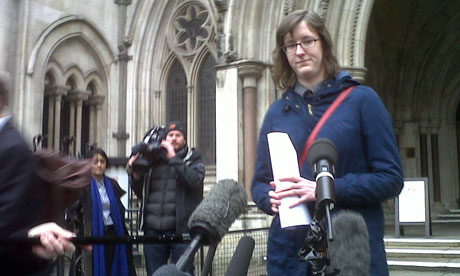
Cait Reilly appeal
Cait Reilly after winning her claim that requiring her to work for free was unlawful. Photograph: Cathy Gordon/PA
 
Before we get too excited about the judges' ruling in Reilly and Wilson v the secretary of state, this is not a judgment against slavery or forced labour. Both Cait Reilly and Jamieson Wilson lodged this appeal on the basis that, in forcing them to do unpaid work or lose their benefits, the government was breaching its own regulations.

You may think that there is a moral case to answer for the secretary of state, in pulling someone away from unpaid work in a sector they're interested in, forcing them instead to work unpaid stacking shelves in Poundland, with no training and no advancement of their skills, driving down wages for the rest of Poundland's employees while benefiting nobody but the retailer and the workfare provider. I know that's what I think.

You might think that when you train a skilled engineer to clean furniture – on the basis that the reason for his idleness was that he'd got out of the habit of work, that he needed to prove his mettle with whatever menial task you chose for him – there's a moral case to answer here, too. I'd agree.
But judges Black, Pill and Burnton haven't ruled on morality, they have merely ruled on nuts and bolts: Reilly was told that her scheme was mandatory, where in fact it was not. Wilson was told that if he refused to take part in a six-month work experience programme, he'd lose his benefits for that period. In fact, the maximum sanction would have been a two-week loss of benefits.

Nevertheless, though a ruling on slavery might have added some weight to it, this remains a punch in the face for this government, the Work Programme generally, and workfare in particular. Even the profile of these two cases significantly damages the reputation of this policy, whose raison d'etre is that long-term unemployment is the result of people getting out of the habit of work.

"What are the barriers that people have?" the employment minister Mark Hoban wondered aloud today on World at One. "One of the things people need to demonstrate to an employer is that they can turn up on time." This old chestnut – that long-term unemployment is the preserve of people who can't haul their sorry bones out of bed, must be countered all the time. The more cases we know about of unemployed people who are highly trained, gainfully occupied and routinely insulted by stupid workfare suggestions, the better.

On a practical note, people who've had their jobseeker's allowance stopped on grounds that are similar to Reilly or Wilson's can now claim the money back. This rights a grave social wrong, and delivers a sorely needed sanction to the workfare providers themselves, who understand nothing but money, and might finally question their deficiencies with cash at stake.

But most importantly, there is a growing sense that this back-to-work system is corrupt – my colleague Shiv Malik discovered recently that people on unpaid schemes were being counted as employed to massage the government's figures, even though by any reasonable person's understanding, they were not. Then the BBC revealed that people were being told to declare themselves "self-employed", even when they were simply without work, on the false basis that they could claim more in in-work benefits than JSA – the real benefit, of course, accruing to the Work Programme provider who could then claim them as having been "helped".

All the statistics released about the Work Programme show execrable results, and yet we've heard nothing about penalties, or remaking the contracts, or rethinking the system. There is a creeping sense that this is turning into a cash cow for the private sector, a get-out-clause for the government ("we've spent all this money, if people can't get jobs despite our help, it's because they are inadequate"), and unemployed people will be left at the bottom, ceaselessly harassed by a totally specious narrative in which their laziness beggars a try-hard administration.

A judge, casting doubt on all this in a sober way, is invaluable – three judges, better still. It makes me want to shake the legal profession by its giant hand.

Welcome to closet illiberalism


Vidya Subrahmaniam in The Hindu
   
Caste might be cast in stone judging from the way the dominant discourse gets conducted in India

“Caste is the most overwhelming factor in Indian life. Those who deny it in principle also accept it in practice. Life moves within the frontiers of caste and cultured men speak in soft tones against the system of caste, while its rejection in action just does not occur to them...” Socialist thinker Ram Manohar Lohia said this in 1964 but the words might be as relevant today as they were five decades ago.

The Ashis Nandy controversy illustrates the paradox of India’s opinion makers preaching caste equality while instinctively, reflexively, articulating positions that bunch them up on one side of the caste divide, thus reinforcing the very order that they have rejected. K. Satyanarayana exposes this contradiction with devastating examples in his article in The Hindu (editorial page, “The question of casteism still remains,” February 5, 2013). Mr. Nandy’s defenders have made the untenable legal claim that he should be judged not by what he said at the Jaipur Literature Festival but by his past record and scholarship. But worse, gradually the defence, which was originally grounded in Mr. Nandy’s right to free expression, has deteriorated into a free-for-all against Dalits and Other Backward Classes (OBC) — who are presumed to have become “sacred cows” protected by “draconian” laws. If to question Mr. Nandy is intolerance, what does one call this rant?

Mr. Nandy’s initial statement was a qualified one: he said the Indian Republic was saved because the corrupt of today were from the “Scheduled castes, OBCs and now the tribals.” But the nuances went for a toss with his stunning insistence that West Bengal was free from corruption because “in the last hundred years, nobody from the OBCs, SCs and STs has come to power there. It is an absolutely clean State.” Forget the backhanded compliment to the Left Front leadership which has been deemed to be clean for being upper caste. The inescapable inference from this is that upper caste means no corruption regardless of the period of reference — today or a 100 years ago.
 
Nandy’s statement as peg

Per se this is indefensible. Yet if for no other reason than to make the caste debate meaningful, we also need to look at Mr. Nandy’s subsequent clarification — more so because contained in the clarification is an uncomfortable truth that the Indian intelligentsia has tiptoed around for too long. To quote Mr. Nandy: “What I meant was that most of the people getting caught for corruption are people from OBC, SC and ST communities, as they don’t have the means to save themselves unlike people from upper castes who can hide their corruption.” 

The Nandy episode would have been well served if this statement had become the peg on which to examine the persisting caste prejudices and double standards that allow one kind of corruption to be exposed and the other to be hidden. However, it is important to understand that exposés and blackouts happen not only because one section is smarter than the other, which surely it is, but because the dominant discourse in India – as is evident from l'affaire Nandy itself — continues to be shaped by the socially advantaged classes. The media, as surveys have established, are a classic example of this stranglehold but upper caste dominance is as much a reality in academia and other key policymaking institutions. This collective is superficially progressive. Yet at a subconscious level, its members harbour all the entrenched biases, resulting in the backward castes being censured far more severely than their “twice-born” counterparts for the same alleged crime — be it ostentation, self-promotion, a specific legal violation or patronage of a particular caste group. 

Mayawati and the Gandhis

A case in point is the differential treatment extended to Mayawati and the Nehru-Gandhis. This difference endures despite xenophobic intolerance of the First family by right-wing sections of the middle class. The Bahujan Samaj Party (BSP) chief’s wealth and her self-projection — creating parks and monuments, naming projects after herself and celebrating lavish birthdays — have been obsessively written about by a media that ignored her political achievements until she compelled attention by forming in 2007 the first majority government in Uttar Pradesh in 17 years. The star of that watershed election was Ms Mayawati but the media ignored her, choosing instead to be embedded with Rahul Gandhi whose party finished last and is still stuck there. 

Compare the relentless focus on Ms Mayawati’s financial assets with the easy ride given to Robert Vadra. The Vadra real estate papers were avidly consumed in private, they had been available for years with the principal Opposition party, but the veil on the Gandhi son-in-law’s vast business empire was lifted only after Arvind Kejriwal made bold to mention the unmentionable. Today, while Ms Mayawati finds the law chasing her, there seem to be no such anxieties for Mr. Vadra. In Prime Minister Vajpayee’s time, similar deference was shown to his foster son-in-law Ranjan Bhattacharya.
 
Tracking the BSP

I had my first real brush with deep-seated caste attitudes in 1988 when I was in Allahabad for a Lok Sabha by-election contested by Rajiv (Gandhi) challenger V.P. Singh. His opponents were Sunil Shastri from the Congress and Kanshi Ram from the BSP. Singh was the media darling and Mr. Shastri derived his importance from being his principal opponent. The BSP faced a near media blackout, and as it turned out, the party was equally contemptuous of the “manuwadi” press. BSP volunteers blocked me off from their meetings, saying they knew what I would write. Over the years, as I tracked the BSP’s astonishing growth, I could not help but notice the unfailingly skewed media coverage of the party, whose rallies would be reported, not for their content but for the traffic chaos they caused. 

As a part-time journalism teacher in 2005, I would discover the same unconscious bias in the essays turned in by my students. Writing on Ms Mayawati’s birthday, they left out the political aspects of the event, concentrating instead on her diamonds, her “flashy” clothes and the size of the cake she cut. They would accept later that diamonds and silks were worn by other women politicians too but that somehow, these outward manifestations hit the eye more in the BSP chief’s case. There is an ironic reality here that must be understood in its proper context. What people saw as distasteful flamboyance was a political tool that Ms Mayawati consciously employed, especially in the formative years when it was important for her to raise the self-esteem of her constituency. This was explained to me by the part Hindutva, part OBC Uma Bharti. The Dalit girls in her village were forbidden from crossing the threshold into even OBC homes. But they would rebel in their own way, wearing Mayawati hair clutches and imitating her mannerisms, thereby signalling that they would not be kept down by force. The handbag, symbolising status and accomplishment, is similarly a deliberate presence in the much-criticised Mayawati statues. 

Admittedly, the showmanship can get excessive, as it did in 2010 when the then Uttar Pradesh Chief Minister wore a gigantic garland of currency notes, estimated to add up to several crores of rupees. This kind of extravagant cash display undoubtedly raises questions about source and accountability. However, in all the outrage over this incident, the media missed mentioning that Indian politicians have traditionally been weighed against coins. At election time this becomes a means of adding to the party coffers without the bother of disclosing the source. 

There is equal duplicity around the perceived caste consciousness of parties such as the BSP and the Samajwadi Party (SP). As a journalist posted in Lucknow in the late 1980s, I was witness to the transfer of power in Uttar Pradesh from the Congress’s Narain Dutt Tiwari to the Janata Dal’s Mulayam Singh Yadav (now with the SP.) The latter took charge to immediate accusations of Yadavisation of government and bureaucracy. Nobody cared to find out which castes ruled in the previous regime. In 1984, 93.8 per cent of the principal secretaries and secretaries to the U.P. government were from the upper castes and 78.6 per cent of the District Magistrates were from the upper castes, including 41 per cent of Brahmins (Christophe Jaffrelot, India’s Silent Revolution)

Political empowerment of the backward castes is a dramatic reality today. But social attitudes have stayed frozen. Why else would 50 per cent of all Central schemes and projects be named after the Nehru-Gandhis? Why would there be a chorus of protests over Mayawati statues but not over the renaming of the Borivali National Park after that champion of democracy, Sanjay Gandhi? In her outstanding book, The Grammar of Caste, Ashwini Deshpande cites evidence from four pioneering studies on the Indian urban labour market to conclude that employers discriminate between equally meritorious candidates on the basis of their caste identities. “Employers talk the language of merit and confess a deep faith solely in the merit of the applicant. However, they also believe that merit is distributed along lines of caste, religious and gender divisions. Nowhere do employers see this as discrimination. It is as if they were describing a neutral and unbiased state of the world.” Back to 1964 and Ram Manohar Lohia?

The injury that has no quick fix. Brearley on Depression

by Mike Brearley in Cricinfo

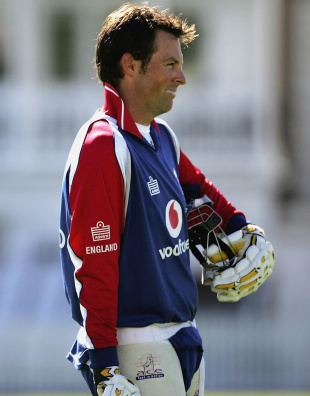
Marcus Trescothick waits for his turn in the nets ahead of the fourth one-dayer against Pakistan tomorrow, Trent Bridge, September 7, 2006
"Snapping out" of depression isn't an option © Getty Images


Depression is a terrible thing. People struggle to describe it to those who aren't subject to it: darkness, pointlessness, worthlessness; a black dog, perhaps, or a nuclear winter of the soul. There are often suicidal thoughts, which can dominate consciousness. Depressed people can't concentrate, can't think, feel lethargic, guilty, worthless and irritable. There may well be disturbance in sleep, and in eating and digestion. Some turn to drugs or drink. Those in its grip often seem addicted to suffering, helpless and hopeless. There is inadequate understanding of what it is about, why it has taken such a hold. 

And, of course, there's no reason why cricketers more than anyone else should be immune: the image of Marcus Trescothick hunched up in a corner of an electronic-goods shop at Heathrow while his Somerset team-mates prepared to board a flight to Abu Dhabi for a pre-season tournament remains a haunting one even four years later.

For sportsmen and women - but in particular men - depression has often been a badge of shame, especially in a world that values confidence, courage and the supposedly manly virtues of strength and assertiveness. When Trescothick's return home from England's tour of India in early 2006 was first explained, it was put down to a virus, which later changed to a "stress-related illness", still the terminology often used when his condition is discussed today. By the time Mike Yardy left the World Cup in 2011, the ECB did feel able to cite depression as the reason. This was a step in the right direction, but the reluctance to be open in the first place about Trescothick's plight stems, I believe, from a long-held idea that we should be thick-skinned and resilient; that to admit fear or unhappiness would be to lay oneself open not only to ridicule but to being dropped from the side (the very word "dropped" hints at the link to early-life anxieties and the insecurities of the baby). We are not supposed to be vulnerable, certainly not to show vulnerability. We don't wear our hearts on our sleeves - particularly not we English.

The proliferation of coaches and backroom staff over recent years may, paradoxically, risk making the situation harder. In the old days, it would be one's closest team-mates to whom one might admit anxiety; they are, after all, in the same boat, and may have a less judgmental or executive response. But the willingness of players such as Trescothick, Yardy, the outwardly chipper Matthew Hoggard, the former Derbyshire captain Luke Sutton, and even that tremendous competitor Andrew Flintoff to admit to their feelings may suggest change at a societal level: depression is not quite the taboo it once was. And, unlike Trescothick and Yardy - who both felt compelled to explain their departures from tours - the others were under no obligation to talk about their emotions.

There are two separable things here: the reluctance to admit to feeling low; and the increasing willingness of players to overcome that reluctance. On the one hand, in order to be a good sportsman one must be tough, a quality which can be weakened by self-doubt and fear. Players may therefore rightly be apprehensive about too much self-doubt. On top of this, there may be a reinforcement of such apprehension from the macho attitude of those who mock ordinary doubt. It is this that leads to the shame. However, self-doubt can be a necessary resource leading to work, improvement and, in the end, greater strength, both technically and emotionally.

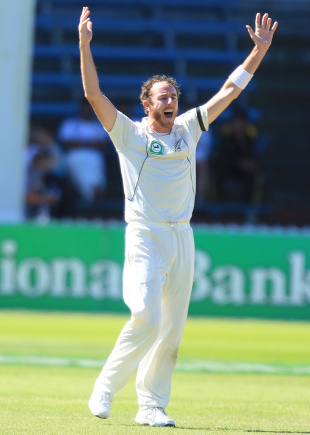
Keeping things bottled up can be disastrous. The New Zealand seamer Iain O'Brien, another sufferer who has felt able to go public about his condition, alluded to this process when he admitted that the potential consequences of saying nothing were far worse than the supposed shame of opening up. "I don't want to be one of those statistics," he said, referring to those cricketers - and there have been too many - who have ended up killing themselves.

Several have now risked this feared ridicule and come out as depressed. O'Brien himself was encouraged to do so after listening to a radio programme on the subject, hosted by Michael Vaughan in 2011, in which Hoggard said he felt like crying as he reached the end of his run-up during his final Test appearance, in Hamilton. The revelation was a poignant one: Vaughan was Hoggard's captain in that game. Not long before my time as a player, bowlers were reluctant to show emotion even when they took a wicket; Hoggard's openness was an encouraging sign of the times. Equally refreshing has been the respect accorded by the press to both Trescothick and Yardy. Despite inevitable pressure from their editors to get the story, journalists have been sensitive enough to allow the players to tell it in their own time. And admitting the extent of the problem may be the first step towards healing and repair.

So why the apparently growing need for healing and repair? Has depression become more prevalent for cricketers? It may be that the speeding up of life, the demand for quick fixes, the "taking the waiting out of wanting" - as the 1980s credit-card advertisement so pithily put it - make for more depression, not less. Such a culture seems to require happiness, briskness, a capacity to succeed early, and in overtly measurable ways. So cricket, with its waiting around, its lonely trudge back to the pavilion, its longueurs, its rain-breaks, may offer a testing task to the modern young man or woman.
But there must be more to it than that. For depression often arises in relation to loss, especially loss that the person cannot, for whatever reason, successfully mourn. It may be of a significant other; it may be more a matter of long separations and loneliness; or it may be of prestige, position or power, such as comes with loss of form, or decline with age, or from a realisation that one is not the only pebble on the beach. Cricket is no exception. Careers are short - few go on beyond their late thirties, unless offered a juicy contract by a Twenty20 franchise. Since most professional cricketers are in it primarily because they love the game, and since it has such intensities of effort, elation and disappointment, the loss related to retirement is bound to be painful. By the time you retire, your contemporaries in other fields will have moved onwards and upwards, while you have to start afresh. 

Most ex-professional cricketers will never again be so directly involved in doing what they are passionate about. Even jobs which involve the skills and knowledge of the sport - umpiring, coaching, commentating or writing - may seem less intensely vocational than playing at a high level, and few go into second careers which involve them as cricket did. Shakespeare, naturally, had a phrase for this general truth about life: "And every fair from fair sometime declines, by chance or nature's changing course untrimmed." For the cricketer, nature's change of course can be too early, too fast, and too damaging. Hoggard, remember, was discarded by England's Test team virtually overnight during that tour of New Zealand.


Depression is an arrangement by which we keep from ourselves the degree of hostility we feel, turning it on ourselves, but in a way inflicting it on others indirectly


Loss is harder to bear and more likely to turn into depression if one is full of hatred. All losses evoke some anger: how dare you leave me! But for some it is particularly strong; loss and separation may evoke bitterness and anger such that in the imagination there are murderous impulses to the person one misses. New Zealand's Lou Vincent, who was dropped on more than one occasion, told the Independent: "I was passionate about playing for New Zealand. But how many times can you be let down by something that you love? It's like the love of your life, she takes you back and she drops you. How many times can you have your heart broken?" Since that person - or, in the case of Vincent, that organisation - is often the very person one would turn to in a crisis, the hostility towards them, and the ensuing guilt, leaves the subject doubly alone. It is harder in such cases to mourn and move on.

Closely related to letting go of one's passionate activity is decline in form. Failure is stark and public. Like a king deposed, the dismissed batsman has to leave the arena; the bowler is merely taken off. The batsman may have to wait days for another chance. One little error, one good delivery, can result in total exclusion. And such outcomes are reported instantly to the public. The starkness of a scorecard that reads "Gatting b Warne 4" tells the casual observer nothing about the drama of the moment. Luck plays a big part. What's more, failures which may be a result of bad luck eat away at one's confidence, making form not only mercurial and uncontrollable, but self-fulfilling, the outcome of self-denigration. There can so easily be a vicious circle.

One type of such destructiveness happens when the person is prone to grievance: the glass is always half empty. Such a person is addicted to suffering and to inflicting suffering; he focuses on what he doesn't have, rather than what he does. He even prefers suffering - perhaps in dramatic or histrionic ways - to making the best of a bad job, and appreciating what he has. Depressed people feel passive, have no energy, a damaged sense of self. They may trade on this, stoking up the role of victim and, without realising, choose it over the ordinary struggle involved in getting on with things. As Iain O'Brien perceptively put it: "Wrapped up in it is how you value and see yourself."

Depression is more likely, too, for someone who at heart feels fraudulent, which itself is related to the weight of expectation felt by international sportsmen. Then - because that fraudulence may have been repressed - the depression can be experienced as something alien to the conscious self, a black dog, something that comes from outer space, or from a blue sky. Reflecting on his swift demise, Hoggard told Vaughan: "I was just thinking that the world was against me, that I'm rubbish, that I can't do this anymore. It just got on top of me. The self-doubt was huge."

People may be depressed at failure, but also at success. How often do we see a tennis player lose his serve immediately after breaking his opponent's? I think this is to do with guilt at triumph, at superiority. We may, in hidden ways, gloat over our defeated opponent or upstaged rival, and this may be so hard to bear that we contrive to fail rather than risk it. We may also discover that success isn't the panacea we have expected. No doubt post-natal depression has many causes, but one might be: this is not a bed of roses!

This may be hard to see in sport, partly because, as spectators, journalists and readers, our attention is so fixed on success; and those who are consistently successful are better able to accept their aggression and manage it well. But I am convinced, partly from my own experience, that we often do draw back from success, reluctant to risk gloating over a defeated rival who in the depths of our minds evokes a father or a sibling. We may also identify with that part of the other which wishes to knock the successful off their pedestals.

Depression, then, is an arrangement by which we keep from ourselves the degree of hostility we feel, turning it on ourselves, but in a way inflicting it on others indirectly. The depressed person is savaged by a judgmental inner voice, whose punitiveness mirrors the often unconscious wish to hurt the person felt to have let him down. He may also displace his bitterness and anger from the lost person on to an available target (an umpire, for example), like someone who comes home from a humiliating day at work and kicks the cat.

So the cricketer has to tolerate loss of form - and with it, perhaps, his place in the team, even his career - and the early ending of at least one of the loves of his life. It can, as Lou Vincent implied, feel like the end of a love affair, or like a sticky patch in a marriage; loss of, or decline in, bodily skill can, like later mental decline, be experienced as the surrender of the essential self. No wonder some find it unbearable. As David Frith catalogued in Silence of the Heart, published in 2001, no fewer than 150 professional cricketers had by then committed suicide. And this must have been the tip of a much larger iceberg of players who had been depressed but not gone to this ultimate. During his career, the successful cricketer also spends a lot of time travelling. Some find this separation from loved ones, especially at great distances, troublesome. One reason why, on the whole, teams do so much better at home lies here. The depression suffered by both Trescothick and Yardy was exacerbated by being far away from the people who knew them best and by the lack of a comparable support network on tour.

Of course, it can be hard to know what is going on in people's minds. But I was occasionally aware of a player being in difficulties, perhaps depressed, especially on tour. And loneliness was often at the heart of it. Some found big hotels in large cities anonymous and not conducive to feeling safe and at home. By contrast, the communal experience of staying in circuit houses or small hotels in India or Pakistan back in the 1970s, usually outside the main cities, could create a feeling of togetherness, humour and sociability that was much harder to find in the five-star luxury of a modern big-city hotel; some would stay in their rooms evening after evening, eating dinner on their own. Such patterns could be hard to notice when there was no place of focus once we were away from the dressing room, the manager's room, or the team bus, and the habit could become more addictive if morale dropped lower. A vicious circle of alienation and loneliness could ensue if no one became aware of it.

Such scenarios also happen in England. There are county cricketers who find it hard to be away even from their home town. One county captain I knew made himself available for dinner with a team member who was prone to depression during every away match. For some, loneliness is an outcome of the sheer routine of socialising on a cricket tour. A certain sameness can become limiting. Such people need other, perhaps more culturally varied, stimuli. Sometimes, one needs to get away from the close cricketing family.

During my playing days, tactful help and awareness of the problem prevented it from getting a grip on a few individuals. Captains and managers vary greatly in this important ability to be sensitive to people when they become unhappy, or aggrieved, or bored. One of Doug Insole's many assets as England manager was in this area. It would be hard to write "sensitivity to potential depression" into the job description of today's England coach. But ordinary human consideration, concern for everyone in the party, and tact should be. And occasionally that would extend to recognising that something more than ordinary friendly management is required, that a player needs to get specialist treatment, and may even have to leave the team for the time being.

Iain O'Brien celebrates Umar Gul's wicket, New Zealand v Pakistan, 2nd Test, Wellington, 3rd day, December 5, 2009
Iain O'Brien felt bottling up what he felt inside would have had far worse consequences than opening up about his condition would © Getty Images
Enlarge

Despite all this, the sporting arena itself can provide an antidote, since sport does permit aggression. Many people give the impression that only on the field can they be thoroughly and spontaneously themselves, though here again, this can make retirement, or absence through injury or poor form, feel like a loss of the true self. But at least the sportsman might be helped to avoid depression by the fact that sport has aggression built in. What is not so readily permitted in its ethos is envious rivalry with one's own team-mates. I think it's impossible not to feel some envy at the successes of a colleague who is vying with you for a place, and this can arouse guilt and shame. So aggression can be a problem when one can't enlist it, and also when one can but with too much or inappropriate venom or force.

Sporting teams are, as I've suggested, tough social groups, and the effect can be amplified in cricket, where the participants spend so much time with each other. Vulnerability may not be respected. Professional cricketers can be quick and perceptive, often cruelly so. The dressing room is not an easy place in which to hide. The rough and tumble, the sarcasm and mockery, are mostly friendly, but can also become bullying, the stuff of small boys in school playgrounds. In short, for some cricketers, aggression causes problems rather than provides a safety valve.

Perhaps what I have suggested in relation to both loss and aggression could be summed up thus: what doesn't kill you - or make you depressed - leaves you stronger. The tipping point can be hard to predict, perhaps the outcome of chance and the presence or absence of the right person, or the right piece of good luck, at the right time. Sport can indeed be an antidote to depression. I remember a time when I was in turmoil in my personal life; batting and playing, however difficult to do well, provided an arena in which life's aims and objectives were for a while simplified. It is not easy to hit a hard ball delivered with speed and skill by a fellow professional, but facing it does, like imminent execution, concentrate the mind.

And yet there is no escaping the profundity of depression - nor, as I noted at the beginning, the difficulty among non-sufferers of grasping it. As Trescothick said: "There's so much to it. People say: 'Pull yourself together, move on.' I wish it was that simple. You try to forget, but it takes over your whole life." Our understanding of this crippling condition, especially in the sporting arena, may merely have scratched the surface. And even when something is recognised and acknowledged, it is still hard to know what's best for the sufferer. Sportsmen want, above all, quick fixes, as with physical injury. The trouble is, established patterns can take a long time to shift. 
Mike Brearley played in 39 Tests for England between 1977 and 1981, captaining them in 31, of which 18 were won and only four lost. He is a practising psychoanalyst

Pope resigns: The pope who was not afraid to say sorry


Pope Benedict XVI was a courageous pontiff who made a sincere attempt to restore the good name of the Church

Pope Benedict XVI: though small of stature and delicate as bone china in demeanour, he grew slowly into the dignity of his office  Photo: AP
When Joseph Ratzinger was chosen by his fellow cardinals to be pope in April 2005, he was universally billed as the continuity candidate. He had spent 25 years doing John Paul II’s bidding in charge of the old Holy Office, and most Catholics believed they knew exactly what Benedict XVI stood for. Few expected any surprises. Yet now he has pulled off the biggest surprise of all by becoming the first pope in 600 years to resign.
The flawless logic of his resignation letter demonstrates that there is nothing clouding Benedict’s reason. “To steer the boat of St Peter… both strength of mind and body are necessary,” he explained, before stating that he simply didn’t have the stamina for it any more.

Which isn’t in the least surprising. In any other multinational organisation of 1.3 billion members, the idea that an 85-year-old could continue to exercise absolute authority on a daily basis would be regarded as untenable. For the Pope is not some figurehead, the religious equivalent of Queen Beatrix of the Netherlands, abdicating on her 75th birthday to make way for “the next generation”. He is an absolute monarch.

Logic, though, isn’t the quality most often associated with the papacy. John Paul II and before him Paul VI carried on in office long after their bodies had failed them. They upheld the conviction in Catholicism that being elected pope is a divinely ordained duty, to be carried along a personal Via Dolorosa unto death.

But that is not what canon law stipulates. It explicitly sets out conditions for abdication, and so Benedict has invoked them. There is no mystery, or smoking gun, but rather just extraordinary courage and selflessness. Perhaps having watched John Paul II, a vigorous athlete of a man when he took office, decline into someone unable to move or to be understood, made Benedict’s decision for him. He did not want to be a lame-duck pope; he knew that is not what the Catholic Church needs.
Yesterday’s announcement inevitably prompts the question of how his eight years on St Peter’s throne are to be viewed. As some kind of extended postscript to John Paul II’s eye-catching, game-changing era? Or as a stand-alone epoch with distinctive policies and preoccupations?

The consensus leans heavily towards the former, but history could well judge Benedict more kindly. He may have lacked his predecessor’s physical and spiritual charisma, and his unmissable presence on the world stage when major events were happening around him (the collapse of the Berlin Wall, two Gulf wars, 9/11), but Benedict has nevertheless shown himself to be very much his own man. Two of his decisions as pope illustrate what a break he made with his predecessor.
Just as they don’t retire, popes also avoid at all costs admitting that they get things wrong, notwithstanding that they are infallible in certain matters of faith and morals. So few can have expected “God’s Rottweiler”, as he was known when he was carrying out John Paul’s orders in relation to dissenters, to start breaking the mould as pope by issuing mea culpas. But that is precisely what he did.

In January 2009, for instance, he wrote to every Catholic bishop in the world to confess to his own mishandling of the case of Bishop Richard Williamson. This self-styled English prelate, a member of the fundamentalist Lefebvrist group excommunicated by John Paul, had been readmitted to the Catholic Church on Benedict’s watch. But days before, Williamson had given a TV interview in which he denied the Holocaust. The international outcry was huge – and magnified because of Benedict’s own brief spell in the Hitler Youth. The Pope’s response was a heartfelt and humble letter of apology.

His second volte-face came over the issue of paedophile priests. Under John Paul, the issue had been shamefully brushed under the carpet. The Polish pontiff, for example, declined to hand over to justice one of his great favourites, Father Marcial Maciel, the Mexican founder of the Legionaries of Christ, a traditionalist religious order. Despite well-documented allegations going back many years about Maciel’s sexual abuse of youngsters in his seminaries, he was treated on papal orders as an honoured guest in the Vatican.

Yet within a month of taking office, Benedict moved to remove any protection and to discipline Maciel. He ordered the priest, then in his late eighties, never again to say mass or speak in public. And when Maciel died in 2008, his low-key funeral was followed by a rapid dismantling of the religious organisation he had built.

It was part of a concerted drive that made Benedict the first pope to sincerely attempt to address clerical abuse and restore the good name of the Catholic Church. In March 2009, for example, he sent another letter of apology, this time to Catholics in Ireland. “You have suffered grievously,” he wrote to Irish victims of paedophile priests, “and I am truly sorry. I know that nothing can undo the wrong you have endured. It is understandable that you find it hard to forgive or be reconciled with the Church. In her name, I openly express the shame and remorse that we all feel.”

That is quite a statement coming from a pope. It may be that his own past as a lieutenant of John Paul made him part of the problem, but he was unafraid to look this appalling betrayal of trust in the eye, not least in a series of meetings he arranged on his travels.

In fact Benedict wasn’t much of a traveller. Global Catholicism and international leaders usually had to come to him in Rome rather than vice versa. Yet, though small of stature and delicate as bone china in demeanour, he grew slowly into the dignity of his office after it had initially threatened to swamp him.

So his 2010 trip to Britain did not, as had been widely predicted, pale beside the enduring and vivid memory of John Paul’s barnstorming 1982 visit. Instead the crowds warmed to this serious man, with his nervous smile and understated humanity, as he kissed babies and waved from his Popemobile. Even sceptics responded positively to his determination to speak his mind about the marginalisation of religion.

There were, inevitably, notable failures in his reign. He was too much the career Vatican insider to shake up the curia, the Church’s central bureaucracy. Its scheming and corruption was exposed for all to see in the “Vatileaks” scandal last year, with Benedict’s own butler, Paolo Gabriele, convicted of stealing the Pope’s private papers that revealed squabbling cardinals and unprincipled priests in the papal inner circle.

And Benedict’s chosen “big tent” approach to leadership – which was to make him more German Shepherd than Rottweiler by welcoming dissidents back into the fold – also soon blew away. What remained was a willingness to make concessions to schismatic ultra-conservatives, but paper-thin patience with liberal theologians or grassroots movements such as that demanding genuine doctrinal change in Austria.

Patently more at home in a library or a theological college than on the world political stage, Benedict could be clumsy – as when in September 2006 his return to his alma mater, Regensburg University in Bavaria, was overshadowed by derogatory remarks about the prophet Mohammed which he quoted in his lecture. But he went out of his way to make amends on a trip to Turkey soon afterwards, joining Muslim clerics in prayer in the Blue Mosque in Istanbul. This was only the second time a pope had ever entered a mosque.

For every failure, there was a success. His inaugural encyclical, Deus Caritas Est (“God is Love”), in December 2005 broke new ground, first in being written in such a way that non‑theologians could follow it, and second in celebrating human love without the standard Catholic exemptions for gays, the unmarried and those using contraception. “Sex please, we’re Catholics” was the reaction of the influential Catholic weekly, the Tablet.

Though his decision to opt for retirement will mark out this papacy in history, Benedict’s eight-year rule did not see the Catholic Church perform spectacular U-turns on any major doctrinal questions. Yet it was also so much more than a seamless continuation of what had gone before.

John Paul II may have left his cardinals with little choice other than to elect Joseph Ratzinger as a safe pair of hands. But Benedict XVI has, by the way he has stood down and by his record in office, made it more possible that a moderniser, in touch with the realities of life in the 21st century, will be chosen as the 266th successor to St Peter.
 
Peter Stanford is a former editor of the 'Catholic Herald’

No one really understands what’s going on in our economy


Does anyone properly understand what’s happening in the UK economy anymore? (Editor's comment: If you don't understand then why are you still in your job?)

Mandy Ellis wears a hat decorated with Union flags as she looks towards the London Eye
Can it really be true that an economy which has created more than a million private sector jobs over the past two and a half years is showing no growth at all?  Photo: Reuters

I’m sure I don’t, though I spend longer than most attempting to read the tea leaves, and I’m ever more convinced the policy makers don’t either.

There are two related problems here. One is with the data, which are ever more contradictory. Some of them point to a flatlining, or even still declining, economy, with badly impaired levels of productivity, but there are also quite a lot of alternative data to suggest something better – most notably in near record levels of private sector job creation. The other problem is with what fiscal and monetary policy are trying to achieve, which seems to grow more confused by the day.

Both intellectually and practically, monetary policy has become something of a mess. Before the crisis, the Bank of England was guided by a simple and absolute inflation target, which it was relatively successful at meeting and was easy to understand. But since the credit crunch, it has taken on another purpose – that of bringing about a return to sustainable growth. This has brought the Bank into conflict with its primary objective. Since the crisis began, inflation has consistently been well above target, but for a brief dip in 2009, and it has twice been above 5pc.

This week’s quarterly inflation report will bring further discomfort, with the Bank forced to concede both that growth is failing to respond as hoped and that inflation is now likely to remain elevated for the next two years.

Unfortunately, there appears to have been no trade-off between inflation and growth. Inflation has stayed high but growth has been non-existent. The Bank excuses its evident failure on inflation by stressing the apparently higher purpose of preventing a collapse in output, and with justification, it further insists that domestically generated wage inflation has remained tame. This is all very well but, with wages lagging prices by some distance, disposable incomes have been quite severely squeezed and this is plainly bad for domestic demand and growth.
With the Bank’s admission that inflation may remain above target for the next two years, the squeeze on disposable incomes is likely to persist. So, in this regard, the Bank’s policy of tolerating elevated inflation in pursuit of higher growth has been quite harmful to both objectives.

Sticking to the inflation remit has become something of a charade but, ridiculously, the Bank still pretends that this is what it is trying to do. It is to be hoped that the new Governor, Mark Carney, can bring more clarity and openness to the Bank’s endeavours. Don’t expect miracles.

Fiscal policy has been equally badly wrong-footed. Lack of growth has derailed the Government’s deficit reduction plan, threatening certain fiscal crisis down the line in the absence of evasive action.
What’s more, the unwritten compact between Government and Bank of England, under which the Bank is supposed to compensate for tight fiscal policy with monetary activism, seems to be breaking down. At last week’s meeting, the Monetary Policy Committee decided to do nothing even though it judges risks still to be on the downside. To the chagrin of George Osborne, the Chancellor, Sir Mervyn seems to be saying there is little more that monetary policy can throw at the problem.
Mind you, the data as they stand would be enough to paralyse even the most sure-footed of policymakers into inaction. Can it really be true that an economy which has created more than a million private sector jobs over the past two and a half years is showing no growth at all?

Equally hard to understand is why the UK’s export performance continues to look so lamentable. The eurozone crisis provides only part of the explanation, since even Spain and Greece have done better on exports than Britain, and that’s without the “benefit” of a sharp devaluation in the currency.
Britain’s exceptionally large services sector, and its fast-growing digital economy, may provide partial answers to all these puzzles. Once you strip out disruptions to, and structural decline in, North Sea oil revenues, then there has been some underlying GDP growth.

Moreover, if you think of much of the growth that took place in the pre-crisis bubble years as essentially just the “candyfloss” of an out of control financial and property sector, then today’s stagnation looks much easier to understand. Service industries in general, and financial services in particular, are notoriously difficult to measure, both in terms of their output and contribution to exports.

Part of Britain’s problem with the European Union is that there is still no properly functioning internal market across key service sectors. The EU exploits the UK’s weaknesses in traded goods while denying it the opportunity to play to its strengths in services. Until these deficiencies are rectified, the EU will struggle to be a net positive to the UK economy.

But that’s by the by. Looking at business investment, it was on a declining trend from long before the crisis and, to the extent that it was happening at all, there was a disproportionate emphasis on commercial property, great swathes of which now lie empty. Bulldozing this unwanted surplus would perhaps be the best solution, or at least converting it into housing.

So there’s another big chunk of past growth that has turned out to be of little or no long-term value. Strip these things out and it is by no means clear that the rest of the economy is suffering the crippling decline in productivity widely assumed. To the contrary, much of the anecdotal evidence points to significant advances, especially in the digital economy, which is growing faster in Britain than almost anywhere else.

According to a report by the Boston Consulting Group, the UK is now home to the largest per capita ecommerce market and the second largest online advertising market anywhere in the world.

Much of the growth in these markets, the productivity gains they drive, and the intangible benefits they deliver, are not caught by official GDP figures, which only attempt to measure the market value of the economy. In a paper just published, Jonathan Haskel of Imperial College Business School and others find that measured real value added has been understated by 1.1pc since the end of 2010 because of failure to capture intangible investment. Take this into account and there has in fact been no fall in productivity since then.

These musings lead to three conclusions. First and foremost, the Chancellor needs to act swiftly to recalibrate fiscal consolidation so as to give growth a supply-side, tax-cutting shot in the arm. Second, he should answer calls from both Sir Mervyn King and Mark Carney for a review of the Bank’s monetary remit. Finally, something has to be done about the GDP data, which beyond their capacity for political knock-about, have become about as useful as a chocolate teapot. (Editor's comments - The analysis is fine but the problem is with the conclusions - This maybe a ruse to cut taxes for the rich! Secondly the author now admits the problems with using GDP data as an apt indicator of economic performance - wheras all this while the UK and the USA have been telling the whole world that GDP performance is the best measure of economic performance. Alas! - the naysayers were saying it all along!)

Monday, 11 February 2013

Alain De Botton: A kinder, gentler philosophy of success.


Alain De Botton: Religion for Atheists


Amy Cuddy: 'Fake it till you've learnt it'. Your body language shapes who you are

Janine di Giovanni: What I saw in the war.

Sunday, 10 February 2013

Islam is not the real issue we are facing in Africa


Christians and Muslims have co-existed here for centuries. Corruption and climate change are much more pressing problems
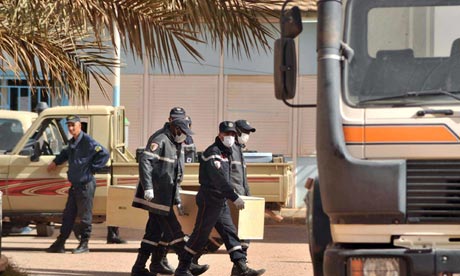
Hostage situation in In Amenas, Algeria - 21 Jan 2013
Algerian firemen carry a dead hostage from the gas plant at Amenas. At least 38 civilians and 29 militants died during the crisis. Photograph: Rex Features
 
Stretching from west to east across Africa – from the Atlantic Ocean to the Red Sea – the Sahel today is a militant's dream. Despite the French military's recent routing of al-Qaida in the Islamic Maghreb and its allies in northern Mali, the threat of safe haven for the west's enemies is not going to end there any time soon.

Although, for the moment, the militia have melted from sight, the latest battles in Algeria and Mali are harbingers of a larger catastrophe: the Sahel, the vast grassland north of the equator, has become the latest battleground in the west's war against Islamist militants.

France's plans to withdraw its 4,000 troops from Mali in late March are premature. From the air, US surveillance drones and French fighter planes will not be enough to keep peace in the Sahel – which includes Mauritania, southern Algeria, northern Mali, Chad and Sudan, as well as Somalia, where a 2006 Ethiopian invasion, tacitly backed by the US, looked at first like an utter defeat for the Islamists. Six months later, the militants returned to wage exactly the kind of war Ethiopia and the US had feared.

So how does the west avoid repeating the pattern? By understanding the root causes of the troubles that plague the Sahel.

First, many of its states are weak, if not utterly failing. Ethnic and religious allegiances are much more binding than those of national identity. Exploiting these ties – as well as the growing importance of a global Islamic identity – foreign fighters have decamped from the drone zone of Afghanistan and Pakistan to melt into the lands of North Africa.

All of these factors sharpen the longstanding religious divide that runs along the southern edge of the Sahel, 700 miles north of the equator – the tenth parallel where, thanks to geography, weather and centuries of human migration, most of North Africa's 500 million Muslims meet the 500 million Christians of sub-Saharan Africa. There is nothing new about the co-existence of Muslim and Christian communities at this latitude – it dates back to the seventh century. There's not so much that's new, even, about the emergence of a political form of Islam that sparks conflict with both Christians and more traditional Muslims. Since the Mahdi Muhammad Ahmad launched a 19th-century jihad against the British in Sudan, Islam has gone through periods of revival and rebellion in Africa.

What might be emerging more clearly into public consciousness is a sense that Africa is a zone of strategic concern for the west. Rather than being a place that crosses our radar because of famine, civil war or the legacies of colonialism, we're entering an era in which it becomes a place where western powers directly intervene to protect their interests. So what might this mean for the continent, for some of those key countries, to be placed in this position? And how will it affect our perception of Africa and Africans?

One of Africa's vital interests, which is linked to the rise in militancy, is climate change. Nowhere is this a more urgent issue than in the Sahel, where both flash floods and droughts – which contribute to the Sahara desert's southern spread – are growing more extreme. In Africa, there are now more people fleeing the weather than fleeing war.

Many of these environmental refugees are nomads whose itinerant way of life is in peril. In North Africa, most are Muslims. Since water and grasslands are being replaced by sand dunes, nomads of the Sahel are being forced into different means of survival, such as smuggling cocaine and cigarettes to Europe along ancient salt routes, or joining up with one militant outfit or another.

Another disastrous pattern is that across the continent, Muslim nomads are pushing south into settled land, which tends to belong to Christian farmers. In many places, what begins as a local fight for land and water becomes a globalised battle for religion. In Sudan, for example, the Islamist regime of the north has armed paramilitary Muslim nomads to push south for the sake of their cattle's survival. Deep beneath the surface, that push allows Khartoum to secure its rights to oil.

Oil underlies much of the Sahel – and its well-known curse leads to that curious paradox in which governments such as Nigeria's or Chad's, which receive billions in revenue each year, impoverish their citizens. Despite vast wealth, these states don't safeguard most people's rights to the basic infrastructure of roads, water, electricity or education. Once again, both Muslims and Christians turn to their local mosque or church to help them survive. The resulting corruption on behalf of governments across the region also feeds rebellion in the name of Islam.

Militants use the notion of a return to an idealised Islamic past to control populations from Sudan to Somalia to Nigeria to Mali. This rallying cry for Islamic law, which is reduced to its most extreme measures, is an outgrowth of the rising role of religious identity, but it's also the most expedient means to terrify a population in the name of religion. In many cases, fellow Muslims are the first to suffer at the hands of militants. This is especially true in North Africa, where most Muslims practise Sufism, a mystical strain of the faith that many hardliners see as heretical.

During the cold war, the west fought proxy battles against the Soviets across Africa. In some ways, the vacuum the cold war left behind has left room for a new political contest between Islam and the west. The west's greatest mistake would be to do nothing but militarise this conflict and to shore up corrupt leaders just because they parrot the right kind of western-friendly speak, as we have done in the past.

Far more important – and more daunting – is the need to address the underlying causes of this burgeoning conflict. Corruption and climate change top the list. Until then, American surveillance drones are going to fly over a growing desert that's increasingly hospitable to its enemies.

US control is diminishing, but it still thinks it owns the world


The United States has long assumed the right to use violence to achieve its aims, but it is now less able to implement its policies
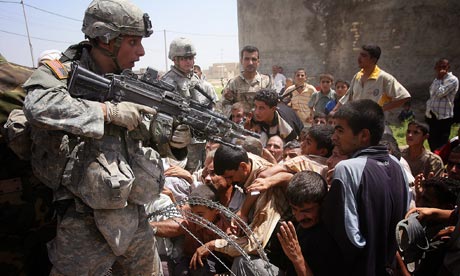
US soldier pointing gun at Iraqis
'We "stabilise" countries when we invade them and destroy them.' Photograph: Olivier Laban-Mattei/AFP/Getty Images
 
This piece is adapted from Uprisings, a chapter in Power Systems: Conversations on Global Democratic Uprisings and the New Challenges to US Empire, Noam Chomsky's new book of interviews with David Barsamian (with thanks to the publisher, Metropolitan Books). The questions are Barsamian's, the answers Chomsky's.

Does the United States still have the same level of control over the energy resources of the Middle East as it once had?

The major energy-producing countries are still firmly under the control of the western-backed dictatorships. So, actually, the progress made by the Arab spring is limited, but it's not insignificant. The western-controlled dictatorial system is being eroded. In fact, it's been being eroded for some time. So, for example, if you go back 50 years, the energy resources – the main concern of US planners – have been mostly nationalised. There are constantly attempts to reverse that, but they have not succeeded.

Take the US invasion of Iraq, for example. To everyone except a dedicated ideologue, it was pretty obvious that we invaded Iraq not because of our love of democracy but because it's maybe the second- or third-largest source of oil in the world, and is right in the middle of the major energy-producing region. You're not supposed to say this. It's considered a conspiracy theory.
The United States was seriously defeated in Iraq by Iraqi nationalism – mostly by nonviolent resistance. The United States could kill the insurgents, but they couldn't deal with half a million people demonstrating in the streets. Step by step, Iraq was able to dismantle the controls put in place by the occupying forces. By November 2007, it was becoming pretty clear that it was going to be very hard to reach US goals. And at that point, interestingly, those goals were explicitly stated. So in November 2007 the Bush II administration came out with an official declaration about what any future arrangement with Iraq would have to be. It had two major requirements: one, that the United States must be free to carry out combat operations from its military bases, which it will retain; and, two, "encouraging the flow of foreign investments to Iraq, especially American investments". In January 2008, Bush made this clear in one of his signing statements. A couple of months later, in the face of Iraqi resistance, the United States had to give that up. Control of Iraq is now disappearing before their eyes.

Iraq was an attempt to reinstitute by force something like the old system of control, but it was beaten back. In general, I think, US policies remain constant, going back to the second world war. But the capacity to implement them is declining.

Declining because of economic weakness?

Partly because the world is just becoming more diverse. It has more diverse power centres. At the end of the second world war, the United States was absolutely at the peak of its power. It had half the world's wealth, and every one of its competitors was seriously damaged or destroyed. It had a position of unimaginable security and developed plans to essentially run the world – not unrealistically at the time.

This was called "grand area" planning?

Yes. Right after the second world war, George Kennan, head of the US state department policy planning staff, and others sketched out the details, and then they were implemented. What's happening now in the Middle East and north Africa, to an extent, and in South America substantially goes all the way back to the late 1940s. The first major successful resistance to US hegemony was in 1949. That's when an event took place that, interestingly, is called "the loss of China". It's a very interesting phrase, never challenged. There was a lot of discussion about who is responsible for the loss of China. It became a huge domestic issue. But it's a very interesting phrase. You can only lose something if you own it. It was just taken for granted: we possess China – and, if they move toward independence, we've lost China. Later came concerns about "the loss of Latin America", "the loss of the Middle East", "the loss of" certain countries, all based on the premise that we own the world and anything that weakens our control is a loss to us and we wonder how to recover it.

Today, if you read, say, foreign policy journals or, in a farcical form, listen to the Republican debates, they're asking, "How do we prevent further losses?"

On the other hand, the capacity to preserve control has sharply declined. By 1970, the world was already what was called tripolar economically, with a US-based North American industrial centre, a German-based European centre, roughly comparable in size, and a Japan-based east Asian centre, which was then the most dynamic growth region in the world. Since then, the global economic order has become much more diverse. So it's harder to carry out our policies, but the underlying principles have not changed much.

Take the Clinton doctrine. The Clinton doctrine was that the United States was entitled to resort to unilateral force to ensure "uninhibited access to key markets, energy supplies and strategic resources". That goes beyond anything that George W Bush said. But it was quiet and it wasn't arrogant and abrasive, so it didn't cause much of an uproar. The belief in that entitlement continues right to the present. It's also part of the intellectual culture.

Right after the assassination of Osama bin Laden, amid all the cheers and applause, there were a few critical comments questioning the legality of the act. Centuries ago, there used to be something called presumption of innocence. If you apprehend a suspect, he's a suspect until proven guilty. He should be brought to trial. It's a core part of American law. You can trace it back to Magna Carta. So there were a couple of voices saying maybe we shouldn't throw out the whole basis of Anglo-American law. That led to a lot of very angry and infuriated reactions, but the most interesting ones were, as usual, on the left-liberal end of the spectrum. Matthew Yglesias, a well-known and highly respected left-liberal commentator, wrote an article in which he ridiculed these views. He said they were "amazingly naive" and silly. Then he explained the reason. He said: "One of the main functions of the international institutional order is precisely to legitimate the use of deadly military force by western powers." Of course, he didn't mean Norway. He meant the United States. So the principle on which the international system is based is that the US is entitled to use force at will. To talk about the US violating international law or something like that is amazingly naive, completely silly. Incidentally, I was the target of those remarks, and I'm happy to confess my guilt. I do think that Magna Carta and international law are worth paying some attention to.

I merely mention that to illustrate that, in the intellectual culture, even at what's called the left-liberal end of the political spectrum, the core principles haven't changed very much. But the capacity to implement them has been sharply reduced. That's why you get all this talk about American decline. Take a look at the year-end issue of Foreign Affairs, the main establishment journal. Its big front-page cover asks, in bold face, "Is America Over?" It's a standard complaint of those who believe they should have everything. If you believe you should have everything and anything gets away from you, it's a tragedy, and the world is collapsing. So is America over? A long time ago we "lost" China, we've lost southeast Asia, we've lost South America. Maybe we'll lose the Middle East and north African countries. Is America over? It's a kind of paranoia, but it's the paranoia of the super-rich and the super-powerful. If you don't have everything, it's a disaster.

The New York Times describes the "defining policy quandary of the Arab spring as how to square contradictory US impulses, including support for democratic change, a desire for stability, and wariness of Islamists who have become a potent political force". The Times identifies three US goals. What do you make of them?

Two of them are accurate. The United States is in favour of stability. But you have to remember what stability means. Stability means conformity to US orders. So, for example, one of the charges against Iran, the big foreign policy threat, is that it is destabilising Iraq and Afghanistan. How? By trying to expand its influence into neighbouring countries. On the other hand, we "stabilise" countries when we invade them and destroy them.

I've occasionally quoted one of my favourite illustrations of this, which is from a well-known, very good liberal foreign policy analyst, James Chace, a former editor of Foreign Affairs. Writing about the overthrow of the Salvador Allende regime and the imposition of the dictatorship of Augusto Pinochet in 1973, he said that we had to "destabilise" Chile in the interests of "stability". That's not perceived to be a contradiction – and it isn't. We had to destroy the parliamentary system in order to gain stability, meaning that they do what we say. So yes, we are in favour of stability in this technical sense.

Concern about political Islam is just like concern about any independent development. Anything that's independent you have to have concern about, because it may undermine you. In fact, it's a little paradoxical, because traditionally the United States and Britain have by and large strongly supported radical Islamic fundamentalism, not political Islam, as a force to block secular nationalism, the real concern. So, for example, Saudi Arabia is the most extreme fundamentalist state in the world, a radical Islamic state. It has missionary zeal, is spreading radical Islam to Pakistan and funding terror. But it's the bastion of US and British policy. They've consistently supported it against the threat of secular nationalism from Gamal Abdel Nasser's Egypt and Abd al-Karim Qasim's Iraq, among many others. But they don't like political Islam because it may become independent.

The first of the three points, our yearning for democracy, that's about on the level of Joseph Stalin talking about the Russian commitment to freedom, democracy and liberty for the world. It's the kind of statement you laugh about when you hear it from commissars or Iranian clerics, but you nod politely, and maybe even with awe, when you hear it from their western counterparts.

If you look at the record, the yearning for democracy is a bad joke. That's even recognised by leading scholars, though they don't put it this way. One of the major scholars on so-called democracy promotion is Thomas Carothers, who is pretty conservative and highly regarded – a neo-Reaganite, not a flaming liberal. He worked in Reagan's state department and has several books reviewing the course of democracy promotion, which he takes very seriously. He says, yes, this is a deep-seated American ideal, but it has a funny history. The history is that every US administration is "schizophrenic". They support democracy only if it conforms to certain strategic and economic interests. He describes this as a strange pathology, as if the United States needed psychiatric treatment or something. Of course, there's another interpretation, but one that can't come to mind if you're a well-educated, properly behaved intellectual.

Within several months of the toppling of [President Hosni] Mubarak in Egypt, he was in the dock facing criminal charges and prosecution. It's inconceivable that US leaders will ever be held to account for their crimes in Iraq or beyond. Is that going to change anytime soon?

That's basically the Yglesias principle: the very foundation of the international order is that the United States has the right to use violence at will. So how can you charge anybody?

And no one else has that right?

Of course not. Well, maybe our clients do. If Israel invades Lebanon and kills 1,000 people and destroys half the country, OK, that's all right. It's interesting. Barack Obama was a senator before he was president. He didn't do much as a senator, but he did a couple of things, including one he was particularly proud of. In fact, if you looked at his website before the primaries, he highlighted the fact that, during the Israeli invasion of Lebanon in 2006, he co-sponsored a Senate resolution demanding that the United States do nothing to impede Israel's military actions until they had achieved their objectives, and censuring Iran and Syria because they were supporting resistance to Israel's destruction of southern Lebanon, incidentally, for the fifth time in 25 years. So they inherit the right. Other clients do, too.

But the rights really reside in Washington. That's what it means to own the world. It's like the air you breathe. You can't question it. The main founder of contemporary IR [international relations] theory, Hans Morgenthau, was really quite a decent person, one of the very few political scientists and international affairs specialists to criticise the Vietnam war on moral, not tactical, grounds. Very rare. He wrote a book called The Purpose of American Politics. You already know what's coming. Other countries don't have purposes. The purpose of America, on the other hand, is "transcendent" – to bring freedom and justice to the rest of the world. But he's a good scholar, like Carothers. So he went through the records. He said that, when you studied the record, it looked as if the United States hadn't lived up to its transcendent purpose. But then he says that to criticise our transcendent purpose "is to fall into the error of atheism, which denies the validity of religion on similar grounds" – which is a good comparison. It's a deeply entrenched religious belief. It's so deep that it's going to be hard to disentangle it. And if anyone questions that, it leads to near-hysteria and often to charges of anti-Americanism or "hating America" – interesting concepts that don't exist in democratic societies, only in totalitarian societies and here, where they're just taken for granted.

Forget Starbucks – what UK companies are doing to avoid tax is far worse


ActionAid investigation looks into financial arrangements of British multinationals
Rainbow, Victoria Falls, Zambia
The Victoria Falls in Zambia, one of the world's poorest countries. Photograph: Nicole Cambre/Rex Features
 
That the world's biggest companies avoid tax on a grand scale is no longer much of a revelation. We know only too well how Starbucks' Dutch royalties, Amazon's Luxembourg hub and Google's Irish operations diminish their tax bill.

But today's investigation by ActionAid into the financing arrangements of an African subsidiary of Associated British Foods plc, the FTSE 100 company behind brands ranging from Ovaltine to Primark, shows how similar practices are hitting some of the world's poorest countries.

Africa's largest sugar producer, Zambia Sugar plc, deploys the familiar techniques of making tax-deductible payments to related companies in distant locations.

Such amounts represent relatively small savings for a conglomerate like Associated British Foods, with annual global pre-tax profits of £750m, but they are a devastating loss for countries like Zambia. Corporate taxes account for more than 20% of total tax revenues of $4bn in a country where 8 million people live in absolute poverty.

And if, as parliament's public accounts committee has discovered, countries like Britain are struggling to counter such "transfer pricing" arrangements, those with even scarcer resources and less expertise have no chance. Or, as one of the Zambian tax authority's advisers put it: "On transfer pricing we are, pardon my language, getting fucked."

ActionAid rightly holds companies responsible for this, but it also points out how they are exploiting international tax law – written by richer northern nations under the auspices of the Organisation for Economic Cooperation and Development – that is biased against poorer countries.

Enforced through bilateral taxation treaties between countries, the rules of the game compel tax authorities to respect transactions such as the payment of interest, royalties and fees between companies within the same multinational group, even when the recipients are based in tax havens and the arrangements have little purpose beyond tax reduction.

Reform to this system is evidently long overdue but, with hundreds of countries signed up to it, progress is glacial. In the meantime political rhetoric such as David Cameron's Davos call for companies to "wake up and smell the coffee" stands as no more than a futile plea to the world's multinationals' better natures.

What will have an impact are George Osborne's relaxations of the UK's "controlled foreign companies" laws governing the diversion of corporate profits into tax havens. The changes are designed, a Treasury memo revealed, "so that [the laws] have a better fit with the way in which [multinational companies] structure their commercial operations…" That is, to facilitate "tax efficient supply chain management".

There is a smell coming from the Government's response to corporate tax dodging at the expense of the world's poor, but it's not coffee.

Richard Brooks is the author of The Great Tax Robbery, to be published by Oneworld Publications next month.

• This article was amended on 10 February 2013. Associated British Foods has said in response to this piece that they do real business in Mauritius and other locations distant from Zambia. They also say that capital tax allowances available in Zambia at the time of the company's investment are the reason for the low Zambian corporate tax revenues.