Search This Blog

Wednesday, 4 April 2012

How Big Pharma Cooks Data –The Case of Vioxx and Heart Disease

 
By Cathy O’Neil, a data scientist who lives in New York City and writes at mathbabe.org

Yesterday I caught a lecture at Columbia given by statistics professor David Madigan, who explained to us the story of Vioxx and Merck. It’s fascinating and I was lucky to get permission to retell it here.

Disclosure

Madigan has been a paid consultant to work on litigation against Merck. He doesn’t consider Merck to be an evil company by any means, and says it does lots of good by producing medicines for people. According to him, the following Vioxx story is “a line of work where they went astray”.

Yet Madigan’s own data strongly suggests that Merck was well aware of the fatalities resulting from Vioxx, a blockbuster drug that earned them $2.4b in 2003, the year before it “voluntarily” pulled it from the market in September 2004. What you will read below shows that the company set up standard data protection and analysis plans which they later either revoked or didn’t follow through with, they gave the FDA misleading statistics to trick them into thinking the drug was safe, and set up a biased filter on an Alzheimer’s patient study to make the results look better. They hoodwinked the FDA and the New England Journal of Medicine and took advantage of the public trust which ultimately caused the deaths of thousands of people.

The data for this talk came from published papers, internal Merck documents that he saw through the litigation process, FDA documents, and SAS files with primary data coming from Merck’s clinical trials. So not all of the numbers I will state below can be corroborated, unfortunately, due to the fact that this data is not all publicly available. This is particularly outrageous considering the repercussions that this data represents to the public.

Background

The process for getting a drug approved is lengthy, requires three phases of clinical trials before getting FDA approval, and often takes well over a decade. Before the FDA approved Vioxx, less than 20,000 people tried the drug, versus 20,000,000 people after it was approved. Therefore it’s natural that rare side effects are harder to see beforehand. Also, it should be kept in mind that for the sake of clinical trials, they choose only people who are healthy outside of the one disease which is under treatment by the drug, and moreover they only take that one drug, in carefully monitored doses. Compare this to after the drug is on the market, where people could be unhealthy in various ways and could be taking other drugs or too much of this drug.

Vioxx was supposed to be a new “NSAID” drug without the bad side effects. NSAID drugs are pain killers like Aleve and ibuprofen and aspirin, but those had the unfortunate side effects of gastro-intestinal problems (but those are only among a subset of long term users, such as people who take painkillers daily to treat chronic pain, such as people with advanced arthritis). The goal was to find a pain-killer without the GI side effects. The underlying scientific goal was to find a COX-2 inhibitor without the COX-1 inhibition, since scientists had realized in 1991 that COX-2 suppression corresponded to pain relief whereas COX-1 suppression corresponded to GI problems.

Vioxx Introduced and Withdrawn From the Market

The timeline for Vioxx’s introduction to the market was accelerated: they started work in 1991 and got approval in 1999. They pulled Vioxx from the market in 2004 in the “best interest of the patient”. It turned out that it caused heart attacks and strokes. The stock price of Merck plummeted and $30 billion of its market cap was lost. There was also an avalanche of lawsuits, one of the largest resulting in a $5 billion settlement which was essentially a victory for Merck, considering they made a profit of $10 billion on the drug while it was being sold.

The story Merck will tell you is that they “voluntarily withdrew” the drug on September 30, 2004. In a placebo-controlled study of colon polyps in 2004, it was revealed that over a time period of 1200 days, 4% of the Vioxx users suffered a “cardiac, vascular, or thoracic event” (CVT event), which basically means something like a heart attack or stroke, whereas only 2% of the placebo group suffered such an event. In a group of about 2400 people, this was statistically significant, and Merck had no choice but to pull their drug from the market.

It should be noted that, on the one hand Merck should be applauded for checking for CVT events on a colon polyps study, but on the other hand that in 1997, at the International Consensus Meeting on COX-2 Inhibition, a group of leading scientists issued a warning in their Executive Summary that it was “… important to monitor cardiac side effects with selective COX-2 inhibitors”. Moreover, in an internal Merck email as early as 1996, it was stated there was a “… substantial chance that CVT will be observed.” In other words, Merck knew to look out for such things. Importantly, however, there was no subsequent insert in the medicine’s packaging that warned of possible CVT side-effects.

What the CEO of Merck Said

What did Merck say to the world at that point in 2004? You can look for yourself at the four and half hour Congressional hearing (seen on C-SPAN) which took place on November 18, 2004. Starting at 3:27:10, the then-CEO of Merck, Raymond Gilmartin, testifies that Merck “puts patients first” and “acted quickly” when there was reason to believe that Vioxx was causing CVT events. Gilmartin also went on the Charlie Rose show and repeated these claims, even go so far as stating that the 2004 study was the first time they had a study which showed evidence of such side effects.

How quickly did they really act though? Were there warning signs before September 30, 2004?

Arthritis Studies

Let’s go back to the time in 1999 when Vioxx was FDA approved. In spite of the fact that it was approved for a rather narrow use, mainly for arthritis sufferers who needed chronic pain management and were having GI problems on other meds (keeping in mind that Vioxx was way more expensive than ibuprofen or aspirin, so why would you use it unless you needed to), Merck nevertheless launched an ad campaign with Dorothy Hamill and spent $160m (compare that with Budweiser which spent $146m or Pepsi which spent $125m in the same time period).

As I mentioned, Vioxx was approved faster than usual. At the time of its approval, the completed clinical studies had only been 6- or 12-week studies; no longer term studies had been completed. However, there was one underway at the time of approval, namely a study which compared Aleve with Vioxx for people suffering from osteoarthritis and rheumatoid arthritis.

What did the arthritis studies show? These results, which were available in late 2003, showed that the CVT events were more than twice as likely with Vioxx as with Aleve (CVT event rates of 32/1304 = 0.0245 with Vioxx, 6/692 = 0.0086 with Aleve, with a p-value of 0.01). As we see this is a direct refutation of the fact that CEO Gilmartin stated that they didn’t have evidence until 2004 and acted quickly when they did.

In fact they had evidence even before this, if they bothered to put it together (in fact they stated a plan to do such statistical analyses but it’s not clear if they did them- or in any case there’s so far no evidence that they actually did these promised analyses).

In a previous study (“Table 13″), available in February of 2002, the could have seen that, comparing Vioxx to placebo, we saw a CVT event rate of 27/1087 = 0.0248 with Vioxx versus 5/633 = 0.0079 with placebo, with a p-value of 0.01. So, three times as likely.

In fact, there was an even earlier study (“1999 plan”), results of which were available in July of 2000, where the Vioxx CVT event rate was 10/427 = 0.0234 versus a placebo event rate of 1/252 = 0.0040, with a p-value of 0.05 (so more than 5 times as likely). This p-value can be taken to be the definition of statistically significant. So actually they knew to be very worried as early as 2000, but maybe they… forgot to do the analysis?

The FDA and Pooled Data

Where was the FDA in all of this?

They showed the FDA some of these numbers. But they did something really tricky. Namely, they kept the “osteoarthritis study” results separate from the “rheumatoid arthritis study” results. Each alone were not quite statistically significant, but together were amply statistically significant. Moreover, they introduced a third category of study, namely the “Alzheimer’s study” results, which looked pretty insignificant (more on that below though). When you pooled all three of these study types together, the overall significance was just barely not there.

It should be mentioned that there was no apparent reason to separate the different arthritic studies, and there is evidence that they did pool such study data in other places as a standard method. That they didn’t pool those studies for the sake of their FDA report is incredibly suspicious. That the FDA didn’t pick up on this is probably due to the fact that they are overworked lawyers, and too trusting on top of that. That’s unfortunately not the only mistake the FDA made (more below).

Alzheimer’s Study

So the Alzheimer’s study kind of “saved the day” here. But let’s look into this more. First, note that the average age of the 3,000 patients in the Alzheimer’s study was 75, it was a 48-month study, and that the total number of deaths for those on Vioxx was 41 versus 24 on placebo. So actually on the face of it it sounds pretty bad for Vioxx.

There were a few contributing reasons why the numbers got so mild by the time the study’s result was pooled with the two arthritis studies. First, when really old people die, there isn’t always an autopsy. Second, although there was supposed to be a DSMB as part of the study, and one was part of the original proposal submitted to the FDA, this was dropped surreptitiously in a later FDA update. This meant there was no third party keeping an eye on the data, which is not standard operating procedure for a massive drug study and was a major mistake, possibly the biggest one, by the FDA.

Third, and perhaps most importantly, Merck researchers created an added “filter” to the reported CVT events, which meant they needed the doctors who reported the CVT event to send their info to the Merck-paid people (“investigators”), who looked over the documents to decide whether it was a bonafide CVT event or not. The default was to assume it wasn’t, even though standard operating procedure would have the default assuming that there was such an event. In all, this filter removed about half the initially reported CVT events, and about twice as often the Vioxx patients had their CVT event status revoked as for the placebo patients. Note that the “investigator” in charge of checking the documents from the reporting doctors is paid $10,000 per patient. So presumably they wanted to continue to work for Merck in the future.

The effect of this “filter” was that, instead of it seeming 1.5 times as likely to have a CVT event if you were taking Voixx, it seemed like it was only 1.03 as likely, with a high p-score.

If you remove the ridiculous filter from the Alzheimer’s study, then you see that as of November 2000 there was statistically significant evidence that Vioxx caused CVT events in Alzheimer patients.
By the way, one extra note. Many of the 41 deaths in the Vioxx group were dismissed as “bizarre” and therefore unrelated to Vioxx. Namely, car accidents, falling of ladders, accidentally eating bromide pills. But at this point there’s evidence that Vioxx actually accelerates Alzheimer’s disease itself, which could explain those so-called bizarre deaths. This is not to say that Merck knew that, but rather that one should not immediately dismiss the concept of statistically significant just because it doesn’t make intuitive sense.

VIGOR and the New England Journal of Medicine

One last chapter in this sad story. There was a large-scale study, called the VIGOR study, with 8,000 patients. It was published in the New England Journal of Medicine on November 23, 2000. See also this NPR timeline for details. They didn’t show the graphs which would have emphasized this point, but they admitted, in a deceptively round-about way, that Vioxx has 4 times the number of CVT events than Aleve. They hinted that this is either because Aleve is protective against CVT events or that Vioxx is bad for it, but left it open.

But Bayer, which owns Aleve, issued a press release saying something like, “if Aleve is protective for CVT events then it’s news to us.” Bayer, it should be noted, has every reason to want people to think that Aleve is protective against CVT events. This problem, and the dubious reasoning explaining it away, was completely missed by the peer review system; if it had been spotted, Vioxx would have been forced off the market then and there. Instead, Merck purchased 900,000 preprints of this article from the NE Journal of Medicine, which is more than the number of practicing doctors in the U.S.. In other words, the Journal was used as a PR vehicle for Merck.

The paper emphasized that Aleve has twice the rate of ulcers and bleeding, at 4%, whereas Vioxx had a rate of only 2% among chronic users. When you compare that to the elevated rate of heart attack and death (0.4% to 1.2%) of Vioxx over Aleve, though, the reduced ulcer rate doesn’t seem all that impressive.

A bit more color on this paper. It was written internally by Merck, after which non-Merck authors were found. One of them is Loren Laine. Loren helped Merck develop a sound-byte interview which was 30 seconds long and was sent to the news media and run like a press interview, even though it actually happened in Merck’s New Jersey office (with a backdrop to look like a library) with a Merck employee posing as a neutral interviewer. Some smart lawyer got the outtakes of this video made available as part of the litigation against Merck. Check out this youtube video, where Laine and the fake interviewer scheme about spin and Laine admits they were being “cagey” about the renal failure issues that were poorly addressed in the article.

The Damage Done

Also on the Congress testimony I mentioned above is Dr. David Graham, who speaks passionately from minute 41:11 to minute 53:37 about Vioxx and how it is a symptom of a broken regulatory system. Please take 10 minutes to listen if you can.

He claims a conservative estimate is that 100,000 people have had heart attacks as a result of using Vioxx, leading to between 30,000 and 40,000 deaths (again conservatively estimated). He points out that this 100,000 is 5% of Iowa, and in terms people may understand better, this is like 4 aircraft falling out of the sky every week for 5 years.

According to this blog, the noticeable downwards blip in overall death count nationwide in 2004 is probably due to the fact that Vioxx was taken off the market that year.

Conclusion

Let’s face it, nobody comes out looking good in this story. The peer review system failed, the FDA failed, Merck scientists failed, and the CEO of Merck misled Congress and the people who had lost their husbands and wives to this damaging drug. The truth is, we’ve come to expect this kind of behavior from traders and bankers, but here we’re talking about issues of death and quality of life on a massive scale, and we have people playing games with statistics, with academic journals, and with the regulators.

Just as the financial system has to be changed to serve the needs of the people before the needs of the bankers, the drug trial system has to be changed to lower the incentives for cheating (and massive death tolls) just for a quick buck. As I mentioned before, it’s still not clear that they would have made less money, even including the penalties, if they had come clean in 2000. They made a bet that the fines they’d need to eventually pay would be smaller than the profits they’d make in the meantime. That sounds familiar to anyone who has been following the fallout from the credit crisis.

One thing that should be changed immediately: the clinical trials for drugs should not be run or reported on by the drug companies themselves. There has to be a third party which is in charge of testing the drugs and has the power to take the drugs off the market immediately if adverse effects (like CVT events) are found. Hopefully they will be given more power than risk firms are currently given in finance (which is none)- in other words, it needs to be more than reporting, it needs to be an active regulatory power, with smart people who understand statistics and do their own state-of-the-art analyses – although as we’ve seen above even just Stats 101 would sometimes do the trick.

Neoclassical Dogma – : How Economists Rationalise Their Hatred of Free Choice


By Philip Pilkington, a journalist and writer living in Dublin, Ireland

What if all the world’s inside of your head
Just creations of your own?
Your devils and your gods
All the living and the dead
And you’re really all alone?
You can live in this illusion
You can choose to believe
You keep looking but you can’t find the woods
While you’re hiding in the trees
– Nine Inch Nails, Right Where it Belongs

Modern economics purports to be scientific. It is this that lends its practitioners ears all over the world; from the media, from policymakers and from the general public. Yet, at its very heart we find concepts that, having been carried over almost directly from the Christian tradition, are inherently theological. And these concepts have, in a sense, become congealed into an unquestionable dogma.
We’ve all heard it before of course: isn’t neoclassical economics a religion of sorts? I’ve argued here in the past that neoclassical economics is indeed a sort of moral system. But what if there are theological motifs right at the heart of contemporary economic theory? What does this say about its validity and what might this mean in relation to the social status of its practitioners?

Let us turn first to one of the most unusual and oft-cited pieces of contemporary economic doctrine: rational expectations theory.

Rational Expectations: Irrationality and an Encounter with the Godhead

Rational expectations is indeed an obscure doctrine. It essentially holds that people operating within a market generally act in line with the expectations of neoclassical theory. This tautology – for it is a tautology – can be traced back to Adam Smith’s ‘invisible hand’ which we explore in more detail later on.

But this goes beyond simple tautology. The neoclassical assumptions are themselves especially stringent and seem to be wholly counterfactual to any observer of human behaviour. Rational expectations theory expects people to act, well, rationally. More specifically it assumes that people always act in order to ‘maximise their utility’ and that such actions result in optimal behaviours that ensure that prices are always perfectly in keeping with what they ‘should be’ – that is, an equilibrium price that perfectly balances supply and demand. Prices then become a pristine and perfect measurement; they translate consumer desire perfectly and are beyond question.

Utility maximisation is a strange doctrine that goes right to the heart of rational expectations theory. It assumes that a fixed value can be placed on the satisfaction people derive from the things they buy. It also assumes – implicitly – that people are in some sense aware of this value and that they undertake their actions rationally in accordance with their perception of it.

At a glance this seems outlandish. Take consumption as the most glaring example. Anyone who has ever encountered any sort of marketing knows well that people don’t act in a perfectly rational manner. People often consume in line with what they perceive to be group expectations. Marketers and corporations take advantage of this and use it as leverage to jack up prices on certain goods. For example, are my brand name jeans really worth that much more in tangible terms than a non-brand names pair of jeans? I would say not.

Economists might counter this by arguing that consumers are still acting rationally insofar as their responding to marketers and brand names helps them further their social esteem: it gives them ‘social capital’ and it is this that the marketer is selling. To argue this is to fundamentally misunderstand the psychology of the consumer. The consumer may indeed identify with the group through the consumption of the product, however this is a deeply emotive act – not one in which the consumer cynically calculates that the product might enhance his or her ‘social capital’. It is not a rational response to the ‘social mores’ that the marketer is selling but rather an irrational response triggered by certain stimuli.

Marketers have understood this for nearly a century. Consider the case of a Lynx ad run a few years ago during the World Cup (here is the ad) – note also that Lynx have been running similar ads for years (which presumably means that this campaign has proved so effective that they have no need to fundamentally change it).

There is a certain amount of group identification present in this ad certainly (doesn’t every guy want to be the Don Juan who ‘scores’ all the chicks?), but there is definitely a deeper strata operating here. I don’t think I need to even point this out. The ad says it quite explicitly: ‘Spray more, get more’. This means that not only will you ‘get more’ women if you use Lynx, but also that if you literally spray on more Lynx you will literally get more women – a fantastic assertion.

Look again at the ad. Note how the guy is using an awful lot of Lynx. Indeed, it almost appears as if more women appear as he sprays on more of the deodorant (if one were to be terribly cynical one might read his end reaction in the ad as a sexual climax induced by his extremely liberal use of the deodorant). Anyone who has stood at a bar in a nightclub next to a guy smelling extremely heavily of Lynx will not doubt that this campaign has been at least somewhat effective.

The idea – a classic in marketing – is that not only to tie the consumer to the brand through group identification and the promise of sexual fulfilment, but to actually influence how the consumer uses the product itself. This ensures that the consumer will purchase more of the product because they will consume it faster. To claim that this behaviour is somehow rational is to pervert the English language itself. This behaviour is strongly irrational and those that attempt to manipulate it know this better than perhaps anyone else.

While we won’t go too far into the argument here, these observations can safely be transferred to most of the decisions that people make in all of the spheres dealt with by rational expectations theory. From direct investment to the purchase of stock to so-called inflation expectations, all have a strongly irrational aspect that is often manipulated by institutions for political and economic ends (the amount of institutions attempting to manipulate inflation expectations at the moment is quite incredible).

One example might be that of housing. During the boom years people invested money in housing not just because they might see a profitable return, but also because it became fashionable to own property – while the following clip is from a comedy show, the social observation is a sound one as far as Irish society during the property bubble is concerned. The boom rested not simply on the fact that it became ‘cool’ to own a house (this would be the social identification element as identified in the above clip), but also because being a homeowner has certain emotive overtones (having a family, being free from one’s parents etc.). These social expectations and emotive responses are key components not only in all speculative bubbles, but in all so-called market activity.

The fundamental point here is that people – be they consumers or producers, investors or forecasters – often act in an almost wholly irrational manner; one that is quite open to manipulation. And once we allow for this the very premise upon which rational expectations theory rests upon falls to pieces.
This is all very interesting, but it has nothing to do with theology, surely. Well, it is in the next key tenet of rational expectations theory that we truly encounter the Godhead.

Rational expectations theory assumes that people always operate on a complete amount of information. Economists call this ‘forecasting’ – although they might call it ‘crystal-ball gazing’. They do not assume that all consumers forecast perfectly at all time. However, they do assume that when any forecasting errors are made they are simply anomalies. This paper sums it up quite nicely:
The hypothesis of rational expectations means that economic agents forecast in such a way as to minimize forecast errors, subject to the information and decision—making constraints that confront them. It does not mean they make no forecast errors; it simply means that such errors have no serial correlation, no systematic component.
The idea here is that all economic actors have access to almost perfect knowledge of economic variables over time (prices, inflation etc.). True the above author qualifies that such forecasting is ‘subject to information and decision’** – which is more than many other economists allow – but this is a smokescreen. If we assume that market actors do not make mistakes in a given market then they must, by default, have access to almost perfect knowledge of that market; otherwise, to say that they don’t make mistakes is silly. If they were to have incomplete information then they would have to act, at least to some extent, on their gut instinct and so would, by definition, not be acting wholly rationally.

In rational expectations theory when market actors get market variables incorrect or act in an ‘incorrect’ manner on these variables this error is not taken to be indicative of some underlying uncertainty in their action, but simply an anomaly; an exception to the rule. Economic actors are assumed to have access to near perfect information, not just about the present but about the past and future as well.

Scratch a little deeper and you’ll find that this is an even more incredible assertion than it first appears. Rational expectations theory essentially assumes that consumers are omniscient beings – or at least, when they are acting ‘normally’ they are omniscient. This is where we encounter truly theological motifs in the edifice of neoclassical economics.

In many theologies, God is assumed to have perfect knowledge. And in order to gain access to this knowledge one needs only to try to build one’s relationship to God onto a higher plateau. In rational expectations it is assumed that individuals can indeed make mistakes – in theological terms: they can Sin – but these mistakes are never systemic – in theological terms: individuals are always on the way toward Salvation. As long as the individual keeps with the ‘tenets’ of the theory (which is presupposed), Sin is minimised and the individuals acts in line with the being possessing perfect knowledge.

The being of perfect knowledge is here not thought of as ‘God’ per se, but instead is given the name ‘The Market’. On a purely intellectual level the ideas seem almost identical. Both are overarching principles governing our lives, both are generally ‘followed’ unless perverse deviations (Sinners) crop up and both are perfect information processors.

We will return to this when we pick up Smith’s theory of the ‘invisible hand’ – a theory from which this all stems. For now let us turn to the true neoclassical Godhead: the efficient markets hypothesis.

The Efficient Markets Hypothesis: The Godhead Embodied

As we shall see shortly, ‘the Market’ is and always was a strongly theological idea. However, it is in the efficient markets hypothesis where the Godhead is truly to be located today.

Whereas the rational expectations model of the economic actor assumes that he or she is always in some sort of relationship with a being of perfect knowledge, the efficient markets hypothesis points the way to this divine being itself.

To really boil it down, the efficient markets hypothesis essentially states that all information is always already built into markets and hence they operate perfectly in line with how neoclassical theory would expect them to operate (i.e. with supply and demand in perfect equilibrium and prices reflecting this perfectly). In a way, the efficient markets hypothesis assumes that markets are made up of the actors we previously encountered in the rational expectations model. Since, as we have already seen, these actors always act in a predictable way, a conglomeration of them will process information perfectly.

The question to be asked is of the ‘chicken and egg’ variety: do these theories begin with the rational actor and then build upon this to form the efficient markets theory OR do these theories begin with the assumption of an overarching arena of rationality which is called ‘the market’ and then assume peoples’ actions based on this abstraction?

I would argue that the latter is the case. As we shall later see, if we trace these ideas right back to their roots we find that the theory of markets is far more primal than the theory of the rational individual – the latter is, in many ways, derived from the former.

So what status does this give the being that we call ‘the Market’? Well, if it is a being that is presupposed to exist while only being seen through its effects and is given the power to direct the behaviour of individuals, then it is surely of the theological variety. It is the Godhead embodied.
Many commentators – including this blog’s editor Yves Smith in her book ECONNED – have pointed out that the efficient markets hypothesis was used by policymakers to justify their cutting back on regulations and allowing ‘the Market’ to operate without constraint. These commentators have pointed out that it was this policy prescription that led to the current financial crisis.

It is also to be pointed out that these prescriptions were always undertaken with a kind of faith. Past experiences had cast into doubt that financial markets operated in line with the efficient markets hypothesis and yet those who pushed for deregulation were true believers in the hypothesis; they acted as if they were in a sort of irrational reverie, a suspension of historical remembrance wholly driven by their beliefs. It should not be surprising then that we find this idea to be a very close approximation of certain religious ideas and ideals.

The idea that there might be some overarching being – whether called ‘God’ or ‘the Market’ – that is directing all our activity and through whom we can be sure our actions are just and righteous, is a very attractive one. Like the religious ideas of yore it can both justify our actions when they are ethically questionable – we can assure people that such actions are in keeping with the Market’s Divine Will – and can assure us that the actions we undertake are reflected in and through some higher ideal – in this case a perfectly rational being we call ‘the Market’.

These ideals can also justify our actions after the fact when the God, so to speak, has failed. When this occurs – as has certainly happened today – devotees can assure the general public and their colleagues that it was simply a glitch, perhaps a testing of our faith and that we should never question the Market’s Will. Some of the more extreme devotees might even suggest that we have Sinned too greatly and that we have not followed the Market’s Will adequately enough. More deregulation is needed otherwise we might incur further punishment from the Divine Wrath.

Lying behind rational expectations theory and the efficient markets hypothesis is Adam Smith’s old notion of the ‘invisible hand’ and it is to this we now turn.

The Invisible Hand and Predestination

For by grace you have been saved through faith, and that not of yourselves; it is the gift of God, not of works, lest anyone should boast. For we are His workmanship, created in Christ Jesus for good works, which God prepared beforehand that we should walk in them – Ephesians 2:8-10

It was on this passage of the bible that the famous Protestant theologian Martin Luther based his idea that human beings had no free will. They were always subjects of God, bound up with Him and merely danced to whatever tune he played. This is the essence of the Protestant idea of Predestination. God has a plan for each and every one of us and we are just cogs in his great harmonious machine. It is His invisible hand that controls our actions and our destinies.

The importance of the invisible hand in the work of the first modern economist Adam Smith is hotly debated, since he used the metaphor only three times in his whole work and even then he used it only loosely. However, it is thought by many – and rightly, I think – as distilling the main thrust of his work in a single, useful phrase.

For Smith, the Market should be free to largely act autonomously. It ironed out its own inconsistencies and operated effectively and harmoniously. But what place did this leave for the individual?

Many today claim that Smith was the great prophet of human freedom. Yet if his theories are read as being wholly deterministic this surely cannot be the case. If the Market acts autonomously, unconsciously dictating all our actions then is there really space for liberty in classical or neoclassical economic theory? I would argue not.

The invisible hand permeates all aspects of neoclassicism. In a seminal paper entitled ‘Situational Determinism in Economics’ the philosopher of science Spiro Latsis shows that the whole neoclassical research program relies on an overarching determinism which he refers to as ‘situational determinism’. What he means by this is that, given a certain situation that a particular individual might find him or herself in, they will always necessarily choose one path – their behaviour will always follows a certain given direction.

This is, of course, the invisible hand at work. The person is directed or guided by an invisible force that leads them to undertake one action and avoid another. This should also be recognised as one of the fundamental aspects of rational expectations theory as outlined above: the individual is assumed to always act in a specific way and any other actions are thought to be ‘deviations’.

The invisible hand is truly the hidden thread tying together all sorts of neoclassical theories – from rational expectations to the efficient markets hypothesis. And in this it is simply a reiteration, in quote-unquote ‘secular’ form, of an age old Protestant theological assertion. What we get is a view of a world governed and controlled by a mystical and invisible force that sorts everything out for us. Everything operates without human governance, the world adheres to a set of laws handed down by an invisible agency; everything in its right place. This is Predestination pure and simple.
(It should be noticed that Austrian School ideologue Ludwig von Mises recognised that the invisible hand in Smith was in fact an image of God. He held, however, that secular reasoning led in this direction and did not see a problem with this. One can only assert that von Mises was more self-aware than other believers. See: note 3 on page 147 of Mises’ ‘Human Action’ – an ironic title given the thrust of our present discussion).

In modern neoclassical theory we find this structure operating mainly through the two theoretical postulates discussed in the first and second parts of this piece.

The efficient markets hypothesis postulates that there is an overarching and invisible force that cannot err. This is an image of a God controlling the world and ensuring that order emerges automatically out of chaos. All of us individuals are then conceptualised as living inside of this holy sphere. This leads to the assumptions of rational expectations theory.

In rational expectations theory, individuals are taken to act in the way assumed by neoclassical economics: that is, they rationally seek to maximise their gain in a particular way etc. The theory allows that they sometimes make mistakes, but these are thought of as ‘deviations’ and are never allowed be the norm. The Market, being infallible, omnipotent and unable to err, effectively ensures that individuals are not allowed to make mistakes in any systematic way. To cast this in theological language: God, being infallible, omnipotent and unable to err ensures that individuals are not able to Sin in any systematic way. While Sinning does take place, the overall thrust is for Man to follow the path that God has laid out for him.

The neoclassical paradigm offers its adherents a very attractive theology. It allows them to look at the world through a remarkably powerful set of rose-tinted glasses. It assures them that everything is okay – provided regulators and Sinners don’t get into positions of power – and that order and harmony will be established by an over-arching, quasi-external power. It gives its adherents a being that they can, in a very real sense, worship. It gives them a moral code that they can follow and that they can use to justify their actions, even when these appear to an external observer as being disgusting, idiotic and objectionable.

Dogmatism and Its Dangers

Perhaps this last point is the key one. The most dangerous personality trait of dogmatic religious devotees is their ability to insist that their extreme views are pure truth and that any action they undertake, no matter how destructive and stupid, are always already sanctioned by a higher power.
In his modernist classic ‘Ulysses’, there is a beautiful sentence in which James Joyce sums up the hypocrisy of religious dogmatists who use their fixed beliefs to justify actions that they might not be able to otherwise undertake in good conscience. Speaking of Oliver Cromwell’s brutal military campaign in Ireland in the mid-seventeenth century Joyce writes:
What about sanctimonious Cromwell and his ironsides that put the women and children of Drogheda to the sword with the bible text ‘God is love’ pasted round the mouth of his cannon?
What about him indeed? Such is the epitaph we might one day see on the tombstone of that strange secular religion that is neoclassical economics – although rather than the text ‘God is love’ pasted round the mouth of its collective cannon, there are instead written the words ‘the Market is always right’.

** As we will soon see, the meaning of the word ‘decision’ here is very shaky. How can a deterministic theory which claims to know how people will act allow them to have the power to make a decision? If they have the power to make a decision then, by default, this decision will be uncertain and no overarching theory will be able to capture it. By making reasonable qualifications to accompany an unreasonable theory the above author unwittingly destroys the theory itself.

Not just unprepared for university, but for life

You don't need to be a 'tiger mother' to think most children are not being stretched enough
They're usually blonde. They're usually these girls who whoop and leap for the cameras, blonde, and pretty, and thin. There must be some short, fat, spotty, and even male 18-year-olds who do so much better than they expected. Who do, in fact, so well that they behave as if they've won The X Factor, or the lottery. But usually it's girls, and blonde, pretty girls, who give us the message that A-level results are better than they've ever been before.
And they are. They always are. There were, last year, like the year before, and the year before, record numbers of A grades. Average scores have gone up by almost 25 per cent over 15 years. They're brilliant. They're amazing. They're just not, unfortunately, much of an indication of how much the people who took them have learnt.

You can, according to the Cambridge Assessment exam board, get the kind of results that make you whoop and leap, and still not know how to spell, or structure a sentence. You can, apparently, get the kind of results that make your parents proud, and still not know how to think. And because so many students can't spell, or think, universities are having to teach them. Sixty per cent of them are putting on extra courses to teach undergraduates what they should have learnt at school.

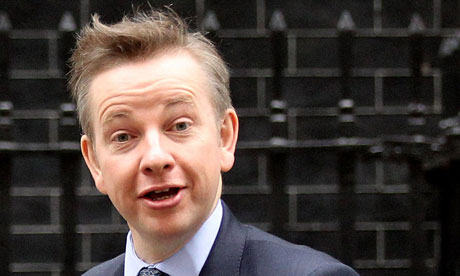
Perhaps it's not surprising that the man who's in charge of education in this country is a little bit worried. "I am increasingly concerned that current A-levels," said Michael Gove, in a letter to the exam regulator, "fall short of commanding the level of confidence we would want to see." It is, he said, "more important" that students start their degrees with "the right knowledge and skills" than that "ministers are able to influence the curriculum". He was, he said, going to hand control of the syllabus to exam boards and academic panels made up of senior dons. He hoped, he said, that the new A-levels would start in two years. He hoped, and so do I.

It's lovely, of course, to have so many pretty girls so happy to have done so well. But it isn't lovely that so many of them are struggling at university, and it isn't lovely that so many people with good GCSEs are having to be taught basic numeracy by employers shocked to find they can't add up. And it isn't lovely that this country is slipping down the world education league tables. In the last one, Britain had dropped to 25th place for reading, 28th for maths, and 16th for science. For the sixth biggest economy in the world, that doesn't sound all that good.

There are all kinds of reasons why standards have dropped. It would, for example, be quite strange for academic rigour in our schools to have increased at a time when academic rigour in our culture has shrunk. It would also be quite strange if schools that are judged on their performance in exam league tables didn't encourage their students into media studies or drama, rather than Mandarin or maths.

There were good reasons for widening the scope of subjects taught in schools, and giving more options to students who didn't look as though they were going to shine academically. It's surely better to leave school with a piece of paper saying you can do something than to leave with nothing at all. And there were good reasons for introducing league tables. If you want people to raise standards, you need them to show they have. But it does mean they're likely to focus less on learning, and more on results.

Whatever the intentions, the result has been that too many of our children aren't prepared for university, or life. The ones who are going to university aren't doing the subjects, like science or engineering, we need them to do if we don't want all our industries to go to China. The ones who aren't going to university aren't getting enough skills to do much at all. And if the ones who do go to university don't develop our industries, the ones who don't will be fighting for even fewer jobs.

"Children," said a man at a conference I went to last week, "aren't the problem. They are," he said, "very interested in anything that adults do. Teenagers," he said, "are desperate for direction. When they ask 'why should I do this?' you have two choices. Either walk out of the room, or tell them."
The conference was on "the manufacturing economy", and the man was a head of physics at a big South London comprehensive, called David Perks. They had, he said, managed to get 100 pupils to do A-level physics. There were, he said, equal numbers of girls and boys. Many of them, he said, were planning to go on and study engineering.

Educating children in a culture that doesn't seem to value academic achievement isn't easy. Nor is motivating them when, if they don't work, they won't starve. But you don't need to be a "tiger mother" to think that most of our children aren't being stretched enough. And, in an increasingly cut-throat global marketplace, it's our children who will suffer, not us.

Do we really believe the toffs who are running this country are brighter than the rest of us? Or that more money means a higher IQ? Do we really want state-educated pupils, who are 93 per cent of the population, to be let into the best educational institutions only through social engineering?
If we don't, we need to start believing that all our children can do better. And you don't help children do better by feeding them lies.

Teachers will work the system as long as they are under pressure for results


There's no room for error now schools are businesses. We need to hire more teachers and give them space to try new ideas
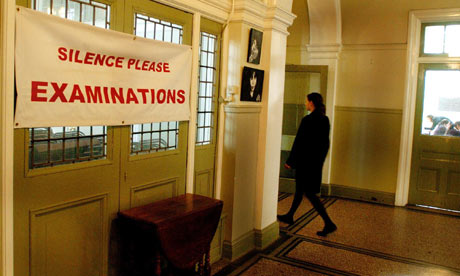
A-level exam in progress
Teachers have been 'gaming' the system to get their pupils through exams. Photograph: Rui Vieira/PA

According to a poll by the Association of Teachers and Lecturers, 35% of teachers say they could be "tempted to cheat". I've been a teacher for 10 years, and those figures hardly surprise me. I've seen everything from teachers openly rubbishing other subjects to ensure revision session attendance, teachers advising pupils to retake a whole year to improve performance in one module (thus ensuring their results don't drop), all the way to teachers encouraging pupils to annotate texts in the form of a shorthand lesson plan. I've seen teachers using exam spec answers and teachers becoming examiners for a year to steal good practice: in other words, we all work the system. What really worries me, however, is that there is no grey area left untapped and staff will feel pressured to go that extra inch into full-blown plagiarism.

Of course, gaming the system to relieve pressure from senior management is as old as the hills. But to get your head around around the whole truth of the ugly situation means unpicking a much larger problem with education in the UK.

Let me burst some bubbles, to start with: schools are businesses. All employees at the schools I have worked at are held accountable for their results. Residuals (how well your students have improved on predicted grades) A*-C pass rates, Alps scores, t-Scores, value-added – all are unpicked by a good management team, in a bid to improve the business. Better pass rates equals a more attractive school, and therefore more students. More students means more money. We are businesses.

The switch to academy status is to most parents confusing and pointless – to staff it means that now, you are officially working for a corporation. These are not your fuzzy, friendly government-run schools, with endless patience for slack teachers. The potential here is to swiftly get rid of staff who don't make the grade. "Good!" you might think. "Lazy teachers! They have it easy anyway, let's cut away the dead wood!" And, perhaps, there is an argument for that.

However, when a teacher sits down and analyses their results, they are set targets. The targets are "aspirational", but still meant to be achievable. Even when your pass rates are 90% and over, or your Alps results scores are a 2 (1 being the best possible, 9 being the worst) targets are put in place. And here is where the problems can begin. It is very easy (and I have known this to be the case) that a teacher's worth is questioned in line with results. Lazy pupils? That'll be your fault for allowing that culture in your classroom. Lack of homework or revision? Why didn't you call parents in to make them understand the importance of the revision sessions after class?

The result is a Mobius strip of a career, where you can feel constantly that you're running to stand still. I've grown pretty resilient to it, but I can empathise with the teachers who haven't. By and large, we all do our best. If you put in the hours, your teaching is focused, you have a keen bunch of kids and you lay on the revision sessions, the outcomes should be good. But when they aren't, there is no room for error. The school up the road had a better year. Raise your game – Bogwood primary sent twice as many kids there this year, and we need bums on seats. And if your results are good, well open a paper and listen to everyone tell you it's because the exams got easier, and it was harder in their day. It might well have been, but it doesn't help the hard work we are doing right now.

Our current school model is not fit for purpose. Schools are hamstrung by a lack of funds to develop teaching practice, the space to develop new ideas, and the confidence to try them out. We need to be attracting innovators with visions for the future, starting with training staff and ending with a flexible, skills-based curriculum that evolves every couple of years. Teachers need time. Look at the current dropout rates of new teachers: over a third leave the job in under three years. Why? Pressure. Hiring more teachers would create jobs and allow us to teach smaller classes, and could create more non-contact time in which to develop the craft. Yet this idea is often ridiculed. Since when did we all get so blasé about the future of our youth?

On Michael Gove's A level proposals - A new kind of class warfare


Michael Gove's A-level proposal will return us to the days when only the privileged were likely to go to university
Michael Gove Downing Street
Gove, ‘who advocates rote-learning of poems and kings and queens of England, has always had a narrow conception of education'. Photograph: Oli Scarff/Getty

So Michael Gove, the education secretary, wants to give more power to academics at "top universities". This should be thrilling news, since coalition policy is swiftly morphing universities into business-driven degree mills, with lecturers feeling more powerless than they have in decades. Yet Gove's invitation to us to set A-levels has not set pulses racing. Few lecturers think A-levels in their present form prepare students well enough for university, or equip them to engage intelligently with the challenges of a complex world. A rethink would ordinarily be welcome. But this proposal will not achieve what it sets out to do.

Education cannot be overhauled in this typically top-down manner, with a select minority of institutions running the show at the expense of the sector as a whole. Like much else that characterises coalition higher education policy, this is a form of class warfare. A rigorous and challenging education is not magically effected simply by setting tougher questions or more essays – much as the modular answers of A-levels at present are to be deplored.

An equal opportunities education requires systemic attention and proper public funding, quite the opposite of coalition priorities. Critical thinking, intellectual curiosity and good writing must be taught from an early age, and made part of every citizen's skills. Gove's suggestion reduces them to instruments for enabling the better-supported to get into a good course. Turning A-levels into old-style Oxbridge entrance exams is consistent with the coalition's damaging and hierarchical attitude to education. Only a handful of well-coached clever clogs will enter a shrinking and expensive university sector.

Gove's proposal to limit the number of retakes also requires scrutiny. As any teacher knows, one-off exam results are not a fail-safe indicator of a student's abilities. Gove's emphasis on them as limited-opportunity tools for determining university entrance highlights the coalition's refusal to see education as a democratic necessity, a resource that should be widely and equally available as a public good.

While it would be productive for schoolteachers and academics across the sector to share ideas about the content and evaluation of school curriculums, it is wrong to suggest that exams can be set by people not directly involved with the teaching of them. At Cambridge we spend much attention on ensuring that the exams we set are fair and enable a wide range of answers in relation to the teaching we provide, but the questions are not instrumental – nor do we teach solely with exams in mind. Schoolteachers, not lecturers, should be the driving force behind A-levels. What Gove calls "university ownership" of A-levels is a euphemism for the managerialism that is already part of the problem. Asking some universities to "drive the system" from a distance threatens to throw everyone else off the vehicle.

Our challenging times call for a richly resourced educational system that equips young people across social classes to develop their intellectual and creative abilities. Jobs and degrees are vital – but so, in a democracy, is the ability to think ideas through at length, make informed judgments, critically evaluate alternatives and argue a case. Would a government that is busily pushing through changes with no real mandate really want to encourage this?

Gove, who advocates rote-learning of poems and kings and queens of England, has always had a narrow conception of education. His proposal returns us to the bad old days when only the privately educated and well-funded could go to university. In tandem with tripled tuition fees, a funding regime that weakens the arts and humanities, and the likely privatisation of many universities, the already privileged will be the only winners.

Tuesday, 3 April 2012

Is the EU taking its over-fishing habits to west African waters?


The UN says EU trawlers are out-muscling 1.5 million fishermen, who themselves warn west Africa could 'become like Somalia'
Mauritania's waters are crowded. Twenty-five miles out to sea and in great danger from turbulent seas are small, open pirogues crewed by handfuls of local fishermen, taking pitifully few fish. Also here within 50 miles of us are at least 20 of the biggest EU fishing vessels, along with Chinese, Russian and Icelandic trawlers and unidentifiable pirate ships.

We are closest to the Margaris, a giant 9,499-tonne Lithuanian factory trawler able to catch, process and freeze 250 tonnes of fish a day, and a small Mauritanian vessel, the Bab El Ishajr 3. Here too, in the early mists, its radio identification signal switched off, is Spanish beam trawler the Rojamar. The Arctic Sunrise, Greenpeace's 40-year-old former ice-breaker, is shadowing one of Britain's biggest factory trawlers – the 4,957-tonne Cornelis Vrolijk. Operated by the North Atlantic Fishing Company (NAFC), based in Caterham, Surrey, it is one of 34 giant freezer vessels that regularly work the west African coast as part of the Pelagic Freezer Association (PFA), which represents nine European trawler owners.

The ship, which employs Mauritanian fish processing workers aboard, is five miles away, heading due south at 13 knots out of dirty weather around Cape Blanc on the western Saharan border. By following the continental ledge in search of sardines, sardinella, and mackerel, it hopes to catch 3,000 tonnes of fish in a four- to six-week voyage before it offloads them, possibly in Las Palmas in the Canary Islands.

But, says NAFC managing director Stewart Harper, while most of its fish will end up in Africa, none will go to Mauritania, despite the country facing a famine in parts. "Unfortunately Mauritania does not yet have the infrastructure to handle cargoes of frozen fish or vessels of our size," he says.

The west African coast has some of the world's most abundant fishing grounds, but they are barely monitored or policed, and wide open to legal and illegal plunder. According to the UN's Food and Agriculture Organisation, all west African fishing grounds are fully or over-exploited to the detriment of over 1.5 million local fishermen who cannot compete with them or feed their growing populations.
Heavily subsidised EU-registered fleets catch 235,000 tonnes of small pelagic species from Mauritania and Moroccan waters alone a year, and tens of thousands of tonnes of other species in waters off Sierra Leone, Ghana, Guinea Bissau and elsewhere.

A further unknown amount is caught by other countries' vessels, but the individual agreements made between west African countries and foreign companies are mostly secret.

Despite possible ecological collapse, and growing evidence of declining catches in coastal waters, west African countries are now some of the EU's most-targeted fishing grounds, with 25% of all fish caught by its fleets coming from the waters of developing countries.

Willie MacKenzie, a Greenpeace ocean campaigner, said: "Europe has over-exploited its own waters, and now is exporting the problem to Africa. It is using EU taxpayers' money to subsidise powerful vessels to expand into the fishing grounds of some of the world's poorest countries and undermine the communities who rely on them for work and food. The EU has committed some €477m for agreements with Mauritania over the past 10 years, essentially paying for vessels like the Cornelis Vrolijk to be able to access these waters," he adds.

According to the PFA, about 50 international freezer-trawlers are active in Mauritanian waters at any one time, of which 30 originate from countries such as Russia, China, Korea or Belize. "By targeting fish species that cannot be fished by local fishermen, we avoid disrupting local competition and growth and always fish outside the 12-13 mile fishing limit for our type of vessel," says a spokesman.
"Not all international operators active in Mauritanian waters meet the EU's safety and environmental standards. This threatens our efforts to foster sustainable practices in the region."

Greenpeace says the over-exploitation of African fisheries by rich countries is ecologically unsustainable and also prevents Africans from developing their own fisheries. It takes 56 traditional Mauritanian boats one year to catch the volume of fish that a PFA vessel can capture and process in a single day. Since the 1990s, the once-abundant west African waters have seen a rapid decline of fish stocks. Local fishermen say their catches are shrinking and they are forced to travel further and compete with the industrial trawlers in dangerous waters unsuitable for their boats.

"Our catch is down 75% on 10 years ago. When the foreign boats first arrived there was less competition for resources with local fishermen and fewer people relied on fishing for food and income. Governments have become dependent on the income received by selling fishing rights to foreign corporations and countries," says Samb Ibrahim, manager of Senegal's largest fishing port, Joal.

"Senegal's only resource is the sea. One in five people work in the industry but if you put those people out of work then you can imagine what will happen. Europe is not far away and Senegal could become like Somalia," said Abdou Karim Sall, president of the Fishermen's Association of Joal and the Committee of Marine Reserves in West Africa.

"People are getting desperate. For sure, in 10 years' time, we will carry guns. The society here destabilises as the fishing resource is over-exploited. As the situation become more difficult, so it will become more and more like Somalia," he said.

There is now growing concern that illegal or "pirate" fishing is out of control in some waters. According to the UN, across the whole of sub-Saharan Africa, losses to illegal fishing amount to about $1bn a year – 25% of Africa's total annual fisheries exports.

Guinea is thought to lose $105m of fish to pirate fishing a year, Sierra Leone $29m, and Liberia $12m. An investigation by Greenpeace and the Environmental Justice Foundation in 2006 found that over half of the 104 vessels observed off the coast of Guinea were either engaging in or linked to illegal fishing activities.

Surveillance and monitoring of overfishing is now urgently needed or fish stocks will collapse, leading to humanitarian disasters in many countries, says the UN. Increasingly, ships are transferring their catches to other vessels while at sea, rather than directly off-loading in ports. This conceals any connection between the fish and the vessel by the time the fish arrives on the market, meaning the true origin of the catch is unknown.

However, the PFA says banning EU vessels from African waters would not be sensible.
In a statement it said: "Less regulated, less transparent and less sustainable fishing operators would replace the European vessels. This would be a bad deal for Europe and the African countries we partner with.

"They would see less strategic infrastructure investment, reduced transfer of skills and knowhow, as well as scientific research and more depleted fish stocks. And in Europe we would damage a viable part of EU's fishing economy to the benefit of countries such as China.

"All of the fish caught by the PFA is destined for west-central African communities rather than consumers in developed countries. In fact, the fish caught and distributed by the PFA is often the only source of essential protein for the people in countries such as Nigeria."

• John Vidal's travel costs to Senegal were paid by Greenpeace. The NGO had no say over editorial content.

Monday, 2 April 2012

Why do bankers get to decide who pays for the mess Europe is in?

There were summits about how much misery would be imposed on the Greeks – and no trade unions got a say
What you're about to read does, I admit, sound like a conspiracy theory. It involves powerful people meeting in private offices, hundreds of billions of euros, and clandestine deals determining the fates of entire countries. All that's missing is a grassy knoll or a wandering band of illuminati. There are, however, two crucial differences: these events are still unfolding – and they're more worrying than any who-killed-JFK fantasy I've ever heard.

Cast your mind back to the euro crisis talks last year, when the future of Greece was being decided. How much Athens should pay its bailiffs in the banks, on what terms, and the hardship that ordinary Greeks would have to endure as a result.

There were times when the whole of 2011 seemed to be one long European summit, when you heard more about Papandreou and Merkozy than was strictly necessary. Yet you probably didn't catch many references to Charles Dallara and Josef Ackermann.

They're two of the most senior bankers in the world – among the top 1% of the 1%. Dallara served in the Treasury under Ronald Reagan, before moving on to Wall Street, while Ackermann is chief executive of Deutsche Bank. But their role in the euro negotiations, and so in deciding Greece's future, was as representatives of the International Institute for Finance.

The IIF is a lobby group for 450 of the biggest banks in the world, with members including Barclays, RBS and Lloyds. Dallara and Ackermann and their colleagues were present throughout those euro summits, and enjoyed rare and astounding access to European heads of state and other policy-makers. EU and IMF officials consulted the bankers on how much Greece should pay, Europe's commissioner for economic affairs Olli Rehn shared conference calls with them.

You can piece all this together by poring over media reports of the euro summits, although be warned: you'll need a very high tolerance threshold for European TV, and financial newswires. But Dallara and co are also quite happy to toot their own trumpets. After a deal was struck last July, the IIF put out a note bragging about its "catalytic" role and claiming its offer "forms an integral part of a comprehensive package".

By now you'll have guessed the punchline: that July agreement was terrible for the Greeks, and brilliant for the bankers. It was widely panned at the time, for slicing only 21% off the value of Greece's loans, when Angela Merkel and many others agreed that financiers ought to be taking a much bigger hit. As the German government's economic adviser, Wolfgang Franz, later remarked in an interview: "If you look at the 21% and our demand for a 50% participation of private creditors, the financial sector has been very successful." Another way of putting it would be to say that the bankers overpowered even the strongest state in Europe.

None of this was inevitable. Iceland had made it clear that simply defaulting on one's loans didn't immediately lead to economic apocalypse. Across Greece, there were massive, repeated protests about the enormous spending cuts that citizens would suffer by paying off Goldman Sachs and the rest. And there was a growing movement in Greece and Portugal and France, among other countries, questioning the legitimacy of some of these loans.

None of these voters, none of these opinions got even a fraction of the consideration, let alone the face time, that was extended to Dallara and Ackermann. At Corporate Europe Observatory in Brussels, Yiorgos Vassalos has been tracking the negotiations over Greece: by his reckoning only the IIF got to have such personal, close-up access. These were summits settling how much misery would be imposed on the Greek people – and no trade unions or civil society groups got a say in them. "The only key players in those meetings were European governments and the bankers," says Vassalos.
Mindful of appearances, the EU has been less eager to admit to the influence of the bankers' lobby. When European officials were first asked by Corporate Europe Observatory about the extent of IIF access, they responded that it was limited to the Greek government. Only when it was pointed out that the Wall Street Journal and Bloomberg were reporting that Dallara met Merkel and Nicolas Sarkozy at midnight at an October summit to finalise a bigger reduction of the value of Greek debt did the officials back down: the IIF, they agreed, had been negotiating with a range of governments, on a whole host of issues to do with Greece's future.

So the bankers whose excesses helped land Europe in this mess then get to sit round the big EU table, like any other government, and decide who should pay for it. And the answer, unsurprisingly, is: not them. The bigger question is: why finance has been granted such power? In a forthcoming paper entitled Deep Stall, the Centre for Research on Socio-Cultural Change gives one compelling reason: because so many countries across Europe are, through both their public and private sectors, so dependent on financiers in other countries for credit. That includes Britain, which relies on 10 eurozone countries for loans worth over 70% of its annual national income – a higher proportion even than Italy. The tale of the IIF and how it got such a powerful say on the fate of ordinary Greeks is really a chapter in a much bigger story of how governments across the western world got swallowed up by their finance industries.

Sunday, 1 April 2012

What to do when you've done your hamstring

by Andrew Leipus in Cricinfo
 
Overwhelming feedback so far shows there are a lot of ESPNcricinfo readers out there currently suffering cricket injuries and they want some help. There are volumes of research out there but over the next few articles I will broadly discuss some guidelines on what I commonly see in practice, and provide some information that might be useful. Of course, it goes without saying that all injuries are unique and wherever possible you need to seek professional advice.

I have just read that my old captain of many years, Sourav Ganguly, has pulled a hamstring which kept him out of the Syed Mushtaq Ali Trophy quarter-final recently. Whilst this was unfortunate for Bengal, what was of interest was his comment that he will be fine by the time the IPL starts. This leaves him around two weeks in which to recover and complete his rehab. But the IPL also presents an interesting challenge to players, in that often they are coming off long seasons or a Test series. The increased intensity and speed of play during a Twenty20 is potentially a risk for the players, and where time allows, they should be gradually increasing their training intensity during the pre-camp. 

Sudden transition from standing around during Test cricket to explosive T20 is an injury waiting to happen and players need time to prepare adequately. I hope Sourav can recover in time. Unfortunately, hamstring strain injuries are a challenge for both the players and support staff, given their high incidence rate, slow healing, and a tendency to recur.

There is a continuum of muscle impairment that can occur in sport, ranging from simple muscle cramping or soreness to the worst-case scenario, of a complete rupture. We like to classify the degree of injury as a grade 1, 2, or 3, as it gives us an idea of how quickly we can get the player back to sport again. The greater the damage, the longer the rehabilitation period for restoration of full function.

Hamstring strains are quite common in cricket and can occur when overloaded eccentrically, like if the hamstring attempts to control a rapidly flexing hip/trunk or an extending leg, or both. This can happen during bowling, running between wickets or sprinting in the outfield, so every player is a potential victim. When the load applied or expected to be controlled by the muscle exceeds its capabilities, especially when on stretch, the muscle fibres tear or get damaged.

In terms of self-diagnosis, if you experience hamstring muscle soreness after a long day in the field or following training in the gym, the problem is unlikely to involve disruption of muscle fibres and will probably heal in a day or two. Many players experience this feeling after long days in the slips during a Test match. But a massage or ice bath in the evening will always help them recover by morning.
Actual muscle strains, however, always are accompanied by an acute onset of pain. A sudden, sharp "grabbing" behind the thigh is generally an indicator of a strain. Feeling pain or a swelling under your thigh when sitting is also quite indicative. The more intense the pain, generally, the higher the grade of injury.

The delineation between strong cramping and a mild strain is often difficult to diagnose, especially when the player is fatigued and dehydrated. This poses problems now that substitute runners are not allowed. Regardless, a grade 1 will probably let you continue playing, albeit with some discomfort, a grade 2 or 3 will bring you off the ground, limping. If this acute "grabbing" or "tearing" sensation isn't experienced and the hamstring pain arrives insidiously, there is a good chance the pain is being referred from surrounding areas like the lower back or pelvis. The management for this sort of injury is very different. There are many other possible sources of hamstring pain, often co-existing. This often results in a player return to sport remarkably quickly, since no muscle is actually injured at the time.

The initial management of all strains begins with protecting or offloading the muscle - applying an ice compression for 15-20 minutes every hour or two for a couple of days (commonly longer). A lot of people start to exercise too early post-injury, and in my experience sometimes it's better left alone, to allow for the natural healing processes to begin. A good rule of thumb to follow is not to do anything that hurts - it is common sense but not always followed, and leads to a premature return to sport, getting injured again, and even more time out of the game.

After a few days, when walking is easier, aim to gradually restore full range of movement, develop good alignment of scar tissue and regain optimal strength, since injured muscle becomes inhibited or weak almost immediately. Active stretching is useful in regaining movement - when sitting, use the quads to straighten the knee and provide a gentle hamstring stretch. It's much more preferable to static stretching at this stage. Soft-tissue massage is also beneficial to normalise muscle tone and soften the healing scar tissue.


A lot of people start to exercise too early post-injury, and in my experience sometimes it's better left alone, to allow for the natural healing processes to begin. A good rule of thumb to follow is not to do anything that hurts


A good sports physio will address these issues and examine for any other contributing or driving factors that may be modifiable, such as muscle imbalances, weakness, poor flexibility or dysfunctional movement patterns. In other words, they will look for reasons, biomechanical or otherwise, why the injury possibly occurred and try to correct or improve them.

After this, a progressive amount of training load is needed to strengthen the injured and weakened muscle without injuring it again. Some of the better traditional exercises prescribed early in rehabilitation don't require any equipment and include hip bridging off of a bench, squats, lunges, deadlifts and single-leg standing windmills.

Hamstring curl machines found in gyms certainly have their place in rehab but are a luxury not a necessity. Stationary cycling is also beneficial for maintaining cardio fitness and initially provides a low load to the hamstring. Access to a spin bike is useful if it has a weighted fly-wheel, since this will introduce an eccentric load to the hamstring. Eccentric loading has been shown to be a critical component to full hamstring rehabilitation.

Jogging can be reintroduced gradually, initially as sideways movements, which places less stress on the hamstrings. As pain-free contraction and full range of motion are regained, drills such as 80-metre run-throughs are common, like 20m of gradual acceleration leading into 40m of steady pace, followed by a deceleration over the next 20m. The distances and intensities of the acceleration and steady pace are gradually increased from session to session as the injured muscle adapts to increasing loads. Progression is based on the ability to complete each session successfully and wake up the next day without pain or stiffness. The ultimate goal is rapid acceleration into a full sprint, and for cricket, rapid changes of direction.

At some stage during this programme, cricketing skills will be reintroduced. For example, once lunging is comfortable it is quite reasonable to begin easy net sessions. Similarly, bowlers coming off hamstring strains need to begin "walking through" their actions, progressing to controlled medicine-ball throws and gradually bowling off a short run.

As mentioned at the start, there is no recipe. What you need instead is a structured and flexible progression of loading the injured muscle and the reintroduction of the necessary skills to avoid the development of altered movement patterns associated with the injury. The loads can be increased as the muscle becomes stronger, as can the progression of the gym programme to include more dynamic functional training and plyometrics/power training.

In terms of returning to play, don't be one of the many people who equate a lack of pain or stiffness with being fit. Prevention of re-injury starts with thorough rehabilitation of the current injury. Incorporating a dynamic warm-up before playing is the norm nowadays and static stretching is uncommon (although there still is a place for it). Bowling actions need to be reviewed carefully by the coach to ensure there is no altered movement - bowlers often don't finish their actions completely when recovering from a hamstring strain, and avoid short or full deliveries as they require a slightly longer delivery stride.

Ultimately, the best functional testing is seen under match conditions. Muscles tend to tighten when weak or fatigued and the best practice for this is to play a match, often at a lower grade than usual, in order to better control the efforts.

As you can see, there is a lot to cover in management of the "simple" hamstring strain and this has just been an introduction. But the best piece of advice I can give for prevention of hamstring strains is to be physically well conditioned. The more functionally strong the muscle, the less likely it is to fail.

The rebirth of Japan

What's the story of the next decade?

The country's urge to reset its business culture is a lesson to Britain in finding the way back to prosperity
Will Hutton, Japan
In some fields Japan is years ahead of the rest of the world. Photograph: Gina Calvi/Alamy

It is a small thing, but it says a lot about the country. At Tokyo's Narita airport, when you take off your shoes at the security screening check, the guard hands you a pair of leather slippers. The message is obvious: this airport cares for your wellbeing and recognises your need.

In Japan, taxi doors swing open automatically; toilet seats are electronically warmed and cleaned; and the extraordinary variety of food is presented exquisitely. There is a passion for satiating every imaginable human want and a joy in embracing the science, technology and innovation that might help deliver just that.

For 40 years, between 1950 and 1990, this passion was a key ingredient driving one of the most remarkable periods of growth in economic history. But for the past 20 years, Japan has been stricken by stagnation. In the late 1980s-90s, it suffered a financial crisis nearly as severe as our own. The economic model – the Ministry of International Trade and Industry guiding Japanese companies; the keiretsu networks of loosely conglomerated firms and associated banks; the great global brands – suffered an implosion.

Yet this remains a $5trn economy, the third largest on the planet. The Japanese themselves are desperate to recover the elixir of growth, and understand that economic conservatism – in Japan just as in Britain – leads to disappointment and heartbreak.

In 2009, the Democratic party of Japan was elected by a landslide, pledging a root and branch reform of every bureaucratic, corporatist and anti-democratic element in Japan's broken system. It also pledged to recast economic policy to serve the people. Despite some epic mistakes, notably its handling of the Fukushima nuclear disaster, it still holds an opinion poll lead over its rival, the Liberal Democratic party (LDP).

However, forces within the government are very much open to pondering where it should go next. Ten days ago, I was invited by the DPJ government to go to Tokyo to contribute to this ongoing conversation.

Cabinet members wanted to discuss what a 21st-century social contract might look like, respecting both necessary labour market flexibility and security. They wanted to understand the contribution that open innovation ecosystems and an entrepreneurial state can play in driving forward innovation and investment. Above all, they asked: how could Japan reinvent its stakeholder capitalism of the second half of the 20th century so that it was more democratic? And they thought there might be something in my ideas rehearsed in the books The State We're In and Them and Us. In short, how could Japan do good capitalism?

It is the question – not only in Japan but, I would argue, in Britain. In Japan the devastating earthquake in Tohoku 12 months ago has made it even more acute. Three hundred and forty thousand people are still without homes. At least 19,000 died. And the nuclear power station at Fukushima very nearly suffered a meltdown.

At the time of the crisis, Japan hoped that, with the DPJ in power, there would be a decisive change from the way such matters had been handled in the past – obfuscation, delay, inactivity and anxiety to protect corporate interests. Yet the new government bounced off the secrecy of Tokyo Electric Power Company, the bureaucratic ministries, a muzzled media and the enveloping tentacles of the employers' organisation, the Keidanren, as if nothing had changed. Prime Minster Kan became party to delivering inadequate and late information via the impenetrable state and corporate networks; many Japanese became devotees of BBC World News as the only purveyor of truth. Kan was forced to resign last summer.

But the Japanese electorate is not ready to return to the status quo. They know they need nuclear power which just 12 months ago provided more than a third of their electricity needs; but as power stations are being closed down for safety inspections local communities are vetoing their reopening. In May, the last nuclear power station operating will also be mothballed.

The terms for their restarting are tough. Local communities, fired up by a new citizen activism, want effective oversight, transparency of information and commitments to meet international safety standards. It is Japanese good capitalism, driven by citizen demands from below.

Faced with this new phenomenon, the LDP is at a loss, while the DPJ itself seems to be re-gathering its conviction that its reform agenda is the only way forward. At an open meeting in the Japanese parliament, I was struck by the interest DPJ MPs showed in discussing innovative ways of kickstarting credit flows – as anathema to the Bank of Japan and Ministry of Finance as they are to the Bank of England and Treasury.

The Bank of Japan has just expanded a version of the Bank of England's quantitative easing programme; but abstains from the activism it used to show in the great days of Japan's growth. The conclusions are obvious. Japan's financial system is broken; an activist state has to restart bank lending by assuming some of the risk – just as it must in Britain.

If Japan could reset its macroeconomic policy, there is an enormous pool of dynamic hi-tech medium-sized firms that could immediately grow very fast. Consultant Gerhard Fasol argues that in areas like LED lighting or mobile phone payment systems, Japan is 10 years ahead of the rest of the world. The Fujitsus and Toshibas of tomorrow are in the wings. What Japan needs is for the increasingly sclerotic giants to be challenged by these many insurgents, who need new institutions to support their ambitions to go global. A new entrepreneurial, accountable state could drive a second phase of powerful Japanese growth.

These debates are foreign to our primitive business culture, which undervalues service and innovation and scarcely thinks about a more productive capitalism. There is a long list of British companies that have tried to break into Japan's market and failed. Observers say the common theme is wholesale insensitivity to the need for service and innovation, the precondition for any success in Japan.

Britain and Japan are two island economies, both mired in private debt with stricken financial systems. Although Japan has a long way to go, it is becoming obvious, confirmed by last week's British budget, which of the two countries is most likely to create the 21st-century framework for growth and prosperity. The Asian story of the next decade will be Japan's renaissance and China's relapse.