Search This Blog

Tuesday, 14 February 2012

'Losing' the world: American decline in perspective, part 1


US foreign policy 'experts' only ever provide an echo chamber for American imperial power. A longer, broader view is necessary
Significant anniversaries are solemnly commemorated – Japan's attack on the US naval base at Pearl Harbor, for example. Others are ignored, and we can often learn valuable lessons from them about what is likely to lie ahead. Right now, in fact.

At the moment, we are failing to commemorate the 50th anniversary of President John F Kennedy's decision to launch the most destructive and murderous act of aggression of the post-second world war period: the invasion of South Vietnam, later all of Indochina, leaving millions dead and four countries devastated, with casualties still mounting from the long-term effects of drenching South Vietnam with some of the most lethal carcinogens known, undertaken to destroy ground cover and food crops.
The prime target was South Vietnam. The aggression later spread to the North, then to the remote peasant society of northern Laos, and finally to rural Cambodia, which was bombed at the stunning level of all allied air operations in the Pacific region during second world war, including the two atom bombs dropped on Hiroshima and Nagasaki. In this, Henry Kissinger's orders were being carried out – "anything that flies on anything that moves" – a call for genocide that is rare in the historical record. Little of this is remembered. Most was scarcely known beyond narrow circles of activists.
When the invasion was launched 50 years ago, concern was so slight that there were few efforts at justification, hardly more than the president's impassioned plea that "we are opposed around the world by a monolithic and ruthless conspiracy that relies primarily on covert means for expanding its sphere of influence", and if the conspiracy achieves its ends in Laos and Vietnam, "the gates will be opened wide."

Elsewhere, he warned further that "the complacent, the self-indulgent, the soft societies are about to be swept away with the debris of history [and] only the strong … can possibly survive," in this case reflecting on the failure of US aggression and terror to crush Cuban independence.

By the time protest began to mount half a dozen years later, the respected Vietnam specialist and military historian Bernard Fall, no dove, forecast that "Vietnam as a cultural and historic entity … is threatened with extinction … [as] … the countryside literally dies under the blows of the largest military machine ever unleashed on an area of this size." He was again referring to South Vietnam.
When the war ended eight horrendous years later, mainstream opinion was divided between those who described the war as a "noble cause" that could have been won with more dedication, and at the opposite extreme, the critics, to whom it was "a mistake" that proved too costly. By 1977, President Carter aroused little notice when he explained that we owe Vietnam "no debt" because "the destruction was mutual."

There are important lessons in all this for today, even apart from another reminder that only the weak and defeated are called to account for their crimes. One lesson is that to understand what is happening, we should attend not only to critical events of the real world, often dismissed from history, but also to what leaders and elite opinion believe, however tinged with fantasy. Another lesson is that alongside the flights of fancy concocted to terrify and mobilize the public (and perhaps believed by some who are trapped in their own rhetoric), there is also geo-strategic planning based on principles that are rational and stable over long periods because they are rooted in stable institutions and their concerns. That is true in the case of Vietnam, as well. I will return to that, only stressing here that the persistent factors in state action are generally well concealed.

The Iraq war is an instructive case. It was marketed to a terrified public on the usual grounds of self-defense against an awesome threat to survival: the "single question", George W Bush and Tony Blair declared, was whether Saddam Hussein would end his programs of developing weapons of mass destruction. When the single question received the wrong answer, government rhetoric shifted effortlessly to our "yearning for democracy", and educated opinion duly followed course; all routine.
Later, as the scale of the US defeat in Iraq was becoming difficult to suppress, the government quietly conceded what had been clear all along. In 2007-2008, the administration officially announced that a final settlement must grant the US military bases and the right of combat operations, and must privilege US investors in the rich energy system – demands later reluctantly abandoned in the face of Iraqi resistance. And all well kept from the general population.

Gauging American decline

With such lessons in mind, it is useful to look at what is highlighted in the major journals of policy and opinion today. Let us keep to the most prestigious of the establishment journals, Foreign Affairs. The headline blaring on the cover of the December 2011 issue reads in bold face: "Is America Over?"
The title article calls for "retrenchment" in the "humanitarian missions" abroad that are consuming the country's wealth, so as to arrest the American decline that is a major theme of international affairs discourse, usually accompanied by the corollary that power is shifting to the East, to China and (maybe) India.

The lead articles are on Israel-Palestine. The first, by two high Israeli officials, is entitled "The Problem is Palestinian Rejection": the conflict cannot be resolved because Palestinians refuse to recognize Israel as a Jewish state – thereby conforming to standard diplomatic practice: states are recognized, but not privileged sectors within them. The demand is hardly more than a new device to deter the threat of political settlement that would undermine Israel's expansionist goals.
The opposing position, defended by an American professor, is entitled "The Problem Is the Occupation." The subtitle reads "How the Occupation is Destroying the Nation." Which nation? Israel, of course. The paired articles appear under the heading "Israel under Siege".
The January 2012 issue features yet another call to bomb Iran now, before it is too late. Warning of "the dangers of deterrence", the author suggests that:
"[S]keptics of military action fail to appreciate the true danger that a nuclear-armed Iran would pose to US interests in the Middle East and beyond. And their grim forecasts assume that the cure would be worse than the disease – that is, that the consequences of a US assault on Iran would be as bad as or worse than those of Iran achieving its nuclear ambitions. But that is a faulty assumption. The truth is that a military strike intended to destroy Iran's nuclear program, if managed carefully, could spare the region and the world a very real threat and dramatically improve the long-term national security of the United States."
Others argue that the costs would be too high, and at the extremes, some even point out that an attack would violate international law – as does the stand of the moderates, who regularly deliver threats of violence, in violation of the UN Charter.

Let us review these dominant concerns in turn.

American decline is real, though the apocalyptic vision reflects the familiar ruling-class perception that anything short of total control amounts to total disaster. Despite the piteous laments, the US remains the world dominant power by a large margin, and no competitor is in sight, not only in the military dimension, in which, of course, the US reigns supreme.

China and India have recorded rapid (though highly inegalitarian) growth, but remain very poor countries, with enormous internal problems not faced by the West. China is the world's major manufacturing center, but largely as an assembly plant for the advanced industrial powers on its periphery and for western multinationals. That is likely to change over time. Manufacturing regularly provides the basis for innovation, often breakthroughs, as is now sometimes happening in China. One example that has impressed western specialists is China's takeover of the growing global solar panel market, not on the basis of cheap labor, but by coordinated planning and, increasingly, innovation.
But the problems China faces are serious. Some are demographic, reviewed in Science, the leading US science weekly. The study shows that mortality sharply decreased in China during the Maoist years, "mainly a result of economic development and improvements in education and health services, especially the public hygiene movement that resulted in a sharp drop in mortality from infectious diseases." This progress ended with the initiation of the capitalist reforms 30 years ago, and the death rate has since increased.

Furthermore, China's recent economic growth has relied substantially on a "demographic bonus", a very large working-age population. "But the window for harvesting this bonus may close soon," with a "profound impact on development": "Excess cheap labor supply, which is one of the major factors driving China's economic miracle, will no longer be available."

Demography is only one of many serious problems ahead. For India, the problems are far more severe.

Not all prominent voices foresee American decline. Among international media, there is none more serious and responsible than the London Financial Times. It recently devoted a full page to the optimistic expectation that new technology for extracting North American fossil fuels might allow the US to become energy-independent, hence to retain its global hegemony for a century. There is no mention of the kind of world the US would rule in this happy event, but not for lack of evidence.

At about the same time, the International Energy Agency reported that, with rapidly increasing carbon emissions from fossil fuel use, the limit of safety will be reached by 2017, if the world continues on its present course. "The door is closing," the IEA chief economist said, and very soon it "will be closed forever".

Shortly before the US Department of Energy reported the most recent carbon dioxide emissions figures, which "jumped by the biggest amount on record" to a level higher than the worst-case scenario anticipated by the International Panel on Climate Change (IPCC). That came as no surprise to many scientists, including the MIT program on climate change, which for years has warned that the IPCC predictions are too conservative.

Such critics of the IPCC predictions receive virtually no public attention, unlike the fringe of denialists who are supported by the corporate sector, along with huge propaganda campaigns that have driven Americans off the international spectrum in dismissal of the threats. Business support also translates directly to political power. Denialism is part of the catechism that must be intoned by Republican candidates in the farcical election campaign now in progress, and in Congress, they are powerful enough to abort even efforts to inquire into the effects of global warming, let alone do anything serious about it.

In brief, American decline can perhaps be stemmed if we abandon hope for decent survival – prospects that are all too real, given the balance of forces in the world.

'Losing' China and Vietnam

Putting such unpleasant thoughts aside, a close look at American decline shows that China indeed plays a large role, as it has for 60 years. The decline that now elicits such concern is not a recent phenomenon. It traces back to the end of the second world war, when the US had half the world's wealth and incomparable security and global reach. Planners were naturally well aware of the enormous disparity of power, and intended to keep it that way.

The basic viewpoint was outlined with admirable frankness in a major state paper of 1948 (PPS 23). The author was one of the architects of the "new world order" of the day, the chair of the State Department policy planning staff, the respected statesman and scholar George Kennan, a moderate dove within the planning spectrum. He observed that the central policy goal was to maintain the "position of disparity" that separated our enormous wealth from the poverty of others. To achieve that goal, he advised, "We should cease to talk about vague and … unreal objectives such as human rights, the raising of the living standards, and democratization," and must "deal in straight power concepts", not "hampered by idealistic slogans" about "altruism and world-benefaction."

Kennan was referring specifically to Asia, but the observations generalize, with exceptions, for participants in the US-run global system. It was well understood that the "idealistic slogans" were to be displayed prominently when addressing others, including the intellectual classes, who were expected to promulgate them.

The plans that Kennan helped formulate and implement took for granted that the US would control the western hemisphere, the Far East, the former British empire (including the incomparable energy resources of the Middle East), and as much of Eurasia as possible, crucially its commercial and industrial centers. These were not unrealistic objectives, given the distribution of power. But decline set in at once.

In 1949, China declared independence, an event known in Western discourse as "the loss of China" – in the US, with bitter recriminations and conflict over who was responsible for that loss. The terminology is revealing. It is only possible to lose something that one owns. The tacit assumption was that the US owned China, by right, along with most of the rest of the world, much as postwar planners assumed.

The "loss of China" was the first major step in "America's decline". It had major policy consequences. One was the immediate decision to support France's effort to reconquer its former colony of Indochina, so that it, too, would not be "lost".

Indochina itself was not a major concern, despite claims about its rich resources by President Eisenhower and others. Rather, the concern was the "domino theory", which is often ridiculed when dominoes don't fall, but remains a leading principle of policy because it is quite rational. To adopt Henry Kissinger's version, a region that falls out of control can become a "virus" that will "spread contagion", inducing others to follow the same path.

In the case of Vietnam, the concern was that the virus of independent development might infect Indonesia, which really does have rich resources. And that might lead Japan – the "superdomino" as it was called by the prominent Asia historian John Dower – to "accommodate" to an independent Asia as its technological and industrial center in a system that would escape the reach of US power. That would mean, in effect, that the US had lost the Pacific phase of the second world war, fought to prevent Japan's attempt to establish such a new order in Asia.

The way to deal with such a problem is clear: destroy the virus and "inoculate" those who might be infected. In the Vietnam case, the rational choice was to destroy any hope of successful independent development and to impose brutal dictatorships in the surrounding regions. Those tasks were successfully carried out – though history has its own cunning, and something similar to what was feared has since been developing in East Asia, much to Washington's dismay.

The most important victory of the Indochina wars was in 1965, when a US-backed military coup in Indonesia led by General Suharto carried out massive crimes that were compared by the CIA to those of Hitler, Stalin, and Mao. The "staggering mass slaughter", as the New York Times described it, was reported accurately across the mainstream, and with unrestrained euphoria.

It was "a gleam of light in Asia", as the noted liberal commentator James Reston wrote in the Times. The coup ended the threat of democracy by demolishing the mass-based political party of the poor, established a dictatorship that went on to compile one of the worst human rights records in the world, and threw the riches of the country open to western investors. Small wonder that, after many other horrors, including the near-genocidal invasion of East Timor, Suharto was welcomed by the Clinton administration in 1995 as "our kind of guy".

Years after the great events of 1965, Kennedy-Johnson national security adviser McGeorge Bundy reflected that it would have been wise to end the Vietnam war at that time, with the "virus" virtually destroyed and the primary domino solidly in place, buttressed by other US-backed dictatorships throughout the region.

Similar procedures have been routinely followed elsewhere. Kissinger was referring specifically to the threat of socialist democracy in Chile. That threat was ended on another forgotten date, what Latin Americans call "the first 9/11", which in violence and bitter effects far exceeded the 9/11 commemorated in the west. A vicious dictatorship was imposed in Chile, one part of a plague of brutal repression that spread through Latin America, reaching Central America under Reagan. Viruses have aroused deep concern elsewhere as well, including the Middle East, where the threat of secular nationalism has often concerned British and US planners, inducing them to support radical Islamic fundamentalism to counter it.

The concentration of wealth and American decline

Despite such victories, American decline continued. By 1970, US share of world wealth had dropped to about 25%, roughly where it remains, still colossal but far below the end of the second world war. By then, the industrial world was "tripolar": US-based North America, German-based Europe, and East Asia, already the most dynamic industrial region, at the time Japan-based, but by now including the former Japanese colonies Taiwan and South Korea, and, more recently, China.

At about that time, American decline entered a new phase: conscious self-inflicted decline. From the 1970s, there has been a significant change in the US economy, as planners, private and state, shifted it toward financialization and the offshoring of production, driven in part by the declining rate of profit in domestic manufacturing. These decisions initiated a vicious cycle in which wealth became highly concentrated (dramatically so in the top 0.1% of the population), yielding concentration of political power, hence legislation to carry the cycle further: taxation and other fiscal policies, deregulation, changes in the rules of corporate governance allowing huge gains for executives, and so on.

Meanwhile, for the majority, real wages largely stagnated, and people were able to get by only by sharply increased workloads (far beyond Europe), unsustainable debt, and repeated bubbles since the Reagan years, creating paper wealth that inevitably disappeared when they burst (and the perpetrators were bailed out by the taxpayer). In parallel, the political system has been increasingly shredded as both parties are driven deeper into corporate pockets with the escalating cost of elections – the Republicans to the level of farce, the Democrats (now largely the former "moderate Republicans") not far behind.

A recent study by the Economic Policy Institute, which has been the major source of reputable data on these developments for years, is entitled Failure by Design. The phrase "by design" is accurate. Other choices were certainly possible. And as the study points out, the "failure" is class-based. There is no failure for the designers. Far from it. Rather, the policies are a failure for the large majority, the 99% in the imagery of the Occupy movements – and for the country, which has declined and will continue to do so under these policies.

One factor is the offshoring of manufacturing. As the solar panel example mentioned earlier illustrates, manufacturing capacity provides the basis and stimulus for innovation leading to higher stages of sophistication in production, design, and invention. That, too, is being outsourced, not a problem for the "money mandarins" who increasingly design policy, but a serious problem for working people and the middle classes, and a real disaster for the most oppressed, African Americans, who have never escaped the legacy of slavery and its ugly aftermath, and whose meager wealth virtually disappeared after the collapse of the housing bubble in 2008, setting off the most recent financial crisis, the worst so far.

American Decline in Perspective, Part 2
By Noam Chomsky

In the years of conscious, self-inflicted decline at home, “losses” continued to mount elsewhere.  In the past decade, for the first time in 500 years, South America has taken successful steps to free itself from western domination, another serious loss. The region has moved towards integration, and has begun to address some of the terrible internal problems of societies ruled by mostly Europeanized elites, tiny islands of extreme wealth in a sea of misery.  They have also rid themselves of all U.S. military bases and of IMF controls.  A newly formed organization, CELAC, includes all countries of the hemisphere apart from the U.S. and Canada.  If it actually functions, that would be another step in American decline, in this case in what has always been regarded as “the backyard.”

Even more serious would be the loss of the MENA countries -- Middle East/North Africa -- which have been regarded by planners since the 1940s as “a stupendous source of strategic power, and one of the greatest material prizes in world history.” Control of MENA energy reserves would yield “substantial control of the world,” in the words of the influential Roosevelt advisor A.A. Berle.
To be sure, if the projections of a century of U.S. energy independence based on North American energy resources turn out to be realistic, the significance of controlling MENA would decline somewhat, though probably not by much: the main concern has always been control more than access.  However, the likely consequences to the planet’s equilibrium are so ominous that discussion may be largely an academic exercise.

The Arab Spring, another development of historic importance, might portend at least a partial “loss” of MENA.  The US and its allies have tried hard to prevent that outcome -- so far, with considerable success.  Their policy towards the popular uprisings has kept closely to the standard guidelines: support the forces most amenable to U.S. influence and control.

Favored dictators are supported as long as they can maintain control (as in the major oil states).  When that is no longer possible, then discard them and try to restore the old regime as fully as possible (as in Tunisia and Egypt).  The general pattern is familiar: Somoza, Marcos, Duvalier, Mobutu, Suharto, and many others.  In one case, Libya, the three traditional imperial powers intervened by force to participate in a rebellion to overthrow a mercurial and unreliable dictator, opening the way, it is expected, to more efficient control over Libya’s rich resources (oil primarily, but also water, of particular interest to French corporations), to a possible base for the U.S. Africa Command (so far restricted to Germany), and to the reversal of growing Chinese penetration.  As far as policy goes, there have been few surprises.
Crucially, it is important to reduce the threat of functioning democracy, in which popular opinion will significantly influence policy.  That again is routine, and quite understandable.  A look at the studies of public opinion undertaken by U.S. polling agencies in the MENA countries easily explains the western fear of authentic democracy, in which public opinion will significantly influence policy.

Israel and the Republican Party

Similar considerations carry over directly to the second major concern addressed in the issue of Foreign Affairs cited in part one of this piece: the Israel-Palestine conflict.   Fear of democracy could hardly be more clearly exhibited than in this case.  In January 2006, an election took place in Palestine, pronounced free and fair by international monitors. 

The instant reaction of the U.S. (and of course Israel), with Europe following along politely, was to impose harsh penalties on Palestinians for voting the wrong way.
That is no innovation.  It is quite in accord with the general and unsurprising principle recognized by mainstream scholarship: the U.S. supports democracy if, and only if, the outcomes accord with its strategic and economic objectives, the rueful conclusion of neo-Reaganite Thomas Carothers, the most careful and respected scholarly analyst of “democracy promotion” initiatives.

More broadly, for 35 years the U.S. has led the rejectionist camp on Israel-Palestine, blocking an international consensus calling for a political settlement in terms too well known to require repetition.  The western mantra is that Israel seeks negotiations without preconditions, while the Palestinians refuse.  The opposite is more accurate.  The U.S. and Israel demand strict preconditions, which are, furthermore, designed to ensure that negotiations will lead either to Palestinian capitulation on crucial issues, or nowhere.

The first precondition is that the negotiations must be supervised by Washington, which makes about as much sense as demanding that Iran supervise the negotiation of Sunni-Shia conflicts in Iraq.  Serious negotiations would have to be under the auspices of some neutral party, preferably one that commands some international respect, perhaps Brazil.  The negotiations would seek to resolve the conflicts between the two antagonists: the U.S.-Israel on one side, most of the world on the other.

The second precondition is that Israel must be free to expand its illegal settlements in the West Bank.  Theoretically, the U.S. opposes these actions, but with a very light tap on the wrist, while continuing to provide economic, diplomatic, and military support.  When the U.S. does have some limited objections, it very easily bars the actions, as in the case of the E-1 project linking Greater Jerusalem to the town of Ma’aleh Adumim, virtually bisecting the West Bank, a very high priority for Israeli planners (across the spectrum), but raising some objections in Washington, so that Israel has had to resort to devious measures to chip away at the project.

The pretense of opposition reached the level of farce last February when Obama vetoed a Security Council resolution calling for implementation of official U.S. policy (also adding the uncontroversial observation that the settlements themselves are illegal, quite apart from expansion).  Since that time there has been little talk about ending settlement expansion, which continues, with studied provocation.

Thus, as Israeli and Palestinian representatives prepared to meet in Jordan in January 2011, Israel announced new construction in Pisgat Ze’ev and Har Homa, West Bank areas that it has declared to be within the greatly expanded area of Jerusalem, annexed, settled, and constructed as Israel’s capital, all in violation of direct Security Council orders.  Other moves carry forward the grander design of separating whatever West Bank enclaves will be left to Palestinian administration from the cultural, commercial, political center of Palestinian life in the former Jerusalem.

It is understandable that Palestinian rights should be marginalized in U.S. policy and discourse.  Palestinians have no wealth or power.  They offer virtually nothing to U.S. policy concerns; in fact, they have negative value, as a nuisance that stirs up “the Arab street.”

Israel, in contrast, is a valuable ally.  It is a rich society with a sophisticated, largely militarized high-tech industry.  For decades, it has been a highly valued military and strategic ally, particularly since 1967, when it performed a great service to the U.S. and its Saudi ally by destroying the Nasserite “virus,” establishing the “special relationship” with Washington in the form that has persisted since.  It is also a growing center for U.S. high-tech investment.  In fact, high tech and particularly military industries in the two countries are closely linked.

Apart from such elementary considerations of great power politics as these, there are cultural factors that should not be ignored.  Christian Zionism in Britain and the U.S. long preceded Jewish Zionism, and has been a significant elite phenomenon with clear policy implications (including the Balfour Declaration, which drew from it).  When General Allenby conquered Jerusalem during World War I, he was hailed in the American press as Richard the Lion-Hearted, who had at last won the Crusades and driven the pagans out of the Holy Land.

The next step was for the Chosen People to return to the land promised to them by the Lord.  Articulating a common elite view, President Franklin Roosevelt’s Secretary of the Interior Harold Ickes described Jewish colonization of Palestine as an achievement “without comparison in the history of the human race.” Such attitudes find their place easily within the Providentialist doctrines that have been a strong element in popular and elite culture since the country’s origins: the belief that God has a plan for the world and the U.S. is carrying it forward under divine guidance, as articulated by a long list of leading figures.

Moreover, evangelical Christianity is a major popular force in the U.S.  Further toward the extremes, End Times evangelical Christianity also has enormous popular outreach, invigorated by the establishment of Israel in 1948, revitalized even more by the conquest of the rest of Palestine in 1967 -- all signs that End Times and the Second Coming are approaching.

These forces have become particularly significant since the Reagan years, as the Republicans have abandoned the pretense of being a political party in the traditional sense, while devoting themselves in virtual lockstep uniformity to servicing a tiny percentage of the super-rich and the corporate sector.  However, the small constituency that is primarily served by the reconstructed party cannot provide votes, so they have to turn elsewhere.

The only choice is to mobilize tendencies that have always been present, though rarely as an organized political force: primarily nativists trembling in fear and hatred, and religious elements that are extremists by international standards but not in the U.S.  One outcome is reverence for alleged Biblical prophecies, hence not only support for Israel and its conquests and expansion, but passionate love for Israel, another core part of the catechism that must be intoned by Republican candidates -- with Democrats, again, not too far behind.

These factors aside, it should not be forgotten that the “Anglosphere” -- Britain and its offshoots -- consists of settler-colonial societies, which rose on the ashes of indigenous populations, suppressed or virtually exterminated.  Past practices must have been basically correct, in the U.S. case even ordained by Divine Providence.  Accordingly there is often an intuitive sympathy for the children of Israel when they follow a similar course.  But primarily, geostrategic and economic interests prevail, and policy is not graven in stone.

The Iranian “Threat” and the Nuclear Issue

Let us turn finally to the third of the leading issues addressed in the establishment journals cited earlier, the “threat of Iran.” Among elites and the political class this is generally taken to be the primary threat to world order -- though not among populations.  In Europe, polls show that Israel is regarded as the leading threat to peace.  In the MENA countries, that status is shared with the U.S., to the extent that in Egypt, on the eve of the Tahrir Square uprising, 80% felt that the region would be more secure if Iran had nuclear weapons.  The same polls found that only 10% regard Iran as a threat -- unlike the ruling dictators, who have their own concerns.

In the United States, before the massive propaganda campaigns of the past few years, a majority of the population agreed with most of the world that, as a signatory of the Non-Proliferation Treaty, Iran has a right to carry out uranium enrichment.  And even today, a large majority favors peaceful means for dealing with Iran.  There is even strong opposition to military engagement if Iran and Israel are at war.  Only a quarter regard Iran as an important concern for the U.S. altogether.  But it is not unusual for there to be a gap, often a chasm, dividing public opinion and policy.

Why exactly is Iran regarded as such a colossal threat? The question is rarely discussed, but it is not hard to find a serious answer -- though not, as usual, in the fevered pronouncements.  The most authoritative answer is provided by the Pentagon and the intelligence services in their regular reports to Congress on global security.  They report that Iran does not pose a military threat.  Its military spending is very low even by the standards of the region, minuscule of course in comparison with the U.S.

Iran has little capacity to deploy force.  Its strategic doctrines are defensive, designed to deter invasion long enough for diplomacy to set it.  If Iran is developing nuclear weapons capability, they report, that would be part of its deterrence strategy.  No serious analyst believes that the ruling clerics are eager to see their country and possessions vaporized, the immediate consequence of their coming even close to initiating a nuclear war.  And it is hardly necessary to spell out the reasons why any Iranian leadership would be concerned with deterrence, under existing circumstances.

The regime is doubtless a serious threat to much of its own population -- and regrettably, is hardly unique on that score.  But the primary threat to the U.S. and Israel is that Iran might deter their free exercise of violence.  A further threat is that the Iranians clearly seek to extend their influence to neighboring Iraq and Afghanistan, and beyond as well.  Those “illegitimate” acts are called “destabilizing” (or worse).  In contrast, forceful imposition of U.S. influence halfway around the world contributes to “stability” and order, in accord with traditional doctrine about who owns the world.

It makes very good sense to try to prevent Iran from joining the nuclear weapons states, including the three that have refused to sign the Non-Proliferation Treaty -- Israel, India, and Pakistan, all of which have been assisted in developing nuclear weapons by the U.S., and are still being assisted by them.  It is not impossible to approach that goal by peaceful diplomatic means.  One approach, which enjoys overwhelming international support, is to undertake meaningful steps towards establishing a nuclear weapons-free zone in the Middle East, including Iran and Israel (and applying as well to U.S. forces deployed there), better still extending to South Asia.

Support for such efforts is so strong that the Obama administration has been compelled to formally agree, but with reservations: crucially, that Israel’s nuclear program must not be placed under the auspices of the International Atomic Energy Association, and that no state (meaning the U.S.) should be required to release information about “Israeli nuclear facilities and activities, including information pertaining to previous nuclear transfers to Israel.” Obama also accepts Israel’s position that any such proposal must be conditional on a comprehensive peace settlement, which the U.S. and Israel can continue to delay indefinitely.

This survey comes nowhere near being exhaustive, needless to say. Among major topics not addressed is the shift of U.S. military policy towards the Asia-Pacific region, with new additions to the huge military base system underway right now, in Jeju Island off South Korea and Northwest Australia, all elements of the policy of “containment of China.” Closely related is the issue of U.S. bases in Okinawa, bitterly opposed by the population for many years, and a continual crisis in U.S.-Tokyo-Okinawa relations.
Revealing how little fundamental assumptions have changed, U.S. strategic analysts describe the result of China’s military programs as a “classic 'security dilemma,' whereby military programs and national strategies deemed defensive by their planners are viewed as threatening by the other side,” writes Paul Godwin of the Foreign Policy Research Institute.  The security dilemma arises over control of the seas off China’s coasts.  The U.S. regards its policies of controlling these waters as “defensive,” while China regards them as threatening; correspondingly, China regards its actions in nearby areas as “defensive” while the U.S. regards them as threatening.   No such debate is even imaginable concerning U.S. coastal waters.  This “classic security dilemma” makes sense, again, on the assumption that the U.S. has a right to control most of the world, and that U.S. security requires something approaching absolute global control.
While the principles of imperial domination have undergone little change, the capacity to implement them has markedly declined as power has become more broadly distributed in a diversifying world.  Consequences are many.  It is, however, very important to bear in mind that -- unfortunately -- none lifts the two dark clouds that hover over all consideration of global order: nuclear war and environmental catastrophe, both literally threatening the decent survival of the species.
Quite the contrary. Both threats are ominous, and increasing

My Weltanschhaung - 14/02/2012

Being Valentine's Day, I am reminded of the guy who spoke at IIT-Kharagpur's humour festival - "Yeh Valentine day kya hai? Yeh to ek soone ka hiran hai jo dhanush banane wale companiyon ne bazaar me chhod rakha hai.! Translation, 'This Valentine's Day business is a golden deer released in to the market by firms selling bows'.

I am shocked at the competence of the managers of Jet Airways and Kingfisher Airlines who have not paid their staff salaries for two months. These are supposedly market savvy, professional and efficient firms.
What shocks me the most is the statement by Sanjay Aggarwal CEO of Kingfisher,  "We got hit by a couple of large unanticipated payments which had to be addressed on an emergency basis." 
How can you be unaware of such large payments coming up? Is there no penalty for not paying salaries on time? I think both these firms tactics aim to scupper any relief and rescue of Air-India, stating that they all need relief from the government.

I am surprised that the Israeli Prime Minister knew who attacked his staff in New Delhi even before the local police. The Israelis and its allies have been assasinating Iranian nuclear scientists without the same publicity though. The bomb blast in Delhi may be aimed at preventing India from signing up a bilateral treaty with Iran. Will the Indian government buckle under the pressure?

Monday, 13 February 2012

Is protecting the environment incompatible with social justice?

When Oxfam investigates the question of whether environment conflicts with development, we should take notice
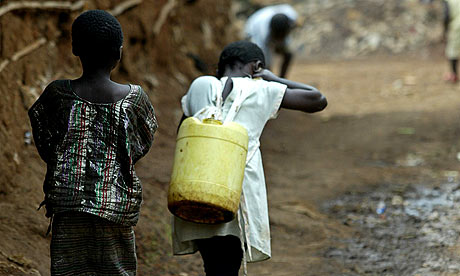
A girl carrying water in Kibera slum, Nairobi.
A girl carrying water in Kibera slum, Nairobi. There is sometimes a clash between environmental policies and social justice. Photograph: Simon Maina/AFP/Getty Images
By George Monbiot
It is the stick with which the greens are beaten daily: if we spend money on protecting the environment, the poor will starve, or freeze to death, or will go without shoes and education. Most of those making this argument do so disingenuously: they support the conservative or libertarian politics that keep the poor in their place and ensure that the 1% harvest the lion's share of the world's resources.

Journalists writing for the corporate press, with views somewhere to the right of Vlad the Impaler and no prior record of concern for the poor, suddenly become their doughty champions when the interests of the proprietorial class are threatened. If tar sands cannot be extracted in Canada, they maintain, subsistence farmers in Africa will starve. If Tesco's profits are threatened, children will die of malaria. When it is done cleverly, promoting the interests of corporations and the ultra-rich under the guise of concern for the poor is an effective public relations strategy.

Even so, it is true that there is sometimes a clash between environmental policies and social justice, especially when the policies have been poorly designed, as I argued on this blog last month.
But while individual policies can be bad for the poor, is the protection of the environment inherently incompatible with social justice? This is the question addressed in a discussion paper published by Oxfam on Monday.

Oxfam, remember, exists to defend the world's poorest people and help them to escape from poverty. Unlike the rightwing bloggers, it is motivated by genuine concern for social justice. So when it investigates the question of whether concern for the environment conflicts with development, we should take notice. Kate Raworth, who wrote the report, has created an essential template for deciding whether economic activity will help or harm humanity and the biosphere.

She points out that in rough terms we already know how to identify the social justice line below which no one should fall, and the destruction line above which human impacts should not rise.
The social justice line is set by the eleven priorities listed by the governments preparing for this year's Rio summit. These are:

• food security
• adequate income
• clean water and good sanitation
• effective healthcare
• access to education
• decent work
• modern energy services
• resilience to shocks
• gender equality
• social equity
• a voice in democratic politics.

The destruction line is set by the nine planetary boundaries identified in Stockholm in 2009 by a group of earth system scientists. They identified the levels beyond which we endanger the earth's living systems of:

• climate change
• biodiversity loss
• nitrogen and phosphate use
• ozone depletion
• ocean acidification
• freshwater use
• changes in land use
• particles in the atmosphere
• chemical pollution.

We are already living above the line on the first three indicators, and close to it on several others.
The space between these two lines is the "safe and just space for humanity to thrive in". So what happens if everyone below the social justice line rises above it? Does that push us irrevocably over the destruction line? The answer, she shows, is no.

For example, providing enough food for the 13% of the world's people who suffer from hunger means raising world supplies by just 1%.

Providing electricity to the 19% of people who currently have none would raise global carbon emissions by just 1%.

Bringing everyone above the global absolute poverty line ($1.25 a day) would need just 0.2% of global income.

In other words, it is not the needs of the poor that threaten the biosphere, but the demands of the rich. Raworth points out that half the world's carbon emissions are produced by just 11% of its people, while, with grim symmetry, 50% of the world's people produce just 11% of its emissions. Animal feed used in the EU alone, which accounts for just 7% of the world's people, uses up 33% of the planet's sustainable nitrogen budget. "Excessive resource use by the world's richest 10% of consumers," she notes, "crowds out much-needed resource use by billions of other people."

The politically easy way to tackle poverty is to try to raise the living standards of the poor while doing nothing to curb the consumption of the rich. This is the strategy almost all governments follow. It is a formula for environmental disaster, which, in turn, spreads poverty and deprivation. As Oxfam's paper says, social justice is impossible without "far greater global equity in the use of natural resources, with the greatest reductions coming from the world's richest consumers".

This is not to suggest that all measures intended to protect the environment are socially just. Raworth identifies the evictions by biofuels companies and plantation firms harvesting carbon credits as examples of the pursuit of supposedly green policies which harm the poor. But before the sneering starts, remember that the fight against both these blights has been led by environmentalists, who recognised their destructive potential long before the libertarians now using them as evidence of the perfidy of the green movement.

But there are far more cases in which poverty has been exacerbated by the lack of environmental policies. The Oxfam paper points out that crossing any of the nine planetary boundaries can "severely undermine human development, first and foremost for women and men living in poverty." Climate change, for example, is already hammering the lives of some of the world's poorest people. You can see the consequences of crossing another planetary boundary in the report just published by the New Economics Foundation, which shows that overfishing has destroyed around 100,000 jobs.

Just as mistaken green policies can damage the poor, mistaken poverty relief policies can damage the environment. For example, where fertiliser subsidies encourage farmers to use more than they need, as they do in China, money supposed to relieve poverty serves only to pollute the water supply. Development which has no regard for whom or what it harms is not development. It is the opposite of progress, damaging the Earth's capacity to support us and the rest of its living systems.

But extreme poverty, just like extreme wealth, can also damage the environment. People without access to clean energy sources, for example, are often forced to use wood for cooking. This shortens their lives as they inhale the smoke, destroys forests and exacerbates global warming by producing black carbon.

With a few exceptions, none of which should be hard to remedy, delivering social justice and protecting the environment are not only compatible: they are each indispensable to the other. Only through social justice, which must include the redistribution of the world's ridiculously concentrated wealth, can the environment and the lives of the world's poorest be defended.

Those who consume far more resources than they require destroy the life chances of those whose survival depends upon consuming more. As Gandhi said, the Earth provides enough to satisfy everyone's need but not everyone's greed.

Sugar: it's time to get real and regulate


The consumption of fructose and sucrose is on the increase – and so are preventable diseases such as Type 2 diabetes

Last week, a trio of American scientists led by Robert Lustig, professor of clinical paediatrics at the University of California, published an article in the journal Nature, outlining the toxic effects that sugar has on humans and arguing for governmental controls on its sale and distribution. While the authors come short of labelling sugar a "poison" outright, in a 2007 interview with ABC Radio about excess sugar consumption, Lustig said: "We're being poisoned to death. That's a very strong statement, but I think we can back it up with very clear scientific evidence."

That evidence has been growing – particularly in the western world, where consumption of sugar is increasing rapidly. Globally, sugar consumption has tripled in the past 50 years. But, it turns out, the greatest threat to human health is one type of sugar in particular: fructose.

In the US, per-capita consumption of fructose, a common food additive there – mainly in the form of high-fructose corn syrup – has increased more than 100-fold since 1970. Although fructose is not a common added sweetener in the UK and other countries, sucrose is; sucrose contains 50% fructose. Lustig and his co-authors note that last year, the United Nations announced that non-communicable diseases (NCDs) had, for the first time, overtaken infectious diseases in terms of the global health burden. Non-communicable diseases now account for 63% of all deaths, and that total is expected to increase by a further 17% over the next decade.

The scientists cite growing evidence that our increasing consumption of sugar is partly responsible for the growth of NCDs: diseases such as cardiovascular disease, cancer, diabetes and the suite of symptoms known as metabolic syndrome. And they argue that, as for substances known to cause NCDs such as tobacco and alcohol, sales and distribution of sugar should be controlled, and products with added sugar should be taxed.

I used to be a sugar addict. And yes, for those who haven't found out first-hand, sugar is addictive; perhaps not to the same degree as alcohol and tobacco, but a recent study has shown that sugary foods, or even just the expectation of eating sweets, can trick the brain into wanting more. When I decided to cut my sugar consumption 12 or so years ago, I had no idea of the serious health concerns that excess sugar consumption brings. I only wanted to avoid the so-called "empty calories" that sugar provides. I had noticed that eating cookies and desserts was making me feel lethargic.
Sugar, and in particular fructose, affects metabolism. Unlike glucose, fructose can only be metabolised in the liver. Some of its effects on the human body include increasing levels of uric acid, which raise blood pressure; increased fat deposition in the liver; and interference with the insulin receptor in the liver. This inhibits ability of the brain to detect the hormone leptin, which regulates appetite. So beyond the empty calories that fructose provides, eating it makes you want to eat more.

When I started reducing my sugar intake, I had no intention of cutting it out completely. Reducing my consumption was a gradual process, over many years. Sugar had been used as a reward when I was a child, and sweets were still a comfort food for me. But I found that the less of it I ate, the less I craved it. Today, I barely eat sweetened foods at all. If I were to eat what to most North Americans or Europeans is an "average" dessert serving, I would feel sick. Avoiding sugar is no longer an exercise in willpower; I have developed a revulsion for it. I feel that I have brought my body back to its original state. Sugar, in anything other than small quantities, feels like a poison to me.

Illnesses related to dietary choices do not affect only the individuals who become sick; they affect us all, as a society. The US alone spends $150bn on healthcare resources for illness related to metabolic syndrome. Of course, I would like to think that governmental regulation of a food-item such as sugar is not necessary. I do place value on an individual's right to choose, and on personal responsibility. But in the case of sugar, it's time to get real. The incidence of preventable diseases such as Type 2 diabetes is increasing and many health authorities have expressed concern that our current youth may be the first generation that does not live as long as their parents.

Most of us have known for some time that excess sugar is not good for us, but education and knowledge are clearly not enough. Regulation is required. This is no longer an issue of personal responsibility, but one of public expenditure and public health.

My Weltanschhaung - 13/02/12

Our fourteen year old entered the labour market as a newspaper boy today. Welcome to the land of wage slaves son.

The first advert targeting dogs will be aired soon, why not if children can be manipulated then why not pets?

The first British sex change male delivered a child. Bravo. Now all women can undergo a sex change, have children, and compete in the labor market as males.

Greek politicians agree to austerity measures while the country is burning. The voice of the people has been heard.

Congrats to Zambia for winning the African cup.

Reading 'Maximum City' by Suketu Mehta. I am surprised at the ignorance of Bal Thackeray. I thought he was a fact knowing  but fact twisting ideologue. The guy is unaware of the geography of Maharashtra. Sad!

The true value of money – or why you can't fart a crashing plane back into the sky

Banknotes aren't worth the paper they're printed on. The entire economy relies on the suspension of disbelief


I'm no financial expert. I scarcely know what a coin is. Ask me to explain what a credit default swap is and I'll emit an unbroken 10-minute "um" through the clueless face of a broken puppet. You might as well ask a pantomime horse. But even an idiot such as me can see that money, as a whole, doesn't really seem to be working any more.

Money is broken, and until we admit that, any attempts to fix the economy seem doomed to fail. We're like passengers on a nosediving plane thinking if we all fart hard enough, we can lift it back into the sky. So should we be storming the cockpit or hunting for parachutes instead? I don't know: I ran out of metaphor after the fart gag. You're on your own from hereon in.

Banknotes aren't worth the paper they're printed on. If they were, they'd all have identical value. Money's only worth what the City thinks it's worth. Or, perhaps more accurately, hopes it's worth. Coins should really be called "wish-discs" instead. That name alone would give a truer sense of their value than the speculative number embossed on them.

The entire economy relies on the suspension of disbelief. So does a fairy story, or an animated cartoon. This means that no matter how soberly the financial experts dress, no matter how dry their language, the economy they worship can only ever be as plausible as an episode of SpongeBob SquarePants. It's certainly nowhere near as well thought-out and executed.

No one really understands how it all works: if they did, we wouldn't be in this mess. Banking, as far as I can tell, seems to be almost as precise a science as using a slot machine. You either blindly hope for the best, delude yourself into thinking you've worked out a system, or open it up when no one's looking and rig the settings so it'll pay out illegally.

The chief difference is that slot machines are more familiar and graspable to most of us. When you hear a jackpot being paid out to a gambler, the robotic clunk-clunk-clunk of coin-on-tray, you're aware that he had to go to some kind of effort to get his reward. You know he stood there pushing buttons for hours. You can picture that.

The recent outrage over City bonuses stems from a combination of two factors: the sheer size of the numbers involved coupled with a lack of respect for the work involved in earning them. Like bankers, top footballers are massively overpaid, but at least you comprehend what they're doing for the money. If Wayne Rooney was paid millions to play lacrosse in a closed room in pitch darkness, people would begrudge him his millions far more than they already do. Instead there he is, on live television: he's skilled, no doubt about it.

Similarly, it may be tasteless when a rapper pops up on MTV wearing so much bling he might as well have dipped himself in glue and jumped into a treasure chest full of vajazzling crystals, but at least you understand how he earned it.

RBS boss Stephen Hester, meanwhile, earns more than a million pounds for performing enigmatic actions behind the scenes at a publicly owned bank. And on top of his huge wage, he was in line for a massive bonus. To most people, that's downright cheeky: like a man getting a blowjob from your spouse while asking you to make him a cup of tea.

But Hester earned his wage, we're told, because he does an incredibly difficult job. And maybe he does. Trouble is, no one outside the City understands what his job actually consists of. I find it almost impossible to picture a day in Hester's life, and I once wrote a short story about a pint-sized toy Womble that ran around killing dogs with its dick, so I know I don't lack imagination. Class, yes: imagination, no. If I strain my mind's eye, I can just about picture Hester arriving at work, picture him thanking his driver, picture the receptionist saying "Hello, Mr Hester", and picture him striding confidently into his office – but the moment the door shuts, my feed breaks up and goes fuzzy. What does he do in there? Pull levers? Chase numbers round the room with a broom? God knows.

Maybe if all bankers were forced to work in public, on the pavement, it would help us understand what they actually do. Of course, you'd have to encase them in a Perspex box so they wouldn't be attacked. In fact, if the experience of David Blaine is anything to go by, you'd have to quickly move that Perspex box to somewhere impossibly high up, where people can't pelt it with golf balls and tangerines. On top of the Gherkin, say. If Hester did his job inside a Perspex box on top of the Gherkin for a year, this entire argument might never have happened.

The row over bonuses has led some to mutter darkly about mob rule and the rise of anti-business sentiment. Complain about mobs all you like, but you can't control gut reactions, and you can't dictate the mood. And when you try to fart a crashing plane back into the sky, you only succeed in making the atmosphere unpleasant for everyone. And spoiling the in-flight movie. And making the stewardess cry. Looks like I'm all out of metaphor again. Time to end the article. Article ends.

Sunday, 12 February 2012

The mathematical equation that caused the banks to crash

 Ian Stewart in The Observer 21-02-12

It was the holy grail of investors. The Black-Scholes equation, brainchild of economists Fischer Black and Myron Scholes, provided a rational way to price a financial contract when it still had time to run. It was like buying or selling a bet on a horse, halfway through the race. It opened up a new world of ever more complex investments, blossoming into a gigantic global industry. But when the sub-prime mortgage market turned sour, the darling of the financial markets became the Black Hole equation, sucking money out of the universe in an unending stream.

Anyone who has followed the crisis will understand that the real economy of businesses and commodities is being upstaged by complicated financial instruments known as derivatives. These are not money or goods. They are investments in investments, bets about bets. Derivatives created a booming global economy, but they also led to turbulent markets, the credit crunch, the near collapse of the banking system and the economic slump. And it was the Black-Scholes equation that opened up the world of derivatives.

The equation itself wasn't the real problem. It was useful, it was precise, and its limitations were clearly stated. It provided an industry-standard method to assess the likely value of a financial derivative. So derivatives could be traded before they matured. The formula was fine if you used it sensibly and abandoned it when market conditions weren't appropriate. The trouble was its potential for abuse. It allowed derivatives to become commodities that could be traded in their own right. The financial sector called it the Midas Formula and saw it as a recipe for making everything turn to gold. But the markets forgot how the story of King Midas ended.

Black-Scholes underpinned massive economic growth. By 2007, the international financial system was trading derivatives valued at one quadrillion dollars per year. This is 10 times the total worth, adjusted for inflation, of all products made by the world's manufacturing industries over the last century. The downside was the invention of ever-more complex financial instruments whose value and risk were increasingly opaque. So companies hired mathematically talented analysts to develop similar formulas, telling them how much those new instruments were worth and how risky they were. Then, disastrously, they forgot to ask how reliable the answers would be if market conditions changed.

Black and Scholes invented their equation in 1973; Robert Merton supplied extra justification soon after. It applies to the simplest and oldest derivatives: options. There are two main kinds. A put option gives its buyer the right to sell a commodity at a specified time for an agreed price. A call option is similar, but it confers the right to buy instead of sell. The equation provides a systematic way to calculate the value of an option before it matures. Then the option can be sold at any time. The equation was so effective that it won Merton and Scholes the 1997 Nobel prize in economics. (Black had died by then, so he was ineligible.)

If everyone knows the correct value of a derivative and they all agree, how can anyone make money? The formula requires the user to estimate several numerical quantities. But the main way to make money on derivatives is to win your bet – to buy a derivative that can later be sold at a higher price, or matures with a higher value than predicted. The winners get their profit from the losers. In any given year, between 75% and 90% of all options traders lose money. The world's banks lost hundreds of billions when the sub-prime mortgage bubble burst. In the ensuing panic, taxpayers were forced to pick up the bill, but that was politics, not mathematical economics.

The Black-Scholes equation relates the recommended price of the option to four other quantities. Three can be measured directly: time, the price of the asset upon which the option is secured and the risk-free interest rate. This is the theoretical interest that could be earned by an investment with zero risk, such as government bonds. The fourth quantity is the volatility of the asset. This is a measure of how erratically its market value changes. The equation assumes that the asset's volatility remains the same for the lifetime of the option, which need not be correct. Volatility can be estimated by statistical analysis of price movements but it can't be measured in a precise, foolproof way, and estimates may not match reality.

The idea behind many financial models goes back to Louis Bachelier in 1900, who suggested that fluctuations of the stock market can be modelled by a random process known as Brownian motion. At each instant, the price of a stock either increases or decreases, and the model assumes fixed probabilities for these events. They may be equally likely, or one may be more probable than the other. It's like someone standing on a street and repeatedly tossing a coin to decide whether to move a small step forwards or backwards, so they zigzag back and forth erratically. Their position corresponds to the price of the stock, moving up or down at random. The most important statistical features of Brownian motion are its mean and its standard deviation. The mean is the short-term average price, which typically drifts in a specific direction, up or down depending on where the market thinks the stock is going. The standard deviation can be thought of as the average amount by which the price differs from the mean, calculated using a standard statistical formula. For stock prices this is called volatility, and it measures how erratically the price fluctuates. On a graph of price against time, volatility corresponds to how jagged the zigzag movements look.

Black-Scholes implements Bachelier's vision. It does not give the value of the option (the price at which it should be sold or bought) directly. It is what mathematicians call a partial differential equation, expressing the rate of change of the price in terms of the rates at which various other quantities are changing. Fortunately, the equation can be solved to provide a specific formula for the value of a put option, with a similar formula for call options.

The early success of Black-Scholes encouraged the financial sector to develop a host of related equations aimed at different financial instruments. Conventional banks could use these equations to justify loans and trades and assess the likely profits, always keeping an eye open for potential trouble. But less conventional businesses weren't so cautious. Soon, the banks followed them into increasingly speculative ventures.

Any mathematical model of reality relies on simplifications and assumptions. The Black-Scholes equation was based on arbitrage pricing theory, in which both drift and volatility are constant. This assumption is common in financial theory, but it is often false for real markets. The equation also assumes that there are no transaction costs, no limits on short-selling and that money can always be lent and borrowed at a known, fixed, risk-free interest rate. Again, reality is often very different.
When these assumptions are valid, risk is usually low, because large stock market fluctuations should be extremely rare. But on 19 October 1987, Black Monday, the world's stock markets lost more than 20% of their value within a few hours. An event this extreme is virtually impossible under the model's assumptions. In his bestseller The Black Swan, Nassim Nicholas Taleb, an expert in mathematical finance, calls extreme events of this kind black swans. In ancient times, all known swans were white and "black swan" was widely used in the same way we now refer to a flying pig. But in 1697, the Dutch explorer Willem de Vlamingh found masses of black swans on what became known as the Swan River in Australia. So the phrase now refers to an assumption that appears to be grounded in fact, but might at any moment turn out to be wildly mistaken.

Large fluctuations in the stock market are far more common than Brownian motion predicts. The reason is unrealistic assumptions – ignoring potential black swans. But usually the model performed very well, so as time passed and confidence grew, many bankers and traders forgot the model had limitations. They used the equation as a kind of talisman, a bit of mathematical magic to protect them against criticism if anything went wrong.

Banks, hedge funds, and other speculators were soon trading complicated derivatives such as credit default swaps – likened to insuring your neighbour's house against fire – in eye-watering quantities. They were priced and considered to be assets in their own right. That meant they could be used as security for other purchases. As everything got more complicated, the models used to assess value and risk deviated ever further from reality. Somewhere underneath it all was real property, and the markets assumed that property values would keep rising for ever, making these investments risk-free.
The Black-Scholes equation has its roots in mathematical physics, where quantities are infinitely divisible, time flows continuously and variables change smoothly. Such models may not be appropriate to the world of finance. Traditional mathematical economics doesn't always match reality, either, and when it fails, it fails badly. Physicists, mathematicians and economists are therefore looking for better models.

At the forefront of these efforts is complexity science, a new branch of mathematics that models the market as a collection of individuals interacting according to specified rules. These models reveal the damaging effects of the herd instinct: market traders copy other market traders. Virtually every financial crisis in the last century has been pushed over the edge by the herd instinct. It makes everything go belly-up at the same time. If engineers took that attitude, and one bridge in the world fell down, so would all the others.

By studying ecological systems, it can be shown that instability is common in economic models, mainly because of the poor design of the financial system. The facility to transfer billions at the click of a mouse may allow ever-quicker profits, but it also makes shocks propagate faster.

Was an equation to blame for the financial crash, then? Yes and no. Black-Scholes may have contributed to the crash, but only because it was abused. In any case, the equation was just one ingredient in a rich stew of financial irresponsibility, political ineptitude, perverse incentives and lax regulation.

Despite its supposed expertise, the financial sector performs no better than random guesswork. The stock market has spent 20 years going nowhere. The system is too complex to be run on error-strewn hunches and gut feelings, but current mathematical models don't represent reality adequately. The entire system is poorly understood and dangerously unstable. The world economy desperately needs a radical overhaul and that requires more mathematics, not less. It may be rocket science, but magic it's not.
Ian Stewart is emeritus professor of mathematics at the University of Warwick.

Saturday, 11 February 2012

Liberal Constipation

 George Monbiot

Self-deprecating, too liberal for their own good, today’s progressives stand back and watch, hands over their mouths, as the social vivisectionists of the right slice up a living society to see if its component parts can survive in isolation. Tied up in knots of reticence and self-doubt, they will not shout stop. Doing so requires an act of interruption, of presumption, for which they no longer possess a vocabulary.

Perhaps it is in the same spirit of liberal constipation that, with the exception of Charlie Brooker(1), we have been too polite to mention the study published last month in the journal Psychological Science, which revealed that people with conservative beliefs are likely to be of low intelligence(2). Paradoxically it was the Daily Mail which brought it to the attention of British readers last week(3). It feels crude, illiberal to point out that the other side is, on average, more stupid than our own. But this, the study suggests, is not unfounded generalisation but empirical fact.

It is by no means the first such paper. There is plenty of research showing that low general intelligence in childhood predicts greater prejudice towards people of different ethnicity or sexuality in adulthood(4). Open-mindedness, flexibility, trust in other people: all these require certain cognitive abilities. Understanding and accepting others—particularly “different” others—requires an enhanced capacity for abstract thinking.

But, drawing on a sample size of several thousand, correcting for both education and socioeconomic status, the new study looks embarrassingly robust. Importantly, it shows that prejudice tends not to arise directly from low intelligence, but from the conservative ideologies to which people of low intelligence are drawn. Conservative ideology is the “critical pathway” from low intelligence to racism. Those with low cognitive abilities are attracted to “right-wing ideologies that promote coherence and order” and “emphasize the maintenance of the status quo”(5). Even for someone not yet renowned for liberal reticence, this feels hard to write.

This is not to suggest that all conservatives are stupid. There are some very clever people in government, advising politicians, running thinktanks, writing for newspapers, who have acquired power and influence by promoting rightwing ideologies.

But what we now see among their parties—however intelligent their guiding spirits may be—is the abandonment of any pretence of high-minded conservatism. On both sides of the Atlantic, conservative strategists have discovered that there is no pool so shallow that several million people won’t drown in it. Whether they are promoting the idea that Barack Obama was not born in the US, that manmade climate change is an eco-fascist-communist-anarchist conspiracy or that the deficit results from the greed of the poor, they now appeal to the basest, stupidest impulses, and find that it does them no harm in the polls.

Don’t take my word for it. Listen to what two former Republican ideologues, David Frum and Mike Lofgren, have been saying. Frum warns that “conservatives have built a whole alternative knowledge system, with its own facts, its own history, its own laws of economics.”(6) The result is a “shift to ever more extreme, ever more fantasy-based ideology” which has “ominous real-world consequences for American society.”

Lofgren complains that “the crackpot outliers of two decades ago have become the vital center today”(7). The Republican party, with its “prevailing anti-intellectualism and hostility to science” is appealing to what he calls the “low-information voter” or the “misinformation voter.” While most office holders probably don’t believe the “reactionary and paranoid claptrap” they peddle, “they cynically feed the worst instincts of their fearful and angry low-information political base”.

The madness hasn’t gone as far in the UK, but the effects of the Conservative appeal to stupidity are already making themselves felt. Yesterday the Guardian reported that recipients of disability benefits, scapegoated by the government as scroungers, blamed for the deficit, now find themselves subject to a new level of hostility and threats from other people(8).

These are the perfect conditions for a billionaires’ feeding frenzy. Any party elected by misinformed, suggestible voters becomes a vehicle for undisclosed interests. A tax break for the 1% is dressed up as freedom for the 99%. The regulation that prevents big banks and corporations from exploiting us becomes an assault on the working man and woman. Those of us who discuss manmade climate change are cast as elitists by people who happily embrace the claims of Lord Monckton, Lord Lawson or thinktanks funded by ExxonMobil or the Koch brothers: now the authentic voices of the working class.

But when I survey this wreckage I wonder who the real idiots are. Confronted with mass discontent, the once-progressive major parties, as Thomas Frank laments in his latest book Pity the Billionaire, triangulate and accommodate, hesitate and prevaricate, muzzled by what he calls “terminal niceness”(9). They fail to produce a coherent analysis of what has gone wrong and why, or to make an uncluttered case for social justice, redistribution and regulation. The conceptual stupidities of conservatism are matched by the strategic stupidities of liberalism.

Yes, conservatism thrives on low intelligence and poor information. But the liberals in politics on both sides of the Atlantic continue to back off, yielding to the supremacy of the stupid. It’s turkeys all the way down.

My Weltanschhaung - 11/2/2012

I am glad that atleast now a few Greek politicos have called the bail out terms extortionate. I think Greeks should default on their loans. Else, where is the risk for the lender who seems to get his money back in all circumstances and even by hurting innocent victims in a society.

A more disturbing news is that Chinese imports (of raw materials, I presume) fell in January. This will worry all export led growth oriented countries, unless they are beating China at their own game. Unlikely though since Chinese firms enjoy state subsidised capitalism.

Harry Redknapp seems to be inching towards the England managership. I suppose every man rises to a level of failure, but it won't be Harry's fault as there appears to be a shortage of talent in England.

Argentina accuses the UK of storing nuclear weapons near the Falklands. At the same time the UK tries to prevent Iran and others from getting nuclear weapons.

The global outlook for oil appears gloomy, so will the energy suppliers lower retail prices?


Friday, 10 February 2012

My Weltanschhaung - 10/2/2012

I am pleased at the new Cameron proposal, - 'Elderly people should be encouraged to go back to work and move into smaller homes'. Thats one more supply side policy. The principle behind it: the purpose of every human being is to contribute to society until death and the Cameron policy exemplifies it. So retirement will only be for the rich, this policy is a third world policy indeed. But who will hire them, I ask? Also, had Britain become a third world country?

I am also pleased that tax breaks are planned for those who employ cooks and cleaners. This is a good way to boost GDP, after all the cooking and cleaning services provided by stay at home parents are free and are not included in the GDP figures.

Its funny the interesting stories seem to appear only in the Daily Telegraph.

Thursday, 9 February 2012

My Weltanschhaung - 9/2/2012

I loved the news, eating fried and sugary stuff for breakfast is the best way to stay trim. Who do I sue if it does not work?

Microchips for dogs is a great idea indeed. But more than that owners should be punished if their dogs are not on leads in a public place.

No one will mourn Capello's departure. I think Capello used Terry's removal as captain as an exceuse to bail out.

Cable v Cameron on the appointment of Fair Access tsar to universities is an interesting idea. Power to you Cable.

England cannot blame Ajmal's bent arm any longer.


Wednesday, 8 February 2012

My Weltanschhaung - 8/2/2012

I watched Prime Minister's questions and noticed that everytime David Cameron felt uncomfortable, he used David Miliband to beat Ed Miliband with. I wondered what that had to do with Ed's questions on the NHS.

I have come to the conclusion that reform or not the NHS will get progressively worse year upon year.

I was surprised at the all party unity in the UK on invading Syria and the hatred towards the Russian and Chinese veto at the UN. Who said imperialism was dead?

I look forward to Argentina raising the Falklands issue at the UN. Will the UK use its veto then?

On of my students opined that a small shareholder could influence decision making in a big corporation, and hence he was a believer in corporate democracy as against political democracy.


I watched two BBC programmes on the ancient African kingdoms of Ashante and Zulu. Very Good.

Tuesday, 7 February 2012

Why we need more banker bashing

Banks are the biggest scroungers of public money – solutions will not simply materialise if we don't keep up the pressure
Banker in the City
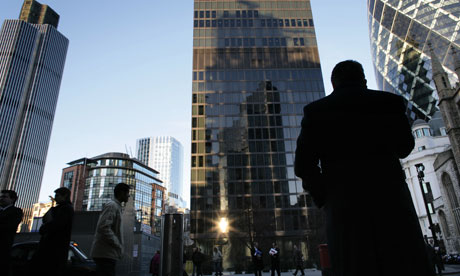
Bank-bashing is in its third year and has become even more vociferous. Photograph: Martin Godwin
 
I have a confession to make: I wanted to be a banker once. While arming myself with a degree in economics, I dreamed of working at an investment bank arranging mergers and acquisitions. The growing size of M&A activity got us budding economists excited and I wanted a part of the action. But the dotcom boom of the late 90s lured me in instead and I missed out on the opportunity to ruin the world's economy. In a sign of the times, when I asked a university mate recently where he worked now, he replied: "Goldm- *cough* -acks" rather haphazardly. It seems not many want to be associated with the "great vampire squid" any more.

Banker bashing has now entered its third year and become even more vociferous, spreading to bonus bashing thanks to Network Rail. Last week columnists at the Times and Financial Times wailed that all this a) was hurting UK's economic prospects and b) would have limited traction with the public. The second excuse is easy to dismiss: actually there is plenty of public appetite for banker bashing to continue. They want more and they don't think it damages our economic prospects. But is it right to continue this, ask critics? Who will think of the [privately educated] children? Let me offer several reasons to continue banker bashing.

First, banking reform has been pitifully weak. If the crash were to happen again tomorrow, the government would have to bail them out again. They remain leveraged up to their eyeballs; remain "too big to fail" and too inter-connected to each other so most can't be allowed to go bust. Without public anger there is no impetus to push banking reforms further, which the Conservatives are stridently resisting and Labour is still reluctant to push too far.

Secondly, the banker bashing begs a wider question – if finance has become the life-blood of modern economies, why can't we exercise more control over such a vital industry? Consider this: we pretend that banks are private businesses that should be allowed to run their own affairs. But they are the biggest scroungers of public money of our time. Banks are lent vast sums of money by central banks at near-zero interest. They lend that money to us or back to the government at higher rates and rake in the difference by the billion. They don't even have to make clever investments to make huge profits.
At the height of the crash, US banks were simply given $13bn overnight. No repayment needed. We don't know what happened, because the details are kept secret. The entire industry is underwritten by guarantees from central banks. If threatened with systematic failure, which is becoming increasingly common, governments have no option but to bail them out. The financial system rules over our lives too, through our credit history. Everything could be choked off at a whim, through administrative error or for political reasons, and we wouldn't have democratic recourse. Organisations such as WikiLeaks were simply frozen out of the global financial system at the click of a button. Banks get special preferences like no other industry, and yet we don't even ask why these publicly subsidised yacht owners have so much control over our lives. Why not?

Far from being the pinnacle of free market capitalism, banking is full of sorry executives who keep asking for more handouts to protect their deliberately bloated businesses. The solutions won't materialise if we go back to how things were. Public anger has grown because it is starting to dawn on middle England that while the rest of us are paying for the crisis, the people who caused the crash want to go back to 2007. Even the Daily Mail is starting to reflect this impatience. This recession is already longer than the 1930s and the stagnation will continue for maybe a decade. For from being over, the nightmare for the Goodwins and Hesters is just getting started. And quite rightly too.

My Weltanschhaung - 7 Feb 2012

- Am I glad that England lost 3-0 to Pakistan at cricket. You can blame Ajmal's action, you can blame the DRS but you still are unable to score enough runs. The cry of World number 1 is not so shrill now and I can remove my ear plugs.

- I am not really sure the NHS bill is privatisation by the back door or is it the vested interests of doctors, managers and nurses crying foul. Unfortunately, only time will tell and by then it maybe too late.

- India refuses to take UK aid, the UK wants India to continue to take its aid. Am I the only person wondering where all this decades long aid has gone and who benefitted from it?

- Its a pity that Sarah Palin will not win the Republican nomination.

-  The US, UK and France are upset that they did not receive a carte blanche to invade Syria. Afetr Libya, they were deluded to think the Russians would cooperate.

- Who will benefit from a war with Iran?


Sunday, 5 February 2012

An Ode to India's Batting Triumvirate


Show me a hero, wrote novelist F. Scott Fitzgerald, and I will write you a tragedy. Sporting heroes come pre-loaded with the tragedy gene. A Muhammad Ali who goes one fight too far, a Kapil Dev who is carried around till he breaks a record, a Michael Schumacher who returns to the scenes of his triumphs but as an also-ran—sport is cruel. The sportsman’s dilemma is simply stated: should he retire when the performances sag or give it one last shot so he can go out on a high? At either end of the performance scale, the temptation is to carry on—either to prove yourself worthy, or to establish there is life in the old dog yet.

Australia’s Ricky Ponting was on the verge of being dropped when he made a century and then a double against India, and must be wondering now how far he ought to push. His inspiration to continue playing, Sachin Tendulkar and Rahul Dravid, are probably wondering too. They have had phases before when nothing went right, but it was business as usual soon enough.

Last year, Dravid made more runs than anybody else in world cricket; the previous year, that record belonged to Tendulkar. Great sportsmen hate to go gentle into that good night; they, like fans on their behalf, rage against the dying of the light. For over a decade-and-a-half, these two, V.V.S. Laxman and the oldest of the group, Sourav Ganguly, gave India their best batting line-up, their greatest victories and their top ranking in world cricket.

Tendulkar made his debut in the same year as the Berlin Wall fell; Nelson Mandela was still in jail, and Mike Tyson was the world heavyweight champion. Now pieces of the Berlin Wall decorate homes of tourists who have visited the site, Mandela has graduated from being a president to a concept, and no one knows who the heavyweight champion is. But Tendulkar plays on, a boyish eminence grise in a country whose average age is nearly the number of years he has been an international cricketer.

Pundits have been calling for the heads of the champions, but what is startling is the reaction of the average fan. That no effigies were burnt and no players’ houses stoned after the Australia tour suggests a level of indifference that is painful to behold.

Clearly, we are in the mourning period; in sport, mourning sometimes precedes the end. But mourning can also be a period of celebration. These cricketers have meant something special to a nation shaking free the coils of mediocrity in so many fields and emerging self-confident and ready to take on the world on its own terms.

At 18, V.V.S. Laxman decided to give himself four years to make it as a cricketer; plan B was a career in medicine, the profession of his parents and many relatives. At 22, Rahul Dravid told a friend, “I do not want to be just another Test cricketer; I want to be bracketed with Sunil Gavaskar and G.R. Vishwanath.” Sachin Tendulkar was 17 when he responded to the standard query on the distractions of big money thus: “I will never forget that it is my success on the field that is the cause of the riches off it.”

 How distant the 1990s seem now. A new India was dawning. A feted finance minister breathed life into the vision of a prime minister whose version of glasnost and perestroika was filed under the less romantic label of “market reforms”. Politicians tend to make poor poster boys of their own reforms. Happily, Tendulkar presented himself as the candidate.

It all seems ordained now, but that is only time imposing order and meaning to events. Tendulkar had everything—he was a Test cricketer at 16, and by 19 had made centuries in both England and Australia. He was so obviously mama’s boy—the manager on his first tour of England, Bishan Bedi, spoke of how all the older women wanted to mother him and the younger ones seduce him—and patently non-controversial. And he had the best straight drive in the business; and in the early days a fierce way of handling the short-pitched delivery that reduced those fielding on the leg side boundary to mere ball boys and collectors of the cricket ball from the crowd.

Received wisdom is that India’s climb to the top of the rankings began with that epic Calcutta Test against Steve Waugh’s Australians, who had won their previous 16 Tests in a row. Laxman’s 281 and the 376-run partnership with Dravid ensured India won the match after following on.

The more likely candidate for the turnaround is the Headingley Test of 2002. India won the toss on a seaming track made-to-order for the England bowlers. Nine times out of ten, they would have, as a defensive measure, fielded first on winning the toss. But this was a new India and new captain Ganguly decided to bat. India played two spinners and didn’t pick opener S.S. Das who had made 250 against Essex in their previous match, preferring Sanjay Bangar for his medium pace bowling and adhesive batting.

It worked. India made over 600, with centuries from Tendulkar, Dravid and Ganguly, and won by an innings. It was reward for boldness, imagination and supreme self-confidence.

For a decade and more, that middle order (now strengthened by the arrival at the top of Virender Sehwag) planted the Indian flag on grounds all over the world—at Leeds and Adelaide, Multan and Harare, Kingston, Johannesburg, Nottingham, Perth, Galle and Colombo.

Individual records came as byproducts of team efforts. Tendulkar’s driving on either side of the wicket was sheer joy. As a 16-year-old, he attacked the leg spinner Abdul Qadir, hitting him for 27 runs in an over. It wasn’t an official international, but it brought together the batsman’s impetuosity and creativity in one nice packet. He was actually beaten in flight once, but trusted his instinct and his forearms to hit high into the crowd.

Where were you when Tendulkar made his Test debut? In India, opposition parties were coming together under the banner of the National Front and projecting V.P. Singh as the “clean” alternative to prime minister Rajiv Gandhi. V.P. Singh took charge while the Indian team was in Pakistan, and Tendulkar was taking his first steps towards cricketing immortality. Those not yet born when Tendulkar made his debut are well over the voting age now.
It is a difficult idea to get your head around—the idea that one individual has been a part of our national consciousness for so long. For those who see everything in black and white, it is easy to ask for the heads of our cricketers; the ingratitude of fans is a running theme in sport. But Tendulkar, Dravid and Laxman have an influence well beyond runs made and victories achieved.
For one, it is entirely possible that Indian cricket itself might have taken a long time to recover from the match-fixing allegations a decade ago. Skipper Mohammed Azharuddin confessed to having manipulated results and without the obvious integrity of men like Dravid and Laxman, and those who have retired like Ganguly, Anil Kumble, Javagal Srinath and Venkatesh Prasad, the game might have been destroyed.

Significantly, these batsmen brought to the game an Indianness, the inherited technique and uniqueness of a nation that is sometimes reduced to the cliche, ‘oriental magic’. You can bowl to Laxman anywhere you want, and he will use his wrists to send it between fielders on either side of the wicket. There is no apparent effort, only the most elegant of bat swings, visually all curves and gentle arcs. Laxman’s bat makes no angles to the wind.

Dravid, the man who chose to “walk” when on 95 on his debut at Lord’s, formed a wonderful relationship with Laxman. They have taken over 300 catches between them at slips, and they relax, as Dravid explained, “by talking about our families, the plumbers and carpenters when we were building houses and so on”. When you saw a serious look on the ever smiling face of vvs at slip, it was probably because he had just realised that plumbers in Hyderabad charged more than those in Bangalore. It didn’t matter. What mattered was the camaraderie, and the fact that nearly every catch was taken.

These three players have played 118 Tests with each other. For Tendulkar and Dravid, make that 146. That’s nearly two years in number of days, and if you add the one-day matches, the travel, practice days and camps to that, that’s more days spent in each other’s company than many couples stay married.

Dravid has scored more runs for India than Tendulkar in the same period, a statistic that is not widely known or appreciated. One of the great sights in recent years has been his authoritative square cut or the pull that brooked no response, played while his helmet dripped honest sweat over a long innings. Year after year, we believed when he was batting that god was in his heaven and all was right with the world.

In their growing years, players make huge sacrifices, leading an almost monastic life, the focus on the game and nothing else. By the late 30s, when other professionals—the accountants and managers who do not cause a nation to stand up and demand their resignation—are looking to settle down, the life of a sportsman is over. Your brief career is done, but you have a lot of life left. How do you cope if you are not into the media or coaching or the cauldron of politics known as cricket administration? Especially since cricket is all you know. At 30, Tendulkar was asked what his favourite book was, and he answered with child-like charm, “I haven’t started reading yet.”

The players may not fully understand their future yet; but ironically, we do not fully understand their present (or past) either. The Owl of Minerva, wrote Hegel, “spreads its wings only with the falling of dusk”. We understand a historical condition just as it passes away. In the next couple of years, as we come to a greater understanding of what Tendulkar and company meant to us, let us not regret anything crass in the manner their twilight years were handled. Indianness and integrity have been important aspects of the cricket of the threesome. Indian cricket needs to handle such stalwarts with dignity and maturity.

There is a sense that an Indian team will change from being an old-fashioned one (in terms of behaviour, “old-fashioned” is a compliment) into a modern, unimaginative one where joy, sorrow, exasperation, irritation, ecstasy, sense of achievement, aggression, love and all emotions are expressed with a four-letter word or its many Indian versions involving close relatives. Virat Kohli is a superb batsman and a future India captain, but his response on getting to a century in Adelaide was juvenile. The Kohlis and others like him need to learn from the earlier generation about self-respect and respecting the game itself.

Not that the older lot have been pussycats, rolling over to be tickled. Initially, Dravid’s shyness was mistaken for weakness, but not after he responded to an Allan Donald taunt in the course of his first century in South Africa. The Bangalore boy told the fastest bowler in the world to assume an impossible anatomical posture, not in those words exactly, but in a crisp, short phrase.

The message went home not only to that bowler but to all bowlers around the world. No one tried riling either Dravid or the other two again.

Indian cricket may be at the crossroads; the retirement of the great players will see the end of a civilisation as we know it. But the Tendulkars, Dravids and Laxmans—seen by many as part of the problem now—can easily be part of the solution. India’s next series outside the subcontinent is in Zimbabwe in July 2013. Then come the series in SA and New Zealand. Time enough to rebuild.
Not so long ago, we used to canonise our heroes. The modern method is to spit at them. Our great players deserve better.


(Suresh Menon is editor, Wisden India Almanack, and author of Bishan: The Portrait of a Cricketer.)