Search This Blog

Wednesday, 18 January 2012

Learning batting from David Warner

Ed Smith

On Sunday, I fly to Adelaide for the fourth Test between India and Australia. I'm due to arrive just in time for the first ball. I hope the plane isn't late: David Warner might have scored a hundred by lunch.

In smashing 180 off 159 balls in Perth, Warner proved quite a few people wrong - not least those who said that Twenty20 would never produce a Test cricketer. Warner, of course, played T20 for Australia and in the IPL long before making the step-up to Test cricket - well, I suppose it's up to him to judge whether it's a step up. 

We've all heard the arguments against the Warner career path: that T20 ruins technique rather than developing it, that you have to learn to bat properly before you can learn to smash it, walk before you can run etc.

But the naysayers may be wrong. The Warner story reveals deep truths about how players bat at their best. In fact, I think it is time we reconsidered the whole question of what constitutes good technique.

Cricket gets itself in a tangle about the word. In football, technique is short-hand for skill. Pundits explain how Cesc Fabregas' brilliant technique allows him to make the killer pass or eye-catching volley. Technique is not the enemy of flair and self-expression: it is the necessary pre-requisite. "Technique is freedom," argued the ballet dancer Vaslav Nijinsky.

Sadly, the word "technique" in cricket is often used as short-hand for controlled batsmanship, even introspection. It is true that some great technicians are very controlled players (think of Rahul Dravid - though even he plays best technically when he is positive). But it is not compulsory that good technique has to be accompanied by caution or repression. After all, Adam Gilchrist had a wonderful technique: there is no other explanation for how he managed to hit the ball in the middle of the bat quite so consistently.

In fact, good technique has a very straightforward definition: it is the simplest, most efficient way of doing something.

Andre Agassi had near-perfect technique on his groundstrokes. He could hit with exceptional power and consistency. How did he learn this technique? When Agassi was a boy, his father used to get him to hit thousands of tennis balls as hard and as cleanly as possible. "Hit it, Andre!" That was the essence of his coaching. If you learn how to hit the ball hard in the middle of the racket, you have to move your body and feet into the right positions to do so. In the same way, Jack Nicklaus summed up his approach to learning golf: "First, hit it hard. Then we'll worry about getting it in the hole."

I should have remembered Agassi and Nicklaus when I was out of form as a batsman and needed to go back to basics. Not only did I suffer prolonged periods of bad form, I would often get out in similar ways - nicking off to the slips, or getting trapped lbw. There were usually plenty of theories about what I was doing wrong. As one coach memorably put it to me, "If you stop getting caught and lbw, you'll be a top player." Er, yes: it would take great ingenuity to get bowled or run out throughout your career!

Many coaches tried to persuade me to change my shot selection. But that rarely helped. When I was nicking off, it was usually because I was driving badly rather than driving at the wrong ball. And I was a far less good player when I was knocked off my instinct to play positively. I came to realise that good form was a very simple issue, almost binary - like a switch that just needed to be clicked back on.

Here comes the difficult part that used to get me into trouble. I learnt that the best way to click the switch back on, to get back into the groove of playing well, was to practise driving on the up. You've probably guessed why it got me in trouble. Imagine a situation in which I had failed three or four times in a row, each time caught in the slips, and the coach walks into the nets and sees me…practising drives! I'd sense him thinking: "Doesn't he ever learn?"

But I knew what worked for me, and I think there are good reasons why it worked. To play at my best, I needed to get into good positions to attack. Why? Because when I was in position to attack, I was inevitably in a good position also to defend. But when I set out my stall to play a defensive shot - before the ball was even bowled - then I not only attacked badly, I also defended badly. Having the intention of defending caused me to be passive and late in my movements. The shot would almost happen to me, rather than me determining the shot.


To play at my best, I needed to get into good positions to attack. Why? Because when I was in position to attack, I was inevitably in a good position also to defend


On the other hand, having the intention of attacking was a win-win: I defended and attacked better. I would set myself to play positively, which had the effect of giving me more time at every stage of the shot.

I think many players are the same. The key to their batting - whether it is defence or attack - is the question of intent. That has nothing to do with recklessness, or even scoring rate. Intent merely determines the messages you send to your brain. Imagine batting as a series of dominos that culminates in the ball being struck. The very first domino, the critical one that begins the whole process, is not physical, but mental. We might call it your "mental trigger movement".

I know it sounds ridiculously simplistic - technique from kindergarten - but many players find that the best mental trigger movement is setting themselves to move towards the ball to strike it back in the direction that it comes from. That does not mean you commit to lurching onto the front foot or playing a drive; you still react to whatever is thrown at you. But your intent is positive and pro-active.

Greg Chappell used the science of physiology to examine the connection between intent and good execution. He studied the preliminary movements of the world's greatest players. Though they all had unique styles and methods, their techniques shared one common thread: at the point of delivery, they were all pushing off the back foot, looking to come forward. Chappell argued that this trait gives great players optimal time to judge length. Why? Because a full ball is released from the bowler's hand early, a short ball is released later. So when batsmen set themselves for the full ball, they will inevitably have time to adjust for the short ball.

Here is my heretical conclusion: by encouraging them to have the intention of striking down the ground with a proper backlift and swing of the bat, T20 may help batsmen get into some good technical habits. Admittedly, T20 will not develop the refinements of sophisticated Test match batting, such as soft hands and the ability to concentrate for six or seven hours. But in terms of basic technique, there is a lot to be said for keeping cricket as simple as possible. The foundation is positive intent and a clear head. In short, we could all learn something from Warner.

The counter-argument is that Warner is a freak of nature, and that no one should try copying him just yet. Either way, I can't wait to watch him in Adelaide and judge for myself. 

Huaxi: The socialist village where everyone is wealthy

Imagine a place where everyone is entitled to a free home, a free car and free healthcare. Clifford Coonan travelled to Huaxi to find out the secret of its success.
The sort of oxen you expect to see in Chinese villages tend to be pulling carts or tilling fields, not a beasts made of a ton of gold. This precious cow is located on the 60th floor of a 328m-tall skyscraper in Huaxi, China's richest village, and building that juts out of the eastern landscape like a giant tripod topped by a golden ball.
Huaxi is a "model socialist village", according to local officials, and was founded by local Communist Party secretary Wu Renbao in 1961. His foresight was to transform a poor farming community into a super wealthy community, built on its clever adaptations of modern agribusiness methods, then its diversification into steel mills, its logistics firms, and its textile businesses.

The commune listed on the stock exchange in 1998 and is now a major corporation in its own right. Its subsidiary companies, built into something that resembles a modern-day conglomerate, exports to more than 40 countries around the world. Huaxi is where Chinese people come to learn how to get rich. At a time when the rest of the world, and indeed much of China, is trying to absorb an economic slowdown, Huaxi is like a parallel universe.

"This cow cost 300 million yuan (£31m), but now it's worth 500 million yuan," says our guide, Tina Yao, as she steers us from floor to floor in the Zengdi Kongzhong New Village Tower, which is taller than anything in London. "Zengdi" translates as "increase the land" and the skyscraper cost three billion yuan (£310m).

Other floors have giant animals of solid silver. Fearsomely bejewelled chandeliers hang over your head in banquet halls that hold thousands of people. You approach these glittering sites walking on gold-leaf marble, passing aquariums with sharks and stingrays.

Far below, you see the villas and theluxury cars. Every villager gets a share of the corporation's profits and is entitled to a car, a house, free healthcare and free cooking oil.

The village feels a little like Dubai. It is not big on charm – the replicas of the Arc de Triomphe and the Sydney Opera House – are of questionable taste, but where it is widely different is in how well it is able to meet its people's needs. Mr Wu is keen that Huaxi should showcase China's achievements and now some two million visitors come to Huaxi every year to gaze upon its splendour.

The original founding families, who are known as "stakeholders", number around 1,600 and the average household income is around £100,000 a year, once all the bonuses, pensions and wages are factored in. White BMWs are ubiquitous and the murals, instead of depicting socialist realist muscled workers in overalls, have pictures of happy families living in wealthy villas.

This is where Huaxi stands apart from so many other villages in China. While the rest of the country suffers from a yawning wealth gap between the rich cities of the eastern seaboard and southern coasts and the rural hamlets, Huaxi took the initiative, driven by Mr Wu's pragmatism, and headed its own way. It behaved like a city, even importing migrant labour.

"We only ever wanted what was good for our people," is a dictum of Mr Wu, who is now 86 years old and retired. His son has taken over as party secretary, but the father still gives lectures on socialism every day. He avoids allying himself too closely with either capitalism or communism, though his pragmatism has strong elements of the Chinese Communist Party about it.

No one doubts the wisdom of Mr Wu, and looking at the village's wealth, why would they? He broke up the collective system of farming and encouraged people to grow their own crops.

Below the stakeholders in the hierarchy come the residents from neighbouring villages that have been absorbed into Huaxi, and then tens of thousands of migrant workers who perform most of the rest of the work.

Work and wealth are the crowning ideologies. No one takes weekend breaks, and the streets tend to be deserted of residents because they are all off working. The hard work has clearly paid off and the money raised has helped the villagers diversify into other industry.

One of those areas is tourism – wealth tourism – and some of the locals help to meet and greet the two million tourists that come every year to see the village.

A new reason to come is to see the skyscraper, which is impressive, although as there is nothing even remotely as tall in the surrounding countryside, it looks strangely incongruous.

The reason it is so tall is a useful insight into the mindset of the people here. It is, as Mr Wu said in a recent interview, because the people Huaxi can compete with anyone in the country. "Beijing's tallest building is the 328m-tall World Trade Centre. Huaxi wants to maintain the same height with the Central Committee of the Communist Party," he said.

The village's total square area is a little less than one square kilometre, and there are barrack-style dormitories, factories, and pagoda style-buildings for local residents. The skyscraper houses the Longxi International Hotel, which has 2,000 beds and will employ 3,000 people eager to learn how to become wealthy, Huaxi-style.

Intriguingly, in the central village park, there are the statutes of five of the true icons of Communism in China, some more controversial than others. The panoply includes the former mayor of Beijing, Liu Shaoqi, who was purged in the period of ideological frenzy that was the Cultural Revolution and whom many believed Mao had murdered. He has never really been rehabilitated and remains outside the pantheon of true revolutionary heroes.

But then Mr Wu himself suffered during the Cultural Revolution. He set up factories but the Red Guards paraded him in the village as a "capitalist roader" and locked him up, much in the same way as Liu Shaoqi. Like Deng Xiaoping, who also suffered during the Cultural Revolution, Mr Wu bided his time and soon was back on his capitalist track after Mao died in 1976, except that these ideas became formulated as socialism with Chinese characteristics.

All over the village are megaphones blasting out the village anthem, which tells of how communist skies shine down Huaxi, a village of everyday miracles. "I have heard about Huaxi for many years. I have wanted to see it for many years," said one octogenarian visitor from Chengzhou.

Two men, both of them employed in security and not stakeholders in the village, say they love what is going on in Huaxi, but they admit they are a bit jealous of the shareholders who get a stake in the village's profits every year.

Certainly, there is a lot of bluster in the way Huaxi markets itself. The divisions between the stakeholders and the migrants on the streets are large. But no one in China doubts its importance as a model for the success of the nation. And deny at your peril the wisdom of Mr Wu and of the wider Chinese psyche: The song from the public address system says it proud: "Socialism is best."

Monday, 16 January 2012

Don't blame the ratings agencies for the eurozone turmoil

Europe and the eurozone are strangling themselves with a toxic mixture of austerity and a structurally flawed financial system
euros and ratings
Standard & Poor's has decided to downgrade France's top-notch credit rating. Photograph: Philippe Huguen/AFP/Getty Images
 
Even the most rational Europeans must now feel that Friday the 13th is an unlucky day after all. On that day last week, the Greek debt restructuring negotiation broke down, with many bondholders refusing to join the voluntary 50% "haircut" – that is, debt write-off – scheme, agreed last summer. While the negotiation may resume, this has dramatically increased the chance of disorderly Greek default.

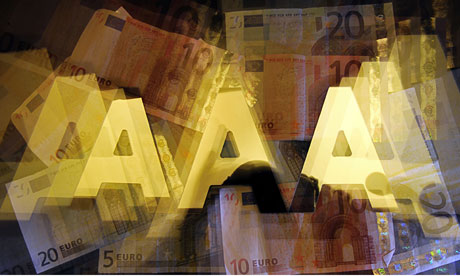
Later in the day, Standard & Poor's, one of the big three credit ratings agencies, downgraded nine of the 17 eurozone economies. As a result, Portugal pulled off the hat-trick of getting a "junk" rating by all of the big three, while France was deprived of its coveted AAA rating. With Germany left as the only AAA-rated large economy backing the eurozone rescue fund (the Dutch economy, the second biggest AAA economy left, is much smaller than the French economy) the eurozone crisis looks that much more difficult to handle.

The eurozone countries criticise S&P, and other ratings agencies, for unjustly downgrading their economies. France is particularly upset that it was downgraded while Britain has kept its AAA status, hinting at an Anglo-American conspiracy against France. But this does not wash, as one of the big three, Fitch, is 80% owned by a French company.

Nevertheless, France has some grounds to be aggrieved, as it is doing better on many economic indicators, including budget deficit, than Britain. And given the incompetence and cynicism of the big three exposed by the 1997 Asian financial crisis and more dramatically by the 2008 global financial crisis, there are good grounds for doubting their judgments.

However, the eurozone countries need to realise that its Friday-the-13th misfortune was in no small part their own doing.

First of all, the downgrading owes a lot to the austerity-driven downward adjustments that the core eurozone countries, especially Germany, have imposed upon the periphery economies. As the ratings agencies themselves have often – albeit inconsistently – pointed out, austerity reduces economic growth, which then diminishes the growth of tax revenue, making the budget deficit problem more intractable. The resulting financial turmoil drags even the healthier economies down, which is what we have just seen.

Even the breakdown in the Greek debt negotiation is partly due to past eurozone policy action. In the euro crisis talks last autumn, France took the lead in shooting down the German proposal that the holders of sovereign debts be forced to accept haircuts in a crisis. Having thus delegitimised the very idea of compulsory debt restructuring, the eurozone countries should not be surprised that many holders of Greek government papers are refusing to join a voluntary one.

On top of that, the eurozone countries need to understand why the ratings agencies keep returning to haunt them. Last autumn's EU proposal to strengthen regulation on the ratings industry shows that the eurozone policymakers think the main problem with the ratings industry is lack of competition and transparency. However, the undue influence of the agencies owes a lot more to the very nature of the financial system that the European (and other) policymakers have let evolve in the last couple of decades.

First, over this period they have installed a financial regulatory structure that is highly dependent on the credit ratings agencies. So we measure the capital bases of financial institutions, which determine their abilities to lend, by weighting the assets they own by their respective credit ratings. We also demand that certain financial institutions (eg pension funds, insurance companies) cannot own assets with below a certain minimum credit rating. All well intentioned, but it is no big surprise that such regulatory structure makes the ratings agencies highly influential.

The Americans have actually cottoned on this problem and made the regulatory system less dependent on credit ratings in the Dodd-Frank Act, but the European regulators have failed to do the same. It is no good complaining that ratings agencies are too powerful while keeping in place all those regulations that make them so.

Most fundamentally, and this is what the Americans as well as the Europeans fail to see, the increasingly long-distance and complex nature of our financial system has increased our dependence on ratings agencies.

In the old days, few bothered to engage a credit ratings agency because they dealt with what they knew. Banks lent to companies that they knew or to local households, whose behaviours they could easily understand, even if they did not know them individually. Most people bought financial products from companies and governments of their own countries in their own currencies. However, with greater deregulation of finance, people are increasingly buying and selling financial products issued by companies and countries that they do not really understand. To make it worse, those products are often complex, composite ones created through financial engineering. As a result, we have become increasingly dependent on someone else – that is, the ratings agencies – to tell us how risky our financial actions are.

This means that, unless we simplify the system and structurally reduce the need for the ratings agencies, our dependence on them will persist – if somewhat reduced – even if we make financial regulation less dependent on credit ratings.

The eurozone, and more broadly Europe, is slowly strangling itself with a toxic mixture of austerity and a structurally flawed financial system. Without a radical rethink on the issues of budget deficit, sovereign bankruptcy and financial reform, the continent is doomed to a prolonged period of turmoil and stagnation.

Sunday, 15 January 2012

Indian students rank 2nd last in global test


MUMBAI: Across the world, India is seen as an education powerhouse - based largely on the reputation of a few islands of academic excellence such as the IITs. But scratch the glossy surface of our education system and the picture turns seriously bleak.

Fifteen-year-old Indians who were put, for the first time, on a global stage stood second to last, only beating Kyrgyzstan when tested on their reading, math and science abilities.

India ranked second last among the 73 countries that participated in the Programme for International Student Assessment (PISA), conducted annually to evaluate education systems worldwide by the OECD (Organisation for Economic Co-operation and Development) Secretariat. The survey is based on two-hour tests that half a million students are put through.

China's Shanghai province, which participated in PISA for the first time, scored the highest in reading. It also topped the charts in mathematics and science.

"More than one-quarter of Shanghai's 15 year olds demonstrated advanced mathematical thinking skills to solve complex problems, compared to an OECD average of just 3%," noted the analysis.

The states of Tamil Nadu and Himachal Pradesh, showpieces for education and development, were selected by the central government to participate in PISA, but their test results were damning.

15-yr-old Indians 200 points behind global topper

Tamil Nadu and Himachal, showpieces of India's education and development, fared miserably at the Programme for International Student Asssment, conducted by the Organisation for Economic Co-operation and Development Secretariat.

An analysis of the performance of the two states showed:

In math, considered India's strong point, they finished second and third to last, beating only Kyrgyzstan

When the Indian students were asked to read English text, again Tamil Nadu and Himachal Pradesh were better than only Kyrgyzstan. Girls were better than boys

The science results were the worst. Himachal Pradesh stood last, this time behind Kyrgyzstan. Tamil Nadu was slightly better and finished third from the bottom

The average 15-year-old Indian is over 200 points behind the global topper. Comparing scores, experts estimate that an Indian eighth grader is at the level of a South Korean third grader in math abilities or a second-year student from Shanghai when it comes to reading skills.

The report said: "In Himachal, 11% of students are estimated to have a proficiency in reading literacy that is at or above the baseline level needed to participate effectively and productively in life. It follows that 89% of students in Himachal are estimated to be below that baseline level."

Clearly, India will have to ramp up its efforts and get serious about what goes on in its schools. "Better educational outcomes are a strong predictor for future economic growth," OECD secretary-general Angel Gurria told The Times of India.

"While national income and educational achievement are still related, PISA shows that two countries with similar levels of prosperity can produce very different results. This shows that an image of a world divided neatly into rich and well-educated countries and poor and badly-educated countries is now out of date."

In case of scientific literacy levels in TN, students were estimated to have a mean score that was below the means of all OECD countries, but better than Himachal. Experts are unsure if selecting these two states was a good idea.

Shaheen Mistry, CEO of Teach For India programme, said, "I am glad that now there is data that lets people know how far we still have to go."

Saturday, 14 January 2012

If everyone did a Worrall Thompson, maybe Tesco wouldn't be too big to fail


Tesco's poor results have led it to review its practices. The self-service tills used by Wozza may be a good place to start
Otto 1401
Illustration by Otto

Sad news for Tesco, which this week discovered an unexpected item in its bagging area. The rogue element has since been identified as "awful Christmas sales and a profits warning", and the company's chief executive Philip Clarke now appears to be having problems removing this item before continuing with Tesco's hitherto unstoppable rise. I do hope he has to wait a long time for assistance.

Britain ceased to be a nation of shopkeepers some time ago, as the local independent stores had the life bled out of them by the supermarket giants. But we're a nation of shoppers, and perhaps this two fingers to the daddy of them all is our retail version of the Arab spring. Watching the suddenly humble Clarke promising to address product quality, customer service and "longstanding business issues" rather put one in mind of a besieged dictator. "Wait!" is the despot's reaction to increasingly volatile protests. "I am literally just about to introduce a raft of democratic reforms!"

It will take rather more than Clarke's needy mea culpa to reverse the perception that Tesco stands for everything that is monolithic, mercilessly expansionist, and machine driven. Tesco is a place that people more principled than myself probably manage to avoid entirely, but into which most of us feel compelled to go fairly frequently because it's nearby, or because it has effectively shut down any alternatives.

For a long time, criticism of it was crushed by that pat little assertion that it was "what the people wanted". Tesco executives and their defenders appeared to be graduates of the Richard Desmond school of debate, which is to paint anyone who questions your methods as snobs or enemies of enterprise. They acted as if everyone criticising Tesco must have the luxury of shopping at Waitrose or M&S, when this week's evidence has revealed that they might just as easily get their goods at Aldi or Lidl.

Thus the unthinkable has happened. And now that Tesco appears to be not so much what the people want, what precisely does it have going for it?

Its expansion has certainly told us little we did not already know about this septic isle, merely throwing into even sharper relief the iniquities of such institutions as council planning departments. Countless ordinary citizens have tales of their applications to make minuscule home improvements being rejected, while mock Tudor Tesco superstores are waved through with as many clock towers and metal-effect weather vanes as their architects care to spike them with. Since the 90s, 200 have been plonked down like spaceships, pulling customers off high streets with their seemingly irresistible tractor beams. Yet we now discover that these behemoths are among the "less potent" parts of Tesco's enterprise. Whether scarcely 15 years of rapacious profits was worth leaving a blight of potential white elephants scattered across the countryside, only time will show.

But it is in the area of employment, and its effect on customer service, that the Tesco modus operandi has been most pernicious. There are few sights in modern retail more pathetic, in the true sense of that word, than that of the lone, low-paid human charged with overriding technical glitches in the banks of self-service tills that have already claimed the jobs of countless check-out assistants, knowing that they will soon enough claim theirs. (Eighteen months ago, Tesco began trialling a stall with no manned checkouts at all, merely the single overseer.) Given the Japanese government is investing heavily in technology that could provide robot care for the elderly, it seems a likely bet that Tesco hopes one day to have its shelves robotically stacked, and even the automated till supervisors replaced by customer service droids. A similar process of dehumanisation has been afoot in car plants, but few of us have the occasion to pass through those very often. Nowhere is the rise of the machine at the expense of human employment more evident than in supermarkets such as Tesco. It is an everyday dystopia.

What is to be done? Oddly enough, perhaps one mad answer lies in the other Tesco-related story of the week. Just possibly – and obviously entirely unwittingly – shoplifting chef Antony Worrall Thompson has suggested an act of civil disobedience. If a critical mass of shoppers were to decide to do a Wozza for moral reasons, then the robotic scanners would become less economically viable than human checkout workers. Pilfering from Tesco would become a political act. However, if your preference is for grandiose schemes that won't involve accepting a police caution before embarking on psychiatric treatment, perhaps we could get up a campaign for a sort of Tesco Tobin tax, in which some tiny percentage of every penny spent in one of their out-of-town stores would be dedicated to reviving Britain's denuded high streets.

That, of course, is about as likely to happen as one of Tesco's machines accepting you've placed your 25g packet of parsley in the bagging area. Alas, Britain's biggest retailer is such a massive part of our economy that it presumably won't be long before someone is explaining that it is too big to fail, in keeping with the vogue for the most rampant capitalists becoming socialists in their many hours of need.

Friday, 13 January 2012

Nothing wrong in killing; you just shouldn't urinate on the corpses.

Robert Fisk: This is not about 'bad apples'. This is the horror of war

How many other abuses took place off camera? How many Hadithas? How many My Lais?
So now it's snapshots of US Marines pissing on the Afghan dead. Better, I suppose, than the US soldiers pictured beside the innocent Afghan teenager they fragged back in March of last year. Or the female guard posing with the dead Iraqi prisoner at Abu Ghraib. Not to mention Haditha or the murder videos taken by US troops in the field – the grenading of an old shepherd by an Iraqi highway comes to mind – or My Lai or the massacre of refugees by US forces in Korea or the murder of Malayan villagers by British troops. Or the Bloody Sunday massacre of 14 Catholics by British troops in Derry in 1972. And please note, I have not even mentioned the name of Baha Mousa.
The US Marines' response to the pissing pictures was oh so typical. These men were not abiding by the "core values" of the Marines, we were informed. Same old story. A "rogue" unit, a few "bad apples", rotten eggs. Maybe.

But if there is one game of pissing on the dead, how many others happened without pictures? How many other shepherds got fragged in Iraq? How many other Hadithas have there been? There were plenty of other My Lais.

As laptop filmography gets better, so it all comes slopping out, the rapes and slaughter – and yes, by the Taliban the stoning of young women for supposed sexual misconduct in Afghanistan; by al-Qa'ida, executions and throat-cuttings in Iraq.

And no – the Americans are not the Nazis, the Brits are not the French Paras of 1960 Algeria (but surely we're not comparing the French paras to the Nazis). The Canadians handed prisoners over to Afghan thugs for brutal questioning but the Canadians are not like Saddam's secret police – and, I suppose, the Taliban are not Stalin's NKVD or Putin's KGB (before he became a statesman). And you can't compare – surely – the Soviet invaders of Afghanistan in 1979 with Genghis Khan.

So let's take a little guessing game. A British Sunday paper reveals shocking revelations of torture and cigarette burning, of physical brutality where prisoners must be hospitalised for a week, of possible electric torture. The French in Algeria? Saddam's mukhabarat? Nope. It's The Sunday Times Insight Team's report of 7 May 1972; the victims, of course, IRA suspects in Belfast. A "rogue" unit? A "few bad apples"? I doubt it.

When the Gloucestershire Regiment went on a rampage near Divis flats, smashing every window in the street the day before they were due to leave Belfast, the line was changed. They had been under "enormous strain" – but weren't these the "Glorious Gloucesters" of Imjin River fame? And the killer Paras of Derry – weren't these the same Paras of Arnhem Bridge?

And so we go on. Yes, British troops murdered SS prisoners after Normandy – just as the Red Army did in the Second World War and the Americans. And all this gets a bit dull, doesn't it?

Dresden was worse than the Blitz – but who started it? Hiroshima was worse than Pearl Harbour (ditto). The Canadians bayoneted German prisoners in the First World War – but the Germans really did committed atrocities in Belgium in 1914. And what about Waterloo? What did we do with the heaps of French dead? Why, we honoured them by shipping their corpses off to Lincolnshire and using them as manure on the fields of East Anglia.

If war were not about the total failure of the human spirit, there would be something grotesquely funny about the American reaction to the pissing pictures.

For note, it was not the killing of these men that worried the Marine Corps in the US – it was the pissing. Nothing wrong in killing amid the "core values" of the Marine Corps; you just shouldn't urinate on the corpses. And even more to the point: YOU MUSTN'T DO IT ON CAMERA! Too late. It comes to this. Armies are horrible creatures and soldiers do wicked things but when we accept all these lies about "bad apples" and the exceptionalism of crime in war – "there may have been some excesses" is the usual dictator-speak – we are accepting war and going along with the dishonesty of it and we are making it more possible and easier and the killings and rapes more excusable and more frequent.
And how should armies react? With one word: guilty.

Wednesday, 11 January 2012

Skyscrapers 'linked with impending financial crashes'

There is an "unhealthy correlation" between the building of skyscrapers and subsequent financial crashes, according to Barclays Capital.

Examples include the Empire State building, built as the Great Depression was underway, and the current world's tallest, the Burj Khalifa, built just before Dubai almost went bust.

China is currently the biggest builder of skyscrapers, the bank said.
India also has 14 skyscrapers under construction.

"Often the world's tallest buildings are simply the edifice of a broader skyscraper building boom, reflecting a widespread misallocation of capital and an impending economic correction," Barclays Capital analysts said.

The bank noted that the world's first skyscraper, the Equitable Life building in New York, was completed in 1873 and coincided with a five-year recession. It was demolished in 1912.

Other examples include Chicago's Willis Tower (which was formerly known as the Sears Tower) in 1974, just as there was an oil shock and the US dollar's peg to gold was abandoned.

And Malaysia's Petronas Towers in 1997, which coincided with the Asian financial crisis.

The findings might be a concern for Londoners, who are currently seeing the construction of what will be Western Europe's tallest building, the Shard.

That will be 1,017ft (310m) tall on completion.

China bubble?

Investors should be most concerned about China, which is currently building 53% of all the tall buildings in the world, the bank said.

A lending boom following the global financial crisis in 2008 pushed prices higher in the world's second largest economy.

In a separate report, JPMorgan Chase said that the Chinese property market could drop by as much as 20% in value in the country's major cities within the next 12 to 18 months.

In India, billionaire Mukesh Ambani built his own skyscraper in Mumbai - a 27-storey residence believed to be the world's most expensive home.

Local newspapers said the house required 600 members of staff to maintain it. Reports suggest the residence is worth more than $1bn (£630m).

"Today India has only two of the world's 276 skyscrapers over 240m in height, yet over the next five years it intends to complete 14 new skyscrapers," according to Barclays Capital.

Barclays Capital's Skyscraper Index has been published every year since 1999.

Tuesday, 10 January 2012

It's time to cancel unpayable old debts

By Aditya Chakrabortty in The Guardian

In the week between Christmas and New Year, those bleary few days when the world has better things to do than catch up on news or check its Twitter account, The Guardian carried a story that bears repeating. It was about Dimitris and Christina Gasparinatos and their kids in the Greek port of Patras. For ever hard up, the parents had been pushed by the economic crisis into outright poverty; and just before Christmas Dimitris and Christina put four of their children into care.

Nor is the Gasparinatos' case an isolated one. Greece must be the most family-centric society in western Europe, yet its media is full of reports of newborns dumped outside clinics, or infants shunted into foster homes.

Such stories almost never come up when politicians and economists debate Europe's meltdown; implicitly, they are categorised as fall-out, for journalists and campaigners to highlight. Yet the abandoned children of Greece are not merely coincidental to those discussions about how to tackle the debt; they are integral to it.

Strip away the technicalities and you are left with two ways to think about the debt crisis. One is as a battle between the past and the future. The vast majority of Greece's debts are historic commitments made to creditors by previous governments, sometimes in very dubious circumstances. Yet Athens has been forced to prioritise repaying these old loans over generating economic growth, or future income. One result of that policy has been to snatch away whatever chance the Gasparinatos kids might have had of decent lives.

Something similar is happening in Britain. David Cameron came to office with the primary goal of paying down debt. Less than two years later, his ministers are now obliged to go on the BBC at regular intervals to explain why more than a million young people are out of work. Study after study shows that a young adult unemployed at the outset of his or her career suffers permanent damage to their prospects, yet this government's economic policy favours the past even though it means ruining the future.

Why? This brings us to the second way to think about any argument over debt: as a fight between creditors and borrowers, or the haves and the have-nots. The creditors have the money and therefore the whip-hand over the borrowers. They also have the political influence: the boss of Deutsche Bank would, one suspects, get more face time with Greece's prime minister or any other eurozone leader than the Gasparinatos family and a whole coachload of their neighbours. His demands are also more likely to get preferential treatment, which is a major reason why Angela Merkel and Nicolas Sarkozy has gone through such contortions over Athens' loans.

Before last summer, eurozone policy-makers swore blind that they would never countenance Greece failing to pay all of its debts in full. After finally accepting that that was impossible, they then asked if bankers would be good enough to knock 21% off the country's loans, rising over time to 40% and then 50%, or even a little more. Meanwhile, economists at the IMF estimate that Greece should actually have 75% wiped off its debt burden – and market prices indicate that figure should really be over 90%. But economic reality has been no match for the stranglehold bankers have on European politicians – who, by the way, swore last month that no other country would fail to pay its loans in full.

And yet economic history is full of examples of successful debt default. When American Airlines declared recently that it was bankrupt and couldn't carry on repaying its loans, it was applauded by Wall Street analysts as "very smart". The whole point of company insolvencies is to work out the value and viability of the underlying enterprise; if it can carry on, banks and other creditors get squared off at vastly reduced sums and the productive part of the firm is back in business.

The same goes for countries. Regimes sunk by revolutions don't repay their debts; nor do countries that lose wars. (When they are made to, as with Germany after the first world war, terrible things can result.) Over the past couple of decades, campaigners have successfully won debt relief for poor countries in Africa and Asia. Other nations, such as Ecuador or Argentina or Iceland, have simply declared they cannot repay all that they owe.

Ultimately, a loan is a social arrangement and, like any other contract, it can be renegotiated. A few decades ago, archaeologists discovered the first ever legal contract in Lagash in modern-day Iraq. Dated back 4,400 years and carved into the bricks of a Mesopotamian temple, it was for the cancellation of debt. It's claimed that countries that don't repay their loans will be frozen out by lenders. Yet, as I wrote here last year, IMF economists have recently argued that "the economic costs are generally significant but short-lived . . . we almost never can detect effects beyond one or two years."

In his recent, brilliant history Debt: the First 5,000 Years, the anthropologist David Graeber calls for a modern-day debt jubilee, a cancellation of all debts, just as they had in Mesopotamia. His suggestion is provocative, but it should be taken seriously. Because the longer we keep protecting the haves over the have-nots and honouring the past while destroying the future, the worse this debt crisis will get.

Is this Prosperity for Real?


By Pritish Nandy

Despite the economic downturn there remain clear signs of growing prosperity all around us. Almost every week someone or the other walks into my office wanting to make a movie and ready to pay for it. It was like this ever since I entered this profession. But earlier, people came with a few lakhs, a script, a camera and an autograph book. Now they come with ten or twenty crores.

Most of them come from remote towns and states, where they claim to have made a neat fortune in some business they are not ready to disclose details about. Others come, having sold off some ancestral land or property. They turn up in Mumbai with big dreams of making movies and doubling or tripling their wealth. When I warn them it’s not that easy, many go away with disbelief. Most times I turn them back because they come with cash. They are surprised when I tell them that the real guys who make movies in this town do not deal in cash any more. Only hustlers do.

But what never ceases to surprise me is the amount of wealth that actually exists in India. It is possibly because once you are a few miles out of the main cities, no one really bothers about things like taxes. Life is simpler. You neither hire CAs nor do you bump into tax officers. You simply do your business and get ahead with life. I seriously doubt how many of the rich guys out there actually bank their wealth. They put their profits back into land and property or gold and, now, increasingly into fancy SUVs and a lifestyle that they see in television serials and movies. That’s what defines their ambitions.

But yes, prosperity exists in certain pockets and it’s clearly growing. Much of this prosperity comes from two things: Inflation and the selling of family assets that the young generation is no longer keen to hold. So the wealth you see is not actually created, as all real wealth ought to be. It is wealth that is generated from the falling value of the rupee and the rising cost of land and property. It is, in that sense, illusory. For the amount of money you get from selling a family asset once acquired in thousands and now being sold in crores is not really all that much as it may appear. The crores you now get have the same purchasing power as the few thousands that were once paid to acquire that very asset. It is the value of the rupee that has fallen. So these crores will not fetch you much more than what those thousands could have fetched your grandfather. And those who sell those assets ultimately find them irreplaceable and the huge pile of cash they get is blown up quicker than they imagine, on a trashy lifestyle that they think will upgrade the quality of their life. It never does. But you realise that only after the money disappears.

That is the danger with unearned wealth. It disappears as swiftly as it comes. And because you never made the effort to acquire the skills required to earn that money, you are unlikely to know how and where to spend it in a way that can actually enhance the magic of your life. That leaves you worse off than where you began. At least you had the assets then. Now you are left with nothing.

I see this happening all around me. Suddenly people become rich and then equally suddenly, they become poor again. In between there’s a lot of selling and buying and selling that takes place but seldom the creation of any real wealth. It’s always land, property, gold, and family heirlooms that have appreciated in value over the years. When you sell them, you sell your past without acquiring a real future. People who talked in thousands begin to talk in lakhs and people who talked in lakhs now talk in crores. But they are talking about the same things. It is just that some extra zeroes have been added to the numbers and no one quite knows why.

But one thing is certain: When old assets become central to the idea of creating wealth, it means we have lost our skills in knowing how to build new ones. All we are relying on is inflation, and inflation just grows the numbers but never gives you anything more in real terms. Certainly not a better life.

Elite Asian students cheat like mad on US college applications


BANGKOK, Thailand — From sleep to social lives, there is little Asia’s most upwardly mobile students won’t sacrifice for education. Though they belong to the so-called “Asian Century,” American colleges remain the premier destination for the elite from Shanghai to Singapore to Seoul.
The path to US college acceptance, however, increasingly compels students to sacrifice their integrity. For the right price, unscrupulous college prep agencies offer ghostwritten essays in flawless English, fake awards, manipulated transcripts and even whiz kids for hire who’ll pose as the applicant for SAT exams.

“Oh my God, they can do everything for you,” said Nok, 17-year-old Thai senior in her final year at a private Bangkok high school. (She asked GlobalPost to alter her name for this article.) “They can take the SAT for you, no problem. Most students don’t really think it’s wrong.”
 
China's latest craze: dyeing pets to look like other wild animals (PHOTOS) [3]

Among Asian high society, and particularly in China, parents’ obsession with sending their offspring to US colleges has given rise to a lucrative trade of application brokers. Depending the degree of assistance, families can expect to pay between $5,000 and $15,000.

“The parent says, ‘My kid needs this GPA but, frankly, his scores aren’t that strong.’ Then the unscrupulous agent says ‘Don’t worry. We’ll figure that out,’” said Tom Melcher, chairman of Zinch China and author of a Chinese-language book on choosing American colleges.

A 250-student survey by Zinch China, a Beijing wing of the California-based Zinch education consultancy, suggests college application fraud among Chinese students is extremely pervasive. According to the survey, roughly 90 percent of recommendation letters to foreign colleges are faked, 70 percent of college essays are ghostwritten and 50 percent of high school transcripts are falsified.
“For the right price,” Melcher said, “the agent will either fabricate it or work with the school to get a different transcript issued.” Admission into a top 10 or top 30 school, as defined by the US News & World Report, can bring a $3,000 to $10,000 bonus for the agent, he said. The magazine, Melcher said, is commonly confused in China for an official government publication.

Demand for such agents is high and getting higher. Rapid economic growth across China and other parts of Asia has sparked an explosion in foreign students hoping to secure their ascent with a Western diploma.

Chinese citizens currently account for more than one in five foreign students studying at US colleges. Nearly 158,000 Chinese students are enrolled at any given time, a full 300 percent jump over mid-1990s numbers, according to the Institute of International Education.

Chinese, Indian and South Korean students comprise roughly half of America’s foreign college student population. Vietnam has sent 13 percent more students to the US within the last year, and Malaysia has added 8 percent, the institute reports.

But many American college officials are oblivious to the application fix-it men these foreign students may have paid back home. Worse yet, remaining blind to the deception is often financially incentivized.

America’s economic downturn has drained the state tax coffers that provide a funding lifeline to many US colleges. Many schools have resorted to unpopular tuition hikes. But many are also courting wealthy foreign students whose families gladly fork over money for housing and tuition along with out-of-state or even out-of-country fees.
 
Rice Fields Of Asia: From Above and Below (PHOTOS) [4]

“International students are seen as a source of revenue ... and the trend has exploded in the past two years,” said Dale Gough, international education director for AACRAO, the American Association of Collegiate Registrars and Admissions Officers.

Foreign students, through tuition and living expenses, contribute $2.1 billion to the US economy, according to the US Commerce Department. “In short,” Gough said, “they help the bottom line.”
Excuses abound for ignoring fraudulent applications, Gough said. Some assume that kids who cheat will inevitably flame out anyway and never score a degree. Some admissions officers, he said, contend that “that’s just the way it’s done over there.”

Many schools also make sloppy attempts to translate foreign transcripts, calculated by an “indigenous” and unfamiliar methodology, into America’s GPA or “grade point average” system, Gough said.

His association publishes a guide to deciphering foreign scores, the only one of its kind, but fewer than 500 of the 3,500 institutions represented by AACRAO bother to buy a copy.
“Translating foreign grades into a GPA system is meaningless,” Gough said. “They attempt to do it anyway.”

Gough fears that universities’ lax standards, and focus on big foreign tuition payments, will eventually undermine the pedigree of an American diploma. The damage, he said, would be nearly impossible to undo.

“This scenario spells disaster,” Gough said. “Even if a lot of the students who cheat are bright, and they go on to succeed, is this fair to American students? Or [to] the foreign students who play by the rules?”

While America has ceded manufacturing power and foreign influence to China, an American degree remains the gold standard of educational prestige. Nok, who is currently applying for colleges abroad, never considered applying to universities in Asia.

“Students who study in America are elite, the privileged,” said Nok. “It shows you’re smarter than the others.”

But like most Asian students, Nok has felt baffled and overwhelmed by America’s complex application system.

“Here, you take a big test one day and report the score. That’s how you figure out where you’ll go to college,” she said. “The Americans are different. They want to know the big picture. All these essays. All this stuff about your life.”

America’s liberal arts application system is “fundamentally more confusing,” said Joshua Russo, director of Top Scholars, a college prep and tutoring agency in Bangkok.

Asian families unfamiliar with the process, he said, are justified in seeking an agency’s help with application strategies and tutoring to build the skills US colleges demand. But Russo’s refrain to parents, he said, is that kids who can’t write their own essays are likely to burn out once enrolled in America.

“Some consultants will promise the world ... and they’re fundamentally preparing students to fail,” Russo said. “Beyond fabricating an essay, they’re fabricating a whole life story. Students will start to believe in the lie. It’s wrong.”

The allure of America’s universities, and the pressure-cooker drive to succeed among Asia’s expanding upper class, will continue to propel Asian students into American schools. Many Chinese teenagers applying abroad, Melcher said, are the sort of highly motivated students colleges desire.
“Chinese kids are typically great,” Melcher said. “They’re not at the tailgate parties drinking. They’re busting their butts. Failure is not an option.”

But college application fraud will continue, he said, so long as the risks are low and the rewards are so high. His consultancy suggests interviewing all Chinese students via online video chats, conducting spot tests in English, and hiring a mainland Chinese staffer in the college’s home office.
“Frankly, I feel really bad for Chinese families who are trying to be honest,” he said. “They’re driving 55 while everyone’s zooming past them. After a while, they throw up their hands and say, ‘Fine, I’ll speed up.’”

The cost of our habits


By Ardeshir Ommani


Altria Group is the leading cigarette maker in the United States. The stock of the company rose 20% in 2011's depressed markets and it's up 50% over the past two years, nearly four times the market's average gain. About two weeks ago, the stock of the company, which is the parent of Philip Morris USA and that of the Marlboro brand hit a 52-week high of $36.40.

The rise in its stock price is influenced by the company's stable cash flow and a dividend yield of 5.5%. At the time when money market rates are less than 0.5%, and the 10-year Treasury is 
yielding less than 2%, the stocks of Altria Group attracts all the attention of the investors who do not ask how many smokers would die this year because of addiction and succumbing to lung cancer. It is worth noting that on December 23, 2011, from Richmond, Virginia, Altria's operating companies launched "Citizens for Tobacco Rights", a nation-wide website to assist the tobacco companies in promoting lowering taxes on cigarette sales.

Although US cigarette sales have been in a severe long-term decline, to be exact, its shipments dropped by a third over the past 10 years, the industry has been able to offset the volume decline with increases in wholesale prices. Naturally after addicting a large segment of the youth around the world, the owners of Altria Corporation are led to raise the cost of their habits and suffering.

The companies have raised cigarette prices by nearly 35% over the past 10 years, even as smokers shouldered huge jumps in federal and state cigarette taxes. Altogether retail prices and additional taxes hiked the cost of a pack to $5.95. This was more than double the rise in overall consumer prices.

This shows that the high rates of profitability in addictive substances is the ideal method of exploiting not only the workers, but also the consumers. The change in the demographics of cigarette addicts has forced the industry to intensify the rate of exploitation of those who can least afford the habit in a long period of economic stress and high rates of unemployment.

The captains of the stock market seem unshaken. The stocks look rich based on their double-digit price per earning ratios. The high rates of profitability in the industry have led the management to implement the strategy of stock buybacks and huge stock awards for management compensation.

Altria is by far the biggest US cigarette maker in both market weight ($61 billion ) and revenue-wise (over $16 billion a year). A substantial share of the company profits are generated outside the US. Philip Morris International, a subsidiary of Altria, sells Philip Morris brand lineups in about 180 countries around the world.

In other words, the men, women and more frequently, elementary-aged children - often at the cost of their lives - are providing these gentlemen in New York and Chicago with lavish life-styles. (Looking at just a few of the advertisements in major corporate newspapers as the Financial Times, New York Times, The Telegraph, etc. directed at this wealthy 1%, we see a woman's handbag selling for $4,000).

In 2009, Altria purchased the smokeless-tobacco producer UST, which makes Copenhagen and Skoal brands at the cost of $11.7 billion. The reason Altria shouldered such a high cost price is that smokeless tobacco is a much-less regulated part of the worldwide cigarette market. Lack of regulations leaves the smokers at the mercy of the tobacco industry. Altria generates in an average $3.5 billion a year in cash flow, most of which ends in the investor's bank accounts in the form of dividends and interests and conspicuous consumption.

As a group, cigarette smokers have lower household incomes than non-smokers and are nearly twice as likely to be unemployed, says a financial officer of Morgan Stanley, a banking corporation. Studies have shown that in communities with higher economic status, its members send their children to better-financed public schools and private universities where environmental sciences and healthier life-styles are emphasized in the educational curriculum from early grade school through university level.

Anti-smoking campaigns partially financed by higher city and state budgets are more predominant on expensive billboards in these higher income communities.

On average a member of this lower economic class spends more than $2,000 annually, smoking a pack a day, the amount that could be allocated towards the present and future sustenance. Smokers, in their attempts to halt casting a large amount of money to the rich, many have traded down to either cheaper cigarettes or bulk tobacco for rolling their own cigarettes.

For this reason, shipments of roll-your-own and pipe tobacco jumped 30% in the first half of 2011. In the brave new world, particularly the Facebook generation age 21 through 29 is no longer fascinated with that rugged cowboy who was for many decades the symbol of Marlboro.

Alongside Altria in the tobacco market stand such giants as Reynolds American, maker of Camel and Pall Mall as well as Natural Spirit brands selling the ugly and more hazardous chewing tobacco brands. To entice new smokers or keep the old ones in the loop, the cigarette companies constantly hatch out new names with new packets. Recently, Philip Morris USA came up with what it calls the "Marlboro Leadership Program" which puts a price cap on what the retailers can charge for a pack of Marlboro in return for promotional incentives, such as a free pack for every carton sold.

While in the US, after years of public pressure, the federal and state governments have imposed some restrictions on advertising and marketing tobacco products, the same companies in the markets of the developing countries promote and glamorize smoking among school children, going so far as to distribute free packs of cigarettes along the pathways leading to schools, the way they did just a few decades ago in the run-down parts of the big cities and the depressed small towns across the US.

Also, the ruling classes of the countries whose economies are dependent on the US and its partners benefit from such relations through providing lucrative markets for the tobacco products of the major international cigarette producers.

It is telling that the gains posted by these tobacco companies in 2011 was skyrocketing when few other stocks were thriving last year. A group of mutual fund managers who tried to avoid negative performance by the end of the year resorted to placing the shares of several tobacco firms among their top holdings.

Gains of more than 20% among the addiction enablers helped these funds outperform their rivals and attracted the moderate savings and the retirement funds of the employed and retired working class. Such is the political economy of the habit-forming industry, addiction of the oppressed and higher rates of profitability.

Ardeshir Ommani is a writer on issues of war, peace, US foreign policy and economic issues. He has two Masters Degrees in the fields of Political Economy and Mathematics Education.

Sunday, 8 January 2012

Germany once admired British workmanship – but that was a long time ago

Over the North Sea lies the richest country in Europe, its success built on the manufacturing industry that Britain has spurned
marklin steam train ian jack
'The war hadn't been over 10 years and somehow Germany was making model trains more convincing than our own'

We all want to be Germans now: to make, to sell and not to yield. We would like to earn some respect, not least self-respect, and have some idea of our national future. The UK will never replace Germany as the world's second largest exporter, but we can surely manage to manufacture a few more things and "rebalance the economy", as the saying goes, to shrink the influence of the City of London.

So many people have had this dream recently – Vince Cable, of course, and Lord Glasman, no doubt, but also George Osborne when he made his fatuous speech about the "march of the makers". And there over the North Sea is the richest country in Europe: exemplary Germany, with its technical schools and apprenticeships, its respect for engineers, and its layer of family businesses known as the Mittelstand that puts long-term reputation above short-term profit by making the specialised parts that industry everywhere needs. How foolish we were to imagine that national prosperity could be spun from figures on a computer screen, out of thin air. How silly to despise the making of three-dimensional objects as a lowly process that had quit the west for the east. And how wise it would be (so the dream goes) to take a leaf from Germany's book and make manufacturing a much larger slice of the economy, therefore returning Britain to an earlier and possibly more solid version of itself.
That self is a long time ago. I remember watching Edgar Reitz's long and haunting film Heimat in the mid 1980s. Through the life of one family, the history of Germany in the 20th century was related in all its difficulty. At one point in the second world war, two characters find part of an aircraft or a bomb (I can't recall which) in a field. "Look," says one to the other as he handles the object, "such fine English workmanship." There was no irony, though it seemed hardly credible that British engineering could have been prized in Germany only 40 years before, given that at that Thatcher moment the typical British workshop was being sold abroad as scrap.

Germany's technical superiority was plain to see by the 1960s, but my own enlightenment came rather earlier, when I was eight or nine and the recipient of German gifts at Christmas. These came from two sources. In 1945, my family had befriended a prisoner-of-war and stayed in touch with him when he went home to Hamburg. We sent parcels of coffee beans, while a small box of marzipan or a bottle of eau-de-cologne came in the other direction. But as the years passed, the German presents grew more sophisticated. For me, a toy fire engine with a working water pump; for my parents, topographical books of black and white photographs printed on cream paper that felt like velvet. Perhaps these luxuries could also be found in Britain, but we had never seen them.

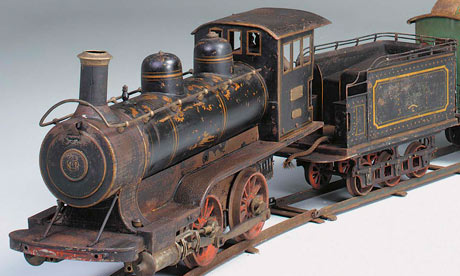
These were portents. The epiphany – not that I thought of it like that at the time – arrived when my older brother came home on leave from national service in Germany. He was the second source of gifts, and once, from his kitbag, produced two model railway coaches, gauge 00 to match my Hornby set but made by the German toymakers, Marklin. Their detail was superb. My tinplate Hornby carriages relied on painting to produce an effect of windows and door handles, but on their Marklin equivalents the windows really were transparent and the pattern of rivets below them stood out in relief. The war hadn't been over 10 years, and somehow Germany was making things as inconsequential as model trains that were more convincing than our own. Suddenly "Made in England" no longer suggested a singularly high quality, not that in 1954 it was easy in Britain to find goods made anywhere else.

Fear and envy of German manufacturing prowess began a long time before, as any economic history will tell you. Together with the US, Germany began to displace Britain as the world's foremost industrial nation well before the close of the 19th century. Books and newspaper articles sounded the alarm ("American furniture in England – a further indictment of the trade unions," read a Daily Mail headline in 1900), but did little to prevent Britain falling further behind in the new industries that became so important in the 20th century. Germany established a clear lead in chemicals, electrical engineering, optics and instrument-making. At the outbreak of war in 1914, the British government found that every magnet in the country came from Stuttgart, while German chemical works supplied all the khaki dye for British military uniforms.

To a large extent, British decline was inevitable: other nations had learned how to make things and export markets would naturally shrink. But the particular contrast with Germany was instructive when it came to scientific education and the social position of manufacturers and engineers. According to Peter Mathias's classic economic history, The First Industrial Nation, only a dozen students were reading for a degree in natural sciences at Cambridge in 1872. Germany, meanwhile, had 11 entire universities devoted to science and technology. Its educational system embraced the idea of manufacturing, while England's public schools and ancient universities held it at arm's length.
Finance became the acceptable business profession for gentlemen. In the words of another historian, Martin Wiener, finance "involved the extraction of wealth by associating with people of one's own class in fashionable surroundings, not by dealing with … the working and lower-middle classes". In this way, the City became part of the elite and "could call upon government much more effectively than could industry to favour and support its interests".

This is a familiar and by now hardly controversial diagnosis of the British malaise, and every so often a government or a politician promises a fundamental reform in political attitudes, praising the country's long tradition of scientific discovery and technical invention. A few television programmes endorse the same point; Sir James Dyson appears with his vacuum cleaner. But, beyond that, nothing much happens. Look around the frontbenches on both sides of the Commons. Who there dares upset the City? Who there ever made anything three-dimensional, or even had a parent who did? Which of them would risk the chamber pot of failed hopes being emptied over their heads by calling for a national industrial strategy?

It would be lovely to emulate the industrial success of the Germans, but so much history is very hard to undo. The one cheerful note (or perhaps more a vengeful one) is that Marklin, which made my memorable little carriages, is now owned by a private equity company based in London.

Tuesday, 3 January 2012


The power to say no

Pritish Nandy
02 January 2012, 09:18 PM IST

4


My worst failing is my inability to say No. This year I intend to correct that. I will clearly and unequivocally say No when I want to. Not a Maybe or a Perhaps; a straight, categorical No.


For people like me it’s not easy. We were brought up being told that No is impolite, rude, and politically incorrect. There are nicer ways to turn down a request. You can gently fob it off. Or procrastinate. Or do what my friend Husain, the painter, always did. He said Yes to everything and promptly disappeared. Poof! People have waited for him to inaugurate an event in London while he went off to New York for a party. No, Husain never allowed a commitment, any commitment to burden him. He happily failed each, knowing fully that he will be forgiven for his indiscretions. He blamed it on his poor memory. But memory had nothing to do with it. Insouciance did.


My friend Mario was identical. He did hundreds of cartoons for me when I was editor, but never on time. Give Mario a deadline and you could be sure he will miss it. He completed every assignment but in his own time. I remember he once came to me with a cartoon so late that I had forgotten what it was for. But no, he never said No. He was always polite, always proper and agreed to any deadline I set him because he knew he would not have to keep to it. We decided to do a book together, of naughty limericks, largely based on Indian politics. I waited three years for him to complete the drawings. By the time they were ready, I had lost the manuscript. (We didn’t have computers in those days and typescripts were easy to lose.)


I smoked my first cigarette at 7 because I couldn’t say No. I downed my first whisky at 9, smoked grass at 11, all because I couldn’t say No. Luckily I found it all quite boring and so, by the time I was 16, it was all over and I was ready to take on life on my own terms. Minor addictions have never distracted me since. I listen to Vivaldi, read Dylan Thomas, try to figure out why Damien Hirst is such a vastly over rated artist. I can spend all day listening to Mallikarjun Mansur and marvelling at his genius if only I can say No to a million silly, irrelevant commitments I pick up, for people I barely know.


My father died because he couldn’t say No to a doctor, a family friend in Jabalpur who convinced him that prostrate surgery was the easiest thing on earth, and he could do it in his own nursing home. By the time I heard of it and rushed there, he was already in a coma from which he never recovered. We finally pulled the plug on him. My mother lost our family home in Kolkata because she couldn’t say No to her landlord, who requested her to give up her decades old tenancy because his family had grown, needed more space. Even before she packed up her meagre belongings and came to me here, the landlord had sold off the house. Yes. Life makes suckers of us all. Especially those prone to saying Yes.


I was reading the cover story in a news magazine recently which argued that the most important thing you can tell your doctor is No. Most people suffer because they say Yes and get lumped with medication they don’t need, tests that are not necessary, and surgeries they could have done without. This is true at the dinner table as well, or in a restaurant. The more often you say No to the lip smacking food there, the better your health will be. The day we can say No to all the candidates when voting, the quality of our politicians will improve.


Life is a honey trap. Everyone’s waiting for you to say Yes. The moment you do, you are entrapped by absolute, arrant nonsense, breathtakingly packaged, aggressively promoted, seductively laid out in front of you, and completely irrelevant to your life or well being. The wise man says No. The fool succumbs. 2012 is my year to say No. An emphatic, easy No. Like Eric Bana told his handler in the last scene of Spielberg’s masterpiece, Munich. If a patriot who risked his life hunting down terrorists can say that, so can you and I.