Search This Blog

Thursday, 21 July 2011

Test cricket - a primal contest


The primal contest

The game's essential match-up, of batsman against bowler, finds its best expression in Test cricket


Cricket is a contest between bat and ball, a struggle that reaches its highest form in the Test arena. In most games the players are attempting the same skills and the result depends on the quality of the execution. Boxers and tennis players land the same sorts of blows, play the same type of shots. In cricket, as in baseball, the teams have the same aim but the process involves a primeval battle between batsman and bowler.
It is a confrontation between prey and predator, collector and hunter, reason and fury. Both sides strive with every power at their disposal to emerge triumphant. At first the bowler presses for a quick kill, for he knows his opponent is at his most vulnerable before he has settled. If the batsman survives his period of reconnoitering, his opponent might change his strategy, play a waiting game, set a trap, seek an opening, probe for weakness, mental or technical, or else invite his rival to reach too far. Victory alone matters and it can be attained by means slow or swift, fair or foul.
For his part the batsman strives to calm his nerves and become accustomed to light and pitch and ball. He tries to take his time and to give no hint of shakiness, even as the elephants dance in his belly. Most likely he will endeavour to play a tried and trusted game honed over the years. Every innings is different, though, and no bowler is quite the same, so the willow wielder needs to have his wits about him.
The attack might include a tearaway, a crafty veteran, an innocent-looking swinger, a mean fingerspinner, and a wristy one, capable of giving both ball and bottle a fearful rip. By and large all of them will fulfill their caricature. At the lower levels the aged chap is the one to watch. Bowlers learn a thing or two as they go along. Hence the saying, "Never underestimate a grey-haired bowler."
Not that a fellow ever learns that lesson. One of the delights of cricket is that even experienced and supposedly intelligent players keep making the same mistakes and keep berating themselves with the same curses. Pitted against a touring Australian side not so long ago, I managed to survive the opening onslaught and then licked my lips as the ball was thrown to a creaking purveyor of slow curlers. Too late I realised that the accursed pensioner was not as guileless as he seemed, and that his deliveries were not so much easy meat as poisoned chalice. By then the trudge back to that place of eternal wisdom and endless regret, the dressing room, was well underway.
Ordinarily the batsman will begin to widen his range of shots once established at the crease. It is not always a conscious decision. As often as not, the change of tempo happens of its own accord. Confidence, a tiring attack and frustration can combine to hasten the flow of runs. Unless the field is pushed back, innings advance in fits and starts. Placement, too, is less common than supposed. Batsmen might manoeuvre the ball into a gap or loft into empty spaces, but piercing the field with a full-blooded shot usually depends as much on luck as skill. 
Of course batsmen and bowlers sometimes switch sides. Then the batsman becomes the predator, attacking from the outset and so changing the course of the contest. Even opening batsmen have become audacious. Previously the movement of the ball and a wider insecurity caused by Depressions and wars dampened ardour. Charlie Macartney, an incorrigible Australian (that might be repetitive), was an exception. By his reckoning an opener ought to dispatch a drive back at the bowler's head at the first opportunity, thereby informing him that he was in for a proper scrap. Nowadays the spread of briefer formats, the dryness of the pitches and the mood of the era encourage early attempts to seize the initiative.
Test cricket provides the opportunity for every player to express his talents to the utmost. Whereas the one-day game, to some degree, dictates terms to those taking part, limiting their overs, reducing their time at the crease, influencing field placements and bowling changes, a five-day match is as liberating as it is daunting.
Unsurprisingly the most compelling exchanges between bat and ball take place in the Test arena. Here the greatest players of the era are given the chance to try their luck against their equivalents, and the freedom to score 200 or a duck, take 10 wickets or concede a stack of runs without reward.
Bowlers, especially, relish the opportunity to prove their worth. At last they can set their own fields anyhow - so long as they don't copy Douglas Jardine - and bowl as many overs as captain and body allow. Inevitably the leading practitioners have produced their best work in this environment, constructing dazzling, tormenting spells that linger as long in the memory as the brilliant innings played by their temporary foes. Along the way they have reminded observers that bowling can be as rewarding as batting, and a lot more destructive.
Every cricket enthusiast will recall occasions when bowlers surpassed themselves. Michael Holding's stint at The Oval in 1976 was unforgettable. At once he was graceful and mesmerising, not so much running to the crease as gliding to it. Head upright, shoulders swaying slightly, toes barely touching the grass, he gathered himself at delivery and without apparent effort sent down thunderbolts that contained the charm of the antelope and the wrath of a vengeful god. Stumps kept toppling over like skittles and shaken batsmen came and went, knowing they had been undone by an irresistible force.
Richard Hadlee's performance in Brisbane was more surgical than stunning. Operating off a seasoned run, summoning formidable expertise, cutting the ball around off a track that helped him a little and others not at all, he worked his way through the local order. Even by his precise standards it was a tour de force. Like so many of the best spells, too, the wicket-taking deliveries were defined not so much by their deadliness as by the company they kept. Superb batsmen were harried and humiliated into error. The Kiwi did not bruise a single body but he damaged many egos.
Wasim Akram's virtuoso display at the MCG stands out because he had the ball upon a string, made it bend both ways at a scintillating pace and left accomplished batsmen gasping and groping. It's hard enough countering a bowler sending them down at 90mph and swinging it in one direction. When they start moving it both ways, it's downright unfair. Wasim streamed to the crease and with a gleam more mischievous than menacing, produced an astonishing spell. 
Malcolm Marshall's most remarkable contribution came on a slow pitch at the SCG. West Indies had already won the series, and some suspected that the track had been prepared for the home spinners. Certainly West Indies were below their best. Amongst the flingers only Marshall rose to the challenge. Shortening his run, adjusting his length, he transformed himself from fearsome fast bowler to relentless, precise, probing swinger. And he kept at it for two days, even as the Australians piled on the runs. It was a thrilling, stunning piece of controlled, resourceful, pace bowling.
Among the modern masters, Glenn McGrath and Shane Warne stand apart. McGrath looked like a hillbilly and bowled like a scientist. He was consistent and accurate, controlled and masterful, nagging away, securing extra bounce and movement, relying on skill alone to remove batsmen. He worked his way through an order as a rodent does a hunk of cheese, constantly nibbling, taking it piece by piece. If Lord's, with its inviting slope and disconcerting ridge witnessed his deadliest spells, it was because it suited him better than any other surface. But McGrath's greatness was most clearly revealed in his hat-trick taken in Perth against West Indies. His dismissals of Sherwin Campbell, Brian Lara and Jimmy Adams were notable for the precision of his analysis, the coldness of the execution, and the degree of craft required and revealed in the space of three balls. McGrath's combination included a perfectly pitched outswinger to an opening batsman inclined to hang back, a cutter landing on the sticks that drew a worried response from a gifted left-hander, and a bumper that rose at the shoulder of a tormented captain. Every delivery was inch perfect.
Warne's stature was revealed in his first and final contributions to Ashes series in England. His genius was shown by that very first delivery, to Mike Gatting, even as his character was confirmed by the fact that he dared to try his hardest-spun and least reliable offering. Twelve years later he was back in the old dart and trying to win an Ashes series off his own back. His performance in claiming 40 scalps in that ill-fated campaign stands alongside any contribution from any spinner in the history of the game. Although his powers were in decline, Warne's mind remained sharp, his determination was unwavering and his stamina superb. It was an unyielding, magnificent performance from a sportsman blessed with artistry, audacity, grit and bluff.
Of course many other great bowlers and bowling feats could be mentioned. The sight of Jeff Thomson unleashing another thunderbolt, Bishan Bedi lulling opponents to their doom, Murali spinning the ball at right angles in his early years, Waqar changing games with his sudden sandshoe crushers, Mike Procter in full flight, Derek Underwood landing it on a threepenny, and so many others pass easily into the mists of time.
That bowling has a beauty of its own is proven by these expert practitioners. They were as big a draw card as any batsman. The buzz that went around grounds as Warne marked out his run, the hush as the fast bowler stood at the top of his run, reinforces the point. Test cricket brings out the best in batsmen and bowlers alike, allows the game to reach its highest point. Confrontations between the giants - Lillee and Richards, Marshall and Gavaskar, Warne and Tendulkar - can be as exhilarating and satisfying. Then spectators and players remember what it was that that drew them to the game in the first place, and why they remain somewhat under its spell.
Peter Roebuck is a former captain of Somerset and the author, most recently, of In It to Win It
RSS Feeds: Peter Roebuck
© ESPN EMEA Ltd.


Tips in PR management during a crisis

8:11PM BST 20 Jul 2011


Halfway through my time as his political secretary, Tony Blair offered me some excellent advice: “You only have to break one of their legs, John.” In vain did I protest that I had never broken a single leg, let alone both. The point Blair was making was that political operatives need to be either feared or respected.
The truth, exposed horrendously over the past fortnight, is that David Cameron’s current operation in Downing Street is neither.
The issue here is not that Ed Miliband has made the political weather – though he has. It is that the Government’s response has been supine. In a crisis, what is required from the centre is “grip”: a tightly controlled and clearly visible strategy that reframes the problem and creates the political space for you to move on. None of that has been apparent.
What should Downing Street have done? Well, the first rule of crisis management is that you need to understand the full dimensions of the problem. That means assembling all the facts: getting everyone together, collecting all the data, making sure that you know exactly what happened and when. Above all, it requires you to ask all the questions that you know will be put to you, especially the ones that you fear the most. This has clearly not been done.
Speaking in the House of Commons yesterday, the Prime Minister could not say whether Neil Wallis, the former News of the World executive who apparently acted as an informal adviser to Andy Coulson before the election, had been into Downing Street to see Coulson after it.
Well, someone in the Garden Room – the home of the elite administrators who keep the Government ticking over – could have checked the diary.
More basically, everyone who comes into No 10 has an entry on a database that the police check at the gate. A simple search would have sufficed to provide the PM with an answer. And that was just one small fact. What was needed was a far more searching process that pulled together every angle, and every possible line of attack.
This was not because full, frank and fearless disclosure was required, but because a choice had to be made. Just as you get only one chance to make a first impression, in a scandal you get only one chance to make a clean breast of things.
The key, though, is to realise that you don’t need to tell the whole truth – just nothing but the truth. Don’t lie. Don’t equivocate. But set out a defensible truth: one that you will not have to expand, modify or resile from.
In all crises, there is a similar pattern. Some information will initially be suppressed, but it will dribble out, or be dragged out. In any event, it won’t be kept secret, and when it emerges, you will end up looking shifty or malevolent. Full disclosure is important, but – speaking cynically – only of what will eventually come out.
Be economical if you are sure some sources are utterly secure. Just be honest about what will become public, and don’t try to conceal it. In any scandal, there are some things it is impossible to evade; your only chance of survival will be to endure them.
To date, there have been no signs that anyone in No 10 has grasped these laws. Paradoxically, the last Cameron staffer who got this, who could have predicted and anticipated the trajectory that the story would take, was Andy Coulson.
With Coulson gone, there has been no trace of the feral in the No 10 DNA – indeed, the new Downing Street prides itself on being a less political place than under Labour, and on operating with fewer special advisers.
What this fails to take into account is that politics is a contact sport. It’s not about “sofa government”: it’s about effective government. No one would have called Jonathan Powell, Tony Blair’s consigliere, “feral”, but he always had someone who could do the business as part of his team: tough, respected operators such as Alastair Campbell, Sally Morgan, Pat McFadden or Darren Murphy.
Who fits the bill in the current set-up? Search me. Indeed, search the house, and the surrounding buildings. No one can do the necessary low politics. For example, Ed Llewellyn, the current chief of staff, is as decent a man as I have dealt with in politics.
He understands that his role is, in part, to shield the Prime Minister from trouble. But in apparently failing to pass on warnings about Andy Coulson, he neglected his duty to put the difficult questions to the boss, even if they were rejected.
The entire civil service machine is paid to say yes to the PM, but his staff – particularly the most senior – are paid to say no. It is fine for him to press ahead with his chosen strategy, but he should have the alternatives, and the costs and benefits, laid out.
The greatest asset of the Cameron operation is the Prime Minister himself. His performance in the Commons yesterday, for example, was typically polished. No one can match his sweeping mastery of the Chamber, or his contemptuous dismissal of objectionable questions. It was a classic of its kind: hours on his feet, answering endless questions, super-cool, witty, calm.
And yet the flaws were revealing. First, it was all his own work. We were back to Cameron in his pomp, the greatest single explicator of the Government’s policies, actions and strategies.
It’s a huge gift, and the Coalition would sink without it. But it emphasised once more that this is what he is – the only one who can make that compelling case. And second, it was a Commons performance on an issue that has broken through to the streets.
Earlier this week, my partner realised that the two women walking behind her on a suburban street were discussing the quality and veracity of News International’s evidence to the select committee. This has become an issue where the public know (and care) enough to become expert.
This is where the flaws in No 10’s strategy – or lack of it – will rebound on the PM. At certain key moments yesterday, he showed a fatal lack of detail, or recall. Why was there no ready response to Tom Watson’s question about his letter to Cameron, which contained warnings about Coulson that went ignored? The PM and his team can’t have imagined that Watson would be absent, or that the Speaker would overlook him.
And why so evasive on the private firm that “vetted” Coulson – is the name really going to stay secret? After all, it would have received government money, and elsewhere ministers boast of total transparency in costs and supply of services.
All governments need head-kickers: in their Cabinets, on their backbenches, and in their offices. It has been a stunning miscalculation not to have a proper political operation in No 10 – and arguably, yet another way that the Coalition has deeply damaged the Tory party. Worse, it has deprived Cameron of a key instrument of government: effective enforcement.
For want of a strategy, Cameron is now tied to Coulson: if the latter is shown to have lied – indeed, if he is convicted of perjury – it is unlikely that a prime ministerial apology to the Commons will be sufficient penance. Sir John Junor used to ask, in his own inimitable way: “Who is in charge of the clattering train?” Well, who is?

After 37 years, post-mortem proves Allende killed himself

Report on Allende's death was part of inquiry into hundreds of murders committed by Pinochet regime in Chile
By Guy Adams
Thursday, 21 July 2011
Salvador Allende, the Chilean president who was widely considered to be the world's first democratically elected Marxist, committed suicide 37 years ago, and was not murdered by right-wing revolutionaries, according to the results of a post-mortem unveiled yesterday.
A forensic team in Santiago, which has been examining Allende's exhumed body for the past two months, concluded that he died from injuries consistent with having turned an AK47 assault rifle on himself. They found no evidence to support theories that a third party was involved.
The detailed report was welcomed by Allende's family, who have always maintained that the 65-year-old politician took his own life as troops stormed La Mondea, the country's Presidential Palace, during a US-backed coup on 11 September 1973.
"The conclusions are consistent with what we already believed," his daughter, Senator Isabel Allende, told reporters. "When faced with extreme circumstances, he made the decision of taking his own life, instead of being humiliated or having to go through with some other situation."
On the day of the coup, Allende, who had voiced hostility to the US and formed diplomatic alliances with Cuba and Russia, is reported to have promised supporters that he would not be taken alive, even as La Mondea was bombed by fighter jets and filled with smoke and tear gas.
Yet for years, left-wing conspiracy theorists, including Allende's old friend and comrade Fidel Castro, have maintained that he was murdered by bloodthirsty revolutionaries. They claimed his corpse, which was never shown to his family, was riddled with bullets, and argued that an "official" autopsy carried out on the night of the coup was rigged.
Adding to the sense of mystery about the death was the fact that neither the weapon (which had been a gift to Allende from Castro) nor one of the two fatal bullets, were ever recovered. The incoming administration never carried out a criminal investigation, and for years the Allende family had refused to sanction another autopsy.
In May, however, a team of coroners and forensic experts were finally authorised by Isabel to examine the former president's corpse. They were unable to uncover any evidence to support murder allegations, and said his injuries were consistent with a self-inflicted wound from a rifle held between his legs.
"There were two bullets fired at the scene; two shells were recovered, but only one bullet," said David Pryor, a former Scotland Yard expert in forensic ballistics who worked as a consultant on the case. "The gun, an AKA rifle, was on automatic. There was one wound in his skull, caused by two bullets."
The 20-page report on Allende's death was commissioned by a judge investigating hundreds of murders and other human rights abuses committed by the regime of General Augusto Pinochet, whose right-wing military dictatorship presided over the country for almost two decades after the 1973 coup.
Pinochet, who seized power with the tacit support of the US, and held onto it with the backing of Lady Thatcher's Conservative administration, is accused of being responsible for the murder or "disappearance" of more than three thousand political opponents.

'I'm so glad I had the chance to take the International Baccalaureate'

Budget cuts mean fewer state schools will offer the International Baccalaureate. But it would be a shame if this tough but stimulating course was only available to the children of the wealthy, argues student Nastassia Dhanraj, who's just completed hers

Thursday, 21 July 2011 in the Independent
 
The International Baccalaureate – or the IB – has cropped up repeatedly in the news over the past few years; being heralded as a superior qualification to replace A-levels and revolutionise education worldwide. Such hyperbole was what led me to sign up to the course two years ago at the only state sixth-form college in my area to offer it. Now, government cuts are forcing headteachers at state colleges to either drop the course, or abolish plans to introduce it. This means that in future the only students who will get access to it will be those with parents rich enough to send them to independent schools. This will be a great shame for our state schools and for the future of Britain's education and its place in future international communication.

After completing the International Baccalaureate, I can say I am so glad I did it. However, that was certainly not always the case. I spent most of the teaching hours feeling like I was being punished for making the decision to be so pretentious as to do a qualification that only a few months before I had not even heard of, let alone known how to pronounce. But like all effective punishment, I see now it was for my own good.

The International Baccalaureate is not what most 16-18 year olds want to be doing. It is harder than I ever believed it could be, involving a huge number of taught hours. While my A-level contemporaries were lounging about in the college field, I was dragging my back-injury-inducing bag from classroom to classroom. It also has significantly more exams than A-levels. You have to do subjects you know you are – to put it mildly – abysmal at. The IB even dictates how you spend your free time, with a compulsory 150 hours of creativity, action and service needed to be completed over the two-year course, with the only incentive being: "If you don't, we'll fail you". But at the end of it all, I'm still glad I did it.

The benefits? Well, first and foremost the kudos from doing such an intense and "hardcore" qualification. Secondly, it forces you to expand your spheres of interest and as a result become a more well-rounded person – that sounds like flowery exaggeration, but is actually true. Perhaps most importantly – as this is supposed to be an education – you just learn more. By studying six subjects without the constant loom of exams every few months, you are able to absorb so much information and frankly, be better educated.
It's no secret that the traditional British education path needs a major overhaul. The once world-renowned A-level qualification is losing credibility by the day – and the Government knows it. By no means do I believe that A-level exams are getting easier; that is a huge insult to thousands of students who have worked exceptionally hard for them. However, more and more people are getting A grades, making it more and more difficult to distinguish which students truly make up the highest echelons of contemporary education. The introduction of the A* for A-levels was an attempt to fix this problem, but that merely attempts to hide the fact that the grades have become more inflated than the lips of Hollywood's superstars. I think this is to do with the basic structure of A-levels. With the modular format of the course, people can do numerous retakes until they get the grades they want.

With the IB, there are no retakes, as all exams are taken at the end of the second year. There is also a points system out of 45, which is a combination of the grades from all of your subjects, the compulsory Theory Of Knowledge course, and the personal research assignment called the "extended essay". Through this numerical system, it is far easier to distinguish between the achievements of students and is a lot fairer to those who truly are excellent and put the effort in, given that only 0.2 per cent of students studying the IB get the coveted 45 points each year.

The main reason that I think the Government's cuts to the IB budget are exceptionally short-sighted, narrow minded and foolish is that the International Baccalaureate, by its very name, encourages something that the future leaders and taxpayers of our country desperately need: a global understanding. The International Baccalaureate was forged out of the despair of the World Wars in an attempt to unite the world through education, by a collection of teachers at the International School of Geneva.

If there is one word that is constantly repeated in response to every instance of prejudice or infringement on human rights, it is education. It is not enough for Britain to sit back and feel that other countries need to be more educated in Western morality, without engaging in educating their own population in a way that actually takes the rest of the world into consideration.

At a time when international communication is growing ever more crucial, how can the Government possibly justify restricting the access of its own young people to a programme that is trying to unify the next generation through education? With some 876,000 students taking it worldwide, surely this is Britain's opportunity to take a forward thinking and pioneering stance and to set an example to the rest of the world that a global education is something we should be striving for.

If the Government goes ahead with these plans to reduce funding to the groundbreaking 139 state schools and colleges that offer the International Baccalaureate, they are not only condemning the students in the years below me to lose out on a more rigorous, fair and highly respected qualification, but also condemning the future of Britain to take a back seat in encouraging the world in global co-operation and understanding.

Tuesday, 19 July 2011

CAMKERALA Lose Thriller in Girton

The CamKerala season started belatedly on 17/7/2011 with a lost thriller against Girton. On a rainy day with frequent interruptions for showers, Girton scored the winning runs with two wickets and one over to spare. In a low scoring game CamKerala overcame its bad start to put up a great fight and the result on another day may have been easily different.

Vijai won the toss, a shock from which CamKerala’s initial batsmen did not recover. Raaj and Austin opened the innings in a semi attacking gambit. Raaj was the first to go given out caught behind of the second ball of the innings. An optical illusion tricked the umpire (this writer) into believing that the ball went off the bat edge and not the pads as Raaj the victim opined. In walked Vinod ever ready to guide the ball to the nether regions on the offside. At the other end Austin got out without troubling the scorers. Vinod in the interim guided a couple of deliveries to the boundary and then was caught in the act by an alert second slip. Thus in the third over CamKerala were 15-3 and captain Vijai was called upon to produce the rescue act in partnership with this writer. The partnership went on to the 17th over when this writer’s legside flick did not trouble the fielder positioned next to the square leg umpire. At 57-4 the moment was ripe for some Kapil Devesque hitting, however last night Samson who gave the impression of preparing for a big hit ended up skying the ball to cover for a golden duck. Thomas managed 4, Jerin 8 and a rain interruption ended Vijai’s vigil after a well compiled 36. There was some tail end heroics between Jobi (14) and Saji and the latter scored a quickfire 22 which gave CamKerala a fighting total of 129 runs to defend.

When Girton started the chase CamKerala needed quick wickets and early breakthroughs were provided by Jobi and Samson. Girton consolidated for the next 10 overs until Vinod captured the first of his 4 wickets at the score of 62. Two more wickets fell quickly, one of them to Austin, and in the 16th over Girton were 63-5. At this point CamKerala appeared to have the better of the exchanges. Girton had their two big hitters at the wicket and Om was brought on in the 19th over to buy a wicket. Om almost managed it when he lured and beat the big hitter with flight and turn but Saji was unable to carryout a stumping that would have done Kirmani proud. The match turned at this point as Om was hit for four boundaries in the over. Vijai was forced to return to medium pace to ration the runs and Thomas managed to snare a batsman. However runs leaked in singles and twos and Girton were relieved to reach the winning total in the 29th over.

The highlight of the game was the excellent catching by Saji behind the stumps. Vinod’s tally of 4 wickets ensured that no other team member would go to a pub with him. And Thomas like all bowlers expects higher fielding standards when he is bowling. Om got a demonstration of it when his misfield made Thomas shout out the commonly used term for procreation which rhymes with muck.

It was a hard fought game and a good start to the season by CamKerala at a time when other teams seem to be coming to the end of their season.

How the phone-hacking scandal unmasked the British power elite


The close ties between politicians and the media mean that if Murdoch's empire falls, the political establishment will suffer

At 2.30 on Tuesday 19 July, the story that has spread itself over the news for weeks will reach one of its most spectacular moments. An elderly American–Australian billionaire and his 38-year-old son will be transported to the Houses of Parliament, along with a 43-year-old woman from Warrington, long used to the company of the rich and powerful, but freshly departed from her high-powered job and just released from a central-London police station. There, they will face a committee of MPs, from a wide array of backgrounds – among them, a trade unionist's son from Kidderminster; a privately educated chick-lit novelist who has recently married the manager of Metallica and the Red Hot Chili Peppers; and a woman who was once the finance director for the company that makes Mars bars.
Exactly what will happen when Rupert Murdoch, James Murdoch and Rebekah Brooks face the culture, media and sport select committee is anyone's guess. Tom Watson – the Kidderminster-raised Labour MP whose dogged pursuit of News International forms one of the key threads of how the hacking scandal has played out – warned the Guardian against getting too excited. "There is not going to be a killer blow on Tuesday," he said. "Expectations are way too high."
That may be true, but even if the trio hide behind half-answers and obfuscation, there will plenty on which to feast. Body language will be picked apart; pauses will acquire huge significance; the merest slip-up might open up very damaging lines of inquiry. And besides, the event will be defined by one massive piece of symbolism. In the 43 years he has been operating in the UK, Rupert Murdoch has never formally faced British MPs. Why would he, when the most powerful among them would gladly grant him regular audiences, opening the back door of Downing Street so they could check that everything in his world was as perfect as it could possibly be?
Yesterday, in the wake of yet more arrests and resignations, I listened to another media appearance by Steve Hewlett, the Guardian columnist and presenter of Radio 4's Media show – who, in the midst of droves of talking heads coming close to losing theirs, has sounded a dependable note of calm and real insight. As far as I know, he has not talked about the "British Spring". But when he popped up towards the end of the Today programme, he seemed to agree that something absolutely remarkable was afoot.
"It's almost as if the whole establishment – the political-media elite – is in a state of wobble," he said. "Any association with Murdoch and his papers, which quite naturally everybody has had in some form . . . is now so toxic that any mention of it is . . ."
A pause.
"I mean, look: it's carnage. It's almost as if the light has suddenly come on, and everybody has said: 'Good lord – were we doing that?'"
This is an example of what he means. On Saturday 2 July, Rupert Murdoch's daughter Elisabeth and her millionaire PR husband Matthew Freud hosted a party at their 22-bedroom mansion in the Cotswolds. Michael Gove, the education secretary, was there. So was David Cameron's consigliere Steve Hilton, and the culture minister Ed Vaizey. The Labour figures in attendance included Peter Mandelson, the ex-work and pensions secretary James Purnell, the shadow foreign secretary Douglas Alexander - and his shadow cabinet colleague Tessa Jowell, who reportedly arrived with her supposedly estranged husband David Mills. They were joined by David Miliband – who, let us not forget, was supported in his quest for the Labour leadership by the entire Murdoch stable of newspapers.
Robert Peston was glimpsed in deep conversation with Will Lewis, News International's general manager. The BBC's director general Mark Thompson turned up, along with Alan Yentob, Jon Snow from Channel 4 News, Bear Grylls, Mariella Frostrup, Lily Allen and Patrick Kielty. And what a time they had: thanks to Nick Jones, the owner of the members-only Soho House club and husband of Desert Island Discs' Kirsty Young, two marquees had been turned into pop-up versions of his London reaturants, Cecconi's and Pizza East, and drinking and dancing went on until 4am.
Also among the guests was James Murdoch, who spent much of the night talking intently to Rebekah Brooks – whose behaviour that night was said to be somewhat uncharacteristic. "Usually, Rebekah flits around having a word with everyone," one witness told the Daily Mail. "She loves being the centre of attention. But that night, she spent nearly all her time with News International people."
The following Monday, when plenty of the revellers must still have been feeling groggy, the Guardian ran the story by Nick Davies and Amelia Hill about Milly Dowler's phone being hacked. And so began the explosion of revelations that has – for the time being, at least – blown this cosy, cloistered world apart.

A long love affair

Self-evidently, powerful people tend to cluster together. Those who control the media are a particularly strong magnet for the rich and influential, and there is a long history of people from all sides of politics sharing their company. Take note: that great socialist godhead Aneurin Bevan was a friend of Lord Beaverbrook, as was Bevan's protege Michael Foot, who was so enamoured of the proprietor of the two Express titles and the London Evening Standard that he once said this: "I loved him, not merely as a friend, but as a second father."
But the endless scramble to Rupert Murdoch's table, and the powerful milieu that sprouted around him and his children, has been something new. When he decisively began to exercise his grip on British politics in the 1980s, Murdoch was an intimate of Margaret Thatcher, who cleared the way for his move into British television, though to claim that she was under his spell was deeply misplaced. As with so many things, the rot decisively started under New Labour, thanks to obvious enough reasoning: News International had so tortured John Major and Neil Kinnock, that rather than be monstered by people who evidently decided who to target and then pursued them to the point of destruction, it was surely better to get them decisively on side, via whatever means were necessary. So, in July 1995, Tony Blair and his retinue famously made their whistlestop trip to a News Corp conference in Hayman Island, off the coast of Australia.
The Murdoch factor undoubtedly informed swaths of New Labour politics: not least, an ingrained reluctance to embrace the more economically interventionist aspects of the European Union, and a reckless belief that Britain should always support American foreign policy, no matter how dangerous the consequences (never forget: all of Murdoch's newspapers loudly backed the invasion of Iraq). Moreover, even before Blair entered Downing Street, he and his allies' closeness to News Corp seems to have led to very precise manoeuvres on Labour's media policy.
In 1996, for example, the Major government's broadcasting bill was making its way through parliament. There was particular controversy surrounding the question of whether the legislation should force Murdoch to manufacture digital TV boxes that could be used for services provided by other companies – so that, if you chose to buy BSkyB kit but wanted to watch television delivered by another provider, that was possible. The alternative was effective monopoly, as plenty of Labour MPs well knew. But when it came to the vote at committee stage, two Labour members mysteriously went missing, meaning that the vote was tied 11-11, Murdoch got his way – and we began our passage into that brave new TV world where BSkyB has a UK market share of 80%.
If you read Volume One of Alastair Campbell's diaries, you find one possible explanation, not just for this, but other New Labour capitulations to News Corp – such as the 2003 "Murdoch clause" that relaxed the rules on the acquisition of TV companies by newspaper owners, and thus opened the way to a Murdoch buyout of Channel 5 (which didn't happen – though it's this change that allowed in that unseemly sub-Murdoch Richard Desmond). It's there in an account of a meeting between Campbell, Blair and Mandelson, and Les Hinton and one Jane Reed, then News International's director of corporate affairs. "They were clearly worried that party pressure would lead us to adopt positions on the broadcasting bill, and legislation if we got in, that would hit their business interests," Campbell recalls.
Later in the same paragraph, he seems to suggest that in return for Labour's quiescence on these issues, they expected full and consistent support from Murdoch's newspapers: "I emphasised that they had to understand that there would be a big price to pay in the party if we restricted and curbed the natural desires of people to do something about Murdoch, and ultimately the Sun and News of the World really went for us."
When I interviewed Campbell last year, he was at pains to deny that the Blair government had ever offered News International any kind of quid pro quo on anything. Still, I asked him about the broadcasting bill, and suggested that behind his account of meeting Hinton and Reed and that mention of "curbing" the collective Labour desire to somehow move on Murdoch, there had been a whole tangle of intrigue. He nodded. "Mmmm. Mmmm," he said. "I'd forgotten about that."
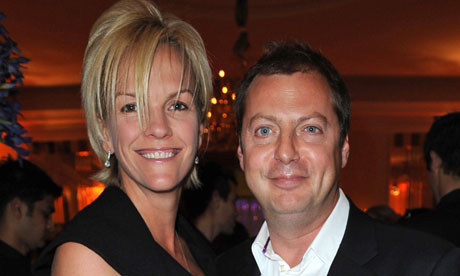
Elisabeth Murdoch and Matthew Freud Power couple: Elisabeth Murdoch and Matthew Freud. Photograph: Richard Young/Rex Features Twelve years later, in the summer of 2008, David Cameron was transported in a private plane – laid on by Freud – to the Greek island of Santorini, from where he was ferried to Rupert Murdoch's 184ft yacht the Rosehearty, for an important meeting. The following year, the Tories began to harden a new antipathy to the BBC, floating the freezing of the licence fee and urging the corporation to do "more with less": messages that were in accord with the chippy anti-BBC lecture James Murdoch gave at that year's Edinburgh TV festival. Just over a month later came achingly predictable news: that the Sun was swinging its support behind the Conservatives, and dumping Labour.
By then, the spell cast by the Murdoch empire on politicians of all parties was endlessly reported as if it was the natural order of things. The next year, when the Sun announced its support for the Tories with the headline "Labour's lost it", even the BBC reported the switch as if it were an enshrined part of the British political process, rarely questioning why its reporters were paying so much attention to the whims of one man, or what it said about the fall of our politics that his manoeuvrings were considered so important.
Meanwhile, the so-called Chipping Norton set – the Camerons, Elisabeth Murdoch and Matthew Freud, Brooks and her husband Charlie, Steve Hilton and his wife Rachel Whetstone, Google's head of communications and public policy – was developing into a hardened clique. News International had long since seduced not just politicians, but police officers. In Sunday's deluge of news about Met commissioner Sir Paul Stephenson, one story was strangely overlooked: that according to the New York Times, his links with News International were sufficiently close for him to have "met for meals 18 times with company executives and editors". All told, British politics was blurring into a mulch largely built around policies the Murdochs could endorse, and their company was apparently so gone on its own power that some of its staff obviously thought they were way beyond the law.

The unpopular press

Which brings us to some of the most important questions of all. Even before the hacking scandal decisively broke, how does anyone suppose all of this was this playing with the public? How did ordinary voters feel, watching every broadcast outlet telling them that Murdoch had swapped from Labour to Tory, and implying that the next election was thereby all but decided, as if their own votes counted for precious little? As they heard about Blair's trip to Australia, or Murdoch and Cameron's tete-a-tete in Greece, what did they think? This is not to suggest that millions of people were anywhere near as hostile to the Murdoch empire as hard-bitten lefties, nor that the politics of his newspapers did not chime with those of millions and millions of people: but rather to point out that if politicians have long gnashed their teeth about "disconnection" and the decline of public trust, the fact that they have increasingly formed a distant, pampered elite – with the Murdochs at its centre – must surely provide some of the explanation.
Right now, as the arrests and resignations pile up, you wonder how dangerous all this is for the amazingly small collection of people who have such a colossal influence on British public life. Comparisons between the fall of News International and the crisis that beset the banks are currently 10-a-penny, but there is one point of comparison that has not yet been mentioned. Just as the entire banking system was almost brought down by the insidious contagion of bad debt, might an entire establishment be horribly damaged by its equally widespread and just as toxic links to News Corp? Each time Andy Coulson crash-lands in the headlines, David Cameron flinches. When Stephenson resigned thanks to the Met's links with the former NoW staffer Neil Wallis, he made explicit reference to Coulson, and thus defined a whole swath of the next day's headlines, as well as jangling Downing Street nerves even further. Now Assistant Commissioner John Yates has gone – and Boris Johnson remains under fire for the London mayoralty's failure to act on the seemingly unhealthy connections between Wapping and Scotland Yard.
On and on it goes. In every report that followed Brooks's resignation and arrest there were potent images of her in the company of Blair, Cameron and others. Ed Miliband may have largely kept his distance from the Murdochs, but there are plenty of senior Labour figures who have been only too happy to pay court, repeatedly. And one other thing worth knowing before the select committee hearing: according to the Independent on Sunday, its chairman, John Whittingdale, has dined with Brooks, met Elisabeth Murdoch on several occasions, and is a good enough friend of Hinton to have been invited to his wedding in 2009 (he didn't go). As you push through the establishment and encounter endless links to News Corp, you start to wonder where it will all end. Questions even started to be asked about whether the prime minister should consider his position. When Stephenson resigned, a friend texted me: "Who's next: the Queen?"
As this whole saga develops, some people's hopes are being raised into the stratosphere. Undoubtedly, it has been great to see a Labour leader so confidently end his party's demeaning relationship with Murdoch, and widen the argument into a discussion about wider irresponsibility at the top and the dangers of large concentrations of power. Yes, we now have the best hope in generations of convincing laws on media ownership. There is a good chance that if Murdoch's shadow recedes, politicians will extend the national debate into at least some of the areas that have been shut off for far too long.
But beware one thing in particular. After the fall of the banks and the scandal of MPs' expenses, the events of the last two weeks are less likely to result in a gleaming new dawn than a deepening of a deadened public scepticism about Britain's elites, and our politicians in particular. We've heard a lot about Watergate lately: it's worth bearing in mind as the full extent of the Nixon administration's transgressions became clear, the main result was not a massed drive to get politics working again, but a drastic hardening of the public cynicism that had initially taken root thanks to the Vietnam war. In 1964, three-quarters of Americans believed the government in Washington could be trusted to do the right thing; in 1974, it was just over a third. Eventually, politics was revived not thanks to the Democrats, but Ronald Reagan and the populist New Right.
In other words, you could be forgiven for looking beyond the hacking scandal and asking a sobering question: rather than marking the point at which Westminster starts to make some kind of recovery and politicians are entrusted to clean things up, might it actually push us into a deadening stand-off between most of those at the top, and a public who now simply trust no one at all?
The Sunday before last, Elisabeth Murdoch was allegedly heard claiming that her brother James and Brooks had "fucked the company". Here's my fear: that as the revelations extend into the distance, they may have done the self-same thing to our politics and public life.

Monday, 18 July 2011

Religion and the search for meaning

Carl Jung, part 8:

Jung thought psychology could offer a language for grappling with moral ambiguities in an age of spiritual crisis
  • Jung Nietzsche
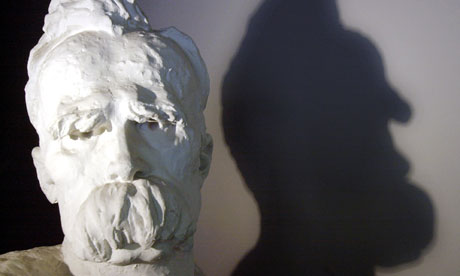
    Friedrich Nietzsche: 'We godless anti-metaphysicians still take our fire… from the flame lit by a faith that is thousands of years old.' Photograph: Jens Meyer/AP
    In 1959, two years before his death, Jung was interviewed for the BBC television programme Face to Face. The presenter, John Freeman, asked the elderly sage if he now believed in God. "Now?" Jung replied, paused and smiled. "Difficult to answer. I know. I don't need to believe, I know." What did he mean? Perhaps several things. He had spent much of the second half of his life exploring what it is to live during a period of spiritual crisis. It is manifest in the widespread search for meaning – a peculiar characteristic of the modern age: our medieval and ancient forebears showed few signs of it, if anything suffering from an excess of meaning. The crisis stems from the cultural convulsion triggered by the decline of religion in Europe. "Are we not plunging continually," Nietzsche has the "madman" ask when he announces the death of God. "Is not the greatness of this deed too great for us?" Jung read Nietzsche and agreed that it was. The slaughter of two world wars and, as if that were not enough, the subsequent proliferation of nuclear weaponry were signs of a civilisation swept along by unconscious tides that religion, like a network of dykes, once helped contain. "A secret unrest gnaws at the roots of our being," he wrote, an unrest that yearns for the divine. Nietzsche agreed that God still existed as a psychic reality too: "We godless anti-metaphysicians still take our fire … from the flame lit by a faith that is thousands of years old." And now the flame is out of control. The sense of threat – real and imagined – that Jung witnessed during his lifetime has not lessened. Ecologists such as James Lovelock now predict that the planet itself has turned against us. Or think of the war games that power an online gaming industry worth £45bn and counting. Why do so many spend so much indulging murderous fantasies? You could also point to the proliferation of new age spiritualities that take on increasingly fantastical forms. One that interested Jung was UFOs: the longing for aliens – we are without God but not without cosmic companions – coupled to tales of being "chosen" for abduction, are indicative of mass spiritual hunger. Or you might ask why a key characteristic of western culture is widespread overwork. Like the economist John Maynard Keynes, Jung wondered whether modern individuals are trying to atone for an ill-defined sense of moral failure: we are no longer sure what makes something valuable, bar an arbitrary designation of financial worth, and this transforms the humdrum need for money into a kind of worship of money. But if the world has rejected God, those who remain religious are, in part, to blame. They have suffered a loss of confidence too, Jung suggests. The powerful, fearful experience of the numinous that speaks of the mystery of life has been traded in for a variety of substitutes that no longer speak to the depths of our humanity or serve our spiritual yearning. Again, this shift is variously manifest. Theologians, for instance, will often feel more comfortable speaking of religious matters in the worldly language of the social sciences. Christians will tell you that when Jesus spoke of the kingdom of God he was really conveying a practical political vision. Or they might reduce the symbols of faith to historical events: it is as if someone with a camera outside Jerusalem, on that Sunday in 33AD, could have caught the resurrection on film. It's a process that empties faith of significance because it turns symbols into signs: symbols transmit an immediate experience that addresses the soul, whereas signs just point to facts. "We simply do not understand any more what is meant by the paradoxes contained in dogma; and the more external our understanding of them becomes the more we are affronted by their irrationality." It is perhaps this craving for immediate experience that drives the highly emotional forms of religion growing so fast in the contemporary world, though Jung would have discerned a sentimentality in them that again simplifies humankind's moral ambiguities and spiritual paradoxes. He did not believe that authentic religiosity was expressed in these peak experiences. Rather he advised people to turn towards their fears, much as the mystics welcomed the dark night of the soul. This shadow is experienced as a foe, but it is really a friend because it contains clues as to what the individual lacks, rejects and distrusts. "What our age thinks of as the 'shadow' and inferior part of the psyche contains more than something merely negative," he writes in The Undiscovered Self, an essay published in 1957. "They are potentialities of the greatest dynamism." That dynamism works by way of compensation. It aims to rebalance what has become lopsided. Hence, if at a conscious level the scientific has eclipsed the theological, the material the valuable, the emotive the spiritual, then the forces that hide in the unconscious will ineluctably make themselves felt once more. It will seem chaotic and quite possibly be destructive. But the passion also contains a prophetic voice calling humanity back to life in all its fullness. Jung is often criticised by religious thinkers for his poor theology and perennial philosophy. They are often correct, but they can also miss the main point. Jung was clear that his analytical psychology was not a new religion, neither was he a guru. "Psychology is concerned with the act of seeing and not with the construction of new religious truths," he wrote. So its role is to provide a language for grappling with what's at stake. "Since the stars have fallen from heaven and our highest symbols have paled, a secret life holds sway in the unconscious. That is why we have a psychology today, and why we speak of the unconscious. All this would be quite superfluous in an age or culture that possessed symbols." Symbols do die. "Why have the antique gods lost their prestige and their effect upon human souls? It was because the Olympic gods had served their time and a new mystery began: God became man." Which raises the question of whether the Christian dispensation has now served its time too and we await a new mystery. Perhaps we do live on the verge of a new age, of another transformation of humanity.

Why are we afraid of male sexuality?


We may have gone a long way towards liberating women, but male desire is increasingly seen as a problem
  • John Major
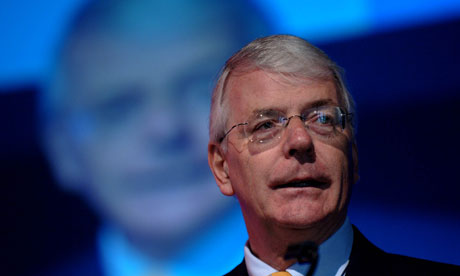
    While older women are now widely eroticised, male equivalents such as John Major are attacked as 'old lechers'. Photograph: Martin Godwin for the Guardian
    Is there anything good to be said about male sexuality? That might seem a daft question. Apparently it brings a lot of pleasure and excitement to the lives of men and women alike, it's inspired some of the greatest art, music and literature through the ages and has played a fairly substantial role in sustaining our species and populating the planet. Nonetheless you'll need to search very, very hard to find any positive appraisal of male heterosexuality. Since the era of the permissive society and the mainstreaming of modern feminism, western society has gone a long way towards liberating women's sexuality. Younger women have, to an unprecedented extent, been encouraged to believe they can be as sexual as they like and to experience and express their desires as they wish. Even the age-old proscriptions on female promiscuity have been largely broken down, exemplified by the glorious flowering of the SlutWalk movement. Simultaneously, and perhaps not coincidentally, male sexuality has been increasingly seen as a problem. You can hear it in the gentle, dismissive mockery that says men are simple creatures who "only want one thing" or, at the extreme, outright vilification. The male gaze threatens, male desire is aggressive. Our primal instincts are pathologised with the jargon of gender studies. Righteous and necessary efforts to reduce sexual crimes have had the unwelcome effect of teaching generations of men that our sexuality can be dangerous and frightening. Don't believe me? Look back at the Bailey review into the early sexualisation of children, and the surrounding media hoo-ha. Leaving aside any concerns about the veracity and accuracy of the report itself (and I have plenty myself) it is striking that acres of print were devoted to the impacts of these social trends on girls, their self-esteem and body image; their developing sexuality; their safety and security. Barely a word was spoken about boys, beyond fears that they are being turned into beasts. Again and again the message came out: girls have problems. Boys are problems. And yet does anyone doubt that there should be concerns about how easy access to porn impacts upon boys' sexual development, their self-esteem, their body image or performance anxieties? It's not as if young men bask in perfect mental health and happiness – young men commit suicide at nearly four times the rate of young women, and sex and relationships rank high on their list of concerns. At the other end of the age range, sexually active older women are now widely eroticised (albeit often with a rather misogynistic undertone) as "cougars" or (forgive me) "Milfs" while their male equivalents are disparaged as dirty old men. Observer columnist Viv Groskop recently went further, opining about any older man who has sex outside marriage, even the mild-mannered old janitor John Major, saying "Unfortunately it's not against the law to be an old lecher. Maybe it should be. Or at the very least you shouldn't be rewarded with the highest office in the land." Perhaps the greatest concern for men and women alike should be the way male sexuality and sexual expressiveness balances on a narrow tightrope of acceptability. One step off the wire and you tumble into the realm of perversion. As feminist blogger Clarisse Thorn noted last year, any man who hits on a woman and gets it wrong risks being branded a "creep" – sometimes deservedly so, of course, but often for no greater sin than being insufficiently attractive or socially skilled, or having misread a perceived signal of invitation. I've never heard of a woman being stigmatised or disparaged for expressing an attraction to big men, rough men, geeky men or whatever. A man who expresses similar desires for women who don't conform to standard norms of beauty is a perv, a fetishist, a weirdo. All of these prejudices are rehearsed and reiterated by men and women alike, they reside in the intangible web of social norms, conventions and culture, but they can and must be challenged and changed. If we can begin to openly and joyously celebrate the positives to male sexuality, it might become easier for men to be happy and confident sexual partners, and in turn become better lovers, and sometimes better people. Male sexuality is no less diverse, complex and wonderful than women's or, for that matter, no more base, coarse and animalistic. Sure, most men might be slightly more likely to let our gaze linger on eye-catching curves, and slightly less likely to giggle about our lovers' proclivities with our friends, but in the grand picture women and men are surprisingly similar, in this respect as in so many others. Women have been entirely justified in asking that we blokes respect their rights, autonomy and wishes, that we respect them as sexual beings. It shouldn't be too much to ask for a little of the same in return.

How to wipe out Islamic terror


Subramanian Swamy | Saturday, July 16, 2011in the DNA


The terrorist blast in Mumbai on July 13, 2011, requires decisive soul-searching by the Hindus of India. Hindus cannot accept to be killed in this halal fashion, continuously bleeding every day till the nation finally collapses. Terrorism I define here as the illegal use of force to overawe the civilian population to make it do or not do an act against its will and well-being.
Islamic terrorism is India’s number one problem of national security. About this there will be no doubt after 2012. By that year, I expect a Taliban takeover in Pakistan and the Americans to flee Afghanistan. Then, Islam will confront Hinduism to “complete unfinished business”. Already the successor to Osama bin Laden as al-Qaeda leader has declared that India is the priority target for that terrorist organisation and not the USA.
Fanatic Muslims consider Hindu-dominated India “an unfinished chapter of Islamic conquests”. All other countries conquered by Islam 100% converted to Islam within two decades of the Islamic invasion. Undivided India in 1947 was 75% Hindu even after 800 years of brutal Islamic rule. That is jarring for the fanatics.

In one sense, I do not blame the Muslim fanatics for targeting Hindus. I blame Hindus who have taken their individuality permitted in Sanatan Dharma to the extreme. Millions of Hindus can assemble without state patronage for the Kumbh Mela, completely self-organised, but they all leave for home oblivious of the targeting of Hindus in Kashmir, Mau, Melvisharam and Malappuram and do not lift their little finger to help organise Hindus. If half the Hindus voted together, rising above caste and language, a genuine Hindu party would have a two-thirds majority in Parliament and the assemblies.
The first lesson to be learnt from the recent history of Islamic terrorism against India and for tackling terrorism in India is that the Hindu is the target and that Muslims of India are being programmed by a slow reactive process to become radical and thus slide into suicide against Hindus. It is to undermine the Hindu psyche and create the fear of civil war that terror attacks are organised.
Hindus must collectively respond as Hindus against the terrorist and not feel individually isolated or, worse, be complacent because he or she is not personally affected. If one Hindu dies merely because he or she was a Hindu, then a bit of every Hindu also dies. This is an essential mental attitude, a necessary part of a virat (committed) Hindu.
We need a collective mindset as Hindus to stand against the Islamic terrorist. The Muslims of India can join us if they genuinely feel for the Hindu. That they do I will not believe unless they acknowledge with pride that though they may be Muslims, their ancestors were Hindus. If any Muslim acknowledges his or her Hindu legacy, then we Hindus can accept him or her as a part of the Brihad Hindu Samaj (greater Hindu society) which is Hindustan. India that is Bharat that is Hindustan is a nation of Hindus and others whose ancestors were Hindus. Others, who refuse to acknowledge this, or those foreigners who become Indian citizens by registration, can remain in India but should not have voting rights (which means they cannot be elected representatives).
Any policy to combat terrorism must begin with requiring each and every Hindu becoming a virat Hindu. For this, one must have a Hindu mindset that recognises that there is vyaktigat charitra (personal character) and rashtriya charitra (national character). For example, Manmohan Singh has high personal character, but by being a rubber stamp of a semi-literate Sonia Gandhi and waffling on all national issues, he has proved that he has no rashtriya charitra.
The second lesson for combating terrorism is that we must never capitulate or concede any demand, as we did in 1989 (freeing five terrorists in exchange for Mufti Mohammed Sayeed’s daughter Rubaiya) and in 1999, freeing three terrorists after the hijack of Indian Airlines flight IC-814.
The third lesson is that whatever and however small the terrorist incident, the nation must retaliate massively. For example, when the Ayodhya temple was sought to be attacked, we should have retaliated by re-building the Ram temple at the site.
According to bleeding heart liberals, terrorists are born or bred because of illiteracy, poverty, oppression, and discrimination. They argue that instead of eliminating them, the root cause of these four disabilities in society should be removed. This is rubbish. Osama bin laden was a billionaire. In the failed Times Square episode, failed terrorist Shahzad was from a highly placed family in Pakistan and had an MBA from a reputed US university.
It is also a ridiculous idea that terrorists cannot be deterred because they are irrational and willing to die. Terrorist masterminds have political goals and a method in their madness. An effective strategy to deter terrorism is to defeat those political goals and to rubbish them by counter-terrorist action.Thus, I advocate the following strategy to negate the political goals of Islamic terrorism in India.
Goal 1: Overawe India on Kashmir.
Strategy: Remove Article 370 and resettle ex-servicemen in the valley. Create Panun Kashmir for the Hindu Pandit community. Look for or create an opportunity to take over PoK. If Pakistan continues to back terrorists, assist the Baluchis and Sindhis to get their independence.

Goal 2: Blast temples, kill Hindu devotees.
Strategy: Remove the masjid in Kashi Vishwanath temple and the 300 masjids at other temple sites.
Goal 3: Turn India into Darul Islam.
Strategy: Implement the uniform civil code, make learning of Sanskrit and singing of Vande Mataram mandatory, and declare India a Hindu Rashtra in which non-Hindus can vote only if they proudly acknowledge that their ancestors were Hindus. Rename India Hindustan as a nation of Hindus and those whose ancestors were Hindus.
Goal 4: Change India’s demography by illegal immigration, conversion, and refusal to adopt family planning.
Strategy: Enact a national law prohibiting conversion from Hinduism to any other religion. Re-conversion will not be banned. Declare that caste is not based on birth but on code or discipline. Welcome non-Hindus to re-convert to the caste of their choice provided they adhere to the code of discipline. Annex land from Bangladesh in proportion to the illegal migrants from that country staying in India. At present, the northern third from Sylhet to Khulna can be annexed to re-settle illegal migrants.
Goal 5: Denigrate Hinduism through vulgar writings and preaching in mosques, madrassas, and churches to create loss of self-respect amongst Hindus and make them fit for capitulation.
Strategy: Propagate the development of a Hindu mindset.
India can solve its terrorist problem within five years by such a deterrent strategy, but for that we have to learn the four lessons outlined above, and have a Hindu mindset to take bold, risky, and hard decisions to defend the nation. If the Jews could be transformed from lambs walking meekly to the gas chambers to fiery lions in just 10 years, it should not be difficult for Hindus in much better circumstances (after all we are 83% of India), to do so in five years.
Guru Gobind Singh showed us how just five fearless persons under spiritual guidance can transform a society. Even if half the Hindu voters are persuaded to collectively vote as Hindus, and for a party sincerely committed to a Hindu agenda, then we can forge an instrument for change. And that is the bottom line in the strategy to deter terrorism in a democratic Hindustan at this moment of truth.
The writer is president of the Janata Party, a former Union minister, and a professor of economics.

Saturday, 16 July 2011

The man who proved that everyone is good at maths

By travelling all the way to Madagascar, the French academic Marc Chemillier has shown that humans have remarkable innate skills with numbers. Alex Duval Smith reports
Saturday, 16 July 2011 The Independent

Maths is simple. But to discover this requires travelling to the ends of the earth where an illiterate, chain-smoking fortune teller lives in a room with a double bed and a beehive.
As the sun rises over the hut belonging to Raoke, a 70-year-old witch doctor, a highly pitched din heralds bee rush hour. The insects he keeps shuttle madly in and out through the window.
This bizarre setting, near nowhere in the harsh cactus savannah of southern Madagascar, is where a leading French academic, Marc Chemillier, has achieved an extraordinary pairing of modern science and illiterate intuition.
In his book, Les Mathématiques Naturelles, the director of studies at EHESS (School for Advanced Studies in Social Sciences) argues that mathematics is not only simple, it is "rooted in human, sensorial intuition". And he believes that Madagascar's population, which remains relatively untouched by outside influences, can help him to prove this.
Mr Chemillier argues that children should be encouraged to do maths before they learn to read and write. "There is a strong link between counting and the number of fingers on our hands. Maths becomes complicated only when you abandon basic measures in nature, like the foot or the inch, or even the acre, which is the area that two bulls can plough in a day."
To make his point, Mr Chemillier chose to charge up his laptop computer, leave Paris and do the rounds of fortune tellers on the Indian Ocean island because its uninfluenced natural biodiversity also extends to its human population. Divinatory geomancy – reading random patterns, or sikidy to use the local word – is what Raoke does, when not smoking cigarettes rolled with paper from a school exercise book.
With a low table covered in pieces of wood – each of which has a particular medicinal virtue – Raoke sits on his straw mat and chants as he runs his fingers through a bag of shiny, dark brown tree seeds. "There were about 600 seeds in the bag to begin with but I have lost a few," he says. "They come from the fane tree and were selected for me many years ago. The fane from the valley of Tsivoanino produces some seeds that lie and others that tell the truth so it is very important to test each seed. I paid a specialist to do that," said the father of six.
Raoke pours a random number of seeds on to his mat, then picks them up singly or in twos and lays them in a grid from right to left. Each horizontal gridline has a name – son, livestock, woman or enemy – and each vertical one has a name, too: chief, zebu (cattle), brother and earth. Whether one or two seeds lie at the intersection of two gridlines determines the subject's fortune and informs Raoke as to the cure required, and its price. From the selection of wood pieces on his table, Raoke can mix concoctions to cure ailments, banish evil spirits and restore friendships.
A basic session with the seeds costs 10,000 ariary (£3), then a price is discussed for the cure. It seems there is nothing Raoke cannot achieve for the top price of one or two zebus – Malagasy beef cattle that cost about £300 each – though some remedies are available for the price of a sheep. "A white man came from Réunion with a stomach ailment that the hospitals in France could not cure. I gave him a powder to drink in a liquid. He vomited and then he was cured," said Raoke.
Given the thousands of plant species in Madagascar that are still undiscovered by mainstream medicine, it is entirely possible that Raoke holds the key to several miracle cures. But Mr Chemillier is not interested in the pharmacopaeic aspect of the fortune teller's work.
"Raoke is an expert in a reflexive view of maths of which we have lost sight in the West," says Mr Chemillier. "Even armed with my computer program, I do not fully comprehend Raoke's capacities for mental arithmetic. He can produce 65,536 grids with his seeds – I have them all in my computer now – but we still need to do more work to understand his mental capacity for obtaining the combinations of single seeds and pairs."
The way in which he poses questions over the seeds requires the same faculties for mental speculation as might be displayed by a winner of the Fields Medal, which is the top award any mathematician can aspire to, said Mr Chemillier.
Over the years, Mr Chemillier has earned respect from Raoke and other Malagasy fortune tellers. "Initially they thought France had sent me to steal their work in an attempt to become the world's most powerful fortune teller. But once I was able to share grids with them that had been through my computer program, we established a relationship of trust," says Mr Chemillier.
Raoke says God shows him how to position the seeds. He does not understand why "Monsieur Marc", and now this other visiting white person, keeps asking him why he lays the seeds in a certain way. Yet it is clear from a stack of grimy copybooks he keeps under his bed that if indeed God is a mathematician dictating to Raoke, then the Almighty keeps him busy. When not consulting clients, the diminutive fortune teller spends hours with his seeds, laying them in different formations and copying the dots down in pencil. Those grids have value and Raoke sells them to other fortune tellers.
Seeing that pages of the copybooks are being sacrificed to his roll-ups, I offer Raoke a packet of cigarette papers which he accepts with delight, having never seen them before. He buys his tobacco leaf in long plaits from the market. So I offer him a green plastic pouch of Golden Virginia. Raoke cannot read but he recognises the word "danger", written in red at the start of the government health warning. He drops the packet to the floor in shock and disgust.

Friday, 15 July 2011

Return of the Gold Standard as world order unravels


As the twin pillars of international monetary system threaten to come tumbling down in unison, gold has reclaimed its ancient status as the anchor of stability. The spot price surged to an all-time high of $1,594 an ounce in London, lifting silver to $39 in its train. 

By Ambrose Evans Pritchard in The Telegraph 15/7/2011

On one side of the Atlantic, the eurozone debt crisis has spread to the countries that may be too big to save - Spain and Italy - though RBS thinks a €3.5 trillion rescue fund would ensure survival of Europe's currency union.
On the other side, the recovery has sputtered out and the printing presses are being oiled again. Brinkmanship between the Congress and the White House over the US debt ceiling has compelled Moody's to warn of a "very small but rising risk" that the world's paramount power may default within two weeks. "The unthinkable is now thinkable," said Ross Norman, director of thebulliondesk.com.
Fed chair Ben Bernanke confessed to Congress that growth has failed to gain traction. "Deflationary risks might re-emerge, implying a need for additional policy support," he said.
The bar to QE3 - yet more bond purchases - is even lower than markets had thought. The new intake of hard-money men on the voting committee has not shifted Fed thinking, despite global anger at dollar debasement under QE2.
Fuelling the blaze, the emerging powers of Asia are almost all running uber-loose monetary policies. Most have negative real interest rates that push citizens out of bank accounts and into gold, or property. China is an arch-inflater. Prices are rising at 6.4pc, yet the one-year deposit rate is just 3.5pc. India's central bank is far behind the curve.
"It is very scary: the flight to gold is accelerating at a faster and faster speed," said Peter Hambro, chairman of Britain's biggest pure gold listing Petropavlovsk.
"One of the big US banks texted me today to say that if QE3 actually happens, we could see gold at $5,000 and silver at $1,000. I feel terribly sorry for anybody on fixed incomes tied to a fiat currency because they are not going to be able to buy things with that paper money."
China, Russia, Brazil, India, the Mid-East petro-powers have diversified their $7 trillion reserves into euros over the last decade to limit dollar exposure. As Europe's monetary union itself faces an existential crisis, there is no other safe-haven currency able to absorb the flows. The Swiss franc, Canada's loonie, the Aussie, and Korea's won are too small.
"There is no depth of market in these other currencies, so gold is the obvious play," said Neil Mellor from BNY Mellon. Western central banks (though not the US, Germany, or Italy) sold much of their gold at the depths of the bear market a decade ago. The Bank of England wins the booby prize for selling into the bottom at €254 an ounce on Gordon Brown's orders in 1999. But Russia, China, India, the Gulf states, the Philippines, and Kazakhstan have been buying.
China is coy, revealing purchases with a long delay. It has admitted to doubling its gold reserves to 1,054 tonnes or $54bn. This is just a tiny sliver of its $3.2 trillion reserves. China's Chamber of Commerce said this should be raised eightfold to 8,000 tonnes.
Xia Bin, an adviser to China's central bank, said in June that the country's reserve strategy needs an "urgent" overhaul. Instead of buying paper IOU's from a prostrate West, China should invest in strategic assets and accumulate gold by "buying the dips".
Step by step, the world is edging towards a revived Gold Standard as it becomes clearer that Japan and the West have reached debt saturation. World Bank chief Robert Zoellick said it was time to "consider employing gold as an international reference point." The Swiss parliament is to hold hearings on a parallel "Gold Franc". Utah has recognised gold as legal tender for tax payments.
A new Gold Standard would probably be based on a variant of the 'Bancor' proposed by Keynes in the late 1940s. This was a basket of 30 commodities intended to be less deflationary than pure gold, which had compounded in the Great Depression. The idea was revived by China's central bank chief Zhou Xiaochuan two years ago as a way of curbing the "credit-based" excess.
Mr Bernanke himself was grilled by Congress this week on the role of gold. Why do people by gold? "As protection against of what we call tail risks: really, really bad outcomes," he replied.


The great Murdoch conspiracy

Peter Oborne in The Telegraph on 15 July 2011

When I went to work in the House of Commons as a lobby correspondent nearly 20 years ago, I assumed that the British constitution worked along the lines we had been taught in textbooks at school and university. Which is to say: Britain was a representative democracy; the police were reasonably honest; and the country was governed under the rule of law. I naively expected MPs to be honest and driven by a sense of duty, and ministers to be public-spirited.
During my first few years at Westminster, I came to appreciate that most of my assumptions were hardly true. In particular, it became clear that power had seeped away from the Commons, which had lost many of its traditional functions. It rarely held ministers to account, and ministers no longer made their announcements to the House, as Erskine May, the rulebook of Parliament, insisted they should; instead they were leaked out through journalists.
For a number of years I was a part of this alternative system of government. We would be fed information confidentially and behind the scenes, and treated as if we were more important than elected MPs. All this was very flattering – and professionally very useful – but I couldn’t help sensing that something was wrong. It wasn’t just that the media had taken over the function of Parliament, it also meant that the traditional checks and balances no longer operated. Above all, information could be put into the public domain privately and therefore unaccountably.
All newspapers were guilty of being part of this new system, but it was exploited in particular by the Murdoch press. I believe that when Rupert Murdoch arrived on the British scene in the 1960s, he was, on balance, a force for good. The deference that still defined a great deal of political culture was challenged by Mr Murdoch, and better still he took on and defeated the print unions, which had all but destroyed the British newspaper industry in the 1970s. But by the 1990s, Murdoch’s newspapers were starting to abuse their power. The best way of demonstrating this is perhaps by examining the career of Rebekah Brooks, the chief executive of News International who is in such trouble this week. Her professional career is, in a number of ways, a parable for the times we have lived through.
One of the greatest adventuresses of her era, she emerged on the scene when New Labour under Tony Blair was on the verge of power. During this time she was married to Ross Kemp, the EastEnders actor who was one of the most powerful defenders of New Labour. They lived in south London, emphasising the faux-proletarian credentials that were such an important, if misleading, part of the New Labour message.
As New Labour’s star waned, Rebekah Brooks changed course. She ceased to be the cool, metropolitan figure favoured by New Labour. She moved to Oxfordshire, took up riding and became the central figure in the now notorious Chipping Norton set. Meanwhile, her titles changed their allegiance. The political editor of the Sun might have been deemed to lack the impeccable social credentials demanded by an incoming Tory government. He was replaced by an Old Marlburian.
The identical transfiguration took place at The Times, where Phil Webster, one of the few remaining journalists in Fleet Street who has come up the hard way, was removed. Webster, who had been a favourite of the Blair government, found himself replaced as political editor by Roly Watson, who had been a member of Pop, the exclusive club at Eton, at the same time as David Cameron. A pattern was clear. Rebekah Brooks (like all the News International insiders) attached herself like glue to whichever political party held the ascendancy.
During the Blair years, News International executives, Mrs Brooks among them, would attend the annual Labour Party conference, but they were scarcely treated as journalists. When Tony Blair gave his leadership speech, they would be awarded seats just behind the cabinet, as if they had been co-opted into the Government. Arguably they had. The first telephone call that Blair made after he had escaped from the conference hall was routinely to Rupert Murdoch himself. And when ministers who had been favoured by the Murdoch press left office, they would be rewarded. David Blunkett and Alastair Campbell were both given columns on News International publications.
A version of this process repeated itself when Gordon Brown became prime minister, with Rebekah Brooks attending Sarah Brown’s cringe-making “pyjama party” at Chequers. It may not suit Mr Brown, who made such a passionate speech in the Commons yesterday, to remember it but he, too, was part of the Murdoch system of government. And so was David Cameron, who last October threw a party for his closest friends to celebrate his 44th birthday. Reportedly everyone present had known the Prime Minister all his adult life – with the exception of Mrs Brooks.
There was a very sinister element to these relationships. At exactly the same time that Mrs Brooks was getting on so famously with the most powerful men and women in Britain, the employees of her newspapers (as we now know) were listening in to their voicemails and illicitly gaining access to deeply personal information.
One News of the World journalist once told me how this information would be gathered into dossiers; sometimes these dossiers were published, sometimes not. The knowledge that News International held such destructive power must have been at the back of everyone’s minds at the apparently cheerful social events where the company’s executives mingled with their client politicians.
Let’s take the case of Tessa Jowell. When she was Culture Secretary five years ago, News International hacked into her phone and spied on her in other ways. What was going on amounted to industrial espionage, since Ms Jowell was then charged with the regulation and supervision of News International, and the media group can scarcely have avoided discovering commercially sensitive information, even though its primary purpose was to discover details about Ms Jowell’s private life.
Yet consider this: Ms Jowell was informed of this intrusion at the time and said nothing. More curious still, she retained her friendship with Rebekah Brooks and other News International figures. Indeed, Ms Jowell appears to have been present at the Cotswolds party thrown by Matthew Freud, son-in-law of Rupert Murdoch, only 10 days ago.
James Murdoch, heir apparent to the Murdoch empire, was also present. These parties were, in effect, a conspiracy between the British media and the political class against the country as a whole. They were the men and women who governed Britain and decided who was up and who was out. Government policy was influenced and sometimes created. I doubt very much whether Britain would have invaded Iraq but for the foolhardy support of the Murdoch press.
The effect on government policy was wretched. Decisions were determined by consideration of the following day’s headlines rather than sound analysis. Furthermore, private favours were dispensed; Blair when prime minister spoke to his Italian counterpart Silvio Berlusconi about one of Murdoch’s business deals in Italy. Of course it was all kept secret, though details did sometimes leak out. All recent prime ministers have insisted that their meetings with Murdoch were confidential and did not need to be disclosed, as if they were somehow private affairs. Mercifully, Cameron – who has partially emerged from the sewer thanks to his Commons statement – has put an end to this concealment.
It has taken the horror of the revelations concerning the targeting by the Murdoch empire of the family of Milly Dowler, terrorist victims and even relatives of British war dead to bring this corrupt, complicit, and conspiratorial system of government to light.
The process of exposure has taken far too long, but there is at last hope. Two years ago, Rebekah Brooks contemptuously turned down an invitation to give evidence to MPs about how she operated. Next week, Rupert Murdoch, his son James and the reluctant Brooks will all be dragged before them.
The system of collaboration between an over-mighty press and timorous politicians is being exposed. There is hope that we can return to a more decent system of government; that Parliament can reassert its rights, and that ministers will make their decisions for the right reasons and not simply to ingratiate themselves with Murdoch and his newspaper editors. Perhaps the sickness that has demeaned and distorted British politics for the last two decades is at last being challenged and confronted.