Search This Blog

Tuesday, 12 July 2011

This media is corrupt – we need a Hippocratic oath for journalists


Our job is to hold power to account. Instead, most of the profession simply ventriloquises the concerns of the elite
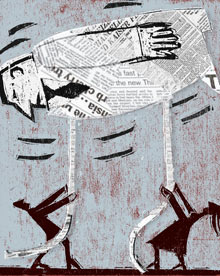
  • Is Murdoch now finished in the UK? As the pursuit of Gordon Brown by the Sunday Times and the Sun blows the hacking scandal into new corners of the old man's empire, this story begins to feel like the crumbling of the Berlin Wall. The naked attempt to destroy Brown by any means, including hacking the medical files of his sick baby son, means that there is no obvious limit to the story's ramifications. Daniel Pudles 1207 Illustration by Daniel Pudles The scandal radically changes public perceptions of how politics works, the danger corporate power presents to democracy, and the extent to which it has compromised and corrupted the Metropolitan police, who have now been dragged in so deep they are beginning to look like Murdoch's private army. It has electrified a dozy parliament and subjected the least accountable and most corrupt profession in Britain – journalism – to belated public scrutiny. The cracks are appearing in the most unexpected places. Look at the remarkable admission by the rightwing columnist Janet Daley in this week's Sunday Telegraph. "British political journalism is basically a club to which politicians and journalists both belong," she wrote. "It is this familiarity, this intimacy, this set of shared assumptions … which is the real corruptor of political life. The self-limiting spectrum of what can and cannot be said … the self-reinforcing cowardice which takes for granted that certain vested interests are too powerful to be worth confronting. All of these things are constant dangers in the political life of any democracy." Most national journalists are embedded, immersed in the society, beliefs and culture of the people they are meant to hold to account. They are fascinated by power struggles among the elite but have little interest in the conflict between the elite and those they dominate. They celebrate those with agency and ignore those without. But this is just part of the problem. Daley stopped short of naming the most persuasive force: the interests of the owner and the corporate class to which he belongs. The proprietor appoints editors in his own image – who impress their views on their staff. Murdoch's editors, like those who work for the other proprietors, insist that they think and act independently. It's a lie exposed by the concurrence of their views (did all 247 News Corp editors just happen to support the invasion of Iraq?), and blown out of the water by Andrew Neil's explosive testimony in 2008 before the Lords select committee on communications. The papers cannot announce that their purpose is to ventriloquise the concerns of multimillionaires; they must present themselves as the voice of the people. The Sun, the Mail and the Express claim to represent the interests of the working man and woman. These interests turn out to be identical to those of the men who own the papers. So the rightwing papers run endless exposures of benefit cheats, yet say scarcely a word about the corporate tax cheats. They savage the trade unions and excoriate the BBC. They lambast the regulations that restrain corporate power. They school us in the extrinsic values – the worship of power, money, image and fame – which advertisers love but which make this a shallower, more selfish country. Most of them deceive their readers about the causes of climate change. These are not the obsessions of working people. They are the obsessions thrust upon them by the multimillionaires who own these papers. The corporate media is a gigantic astroturfing operation: a fake grassroots crusade serving elite interests. In this respect the media companies resemble the Tea Party movement, which claims to be a spontaneous rising of blue-collar Americans against the elite but was founded with the help of the billionaire Koch brothers and promoted by Murdoch's Fox News. Journalism's primary purpose is to hold power to account. This purpose has been perfectly inverted. Columnists and bloggers are employed as the enforcers of corporate power, denouncing people who criticise its interests, stamping on new ideas, bullying the powerless. The press barons allowed governments occasionally to promote the interests of the poor, but never to hamper the interests of the rich. They also sought to discipline the rest of the media. The BBC, over the last 30 years, became a shadow of the gutsy broadcaster it was, and now treats big business with cringing deference. Every morning at 6.15, the Today programme's business report grants executives the kind of unchallenged access otherwise reserved for God on Thought for the Day. The rest of the programme seeks out controversy and sets up discussions between opponents, but these people are not confronted by their critics. So what can be done? Because of the peculiar threat they present to democracy there's a case to be made for breaking up all majority interests in media companies, and for a board of governors, appointed perhaps by Commons committee, to act as a counterweight to the shareholders' business interests. But even if that's a workable idea, it's a long way off. For now, the best hope might be to mobilise readers to demand that journalists answer to them, not just their proprietors. One means of doing this is to lobby journalists to commit themselves to a kind of Hippocratic oath. Here's a rough stab at a first draft. I hope others can improve it. Ideally, I'd like to see the National Union of Journalists building on it and encouraging its members to sign. 'Our primary task is to hold power to account. We will prioritise those stories and issues which expose the interests of power. We will be wary of the relationships we form with the rich and powerful, and ensure that we don't become embedded in their society. We will not curry favour with politicians, businesses or other dominant groups by withholding scrutiny of their affairs, or twisting a story to suit their interests. "We will stand up to the interests of the businesses we work for, and the advertisers which fund them. We will never take money for promulgating a particular opinion, and we will resist attempts to oblige us to adopt one. "We will recognise and understand the power we wield and how it originates. We will challenge ourselves and our perception of the world as much as we challenge other people. When we turn out to be wrong, we will say so." I accept that this doesn't directly address the power relations that govern the papers. But it might help journalists to assert a measure of independence, and readers to hold them to it. Just as voters should lobby their MPs to represent them and not just the whips, readers should seek to drag journalists away from the demands of their editors. The oath is one possible tool that could enhance reader power. If you don't like it, suggest a better idea. Something has to change: never again should a half a dozen oligarchs be allowed to dominate and corrupt the life of this country.
Monday, 11 July 2011

Capitalism’s ideological crisis


Just a few years ago, a powerful ideology - the belief in free and unfettered markets - brought the world to the brink of ruin.


Even in its hey-day, from the early 1980s until 2007, American-style deregulated capitalism brought greater material well-being only to the very richest in the richest country of the world. Indeed, over the course of this ideology's 30-year ascendance, most Americans saw their incomes decline or stagnate year after year.


Moreover, output growth in the United States was not economically sustainable. With so much of US national income going to so few, growth could continue only through consumption financed by a mounting pile of debt.


I was among those who hoped that, somehow, the financial crisis would teach Americans (and others) a lesson about the need for greater equality, stronger regulation, and a better balance between the market and government. Alas, that has not been the case. On the contrary, a resurgence of right-wing economics, driven, as always, by ideology and special interests, once again threatens the global economy - or at least the economies of Europe and America, where these ideas continue to flourish.


In the US, this right-wing resurgence, whose adherents evidently seek to repeal the basic laws of math and economics, is threatening to force a default on the national debt. If Congress mandates expenditures that exceed revenues, there will be a deficit, and that deficit has to be financed. Rather than carefully balancing the benefits of each government expenditure programme with the costs of raising taxes to finance those benefits, the right seeks to use a sledgehammer - not allowing the national debt to increase forcesexpenditures to be limited to taxes.


This leaves open the question of which expenditures get priority - and if expenditures to pay interest on the national debt do not, a default is inevitable. Moreover, to cut back expenditures now, in the midst of an ongoing crisis brought on by free-market ideology, would inevitably simply prolong the downturn.


A decade ago, in the midst of an economic boom, the US faced a surplus so large that it threatened to eliminate the national debt. Unaffordable tax cuts and wars, a major recession, and soaring healthcare costs - fuelled in part by the commitment of George W Bush's administration to giving drug companies free rein in setting prices, even with government money at stake - quickly transformed a huge surplus into record peacetime deficits.


The remedies to the US deficit follow immediately from this diagnosis: put America back to work by stimulating the economy; end the mindless wars; rein in military and drug costs; and raise taxes, at least on the very rich. But the right will have none of this, and instead is pushing for even more tax cuts for corporations and the wealthy, together with expenditure cuts in investments and social protection that put the future of the US economy in peril and that shred what remains of the social contract. Meanwhile, the US financial sector has been lobbying hard to free itself of regulations, so that it can return to its previous, disastrously carefree, ways.


But matters are little better in Europe. As Greece and others face crises, the medicine du jour is simply timeworn austerity packages and privatisation, which will merely leave the countries that embrace them poorer and more vulnerable. This medicine failed in East Asia, Latin America and elsewhere, and it will fail in Europe this time around, too. Indeed, it has already failed in Ireland , Latvia , and Greece.


There is an alternative: an economic-growth strategy supported by the EU and the IMF. Growth would restore confidence that Greece could repay its debts, causing interest rates to fall and leaving more fiscal room for further growth-enhancing investments. Growth itself increases tax revenues and reduces the need for social expenditures, such as unemployment benefits. And the confidence that this engenders leads to still further growth.


Regrettably, the financial markets and right-wing economists have gotten the problem exactly backwards: they believe that austerity produces confidence, and that confidence will produce growth. But austerity undermines growth, worsening the government's fiscal position, or at least yielding less improvement than austerity's advocates promise. On both counts, confidence is undermined, and a downward spiral is set in motion.


Do we really need another costly experiment with ideas that have failed repeatedly? We shouldn't, but increasingly it appears that we will have to endure another one nonetheless. A failure of either Europe or the US to return to robust growth would be bad for the global economy. A failure in both would be disastrous - even if the major emerging market countries have attained self-sustaining growth. Unfortunately, unless wiser heads prevail, that is the way the world is heading.


(The author is University Professor at Columbia University and a Nobel laureate in economics)

Why I had to leave The Times

Robert Fisk:

When he worked at The Times, Robert Fisk witnessed the curious working practices of the paper's proprietor, Rupert Murdoch. Despite their jocular exchanges, the writer knew he couldn't stay...
Monday, 11 July 2011 in The Independent
He is a caliph, I suppose, almost of the Middle Eastern variety.
You hear all these awful things about Arab dictators and then, when you meet them, they are charm itself. Hafez al-Assad once held my hand in his for a long time with a paternal smile. Surely he can't be that bad, I almost said to myself – this was long before the 1982 Hama massacres. King Hussein would call me "Sir", along with most other journalists. These potentates, in public, would often joke with their ministers. Mistakes could be forgiven.
The "Hitler Diaries" were Murdoch's own mistake, after refusing to countenance his own "expert's" change of heart over the documents hours before The Times and The Sunday Times began printing them. Months later, I was passing by the paper's London office on my way back to Beirut when the foreign editor, Ivan Barnes, held up the Reuters wire copy from Bonn. "Aha!" he thundered. "The diaries are forgeries!" The West German government had proved that they must have been written long after the Führer's death.
So Barnes dispatched me to editor Charles Douglas-Home's office with the Reuters story and I marched in only to find Charlie entertaining Murdoch. "They say they're forgeries, Charlie," I announced, trying not to glance at Murdoch. But I did when he reacted. "Well, there you go," the mogul reflected with a giggle. "Nothing ventured, nothing gained." Much mirth. The man's insouciance was almost catching. Great Story. It only had one problem. It wasn't true.
Oddly, he never appeared the ogre of evil, darkness and poison that he's been made out to be these past few days. Maybe it's because his editors and sub-editors and reporters repeatedly second-guessed what Murdoch would say. Murdoch was owner of The Times when I covered the blood-soaked Israeli invasion and occupation of Lebanon in 1982. Not a line was removed from my reports, however critical they were of Israel. After the invasion, Douglas-Home and Murdoch were invited by the Israelis to take a military helicopter trip into Lebanon. The Israelis tried to rubbish my reporting; Douglas-Home said he stood up for me. On the flight back to London, Douglas-Home and Murdoch sat together. "I knew Rupert was interested in what I was writing," he told me later. "He sort of waited for me to tell him what it was, although he didn't demand it. I didn't show it to him."
But things changed. Before he was editor, Douglas-Home would write for the Arabic-language Al-Majella magazine, often deeply critical of Israel. Now his Times editorials took an optimistic view of the Israeli invasion. He stated that "there is now no worthy Palestinian to whom the world can talk" and – for heaven's sake – that "perhaps at last the Palestinians on the West Bank and in the Gaza Strip will stop hoping that stage-strutters like Mr Arafat can rescue them miraculously from doing business with the Israelis."
All of which, of course, was official Israeli government policy at the time.
Then, in the spring of 1983, another change. I had, with Douglas-Home's full agreement, spent months investigating the death of seven Palestinian and Lebanese prisoners of the Israelis in Sidon. It was obvious, I concluded, that the men had been murdered – the grave-digger even told me that their corpses had been brought to him, hands tied behind their backs, showing marks of bruising. But now Douglas-Home couldn't see how we would be "justified" in running a report "so long after the event".
In other words, the very system of investigative journalism – of fact-checking and months of interviews – became self-defeating. When we got the facts, too much time had passed to print them. I asked the Israelis if they would carry out a military inquiry and, anxious to show how humanitarian they were, they duly told us there would be an official investigation. The Israeli "inquiry" was, I suspected, a fiction. But it was enough to "justify" publishing my long and detailed report. Once the Israelis could look like good guys, Douglas-Home's concerns evaporated.
When he died, of cancer, it was announced that his deputy, Charles Wilson, would edit the paper. Murdoch said that Wilson was "Charlie's choice" and I thought, so, all well and good – until I was chatting to Charlie's widow and she told me that it was the first time she had heard that Wilson's editorship had been her late husband's decision. We all knew Murdoch had signed up to all manner of guarantees of editorial independence, oversight and promises of goodwill when he bought The Times – and had then fired his first editor, Harold Evans. He would deal with the trade unionists later.
Charles Wilson – who much later became, briefly, the editor of The Independent – was a tough, friendly man who could show great kindness, as well as harshness, to his staff. He was kind to me, too. But once, when I was visiting Wilson in London, Murdoch walked into his office. "Hallo, Robert!" Murdoch greeted me, before holding a jocular conversation with Wilson. And, after he had left, Wilson said to me in a hushed voice: "See how he called you by your first name?" This was laughable. It was like the Assad smile or the King Hussein "Sir". It meant nothing. Murdoch was joking with his ministers and courtiers.
A warning sign. Still in west Beirut, where dozens of Westerners were being kidnapped, I opened The Times to discover that a pro-Israeli writer was claiming on our centre page that all journalists in west Beirut, clearly intimidated by "terrorism", could be regarded only as "bloodsuckers". Was the paper claiming that I, too, was a bloodsucker? In all this time, Murdoch had expressed exclusively pro-Israeli views, and had accepted a "Man of the Year" award from a prominent Jewish-American organisation. The Times editorials became more and more pro-Israeli, their use of the word "terrorist" ever more promiscuous.
The end came for me when I flew to Dubai in 1988 after the USS Vincennes had shot down an Iranian passenger airliner over the Gulf. Within 24 hours, I had spoken to the British air traffic controllers at Dubai, discovered that US ships had routinely been threatening British Airways airliners, and that the crew of the Vincennes appeared to have panicked. The foreign desk told me the report was up for the page-one splash. I warned them that American "leaks" that the IranAir pilot was trying to suicide-crash his aircraft on to the Vincennes were rubbish. They agreed.
Next day, my report appeared with all criticism of the Americans deleted, with all my sources ignored. The Times even carried an editorial suggesting the pilot was indeed a suicider. A subsequent US official report and accounts by US naval officers subsequently proved my dispatch correct. Except that Times readers were not allowed to see it. This was when I first made contact with The Independent. I didn't believe in The Times any more – certainly not in Rupert Murdoch.
Months later, a senior night editor who had been on duty on the night my Vincennes report arrived, recalled in a letter that he had promoted my dispatch as the splash, but that Wilson had said: "There's nothing in it. There's not a fact in it. I wouldn't even run this gibberish." Wilson, the night editor said, called it "bollocks" and "waffle". The night editor's diary for that day finished: "Shambles, chaos on Gulf story. [George] Brock [Wilson's foreign editor] rewrites Fisk."
The good news: a few months later, I was Middle East correspondent for The Independent. The bad news: I don't believe Murdoch personally interfered in any of the above events. He didn't need to. He had turned The Times into a tame, pro-Tory, pro-Israeli paper shorn of all editorial independence. If I hadn't been living in the Middle East, of course, it might have taken me longer to grasp all this.
But I worked in a region where almost every Arab journalist knows the importance of self-censorship – or direct censorship – and where kings and dictators do not need to give orders. They have satraps and ministers and senior police officers – and "democratic" governments – who know their wishes, their likes and dislikes. And they do what they believe their master wants. Of course, they all told me this was not true and went on to assert that their king/president was always right.
These past two weeks, I have been thinking of what it was like to work for Murdoch, what was wrong about it, about the use of power by proxy. For Murdoch could never be blamed. Murdoch was more caliph than ever, no more responsible for an editorial or a "news" story than a president of Syria is for a massacre – the latter would be carried out on the orders of governors who could always be tried or sacked or sent off as adviser to a prime minister – and the leader would invariably anoint his son as his successor. Think of Hafez and Bashar Assad or Hosni and Gamal Mubarak or Rupert and James. In the Middle East, Arab journalists knew what their masters wanted, and helped to create a journalistic desert without the water of freedom, an utterly skewed version of reality. So, too, within the Murdoch empire.
In the sterile world of the Murdochs, new technology was used to deprive the people of their freedom of speech and privacy. In the Arab world, surviving potentates had no problem in appointing tame prime ministers. Nothing ventured, nothing gained.

Sunday, 10 July 2011

The suspects are in charge of the case

John O'Connor:

News International and the Metropolitan Police are looking into corruption at Wapping. But face-saving is their priority
Sunday, 10 July 2011 The Independent
Scotland Yard is facing its worst corruption crisis since the 1970s, when senior police officers were found to be controlling London's pornography industry. The investigation and subsequent purge left many detectives out of a job and in some case serving prison sentences. The gloom that surrounded the Yard in those days is similar to the atmosphere that pervades it today.
Each day reveals more details of misconduct by the press and the police. The investigation is going to be looking for heads to roll, and the higher the rank the better. This extraordinary state of affairs has its roots back in the Eighties, in the days when News International was dependent on the police to protect its new premises in Wapping.
Violent demonstrations occurred each night and the police were able to assist News International in getting its product out on to the streets. This was a complete turnaround for The Times newspaper, which only a decade earlier had launched the huge inquiry into police corruption that shook Scotland Yard to its foundations. News International was now best friends with Scotland Yard, and senior executives and top policemen wined and dined together on a regular basis.
Nobody could see the potential problems of a free lunch. This mutual admiration society worked very well for a time. Information passed freely both ways. The police benefited from undercover operations run by the newspapers, and in return the papers got their exclusive stories. This comfortable arrangement was cemented by regular briefings from Scotland Yard's press bureau to the national press directly and sometimes through the Crime Writers Association.
The culture of police officers mixing with journalists was encouraged, and little thought was given to the potential of misconduct. Crime writers were expected to know lots of police officers, and there was great competition to get the inside story. If only things could have stayed the same.
The News of the World began to pursue a strategy of aggressively targeting celebrities. The use of "the Fake Sheikh", Mazher Mahmood, was very effective, and produced some exclusive exposés on the greed and stupidity of people who should have known better. They were able to obtain confidential information on individuals including criminal records but they were in too much of a hurry to research public records.
Some private detective agencies realised that there was money to be earned from celebrity stories and confidential crime stories. Some of these detective agencies were run by former Metropolitan Police officers who maintained good contacts with serving officers. Some ex-police officers set themselves up as stringers, and provided a conduit for confidential information supplied by officers directly to the press. Once the Rubicon had been crossed, it was comparatively easy for police officers to contravene the Data Protection Act and supply information from the Police National Computer.
Short cuts adopted by the News of the World put them closer to the coalface. The strategy of using several intermediaries was abandoned and they employed private detectives such as Jonathan Rees of Southern Investigations and Glenn Mulcaire. This was clearly cheaper but the drawback was that if the private detectives came unstuck so did those who hired them.
The Department of Professional Standards at Scotland Yard has not been standing idly by. A number of undercover operations were mounted against ex- and serving police officers who were suspected of receiving corrupt payments. Nobody in authority was prepared to recognise the endemic nature of this corruption and each case was dealt with as a stand-alone incident. Much the same attitude was adopted when Glenn Mulcaire and Clive Goodman were convicted of hacking messages of members of the royal family.
At this stage, the number of police officers involved is unknown. News International's attempts to switch the focus of the inquiry onto the police by releasing details of payments to officers raised more questions than answers. The obvious questions are "What about payments to intermediaries?" and "What were the payments for?" Hospitality and gifts must also be probed.
The two organisations that are carrying out the investigations are... the Metropolitan Police and News International, both of whom are the subject of these allegations.
It is with breathtaking cheek that News International announced its own investigation. It is quite clear that getting to the truth is not a goal, its real objective is damage limitation and face-saving. It is quite clear that any number of junior staff will be sacrificed in order the save the skins of the real decision-makers. The News International investigation should be laughed out of court, not that it is ever likely to get there.
The new police investigation is even more curious. Everybody wants to know why the original hacking investigation was curtailed after the convictions of Mulcaire and Goodman. It seems unlikely that this decision was made solely by the police, but it is a possibility, and if so, why?
The suspicion must be that pressure was brought to bear by either News International, the Crown Prosecution Service or a very high-ranking police officer, or perhaps a combination of all three.
The new police investigation into hacking has been running since January 2011 and the police corruption enquiry has only just begun. It seems to me that this is a classic situation whereby an outside police force should be used, under the supervision of the Independent Police Complaints Commission. There is clear precedent for using an outside force, and if the public are to be convinced that this is a fair and unbiased investigation then that should clearly point to using an independent force outside of London.
This is no reflection on the skill, determination or ability of Deputy Assistant Commissioner Sue Akers, but the pressure which killed off the first enquiry might still exist.
The Metropolitan Police had one go at this and fell very short. At risk is the reputation and integrity of the service. It cannot afford to get it wrong again. The problem is that senior officers did not recognise the extent of the corruption and were probably unwilling to upset their new found pals in the media.
They must accept their responsibility for what has happened. It is astonishing that with so many resources being spent on anti-corruption, they could not see it when it was right under their noses.
John O'Connor is former commander of the Flying Squad at Scotland Yard

Transcendental Meditation: Were the hippies right all along?


For years, it has been ridiculed as a 1960s embarrassment. Now Transcendental Meditation is back in a big way. So were those hippies on to something all along?
By Laura Tennant
Sunday, 10 July 2011 The Independent
Remember M-People's 1995 Top 10 hit instructing you to "search for the hero inside yourself"? A decade-and-a-half on, it seems that things have changed – these days, it's not so much a hero as a guru that many of us are hoping to internalise. For strange as it may sound, among those of us who seek to surf the zeitgeist, the most fashionable thinker of 2011 may turn out to be Maharishi Mahesh Yogi, the founder of the Transcendental Meditation movement – and the fact that he passed to a better place in 2008 doesn't appear to have discouraged us one bit.
TM, as its followers call it, is rapidly moving from kooky margin to respectable mainstream thanks largely to a burgeoning body of scientific research which indicates that regular meditators can expect to enjoy striking reductions in heart attack, stroke and early mortality (as much as 47 per cent, according to one study). And the apparent benefits don't stop there: according k to a pilot study just published in the US journal Military Medicine, veterans of the Iraq and Afghanistan wars showed a 50 per cent reduction in their symptoms of post-traumatic stress disorder after eight weeks of TM.
Meanwhile, educational establishments which introduce a "quiet time programme" – as did Visitacion Valley Middle School in San Francisco – report drops in fights and suspensions, increased attendance and improvements in exam results. In this country, the Maharishi School in Ormskirk, Lancashire, gets glowing reports from Ofsted and achieves exceptional academic results.
An estimated four million people now practise TM globally – 20 minutes twice daily, as per the Maharishi's prescription – many of them over the course of many decades, and there are some famous, and rather surprising, names on the list. Clint Eastwood, for example, has been doing it for 40 years, a fact he vouchsafed via video link at a fund-raising dinner for the David Lynch Foundation, an organisation set up by the film-maker to teach TM to school children, soldiers suffering post-traumatic stress, the homeless and convicted prisoners. Other celebrity adherents include Paul McCartney, Russell Brand, Martin Scorsese, Ringo Starr, Mary Tyler Moore, Laura Dern and Moby.
TM reaches far into the rational and sceptical world, too; the American philosopher Daniel Dennett does it, as does Dr Jonathan Rowson, head of the Social Brain project at the Royal Society for the Encouragement of Arts, Manufactures and Commerce (RSA) and a chess grandmaster (more from them later). Now a psychiatrist with 30 years' clinical experience, Dr Norman Rosenthal has written a book, Transcendence: Healing and Transformation through Transcendental Meditation, which gathers all the available evidence for TM and urges healthcare professionals to offer it to patients suffering from mental illnesses ranging from mild depression to bipolar disorder.
While the research on the health benefits of TM is fascinating, there's another, more compelling, reason why meditation is in the air just now. Done consistently, it seems to offer some sort of corrective to modernity, a respite from anxiety and the ability to really, truly relax, without chemical assistance; a break from our constant, restless and often doomed aspirations to be thinner, richer and more popular on Facebook; the welcome discovery that happiness is to be found not in retail therapy, but within.
Those spiritual cravings explain why Rosenthal's book is now riding high at number 14 on America's Publishers Weekly non-fiction list. And according to TM UK's official representative, David Hughes, there's a similar surge of interest on this side of the Atlantic; figures are vague, but he reports that "there's definitely an ongoing increase month by month" to the estimated 200,000 people who have learnt TM in the UK since 1960.
I first began to ponder the notion of meditation while writing a piece on solitude. While aloneness might not be a state that comes naturally to most humans, without it, mental-health experts believe, it is impossible to be creative or even really to know oneself. It was the sheerest coincidence that on the day I contacted TM's UK website they were preparing for Dr Rosenthal's press conference.
My own adventures in TM began soon after – but first, a little history for readers too young to remember TM's 1960s "first wave". Many of those who do recall the arrival of the Maharishi Mahesh Yogi in Britain in 1967 understandably feel that TM has been discredited beyond hope of rehabilitation by years of embarrassing rumours and implausible claims. Long before his death, the Maharishi's leadership of the movement had been associated with an unseemly desire to cash in on his celebrity followers – including, most famously, The Beatles (as well as McCartney, George Harrison continued to meditate every day until he died) – and the accumulation of a substantial personal fortune (in 1998, the movement's property assets were valued at $3.5bn). Sexual impropriety was also alleged; The Beatles were said to have fallen out with the Maharishi at least partly because of his attempted seduction of Mia Farrow, or possibly her sister Prudence, at his ashram in India.
Generations of Oxford undergraduates have joked about nearby Mentmore Towers, the Buckinghamshire mansion where the Maharishi installed 100 young men in 1979 to practise continuous, advanced-level TM (they've since been retired). The inherently comical idea of yogic flying (actually yogic hopping) has always strained credibility, as has the Maharishi's claim that if 1 per cent of the globe's population practised TM, the flow of "good vibrations" would bring about a universal state of "bliss consciousness".
Then there was the Natural Law Party, the "political arm" of the TM movement, extant from 1993 to 1999 and set up, according to David Hughes, to "get the message across" about TM and also, bizarrely, the dangers of GM food. The party was a resounding flop – testament, perhaps, to the British mistrust of mysticism and religiosity in politics.
TM also infuriates many militant atheists in a way that "mindfulness meditation", which draws on the Buddhist tradition, does not. Sam Harris is a neuroscientist and the author of books including The End of Faith and The Moral Landscape and a blog, On Spiritual Truths. In a recent piece for The Huffington Post entitled "How to Meditate", he remarks that: "Even an organisation like Transcendental Meditation, which has spent decades self-consciously adapting itself for use by non-Hindus, can't overcome the fact that its students must be given a Sanskrit mantra as the foundation of the practice. Ancient incantations present an impediment to many a discerning mind (as does the fact that TM displays several, odious signs of being a cult)."
Against these objections should be set the fact that people who start meditating tend to keep at it, often for the rest of their lives – a phenomenon suggesting that its benefits, while slow and cumulative, are palpable. The aforementioned Dr Rowson, who was British chess champion from 2004 to 2006, has been practising TM for 14 years. "I'd say that TM is physiologically very powerful, and spiritually a bit shallow," he says. "There are few things better for giving you a feeling of serenity, energy and balance. But I don't think it gives you any particular insight into your own mind."
It seems that scientific research backs his experience. The bestselling Dr Rosenthal came to public prominence through his work on seasonal affective disorder at the National Institute of Mental Health in Maryland, where he also pioneered the use of light therapy to treat it. His interest in TM was piqued when one of his bipolar patients described how practising TM alongside his regular medication had helped him move from "keeping his head above water" to feeling "really happy 90 per cent of the time".
Dr Rosenthal began to examine the large body of scientific research into the effects of TM on long-term users, and also to collect anecdotal evidence from meditators. His book Transcendence is the result, though as he acknowledges in his introduction, "Some of you may find this preview of the benefits of TM – this seemingly simple technique – exaggerated and hard to believe. I don't blame you." He draws on 340 peer-reviewed research articles to back his argument that TM can not only reduce the incidence of cardiovascular disease, but also assist in treating addiction, post-traumatic stress disorder, ADHD and depression, not to mention helping high-functioning individuals achieve greater "self-actualisation".
Listening to Rosenthal talk, I was impressed by his medical experience and academic credentials. Yet TM's ability to reduce one's risk of heart disease interested me less than its effects on mental wellbeing and creativity. Maslow's famous hierarchy of needs described "self-actualisation" as the thing humans seek when their six basic needs for food, safety, physical shelter, love, sex and a sense of belonging have been met. Like many other evolved and somewhat spoilt beneficiaries of the affluent West, I too wanted to self-actualise, and I hoped TM could help me do it.
Acquiring the skill isn't difficult, but it does require time and money. Fees are charged on a sliding scale according to income – courses start at £190 for children and rise to £590. Initiates attend four sessions, and are given a Sanskrit mantra, which is repeated soundlessly in one's head while meditating. The objective, according to TM's website, is that "the mind effortlessly transcends mental activity and experiences pure consciousness at the source of thought, while the body experiences a unique state of restfulness".
The first thing I noticed was that repeating the "sound vibration" of my mantra took me to a place which was neither wakefulness, sleeping nor dreaming. Over the course of subsequent sessions I've regularly become detached from my physical self and dipped in and out of this "fourth state" of consciousness. Allowing sometimes painful thoughts and feelings to come to the surface has bought tears to my eyes, but I've also reached important decisions.
A month into my practice, I have not so far experienced "bliss", a condition beyond time and space in which one is not "ebulliently happy", as Rosenthal puts it, but "calm and alert"; a state, he explains, in which one realises that "just to be is a blessing". But I'm prepared to believe the effects are gradual and I'm struck by the fact that I no longer resent the necessary investment of time.
The effectiveness of this daily "yoga for the mind", as the meditator and fashion designer Amy Molyneux calls it, is the reason, I think, that thousands of people can ignore the Maharishi's theory in favour of his practice. But depending on your point of view, TM's spiritual aspects remain problematic. When the Maharishi School was granted "free school" status, for example, allowing it to scrap its annual £7,600 fees and receive Government funding, hackles were raised in more determinedly sceptical quarters.
Should we be concerned that a school infused with the TM philosophy is getting Government funding? To find out whether the organisation merited the accusations of "cultishness" levelled at it, I spoke to Suzanne Newcombe, a research officer for Inform, the charity run by the London School of Economics to provide information about new religious movements or "cults". "We've had a certain number of complaints from members of the public about the fee structure," she told me. "And occasionally relatives may be anxious about people who commit their lives to the movement. But we're not overly concerned about adults making decisions for themselves which don't hurt anyone else."
According to David Hughes, TM is a not-for-profit, charitable and educational foundation which, once it has paid its teachers and covered its costs, ploughs its revenue back into outreach programmes in the developing world. It is certainly not shy about proselytising; but if its impact on public health is as great as Dr Rosenthal believes, one could argue it has a moral responsibility to spread its message. As for me, I'm seriously considering introducing my children to a stress- and anxiety-busting daily ritual that seems to do no harm and may well do a great deal of good.

Saturday, 9 July 2011

Fiction takes you to places that life can't

Philip Hensher in The Independent:

It takes a novelist, not a psychologist, to explain why people sometimes behave out of character
Saturday, 9 July 2011
 
What's it like to die? There's no answer to this cheerful question, or there shouldn't be.

People have told us what it's like nearly to die, to come back from the brink. The external process of death has been gone over in great detail. But no one has definitively returned from the other side, to tell us what it's like to feel the last breath leaving your body. We don't know anything about it.

Or rather, we shouldn't know anything about it. In 1886, Tolstoy published a short story called "The Death of Ivan Ilych", which follows a fairly unremarkable man to the complete extinction of life. After reading that, you feel you know what death will be like: "Suddenly some force struck him in the chest and side, making it still harder to breathe, and he fell through the hole and there at the bottom was a light. What had happened to him was like the sensation one sometimes experiences in a railway carriage when one thinks one is going backwards while one is really going forwards and suddenly becomes aware of the real direction." How could Tolstoy possibly know that? You will read any number of academic studies of the processes of death without coming near the novelist's instinctive understanding.

A wonderful Canadian academic and psychologist, Keith Oatley, has carried out some research on readers and non-readers of fiction, and has questioned this widespread assumption. Speaking to the Today programme this week, he shared his conclusion that habitual readers of novels were much better at coping with social situations and with a wide range of human beings. The usual image of the thick-lensed bookworm who can't cope with people – Philip Larkin's character who says "when getting my nose in a book/cured most things short of school" – is far from reality.

Well, all of us Dewey-botherers knew that. I guess from day one, I had a general sense that novels were going to introduce me to more sorts of people than life would. There was Mummy and Daddy and my big sister; there was Mr and Mrs Griffiths next door, and there were the Skittles at the end of the garden. On the other hand, if you opened a book, there wasDorothy and her friends the lion and the tinman and a boy called Tip, later transformed into Princess Glinda of Oz.

Later on, there were girls who went away to a super school called Malory Towers, not very much like anyone I knew; there were robots and Boy Detectives and a talking spider called Charlotte (who died) and a foul-tempered talking pudding and a larrikin koala, some rather intimidating children called Bastable and a boy called Philip Pirrip.

Whenever I hear someone say "I don't read novels – I prefer to read about the truth," I wonder about their notion of "the truth". The conviction that reading fiction is a dispensable part of a rich, full life is a widely held one. Members of my own family, to this day, will say to me if they find me engrossed in a thriller, "If you're not doing anything...".

The saddest expression of this attitude must be Quentin Crisp's famous landlady, who was always commenting on his actions. If she came across him having his lunch, she would say "Eating." If she saw him sewing a button on, she would say "Mending. Once, she found him reading a novel. She looked at him, and said "Waiting."

I don't suppose any reader complains for a moment that his life is failing to introduce him to as interesting a collection of people as he will find in 10 minutes in the nearest bookshop. On the other hand, real life has a way of intruding itself. You can't live your life entirely within the pages of a novel, as much as some of us attempt to. And when real life starts to expand beyond the small domestic circle, then your reading of novels is going to prepare you for what life can hold. India is not completely strange if you have read Narayan; nor is old age after Elizabeth Taylor's Mrs Palfrey at the Claremont.

Fiction won't tell you the whole story, but it will take you to places that life won't – Sicilian ducal houses, 13th-century convents, cities in Calvino that never existed. And sometimes with a shock of recognition, you meet in real life a friend from a book. I have a dear old German friend who, the very first time I met him, I thought "Snufkin". He really was Tove Jansson's charismatic, silent, solitary wanderer to the life. I wouldn't have known what to make of him without those magical novels.

How do novelists do it? They throw themselves into lives very unlike their own; their imaginative reconstructions are as apt to be as convincing as reports back from experience. Tolstoy knows what it is like to die; Stephen Crane tells us what war is like in The Red Badge of Courage, only experiencing battle after writing it. Conrad undoubtedly knew what it was like to endure a stupendous tropical storm. Thousands of sailors went through events like the ones described in Typhoon, but only one had the imaginative sympathy to write it down.

As Martin Amis has said, we still have no real idea what it is like to go into space. No one who has done so has had the ability to write well about the experience. Whatever systematic analysis is undertaken of a human experience, still the novelist's human spread seems the most substantial, authentic, accurate account.
Psychologists can offer explanations of behaviour, but they can't explain why people sometimes act out of character, or against their own interests. Even so subtle an analyst of behaviour as Erving Goffman, say, would struggle to account for the moment at the end of Vanity Fair where Becky Sharp hands Amelia Osborne the letter, destroying her own interests. And yet we know it to be true in the deepest sense.

The writer Marc Abrahams has shared an amusing encounter with a psychologist, who told him: "Whenever any group of really good research psychologists gets together socially, after a few drinks they always – and I do mean always – talk about why novelists are so much better at it than we are."

It's true. No psychologist is as good a psychologist as Graham Greene, let alone Tolstoy. And it's also true that no social life contains the range and interest of a shelf of novels. We love our friends: human beings fascinate us endlessly; and to teach us how they work, there are always novels. I've never met anyone remotely like Emma Bovary, Miss Flite, or Belinda, the madcap genius of the Fourth Form at Malory Towers. But one day, they'll come along, and when they do, I'll recognise them instantly.

Hacking scandal: is this Britain's Watergate?


By Oliver Wright, Ian Burrell, Martin Hickman, Cahal Milmo and Andrew Grice

Saturday, 9 July 2011
David Cameron was forced to cut Rupert Murdoch and his newspaper empire loose from the heart of government yesterday as he tried to deflect public anger about his failure to tackle the phone-hacking scandal.
Mr Cameron turned on Mr Murdoch's son James, saying there were questions "that need to be answered" about his role during the phone-hacking cover-up, and criticising him for not accepting the resignation of News International's chief executive Rebekah Brooks.

He also admitted that his desire to win support from the company's newspapers had led him to turn "a blind eye" as evidence grew of widespread illegality at the News of the World.

With a newspaper closed, five arrests and more to follow, 4,000 possible victims, a media empire shaken to its foundations and the Prime Minister reeling, the escalating scandal has become a controversy comparable to the US Watergate saga, with ramifications for Downing Street, the media and police.

Last night the media regulator Ofcom announced it would contact police about the conduct of Mr Murdoch's empire in covering up phone-hacking allegations, to determine whether it was a "fit and proper" owner of the broadcaster BSkyB, which Mr Murdoch is attempting to buy outright. He is due to fly into London today to deal with the crisis, according to reports. Shares in the broadcaster fell by eight per cent.
 
In a day of further dramatic developments it emerged that:
 
*Police are investigating allegations that a News International (NI) executive deleted millions of emails from an internal archive, in an apparent attempt to obstruct inquiries into phone hacking.
 
*Andy Coulson was arrested on suspicion of bribing police officers and conspiracy to phone hack, and Clive Goodman, the NOTW's former royal correspondent, was held in a dawn raid on suspicion of bribing police officers. Both were bailed. A 63-year-old man, thought to be a private investigator, was also arrested in Surrey.
 
*Mr Cameron's most senior officials were warned before the last election about connections between Mr Coulson and Jonathan Rees, a private investigator paid up to £150,000 a year to illegally trawl for personal information. But Mr Cameron appointed Mr Coulson as his director of communications.
 
*A judge-led public inquiry will take place to investigate phone hacking. Rupert Murdoch and James Murdoch are prepared to give evidence on phone hacking under oath.
 
*Ms Brooks was stripped of control of NI's internal investigation and faced calls for her resignation from the Deputy Prime Minister Nick Clegg.
 
*Wapping sources warned of worse phone-hacking revelations to come.

At a Downing Street press conference, Mr Cameron defended his decision to appoint Mr Coulson but admitted his relationship with senior members of the Murdoch empire had been too close.

"The deeper truth is this... because party leaders were so keen to win the support of newspapers we turned a blind eye to the need to sort this issue, get on top of the bad practices, to change the way our newspapers are regulated," he said. "I want to deal with it."

Mr Cameron said he now thought it was wrong to keep Ms Brooks at the company: "It has been reported that she offered her resignation over this and in this situation, I would have taken it."

Mr Cameron was also asked whether James Murdoch remained a fit and proper person to run a large company, following his admission yesterday that he personally approved out-of-court payments in a way which he now accepted was wrong. The Prime Minister replied: "I read the statement yesterday. I think it raises lots of questions that need to be answered and these processes that are under way are going to have to answer those questions."

Mr Cameron announced two inquires: one to deal with phone hacking and the failure of the police to properly investigate it, and another into press regulation. He said it was clear that the Press Complaints Commission had failed and the second inquiry would bringing forward proposals for an independent body.

Asked what enquiries he had made before employing Andy Coulson, the Prime Minister said: "Obviously I sought assurances, I received assurances. I commissioned a company to do a basic background check."

But the Labour leader, Ed Miliband, said Mr Cameron was still failing to restore confidence in the Government's handling of the scandal: "This is a Prime Minister who clearly still doesn't get it. He is ploughing on regardless on BSkyB. He failed to apologise for the catastrophic mistake of bringing Andy Coulson into the heart of government.

"His wholly unconvincing answers of what he knew and when he knew it about Mr Coulson's activities undermine his ability to lead the change Britain needs."

Asked if Mrs Brooks should consider her position, Mr Clegg told The Independent: "Yes. The whole senior management has to ask how it could have presided over this without appearing to know what was going on. Someone somewhere higher up the food chain needs to be held to account. You can't just ask journalists, secretaries, photographers and low-paid office workers to carry the can for a failure, on James Murdoch's own admission, of corporate governance."
 
Watergate Parallels
 
The Watergate and phone-hacking scandals had small beginnings – a break-in at a hotel, and a single "rogue" reporter and private detective. The News of the World scandal is not just about phone hacking. It is also about statements made to Parliament, personally to David Cameron, and in a court of law which – as James Murdoch has now admitted – were not true. As with Watergate, which brought down Richard Nixon's presidency, the cover-up could have bigger implications than the original offence.

The great age of Britain's popular press is drawing squalidly to its close

by Ian Jack in The Guardian

Who will mourn the passing of the News of the World? The staff will, especially those not recruited by the Sun on Sunday. A pure-minded lover of Pakistani cricket might, thanking "the fake sheikh" for exposing the national team's easy corruption. This week everyone hates the News of the World, and yet only last Sunday around 2.6 million people liked it enough to buy a copy. They didn't mind what they were reading, so long as they didn't know how some of it came to be written. And they didn't mind that too much, either – if they knew about phone hacking, they overlooked it – until it came to the case of the abducted and then murdered girl, Milly Dowler.

We own what the Victorians knew as our baser selves. When the News of the World first appeared in 1843, Britain was embarking on a long age of public respectability in which salacious accounts of sex and violence were hard to find. The News of the World made this a specialism, mainly by reporting court cases no other paper would touch. The education acts of 1870 and 1880 spread literacy through every social class and hugely expanded the reading public. By 1914, the paper was selling a couple of million copies a week, all of them deliciously published on a day nominally devoted to worship and quiet reflection. In its peak year, 1949, the circulation averaged close to 8.5m and required not a parcels van or two but a whole train to take Scottish copies north from the presses in Manchester.

It was, by then, the world's biggest-selling newspaper – a publishing triumph owned by an English family, the Carrs, that exploited an otherwise unsatisfied appetite for sexual voyeurism and scandal. At 11 o'clock in church: remember the Sabbath day to keep it holy. Behind one's lavatory door at 12: Vicar Denies Weekend in Caravan. "As British as roast beef and Yorkshire pudding," was how its then editor described his paper during the takeover battle of 1969 (and everyone knew that the loser, Robert Maxwell, was a Czech).

Whether hypocrisy is a peculiarly British vice is debatable; other societies may be just as two-faced in different ways. But understanding the difference between how people were supposed to be and how they actually were became a key weapon for the pioneers of British popular newspaper journalism when universal primary education delivered new audiences in the late 19th century. Social reformers and educationalists thought of reading in terms of self-improvement and a more skilled workforce – a moral and economic good. A new breed of newspaper publishers, of which Alfred Harmsworth (later Lord Northcliffe) was by far the most inventive, saw a less worthy side. He spread the message to his staff like a preacher: roughly, to subvert the words of Philip Larkin, readers were forever surprising a hunger in themselves to be more trivial.
"Crime exclusives are noticed by the public more than any other sort of news," Northcliffe told his news editor at the Daily Mail, Tom Clarke, in 1921. "They attract attention, which is the secret of newspaper success. They are the sort of dramatic news the public always affects to criticise but is always in the greatest hurry to read. Watch the sales during a big murder mystery, especially if there is a woman in it. It is a revelation of how much the public is interested in realities, action and mystery. It is only human."

Northcliffe first put his "only human" principle to work as the 22-year-old editor-publisher of a little weekly, Answers to Correspondents, which told its readers how many MPs had glass eyes (three) or cork legs (one), and how tall Gladstone was (5ft 9ins!), and adjudicated debates over whether women lived longer than men and if snakes could kill pigs. Later he would say that his fortune had been founded on useless information, but by then he could afford to make jokes about his youth, having in the meantime launched the Daily Mail (1896) and the Daily Mirror (1903), and bought the Observer (1905) and the Times (1908). No one did more to shape the future of British journalism. Northcliffe divided news into two main divisions – reports of happenings and what he called "talking points", where his reporters would develop the topics people were discussing, or stimulate new ones. "What a great talking point," he told Clarke when he read that Paris had decided skirts should be long. "Every woman in the country will be excited about it. We must start an illustrated discussion on 'THE BATTLE OF THE SKIRTS: LONG v SHORT.' Get different people's views. Cable to New York and Paris, get plenty of sketches by well-known artists … print as many as you can … plenty of legs."

Such enterprising devotion to the frivolous – and to women – had never before been heard in a newspaper office. In this, he prefigured the modern British editor; similarly, his close relationships with politicians made him the model for the modern British proprietor. During the first world war he met a young Australian journalist, Keith Murdoch, and adopted him as a kind of editorial pupil. Promoted to an editorship in Melbourne, Murdoch emulated the maestro's techniques and forged his own political alliances, so much so he got the nickname Lord Southcliffe. His only son, Rupert, learned the trade at his knee.

Northcliffe had an unhappy end. He became paranoid and issued bewildering instructions that his staff, trained to oblige his imperiousness, never knew how to disobey. He appointed a Daily Mail concierge as the censor of advertisements, he saw two moons in the sky at Biarritz, at Boulogne he tried to push a railway porter into the sea. Perrier water became an obsession, and on the train from Dover to London he drank 13 bottles of it. (In the spirit of Answers, I can't resist the information that his brother, St John Harmsworth, bought the French spring that was then in the custody of a Dr Perrier. St John bottled the water in bottles shaped like Indian clubs and gave a few to Sir Thomas Lipton, which the grocery magnate pressed on King Edward VII, who gave Perrier a royal warrant. Bingo.)

He died under the supervision of two nurses in a hut on the roof of a house in Carlton Gardens. Neurosyphilis has always been strongly rumoured, but never proved. It was an organic psychosis of some sort, in a mind that had been unsteadied by power. In his last days, he ordered hundreds of sackings, but he had always been a brisk sacker: "My dear Tom Clarke, Fire [name deleted]. Chief" is a memo reproduced by Clarke in his fascinating memoir. An editor who said she wasn't to blame for her paper's criminal behaviour because she'd been on holiday at the time? Her feet (I like to think) would never have touched the ground.

For the moment Rebekah Brooks stays, but all around her the great age of Britain's popular press is tumbling squalidly to its close.

Phone hacking: how News of the World's story unravelled


Tabloid's publisher aggressively denied scandal – until the latest revelations
  • guardian.co.uk,
  • larger | smaller
  • News of the World
    News of the World will print its last ever edition on Sunday July 10, 2011 – the phone-hacking scandal has forced the tabloid's closure. Photograph: Adrian Dennis/AFP/Getty Images
    It was a strategy of cover-up, quarter-admission, and foot dragging that took years to unravel – beginning with the first court case brought in the wake of jailing of the News of the World's former royal editor Clive Goodman and the newspaper's £100,000-a-year private investigator Glenn Mulcaire. At the trial it emerged that five others had their phones or messages hacked into – none of whom were members of the Royal family, subjects of Goodman's work – but prominent individuals Simon Hughes, Elle Macpherson, Max Clifford, football agent Sky Andrew and Gordon Taylor, the chief executive of the Professional Footballer's Association. Nevertheless, News International chose to gloss over the glaring contradiction of a court case that prompted the resignation of Andy Coulson, as editor, taking the "ultimate sacrifice" for activities he said he was unaware of. In March 2007, the company's then executive chairman Les Hinton was clear that the hacking scandal was narrow in scope. Giving evidence to MPs on the culture media and sport select committee Hinton said, when asked if Goodman was the only person who knew about phone hacking, he replied that "I believe he was the only person" who was aware of the practice and "I believe absolutely that Andy did not have knowledge of what was going on". Despite that, though, it was Gordon Taylor's legal team pursued a court case on his behalf. News International offered Taylor £250,000 to quietly settle the case, but he fought on and as his lawyers obtained evidence from Mulcaire's notebooks and tapes seized by the Metropolitan Police, there was early evidence that hacking practice may have spread wider. Mark Lewis, who was Taylor's solicitor, recalls that it was shortly after the legal team obtained a tape of Mulcaire talking to another journalist (a tape later leaked to the New York Times), that the company's lawyer Tom Crone offered to settle at a higher price. This time Taylor won a massive £700,000 out-of-court settlement. Crucially, though, News International wanted it to remain confidential – which Taylor had little choice but to agree to, given the amount of money on offer. Documents relating to the case were sealed, and the matter would never have become public until the existence of the settlement – signed off by James Murdoch on the recommendation of News of the World editor Colin Myler and Crone – was revealed in July 2009 by the Guardian. That Guardian's report was accompanied by the revelation that private investigators had hacked into "two or three thousand" mobile phones – and the suggestion that MPs from all three parties and cabinet ministers, including former deputy prime minister John Prescott and ex-culture secretary Tessa Jowell, were among the targets. Two days later, News International responded late on a Friday afternoon with an aggressive denial, authored it is believed by Crone, with some help from Myler, and corporate communications head Matthew Anderson. It concluded there was no evidence to support the contention that "News of the World or its journalists have instructed private investigators or other third parties to access the voicemails of any individuals" or that "there was systemic corporate illegality by News International to suppress evidence". In reaching the conclusion, News International had two seeming allies. John Yates, the assistant commissioner at the Met, refused to reopen the original investigation into phone hacking, saying that "potential targets may have run into hundreds of people, but our inquiries showed that they only used the tactic against a far smaller number of individuals". Meanwhile, the regulator also chose to take News International's evidence at face value, concluding in its own enquiry in November 2009 it had "seen no new evidence to suggest that the practice of phone message tapping was undertaken by others beyond Goodman and Mulcaire, or evidence that News of the World executives knew about Goodman and Mulcaire's activities". Not everybody was so convinced. A growing number of angry celebrities and politicians began to initiate their own lawsuits in the belief their phones had been hacked. Legal actions gathered momentum in 2010, but News International fought every step of the way, while the Met was slow to share evidence with the claimants and key witnesses like Glenn Mulcaire refused to testify. It was not until December 2010 that Sienna Miller's legal action that alleged that hacking was almost certainly initiated by at least one other journalist – Ian Edmondson, then still employed by the Sunday tabloid. Even then some appeared in denial. In October 2010, Rupert Murdoch, speaking at News Corp's annual meeting, said "there was one incident more than five years ago" before taking aim at the Guardian. "If anything was to come to light, and we have challenged those people who have made allegations to provide evidence … we would take immediate action". Andy Coulson, by now working in Number 10 for David Cameron, said as recently as December of last year in the Tommy Sheridan perjury trial that: "I don't accept there was a culture of phone hacking at the News of the World.". It was not until 2011 – some say at the urging of former Daily Telegraph editor and News International's group general manager Will Lewis – that News International began gradually to soften its stance. Edmondson was dismissed, as it appeared that some of the newspaper's upper-middle ranks could also be under threat. The company stopped contesting the civil cases in April, reaching a £100,000 settlement with Sienna Miller, although that meant News International would avoid the embarassment of court cases were all sorts of additional evidence could have emerged. However, it was not until the Met chose to reopen the criminal enquiry after five years of refusal, handing the job to deputy assistant commissioner Sue Akers rather than John Yates, that News Corp had to admit more. With the police trawling over 11,000 pages of notes, suddenly officers found allegations that the phone of murdered schoolgirl Milly Dowler had been targeted by the newspaper, prompting James Murdoch to concede on Thursday that unnamed "wrongdoers turned a good newsroom bad" and that "this was not fully understood or adequately pursued" by those in charge.

Tuesday, 5 July 2011

INTELLIGENT MAN


Whenever an INTELLIGENT MAN makes an important decision

He closes his eyes Thinks a lot
Listens to his heart. Uses his brain.
Contemplates pros and cons
&


Finally does what his WIFE says


Monday, 4 July 2011

Spicy beef burger

Ingredients
450g/16oz lean beef mince
2 garlic cloves, crushed
1 tsp tomato ketchup
1 tsp mustard
1 egg, lightly beaten
1 red chilli, finely chopped
1 small onion, finely diced
2 spring onions, sliced
handful basil leaves, chopped
olive oil for frying
Preparation method
1. In a large bowl mix together the mince, garlic, tomato ketchup,
mustard, egg, chilli and onion.
2. Dive in with your hands and mix until the ingredients are well
blended.
3. Just before cooking, add the spring onions and basil to the mixture
and divide into four patties.
4. Heat a little olive oil in a large non-stick frying pan and fry the
burgers.
5. Turn them once only, cooking for about 5-6 minutes each side.
(Alternatively you can cook them under a grill for the same time
turning half way through.)
6. Serve with burger buns and salad.

Novak Djokovic's recipe for success

Wimbledon 2011: Novak Djokovic's recipe for success


Page last updated at

16:12 GMT, Sunday, 3 July 2011 17:12 UK

By David Ornstein

BBC Sport at Wimbledon

Wimbledon Championships

Venue: All England Club, London Date: 20 June-3 July Coverage: Live on BBC One, Two, 3D, HD, Red Button, online (UK only), Radio 5 live, 5 live sports extra; live text commentary from 0900 BST on BBC Sport website (#bbctennis); watch again on iPlayer

Djokovic too good for spirited Tsonga (UK only)

Novak Djokovic's progress to the Wimbledon final means he will become the new world number one when the next ATP rankings are released on Monday.


The 24-year-old's rise to the summit of men's tennis owes much to an incredible 43-match unbeaten streak, which spanned six months, seven tournaments and started in December last year.


It came to an end with defeat by Roger Federer at the French Open, but marked a remarkable turnaround for a player who struggled badly for much of 2010 - winning only two of 19 tournaments all season.


Djokovic's SW19 run has extended his 2011 win-loss record to 48-1 after his four-set victory over Rafael Nadal in Sunday's showpiece.


But what sparked the improvement and why is he so much better in 2011? BBC Sport spoke to Marian Vajda, a former world number 34 and the Serbian's coach since 2006.


HOW DO YOU REFLECT ON NOVAK'S WINNING SEQUENCE?


"Special, wonderful, amazing - there aren't enough superlatives to describe how this year has been for him, and for us as his team. It shows we're doing a good job and we should celebrate and admire what has happened. Since I started working with him in 2006 this has been his goal.


Continue reading the main story

We found he had a gluten allergy and since he's cut that out of his diet, he is able to breathe better and take in more oxygen. His body is much healthier and this is the key


Marian Vajda

"He found a way to play the guys, learned how to beat them, how to prepare properly, how to handle the pressure. It's a process. Before, he had lapses, nerves, we could see he often couldn't handle the pressure. Physically he was not good. Now, he's 24 years old, much stronger and his talent is coming to the surface.


"Unfortunately the loss to Federer ended his unbeaten run and stopped him from becoming world number one, so that was bitter and took away some mental strength. But my role as his coach was to get him to try to forget this defeat and prepare as well as possible for Wimbledon."


WHAT HAS HE DONE DIFFERENTLY TO MAKE SUCH A DRASTIC STEP UP?


"There was a tough period in his tennis career when, in 2009, he decided he wanted to switch to working with two coaches. Todd Martin came in, changed a couple of techniques and his serve was not working well.


Vajda (second from right) has worked with Djokovic since 2006 "At the start of 2010, he was in serious trouble. He managed to win a few matches and stay in the world's top three, but he had no serve. He had to get back to his old routines. In men's tennis, the serve is the number one issue. We worked hard and about 12 months ago he started to improve, but he was still far away from where he is now.


"You can see his serve is much better and he is so confident now that he tends to win the most important points - break points, match points etc. At the start of this year he began winning matches in straight sets, dropping very few games and even in the giant battles against Nadal and Federer he was able to dominate, which rarely happened in 2010."


WAS THERE ANYTHING ELSE YOU PAID SPECIAL ATTENTION TO?


"Yes, we also worked hard on the physical side. Novak needed to improve his endurance. He was not able to stay on the court for a long time. He would manage five sets but it would take a lot of energy away from him for the next match. Now he's able to maintain that because he's far better technically and physically.


"We did a lot of running and a bike work but, in addition, he improved his health. We found he had a gluten allergy and since he's cut that out of his diet, he is able to breathe better and take in more oxygen. His body is much healthier and this is the key.


"But most of all, when you have a good serve you shorten games and hold easily - and that makes you stronger mentally. There are still areas to work on - he can improve his approach to and position at the net - but he's getting better and better."


HOW PLEASED WERE YOU WITH HIS PREPARATION FOR WIMBLEDON?


"Novak recovered really well from Paris. He went straight to Monte Carlo to be with his girlfriend Jelena for a couple of days - to have some time off, relax, do different things that would take his mind completely away from tennis.


Final dream 'comes true' for Djokovic (UK only)

"He went to the beach, did some swimming, saw his family and helped Jelena ahead of her graduation for an economics diploma on Sunday 12 June. Then we came over and practised at Aorangi for the first time on Monday 13 June.


"From the moment he stepped on to the grass he looked unbelievable. He played two practice sets against Richard Gasquet at an incredibly high level, as if Wimbledon was only two days away.


"In his only pre-Wimbledon warm-up match, against Gilles Simon, it was scary how good he was. He was relaxed and looking happier on grass than ever before. That made me feel pretty confident.


"The Federer defeat was bitter but champions like Novak realise that it's no shame to lose matches like that and unbeaten runs have to come to an end. Emotionally it stayed with him for a while, but he's experienced enough to get over it and regain his focus. To become world number one was something we were all focused on achieving. We prepared in a very professional way. He was ready.


WHY IS THIS TOURNAMENT SO SPECIAL TO NOVAK?


"It's a tradition. As a young kid, everyone watches Wimbledon. When I was a young kid I remember when we didn't have that much sport on TV, but we always had Wimbledon.


"You want to reach for that trophy, you want to see it high above your shoulders. This is the most exciting moment of your career. You work for this. It's the biggest tournament in the world. The history, the tradition, the champions. It's unique."


DID YOU FEEL HE ARRIVED AT SW19 UNDER LESS PRESSURE?


"Yes, and I was really pleased about that. The unbeaten run coming to an end released him. This was the tournament for Andy Murray, for Federer, for Rafael Nadal. Rafa was defending champion and had to defend all his ranking points from last year.


"Novak recovered well and came here in good condition, but we knew the relative lack of pressure could help him go far."

How to prepare a Public sector firm for Privatisation - the Air India story

Air India, India’s national carrier-turned-cadaver, is waiting for its last rites. When last heard of, the airline had turned in a loss of Rs 7,000 crore in 2010-11, and was investing in an oversized hat to hit the government for yet another bailout masquerading as a turnaround package.


Only, the amounts this time are too staggering for Pranab Mukherjee to agree to without a fight. According to a report in The Times of India, the airline will need equity support of Rs 43,255 crore just to stay afloat over the next 10 years. Mukherjee is hoping to raise that kind of money by selling public sector equity this year. If he agrees to bail out Air India, it’s as good as kissing goodbye to this moolah.


With liabilities of over Rs 47,000 crore, the airline is on the verge of defaulting on its loans. Mukherjee will thus have to chip in with some money willy-nilly – even if he is not asked for the full sum that SBI Caps has suggested as part of its revival plan for the airline. The newspaper says Air India will require Rs 8,372 crore this year itself – Rs 6,600 crore to pay its bills for 2011-12 and Rs 1,772 crore to keep up with loan payments.


But for all this, the airline still won’t be able to make a profit till 2017-18. Air India, it seems, has been fixed – and fixed for good – by former Civil Aviation Minister Praful Patel, who has often been accused by the unions of batting for Air India’s rivals till the ministry was prised away from his grip last January.


When Patel took over as Minister of State for Civil Aviation in 2004, the domestic carrier (then Indian Airlines) was market leader with a 42% share, but slipping. Today, it is No 5 – behind Jet, Kingfisher, IndiGo and SpiceJet – fighting extinction.


Here’s how Praful Patel did it – ruin Air India that is – and there’s nothing his successor Vayalar Ravi can do to rescue it.


First, load it with debt so high that it can never raise its head again. It is now clear the Air India’s financial problems began in 2004 when Praful Patel chaired a meeting of the board in which the airline suddenly inflated its order for new aircraft from 28 to 68 without a revenue plan or even a route-map for deploying the aircraft, says an India Today report.


An airline with revenues of Rs 7,000 crore was being asked to take on a debt of Rs 50,000 crore. Today, it’s losses themselves are Rs 7,000 crore. And the bailout it is seeking is as big as the cost of those 68 aircraft. The government might as well have gifted those birds to Air India.


Second, Patel presented a merger of Air India with Indian Airlines as the panacea for all ills. It is surprising how often ministers suggest mergers when public sector companies head for ruin. When telecom company MTNL was sliding, then Communications Minister Dayanidhi Maran was suggesting a merger with Bharat Sanchar Nigam Ltd. That didn’t happen, but both MTNL and BSNL are in the sick bay anyway. Praful Patel used the losses of Air India and Indian Airlines to push for their merger, claiming there would be cost savings from synergies. Worldwide, mergers usually destroy value. The Air India-IA merger has been the biggest man-made disaster in aviation history – thanks to their varying cultures and employee costs.


Says Gustav Baldauf, former COO of Air India who fell foul of Patel’s successor and had to quit: “The management never resolved the pending human resource (HR) issues related to the merger. I had warned the Chairman-cum-Managing Director and the Aviation Ministry of the consequences of introducing a single code without resolving issues first. But they never listened,” he told Mid-Day.


Third, Patel seemed to be batting for Air India’s rivals. He handed over lucrative routes to private players. Though Air India had no birthright to every lucrative route, Patel’s overnight manoeuvres in this regard suggested that he had a clear conflict of interest by being both Aviation Minister and board member in Air India.


A Tehelka report quotes Capt Mohan Ranganathan, an aviation expert, as saying that the airline handed over “flying rights on lucrative sectors in the Gulf to foreign airlines, including Etihad Airways, Qatar Airways, Air Asia, Singapore Airlines and several others…” One glaring instance of a sudden handover could not have come without Patel’s nod. Tehelka says that in October 2009, the airline sent “letters…to its stations in Kozhikode, Doha and Bahrain stating that it was withdrawing operations on the route” – a route in which the airline was making money hand over fist. Very soon, Jet and Etihad stepped in to fill the gaps, and so did Emirates.


Fourth, Praful Patel’s own airline preferences made it clear who he favoured. According to replies received under the Right to Information Act by one Jagjit Singh, Patel used mostly private airlines. Between June 1, 2009 and July 2, 2010, 26 of the 41 flights he took between Delhi and Mumbai were with Kingfisher. “It is intriguing that the minister who stresses the need for revival of the national carrier himself chooses to ignore it,” said Singh. And this happened just when the Finance Ministry was asking all government employees to use Air India for their official travel to help revive the carrier.


Patel’s haughty reply when asked about this preference of private airlines: “I am the Union Civil Aviation Minister and not the minister in charge for Air India. As a minister, it is not binding upon me to fly only one particular airline. I fly according to my convenience.” But when he ordered so many places for Air India, was he acting as Minister or superboss of the airline?


Fifth, Patel used his clout with Air India often for personal ends. Another RTI query showed that Patel’s kin used the Air India Managing Director’s office to regularly upgrade from economy to business class. Business class is a cost Patel’s family, which is rolling in wealth, can easily afford. So what does this say about Patel’s attitude to the airline?


But is the new Civil Aviation Minister going to reverse the rot set off by Patel?


According to a Financial Express report, the new turnaround plan does not look any more viable than the deadweight Patel cast on Air India by getting it to buy planes it could not afford. The newspaper quotes a Deloitte review of the SBI Caps revival plan which says it’s simply not viable.


Reason: Air India again wants to buy too many aircraft, just like Patel did. “Aviation consultancy Simat Helliesen & Eichner, which carried out a detailed route planning and capacity exercise, has suggested 87 narrow-body aircraft for Air India by 2015, but the carrier has proposed 143, according to Deloitte’s report dated February 11, 2011,” says the newspaper.


Deloitte’s comment: “The only justification that one can have for going in for such capacity expansion can, therefore, be the adoption of a strategy of buying market share through deploying high capacity into the market (with corresponding lower yields and consequent financial implications).”


This means Air India is planning to sink further into losses for years to come.


Over to you, Mr Ravi. Do you want to go down the same path Praful Patel pushed Air India?


The government’s best bet now is to cut its losses. Air India should be privatised or closed down.

Tuesday, 28 June 2011

Narasimha Rao - The Unsung hero of the India story

by S A Aiyar in Swaminomics

Twenty years ago, Narasimha Rao became Prime Minister and initiated economic reforms that transformed India. The Congress party doesn’t want to remember him: it is based entirely on loyalty to the Gandhi family, and Rao was not a family member. But the nation should remember Rao as the man who changed India, and the world too.


In June 1991, India was seen globally as a bottomless pit for foreign aid. It had exhausted an IMF loan taken six months earlier and so was desperate. Nobody imagined that, 20 years later, India would be called an emerging superpower, backed by the US to join the UN Security Council, and poised to overtake China as the world’s fastest growing economy.


For three decades after Independence, India followed inward looking socialist policies aiming at public sector dominance. The licence-permit raj mandated government clearance to produce, import or innovate. If you were productive enough to create something new or produce more from existing machinery, you faced imprisonment for the dreadful crime of exceeding licensed capacity.


Socialism reached its zenith in the garibi hatao phase of Indira Gandhi (1969-77), when several industries were nationalized and income tax went up to 97.75%. This produced neither fast growth nor social justice. GDP growth remained stuck at 3.5% per year, half the rate in Japan and the Asian tigers. India’s social indicators were dismal, often worse than in Africa. Poverty did not fall at all despite three decades of independence.


In the 1980s, creeping economic liberalization plus a government-spending spree saw GDP growth rise to 5.5%. But the spending spree was based on unsustainable foreign borrowing, and ended in tears in 1991.


When Rao assumed office, the once-admired Soviet model was collapsing. Meanwhile, Deng had transformed China through market-oriented reforms. Rao opted for market reforms too. He was no free market ideologue like Ronald Reagan or Margaret Thatcher: he talked of the middle path. His model was Willy Brandt of Germany.


His master stroke was to appoint Manmohan Singh as finance minister. Rao wanted a non-political reformer at the centre of decision-making, who could be backed or dumped as required. He presented Singh as the spearhead of reform while he himself advocated a middle path. Yet, ultimately, it was his vision that Singh executed.


In his first month in office, the rupee was devalued. There followed the virtual abolition of industrial licensing and MRTP clearance. At one stroke, the biggest hurdles to industrial expansion disappeared. Who was the industry minister who initiated these revolutionary reforms? Narasimha Rao himself! He held the industry portfolio too.


Yet he did not want draw attention to himself. So he ingeniously made the delicensing announcement on the morning of the day Manmohan Singh was presenting his first Budget. The media clubbed the Budget and delicensing stories together as one composite reform story. In the public mind, Manmohan Singh was seen as the liberalizer, while Rao stayed in the background.


Singh initiated the gradual reduction of import duties, income tax and corporate tax. Foreign investment was gradually liberalized. Imports of technology were freed. Yet the overall government approach was anything but radically reformist. When bank staff threatened to go on strike, Rao assured them that there would be no bank privatization or staff reforms. When farmers threatened to take to the streets, Rao assured them there would be no opening up of Indian agriculture.


The IMF and World Bank believed that when a country went bust, that was the best time for painful reforms like labour reforms. However, Rao took the very opposite line. He focused on reforms that would produce the least mass losers (such as industrial delicensing) and yet produced 7.5% growth in the mid-1990s. These gave reforms a good name, and ensured their continuance even when Opposition parties later came to power.


In the 2000s, the cumulative effect of gradual reform finally made India an 8.5% miracle growth economy. Rao got no glory for this. He had lost the 1996 election amidst charges of buying the support of JMM legislators. This led to his exit as Congress chief. Although he was eventually exonerated by the courts, he died a political nobody.


How unjust! He deserves a high place in economic history for challenging the Bank-IMF approach on painful austerity, and focusing instead on a few key changes that produced fast growth with minimum pain. The World Bank itself later changed its policy and started targeting “binding constraints” (like industrial licensing)


Manmohan Singh said repeatedly that he could have achieved nothing without Rao’s backing. Today, 20 years after the start of India’s economic miracle, let us toast India’s most underrated Prime Minister — Narasimha Rao.

Dravid and the art of defence


India's No. 3 is a living testament to the belief that you need application and will more than talent to succeed in sport
Sanjay Manjrekar
June 28, 2011
 

Rahul Dravid pulls on his way to 62, ACT XI v Indians, 1st day, Canberra, January 10, 2008
For a defensive batsman, Rahul Dravid is extraordinarily skilled at pulling the short ball © Getty Images
The pitch at Sabina Park was challenging and the Test match was in the balance, but Rahul Dravid would agree that a more experienced bowling attack would have tested him more. Dravid's 151 Tests against the 69 of the West Indian bowlers combined was always going to be a mismatch. But while this was not one of his best hundreds by any stretch of the imagination, it was an important one nevertheless, given the stage his career is at. And it allows us dwell a bit on the Dravid success story as he completes 15 years in international cricket.
To start with, success does not come as easily to Dravid as it seems to do to others: you get the feeling that he has had to work at it a little more.
I believe Dravid can be a more realistic batting role model for young Indian batsmen than a Tendulkar, Sehwag or VVS Laxman, for Dravid is the least gifted on that list. While Tendulkar is a prodigious, rare talent, Dravid's basic talent can be found in many, but what he has made of it is the rare, almost unbelievable, Dravid story. That you don't need to have great talent to become a sportsman is reinforced by Dravid's achievements over the last 15 years. And that he is now an all-time Indian batting great highlights his speciality: his ability to over-achieve. Indeed, he would have probably have performed beyond his talent in any profession of his choosing. Indian cricket is fortunate that he chose it.
For a batsman of his nature and skills, that he ended up playing 339 one-day internationals, and still contributes to his IPL team in Twenty20, shows his strength of mind. It is a mindset that sets almost unreasonably high goals for his talents to achieve and then wills the body on to achieve them.
Dravid is a defensive batsman who has made it in a cricket world that fashions and breeds attacking batsmen. If he had played in the '70s and '80s, life would have been easier for him. Those were times when a leave got nods of approval and admiration from the spectators.
Dravid has played the bulk of his cricket in an era when defensive batting is considered almost a handicap. This is why it is rare to see a defensive batsman come through the modern system. Young batsmen with a defensive batting mindset choose to turn themselves into attacking players, for becoming a defensive player in modern cricket is not considered a smart choice.
Not to say that Dravid has been all defensive, though. He has one shot that is uncommon in a defensive Indian batsman: the pull. It is a superb instinctive stroke against fast bowling, and it is a stroke Dravid has had from the outset; a shot that has bailed him out of many tight situations in Tests.
When I saw him at the start of his career, I must confess Dravid's attitude concerned me. As young cricketers, we were often reminded to not think too much - and also sometimes reprimanded by our coaches and senior team-mates for doing so. Being a thinker in cricket, it is argued, makes you complicate a game that is played best when it is kept simple. I thought Dravid was doing precisely that: thinking too much about his game, his flaws and so on. I once saw him shadow-playing a false shot that had got him out. No problem with that, everyone does it. Just that Dravid was rehearsing the shot at a dinner table in a restaurant! This trait in him made me wonder whether this man, who we all knew by then was going to be the next No. 3 for India, was going to over-think the game and throw it all away. He reminded me a bit of myself.


He has not committed the folly of being embarrassed about grinding when everyone around him is attacking and bringing the crowd to their feet. Once he is past 50, he resists the temptation to do anything different to quickly get to the next stage of the innings


Somewhere down the line, much to everyone's relief, I think Dravid managed to strike the right balance. He seemed to tone down the focus on his mistakes, and the obsession over his game and his technique, and started obsessing over success instead. Judging from all the success he has had over the years, I would like to think that Dravid, after his initial years, may have lightened up on his game. Perhaps he looks a lot more studious and intense on television to us than he actually is out there.
Dravid has to be the most well-read Indian cricketer I have come across, and it's not just books about cricket or sports he reads. I was surprised to discover that he had read Freedom at Midnight, about the partition of India, when he was 24. Trust me, this is very rare for a cricketer at that age. You won't find a more informed current cricketer than him - one who is well aware of how the world outside cricket operates.
Most of us cricketers develop some understanding of the world only well after we have quit the game. Until then, though experts of the game, we remain naïve about lots of things. I think this awareness of the outside world has helped Dravid put his pursuit of excellence in the game of his choice in perspective. At some point in his career he may have come to accept that cricket is just a sport and not a matter of life and death - even if he seemed prepared to work at it like it was.
Life isn't that easy, as I have said, for a defensive batsman in this age, when saving runs rather than taking wickets is the general approach of teams. A defensive batsman's forte is his ability to defend the good balls and hit the loose ones for four. But with bowlers these days often looking to curb batsmen with very defensive fields, batting becomes a bit of a struggle for players like Dravid.
It is a struggle he is content with, though. He has not committed the folly of being embarrassed about grinding when everyone around him is attacking and bringing the crowd to their feet. He is quite happy batting on 20 when his partner has raced to 60 in the same time. Once he is past 50, he seems to get into this "mental freeze" state, where it does not matter to him if he is stuck on 80 or 90 for an hour; he resists the temptation to do anything different to quickly get to the next stage of the innings. It is a temptation that many defensive batsmen succumb to after hours at the crease, when the patience starts to wear, and there is the temptation to hit over the infield, for example, to get a hundred. Dravid knows this is something that Sehwag can get away with, not him.
He has resisted that impulse and has developed the mind (the mind, again) to enjoy the simple task of meeting ball with bat, even if it does not result in runs, and he does this even when close to a Test hundred. The hundred does come eventually, and after it does, the same discipline continues - in that innings and the next one. A discipline that has now got him 12,215 runs in Test cricket.